PRESENTED BY
SUCHITRA sahoo
HARSHITA BHAWSAR
Outline
< FEATURES
< STRUCTURE
-- PRIMARY STRUCTUTRE
-- SECONDARY STRUCTURE
-- TERTIARY STRUCTURE
< FUNCTIONS
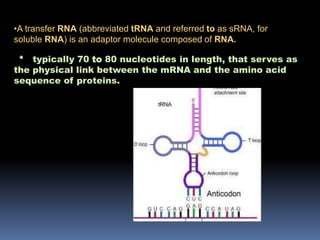
•A transfer RNA (abbreviated tRNA and referred to as sRNA, for
soluble RNA) is an adaptor molecule composed of RNA.
* typically 70 to 80 nucleotides in length, that serves as
the physical link between the mRNA and the amino acid
sequence of proteins.
t
PRIMARY STRUCTURE
SECONDARY STRUCTURE
TERTIARY STRUCTURE
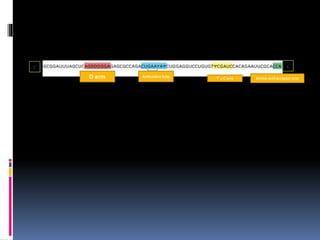
The primary structure is short.
It contains about 70 to 80 nucleotides.
Three of the nucleotides make up the anticodon
5’ 3’
Amino acid acceptor armT y C armD arm Anticodon loop
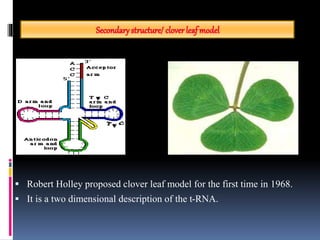
 Robert Holley proposed clover leaf model for the first time in 1968.
 It is a two dimensional description of the t-RNA.
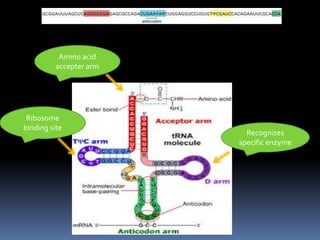
Recognizes
specific enzyme
Amino acid
accepter arm
Ribosome
binding site
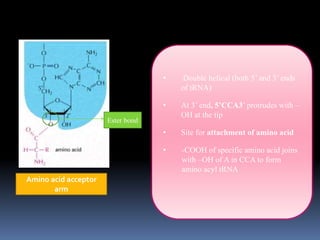
Amino acid acceptor
arm
• Double helical (both 5’ and 3’ ends
of tRNA)
• At 3’ end, 5’CCA3’ protrudes with –
OH at the tip
• Site for attachment of amino acid
• -COOH of specific amino acid joins
with –OH of A in CCA to form
amino acyl tRNA
Ester bond
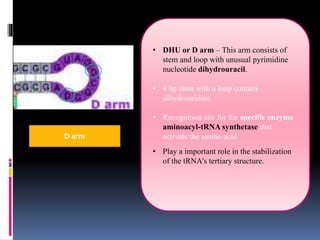
D arm
• DHU or D arm – This arm consists of
stem and loop with unusual pyrimidine
nucleotide dihydrouracil.
• 4 bp stem with a loop contain
dihydrouridine
• Recognition site for the specific enzyme
aminoacyl-tRNA synthetase that
activate the amino acid
• Play a important role in the stabilization
of the tRNA's tertiary structure.
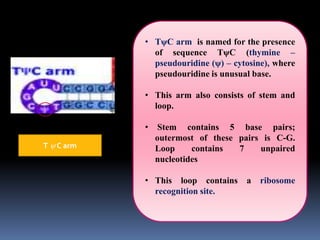
T y C arm
• TψC arm is named for the presence
of sequence TψC (thymine –
pseudouridine (ψ) – cytosine), where
pseudouridine is unusual base.
• This arm also consists of stem and
loop.
• Stem contains 5 base pairs;
outermost of these pairs is C-G.
Loop contains 7 unpaired
nucleotides
• This loop contains a ribosome
recognition site.
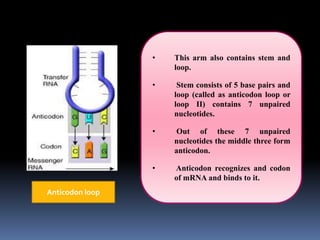
• This arm also contains stem and
loop.
• Stem consists of 5 base pairs and
loop (called as anticodon loop or
loop II) contains 7 unpaired
nucleotides.
• Out of these 7 unpaired
nucleotides the middle three form
anticodon.
• Anticodon recognizes and codon
of mRNA and binds to it.
Anticodon loop
Variable arm
 The variable arm has between 3 and 21 nucleotides, depending
on which amino acid the tRNA encodes.
 Between anticodon loop and TΨU loop
 This tRNA's variable arm is very short so it looks quite
different from the other arms of the molecule.
 May present or absent, it depends on species.
 The length of the variable arm is important in the recognition of
the aminoacyl tRNA synthetase for the tRNA.
 Variable arm helps is stability of tRNA
 tRNAs are called class 1 if they lack it, and class 2 if they have
it.
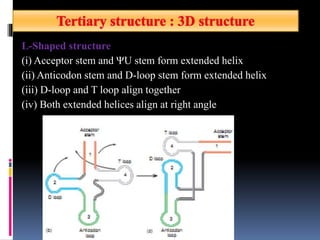
L-Shaped structure
(i) Acceptor stem and ΨU stem form extended helix
(ii) Anticodon stem and D-loop stem form extended helix
(iii) D-loop and T loop align together
(iv) Both extended helices align at right angle
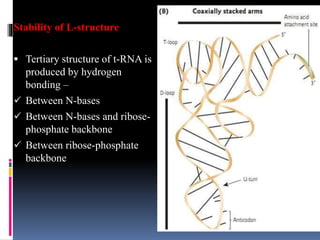
Stability of L-structure
 Tertiary structure of t-RNA is
produced by hydrogen
bonding –
 Between N-bases
 Between N-bases and ribose-
phosphate backbone
 Between ribose-phosphate
backbone
TRNA FUNCTION
• tRNA as a primer
• tRNA as an Enzyme Inhibitor
• Aminoacyl-tRNATransferases
• Channeled tRNA Cycle during Protein Synthesis
• tRNA and the Regulation of Enzyme Synthesis
tRNA used as a primer
 A reverse transcriptase (RT) is an enzyme used to
generate complementary DNA (cDNA) from an RNA
template, a process termed reverse transcription. It
is mainly associated with retroviruses.
 It has been found that a particular species of tRNA is
used as a primer in this process.
 Avian myeloblastosis virues reverse transcriptase
(AMV-RT) uses tRNA-Trp, whereas the murine
leukemia virus enzyme uses tRNA-Pro as a primer.
 Recent studies shown that the reverse transcriptase
has a strong affinity for the tRNA primer.
 many plant viral as well as animal viral RNAs possess
a "tRNA-like" structure at the 3’-end of the RNA
which found to act as substrates for aminoacylation
by aa-tRNA synthetases.
tRNA as an Enzyme Inhibitor
 tRNA is a potent inhibitor of E. coli endonuclease I.
 The work of Goebel & Helsinki
 They suggests that tRNA alters the mode of action
of endonuclease I from that double strand scission of
DNA to a nicking activity.
 A specific isoacceptor species of tRNA-Tyr in
Drosophila has been found to act as an inhibitor to
the enzyme tryptophan pyrrolase , which is involved
in the conversion of tryptophan to an intermediate
in brown-pigment synthesis.
 In this case, an uncharged tRNA appears to act in a
regulatory capacity by directly interfering with an
individual enzymatic activity,
Aminoacyl-tRNA Transferases
 Aminoacyl-tRNA transferases are a group of enzymes that
catalyze the transfer of an amino acid from aa-tRNA to
specific acceptor molecules without the participation of
ribosomes or other kinds of nucleic acid.
 The acceptor molecules can be divided into three classes:-
1. The acceptor can be an intact protein, in which the amino
acid is added to the N-terminus of the protein.
2. The acceptor can be a phosphatidyl glycerol molecule, in
which the enzyme catalyzes the formation of aminoacyl
esters of phosphatidyl glycerol that are components of cell
membranes.
3. The acceptor can be an N-acetyl muramyl peptide, an
intermediate of the synthesis of inter-peptide bridges in
bacterial cell walls.
 These are important links in cell wall biosynthesis, and for
this specialized tRNAs are used.
 The aa-tRNA transferases have recently been reviewed by
Softer.
tRNA and the Regulation of
Enzyme Synthesis
 One of the remarkable features of aa-tRNA is
the fact that it has been shown to play a role
in regulating the transcription of messenger
RNA for enzymes associated with
biosynthesis of its amino acid.
 This was first discovered in the operon for
histidine biosynthesis.
 The regulatory role of tRNA has been
reviewed recently.
Channeled tRNA cycle
during Protein Synthesis
 Translation system is highly organized in vivo and the
intermediates in the process, aminoacyl-tRNAs (aa-tRNA), are
channeled i.e., they are directly transferred.
 As we know tRNA plays a central role in translation, acting as the
carrier of both the monomeric units of proteins i.e the amino
acids, and the growing polypeptide chains
 During this, the tRNAs interact, with most of the components of
the protein-synthesizing machinery-including the aminoacyl-
tRNA synthetases, the elongation factors, and the ribosomes
without dissociating into the cellular fluid.
 Proof:- Using a permeabilized CHO (Chinese hamster ovary) cell
system that closely mimics living cells, they found that there is no
leakage of endogenous tRNA during many cycles of translation.
 tRNAs, upon leaving the ribosome, must reassociate with their
cognate aminoacyl-tRNA synthetases to regenerate the
aminoacyl-tRNAs
tRNA structure and function

tRNA structure and function

  • 1.
  • 2.
    Outline < FEATURES < STRUCTURE --PRIMARY STRUCTUTRE -- SECONDARY STRUCTURE -- TERTIARY STRUCTURE < FUNCTIONS
  • 3.
    •A transfer RNA(abbreviated tRNA and referred to as sRNA, for soluble RNA) is an adaptor molecule composed of RNA. * typically 70 to 80 nucleotides in length, that serves as the physical link between the mRNA and the amino acid sequence of proteins.
  • 4.
  • 5.
    The primary structureis short. It contains about 70 to 80 nucleotides. Three of the nucleotides make up the anticodon
  • 6.
    5’ 3’ Amino acidacceptor armT y C armD arm Anticodon loop
  • 8.
     Robert Holleyproposed clover leaf model for the first time in 1968.  It is a two dimensional description of the t-RNA.
  • 9.
  • 10.
    Amino acid acceptor arm •Double helical (both 5’ and 3’ ends of tRNA) • At 3’ end, 5’CCA3’ protrudes with – OH at the tip • Site for attachment of amino acid • -COOH of specific amino acid joins with –OH of A in CCA to form amino acyl tRNA Ester bond
  • 11.
    D arm • DHUor D arm – This arm consists of stem and loop with unusual pyrimidine nucleotide dihydrouracil. • 4 bp stem with a loop contain dihydrouridine • Recognition site for the specific enzyme aminoacyl-tRNA synthetase that activate the amino acid • Play a important role in the stabilization of the tRNA's tertiary structure.
  • 12.
    T y Carm • TψC arm is named for the presence of sequence TψC (thymine – pseudouridine (ψ) – cytosine), where pseudouridine is unusual base. • This arm also consists of stem and loop. • Stem contains 5 base pairs; outermost of these pairs is C-G. Loop contains 7 unpaired nucleotides • This loop contains a ribosome recognition site.
  • 13.
    • This armalso contains stem and loop. • Stem consists of 5 base pairs and loop (called as anticodon loop or loop II) contains 7 unpaired nucleotides. • Out of these 7 unpaired nucleotides the middle three form anticodon. • Anticodon recognizes and codon of mRNA and binds to it. Anticodon loop
  • 14.
    Variable arm  Thevariable arm has between 3 and 21 nucleotides, depending on which amino acid the tRNA encodes.  Between anticodon loop and TΨU loop  This tRNA's variable arm is very short so it looks quite different from the other arms of the molecule.  May present or absent, it depends on species.  The length of the variable arm is important in the recognition of the aminoacyl tRNA synthetase for the tRNA.  Variable arm helps is stability of tRNA  tRNAs are called class 1 if they lack it, and class 2 if they have it.
  • 15.
    L-Shaped structure (i) Acceptorstem and ΨU stem form extended helix (ii) Anticodon stem and D-loop stem form extended helix (iii) D-loop and T loop align together (iv) Both extended helices align at right angle
  • 16.
    Stability of L-structure Tertiary structure of t-RNA is produced by hydrogen bonding –  Between N-bases  Between N-bases and ribose- phosphate backbone  Between ribose-phosphate backbone
  • 17.
    TRNA FUNCTION • tRNAas a primer • tRNA as an Enzyme Inhibitor • Aminoacyl-tRNATransferases • Channeled tRNA Cycle during Protein Synthesis • tRNA and the Regulation of Enzyme Synthesis
  • 18.
    tRNA used asa primer  A reverse transcriptase (RT) is an enzyme used to generate complementary DNA (cDNA) from an RNA template, a process termed reverse transcription. It is mainly associated with retroviruses.  It has been found that a particular species of tRNA is used as a primer in this process.  Avian myeloblastosis virues reverse transcriptase (AMV-RT) uses tRNA-Trp, whereas the murine leukemia virus enzyme uses tRNA-Pro as a primer.  Recent studies shown that the reverse transcriptase has a strong affinity for the tRNA primer.  many plant viral as well as animal viral RNAs possess a "tRNA-like" structure at the 3’-end of the RNA which found to act as substrates for aminoacylation by aa-tRNA synthetases.
  • 19.
    tRNA as anEnzyme Inhibitor  tRNA is a potent inhibitor of E. coli endonuclease I.  The work of Goebel & Helsinki  They suggests that tRNA alters the mode of action of endonuclease I from that double strand scission of DNA to a nicking activity.  A specific isoacceptor species of tRNA-Tyr in Drosophila has been found to act as an inhibitor to the enzyme tryptophan pyrrolase , which is involved in the conversion of tryptophan to an intermediate in brown-pigment synthesis.  In this case, an uncharged tRNA appears to act in a regulatory capacity by directly interfering with an individual enzymatic activity,
  • 20.
    Aminoacyl-tRNA Transferases  Aminoacyl-tRNAtransferases are a group of enzymes that catalyze the transfer of an amino acid from aa-tRNA to specific acceptor molecules without the participation of ribosomes or other kinds of nucleic acid.  The acceptor molecules can be divided into three classes:- 1. The acceptor can be an intact protein, in which the amino acid is added to the N-terminus of the protein. 2. The acceptor can be a phosphatidyl glycerol molecule, in which the enzyme catalyzes the formation of aminoacyl esters of phosphatidyl glycerol that are components of cell membranes. 3. The acceptor can be an N-acetyl muramyl peptide, an intermediate of the synthesis of inter-peptide bridges in bacterial cell walls.  These are important links in cell wall biosynthesis, and for this specialized tRNAs are used.  The aa-tRNA transferases have recently been reviewed by Softer.
  • 21.
    tRNA and theRegulation of Enzyme Synthesis  One of the remarkable features of aa-tRNA is the fact that it has been shown to play a role in regulating the transcription of messenger RNA for enzymes associated with biosynthesis of its amino acid.  This was first discovered in the operon for histidine biosynthesis.  The regulatory role of tRNA has been reviewed recently.
  • 22.
    Channeled tRNA cycle duringProtein Synthesis  Translation system is highly organized in vivo and the intermediates in the process, aminoacyl-tRNAs (aa-tRNA), are channeled i.e., they are directly transferred.  As we know tRNA plays a central role in translation, acting as the carrier of both the monomeric units of proteins i.e the amino acids, and the growing polypeptide chains  During this, the tRNAs interact, with most of the components of the protein-synthesizing machinery-including the aminoacyl- tRNA synthetases, the elongation factors, and the ribosomes without dissociating into the cellular fluid.  Proof:- Using a permeabilized CHO (Chinese hamster ovary) cell system that closely mimics living cells, they found that there is no leakage of endogenous tRNA during many cycles of translation.  tRNAs, upon leaving the ribosome, must reassociate with their cognate aminoacyl-tRNA synthetases to regenerate the aminoacyl-tRNAs