RNA
PROCESSING
OLGA ISABEL ARANGO B.
MOLECULAR BIOLOGY
In the maturation are
removed noncoding
sequences.
Ribosomal RNA and transfer
RNA splicing, is similar in
prokaryotic and Eukaryotic; while
that the messenger RNA splicing
is different between eukaryotic
and prokaryotic, because
ribosomes in bacteria have direct
access to mRNA.
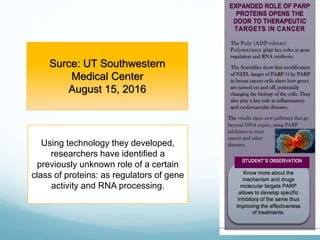
Surce: UT Southwestern
Medical Center
August 15, 2016
Using technology they developed,
researchers have identified a
previously unknown role of a certain
class of proteins: as regulators of gene
activity and RNA processing.
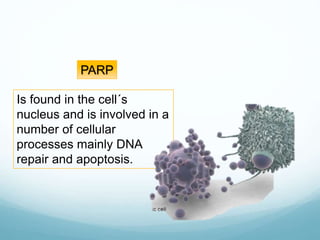
Is found in the cell´s
nucleus and is involved in a
number of cellular
processes mainly DNA
repair and apoptosis.
PARP
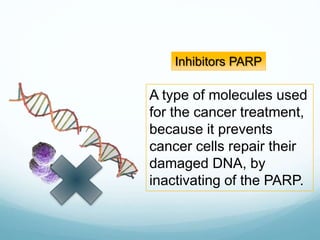
Inhibitors PARP
A type of molecules used
for the cancer treatment,
because it prevents
cancer cells repair their
damaged DNA, by
inactivating of the PARP.
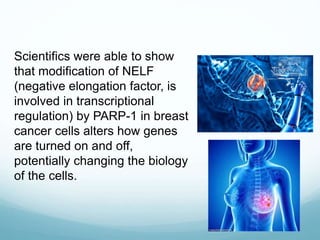
Scientifics were able to show
that modification of NELF
(negative elongation factor, is
involved in transcriptional
regulation) by PARP-1 in breast
cancer cells alters how genes
are turned on and off,
potentially changing the biology
of the cells.
Student’ s observation
To know more about the action mechanism and
molecular targets PARP, as its isoforms, allows to
develop more specific inhibitors, thus improving
the effectiveness of cancer treatments. Also, it
might potentiate the effect of chemotherapies,
because the destroyed cells can not be repaired;
And it can be used for other diseases treatment.
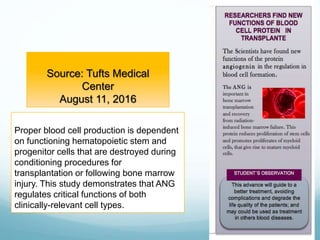
Source: Tufts Medical
Center
August 11, 2016
Proper blood cell production is dependent
on functioning hematopoietic stem and
progenitor cells that are destroyed during
conditioning procedures for
transplantation or following bone marrow
injury. This study demonstrates that ANG
regulates critical functions of both
clinically-relevant cell types.
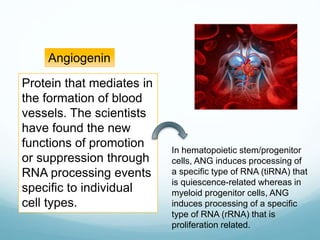
Protein that mediates in
the formation of blood
vessels. The scientists
have found the new
functions of promotion
or suppression through
RNA processing events
specific to individual
cell types.
Angiogenin
In hematopoietic stem/progenitor
cells, ANG induces processing of
a specific type of RNA (tiRNA) that
is quiescence-related whereas in
myeloid progenitor cells, ANG
induces processing of a specific
type of RNA (rRNA) that is
proliferation related.
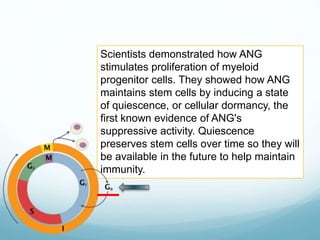
Scientists demonstrated how ANG
stimulates proliferation of myeloid
progenitor cells. They showed how ANG
maintains stem cells by inducing a state
of quiescence, or cellular dormancy, the
first known evidence of ANG's
suppressive activity. Quiescence
preserves stem cells over time so they will
be available in the future to help maintain
immunity.
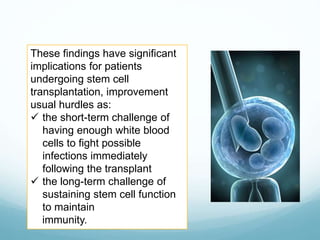
These findings have significant
implications for patients
undergoing stem cell
transplantation, improvement
usual hurdles as:
 the short-term challenge of
having enough white blood
cells to fight possible
infections immediately
following the transplant
 the long-term challenge of
sustaining stem cell function
to maintain
immunity.
RESEARCHERS FIND NEW FUNCTIONS OF BLOOD CELL
PROTEIN IN TRANSPLANT
Student’ s observation
The newly discovered properties of
angiogenin give rise to the
development of new less invasive
treatments, with fewer side effects
and perhaps with faster and lasting
results, to better the quality life of
the patients.
MEDICAL
UTILITY
In medicine every day knowledge is
changing, extending, and evolving, to
develop new solution and treatments,
however the diseases do not stop and
so the research does not stop either.
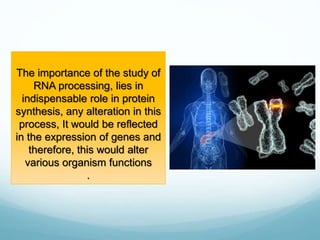
The importance of the study of
RNA processing, lies in
indispensable role in protein
synthesis, any alteration in this
process, It would be reflected
in the expression of genes and
therefore, this would alter
various organism functions
.
MEDICAL UTILITY
Discovering the mechanism of
action and molecular targets of
protein, can help to develop
new drugs with higher
specificity
MEDICAL UTILITY
The investigation of molecules
that may be involved in RNA
splicing will increase efficiency
and reduce usual hurdles of
therapies currently used in
diseases such as cancer.
BIBLIOGRAPHY
• Tufts Medical Center. (2016, August 11). Researchers find
new functions of blood cell protein in transplant.
ScienceDaily. Retrieved September 3, 2016 from
www.sciencedaily.com/releases/2016/08/160811131600.ht
m
• UT Southwestern Medical Center. (2016, August 15).
Expanded role of PARP proteins opens the door to
explore therapeutic targets in cancer. ScienceDaily.
Retrieved September 3, 2016 from
www.sciencedaily.com/releases/2016/08/160815111310.ht
m
RNA processing

RNA processing

  • 1.
  • 4.
    In the maturationare removed noncoding sequences. Ribosomal RNA and transfer RNA splicing, is similar in prokaryotic and Eukaryotic; while that the messenger RNA splicing is different between eukaryotic and prokaryotic, because ribosomes in bacteria have direct access to mRNA.
  • 5.
    Surce: UT Southwestern MedicalCenter August 15, 2016 Using technology they developed, researchers have identified a previously unknown role of a certain class of proteins: as regulators of gene activity and RNA processing.
  • 6.
    Is found inthe cell´s nucleus and is involved in a number of cellular processes mainly DNA repair and apoptosis. PARP
  • 7.
    Inhibitors PARP A typeof molecules used for the cancer treatment, because it prevents cancer cells repair their damaged DNA, by inactivating of the PARP.
  • 8.
    Scientifics were ableto show that modification of NELF (negative elongation factor, is involved in transcriptional regulation) by PARP-1 in breast cancer cells alters how genes are turned on and off, potentially changing the biology of the cells.
  • 9.
    Student’ s observation Toknow more about the action mechanism and molecular targets PARP, as its isoforms, allows to develop more specific inhibitors, thus improving the effectiveness of cancer treatments. Also, it might potentiate the effect of chemotherapies, because the destroyed cells can not be repaired; And it can be used for other diseases treatment.
  • 10.
    Source: Tufts Medical Center August11, 2016 Proper blood cell production is dependent on functioning hematopoietic stem and progenitor cells that are destroyed during conditioning procedures for transplantation or following bone marrow injury. This study demonstrates that ANG regulates critical functions of both clinically-relevant cell types.
  • 11.
    Protein that mediatesin the formation of blood vessels. The scientists have found the new functions of promotion or suppression through RNA processing events specific to individual cell types. Angiogenin In hematopoietic stem/progenitor cells, ANG induces processing of a specific type of RNA (tiRNA) that is quiescence-related whereas in myeloid progenitor cells, ANG induces processing of a specific type of RNA (rRNA) that is proliferation related.
  • 12.
    Scientists demonstrated howANG stimulates proliferation of myeloid progenitor cells. They showed how ANG maintains stem cells by inducing a state of quiescence, or cellular dormancy, the first known evidence of ANG's suppressive activity. Quiescence preserves stem cells over time so they will be available in the future to help maintain immunity.
  • 13.
    These findings havesignificant implications for patients undergoing stem cell transplantation, improvement usual hurdles as:  the short-term challenge of having enough white blood cells to fight possible infections immediately following the transplant  the long-term challenge of sustaining stem cell function to maintain immunity.
  • 14.
    RESEARCHERS FIND NEWFUNCTIONS OF BLOOD CELL PROTEIN IN TRANSPLANT Student’ s observation The newly discovered properties of angiogenin give rise to the development of new less invasive treatments, with fewer side effects and perhaps with faster and lasting results, to better the quality life of the patients.
  • 15.
    MEDICAL UTILITY In medicine everyday knowledge is changing, extending, and evolving, to develop new solution and treatments, however the diseases do not stop and so the research does not stop either.
  • 16.
    The importance ofthe study of RNA processing, lies in indispensable role in protein synthesis, any alteration in this process, It would be reflected in the expression of genes and therefore, this would alter various organism functions .
  • 17.
    MEDICAL UTILITY Discovering themechanism of action and molecular targets of protein, can help to develop new drugs with higher specificity
  • 18.
    MEDICAL UTILITY The investigationof molecules that may be involved in RNA splicing will increase efficiency and reduce usual hurdles of therapies currently used in diseases such as cancer.
  • 19.
    BIBLIOGRAPHY • Tufts MedicalCenter. (2016, August 11). Researchers find new functions of blood cell protein in transplant. ScienceDaily. Retrieved September 3, 2016 from www.sciencedaily.com/releases/2016/08/160811131600.ht m • UT Southwestern Medical Center. (2016, August 15). Expanded role of PARP proteins opens the door to explore therapeutic targets in cancer. ScienceDaily. Retrieved September 3, 2016 from www.sciencedaily.com/releases/2016/08/160815111310.ht m