Tracheostomy
Mr. Manikandan.T,
RN., RM., M.Sc(N)., D.C.A .,(Ph.D)
Assistant Professor,
Dept. of Medical Surgical Nursing,
VMCON, Puducherry.
Definition
 A Artificial (Usually) surgically created
airway fashioned by making a hole in the
anterior wall of the trachea & the insertion
of a tracheostomy tube, which may or
may not be permanent
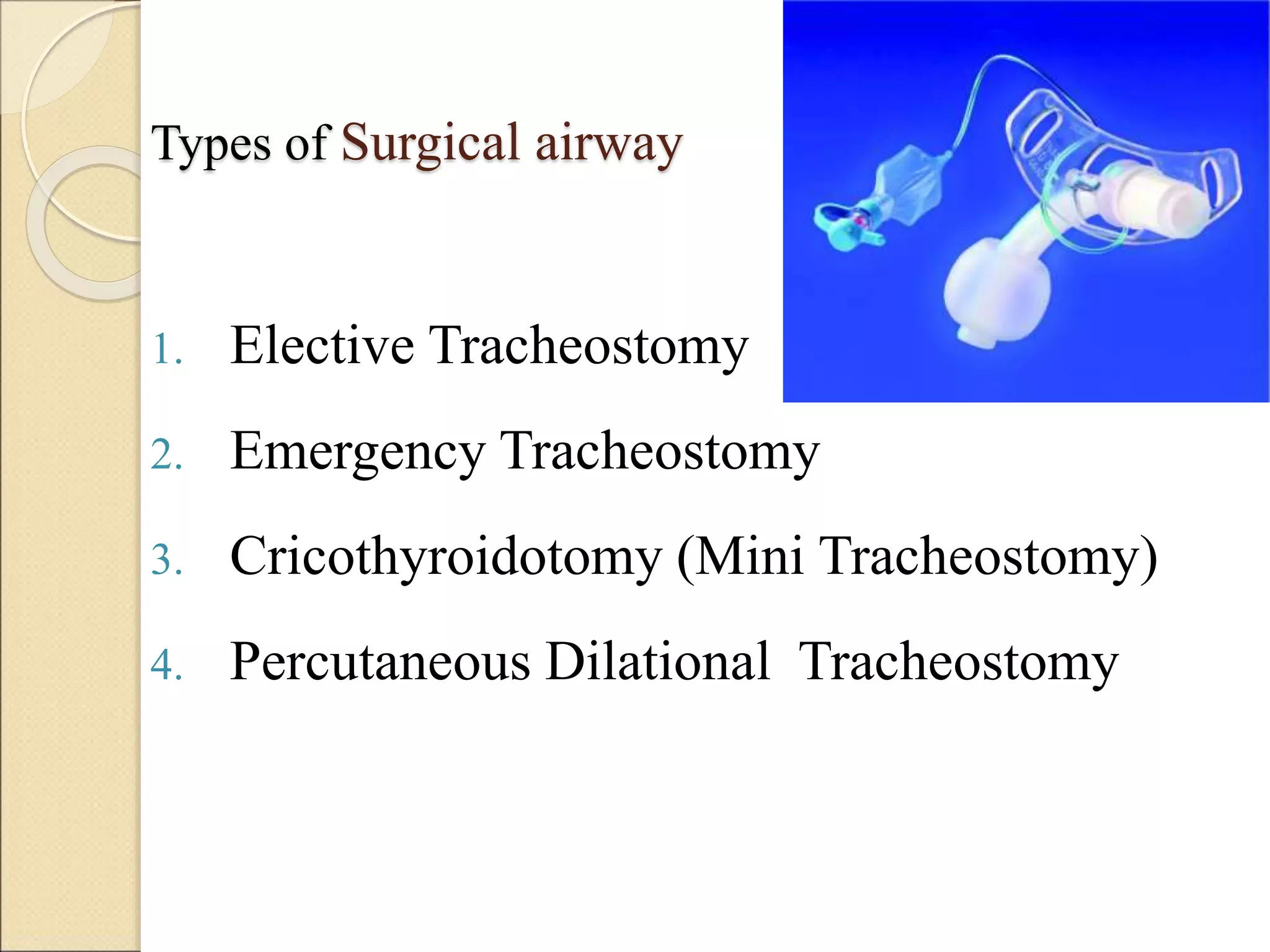
Types of Surgical airway
1. Elective Tracheostomy
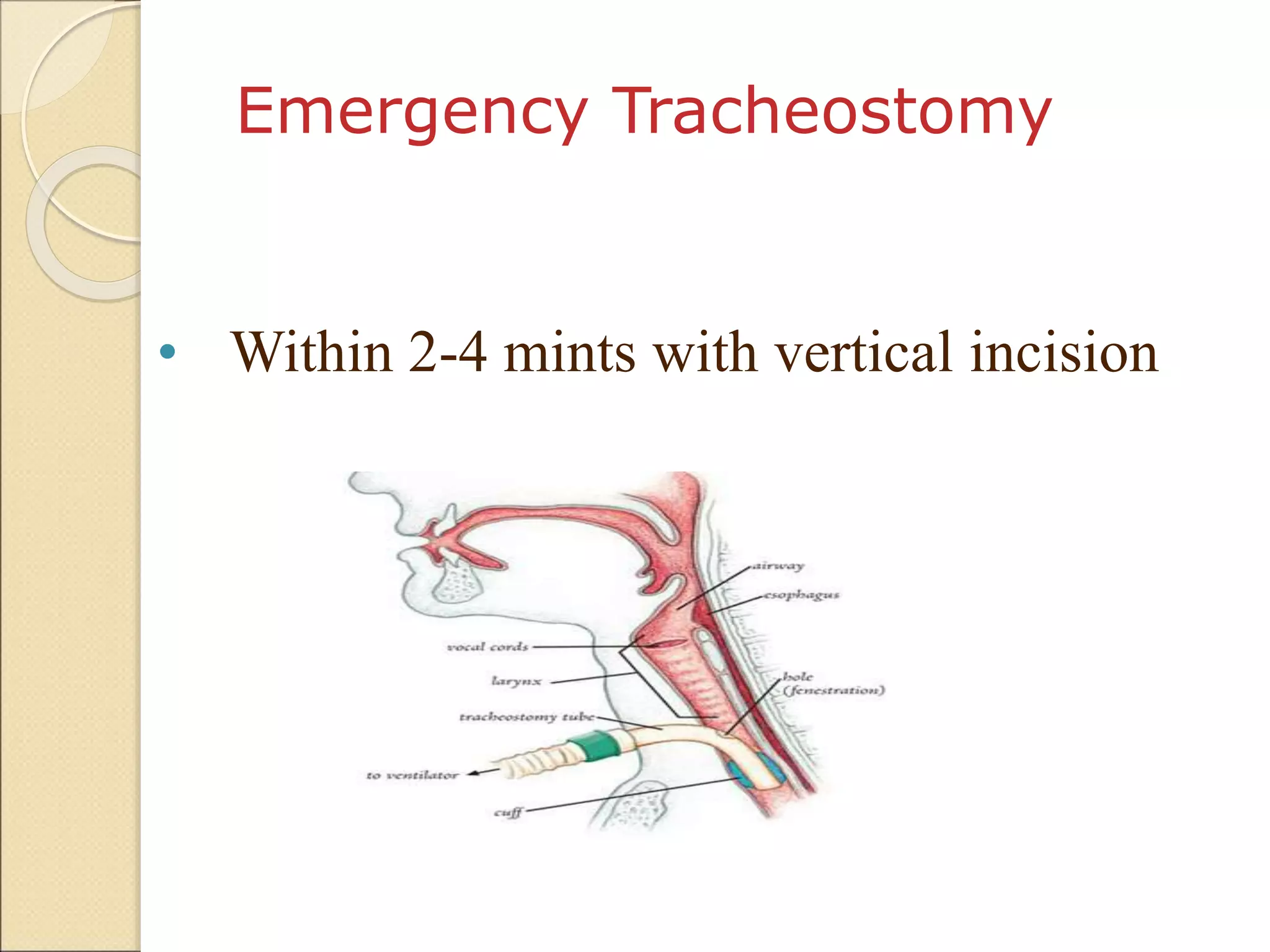
2. Emergency Tracheostomy
3. Cricothyroidotomy (Mini Tracheostomy)
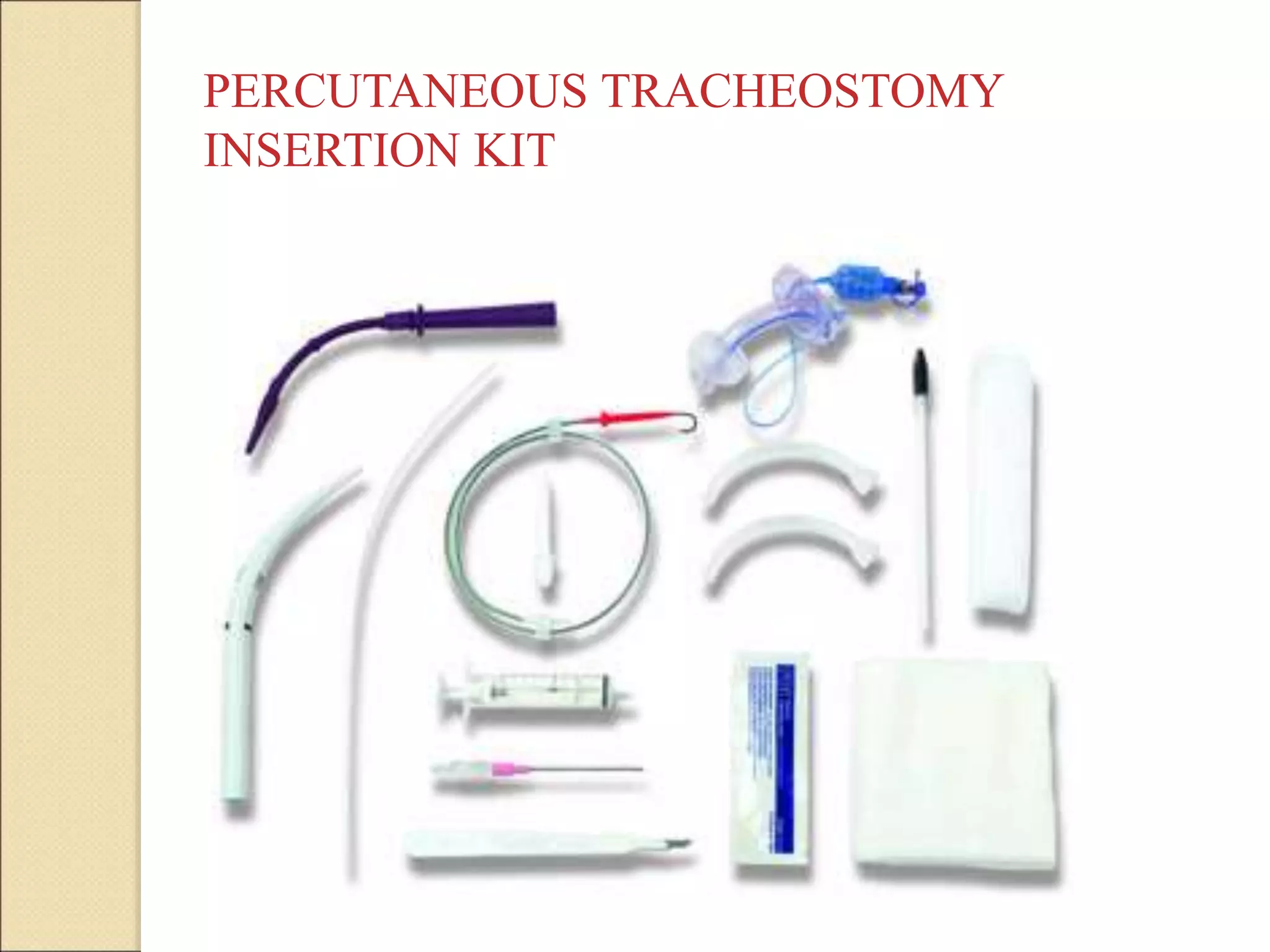
4. Percutaneous Dilational Tracheostomy
Tracheostomy
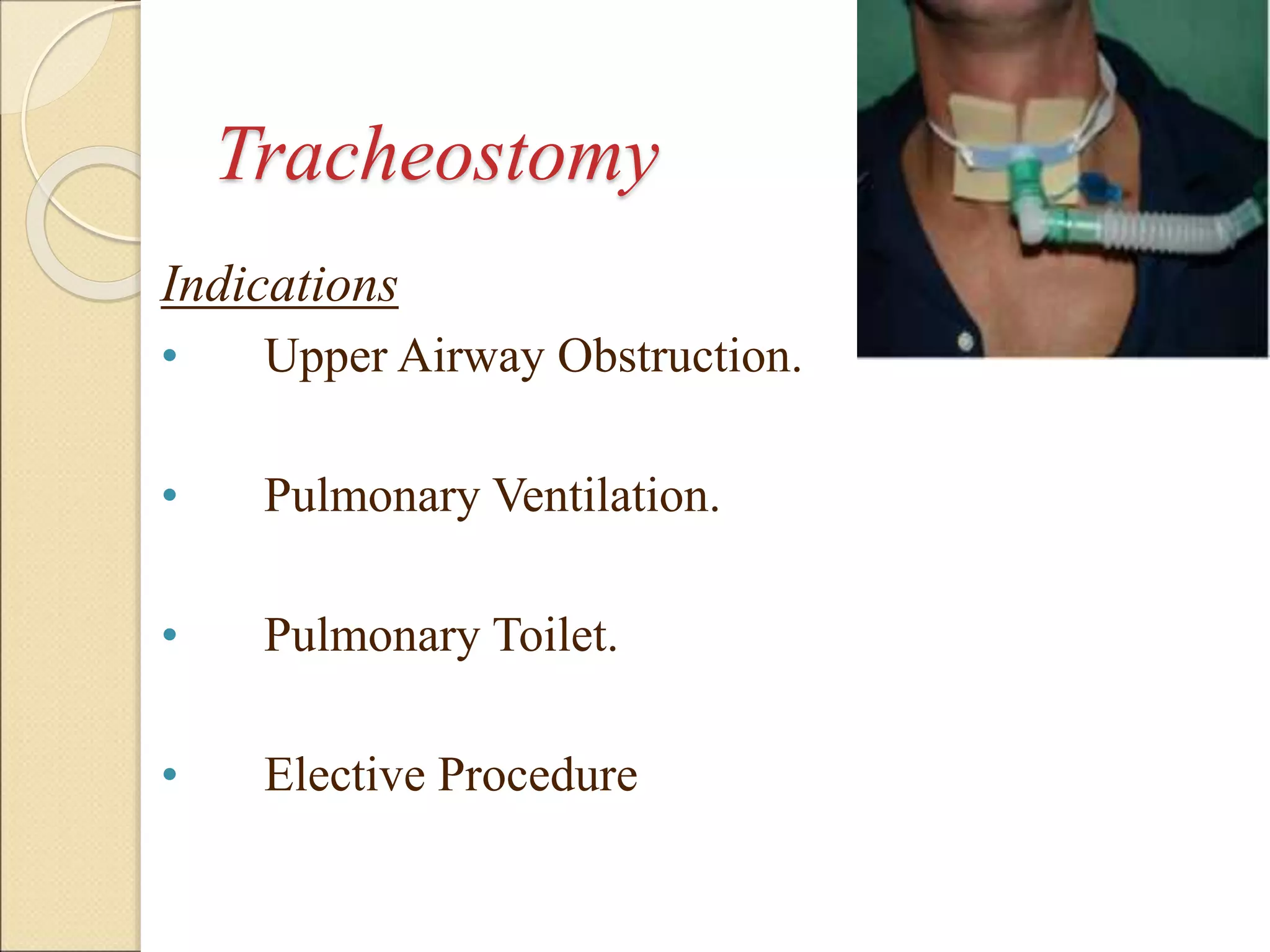
Indications
• Upper Airway Obstruction.
• Pulmonary Ventilation.
• Pulmonary Toilet.
• Elective Procedure
1. Upper Airway Obstruction
a. Trauma
b. Foreign body
c. Infections
d. Malignant lesions
e. Vocal cord palsy
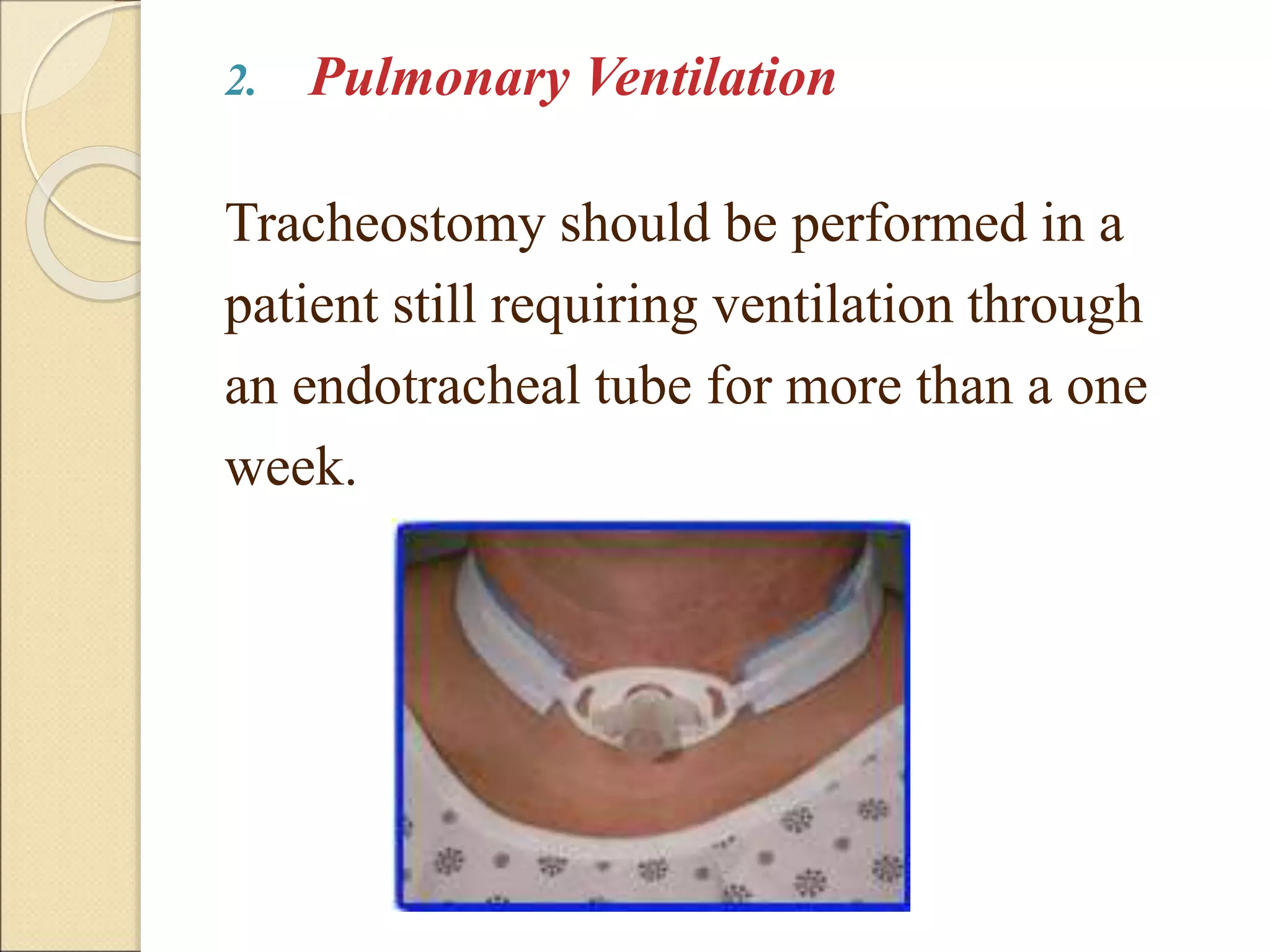
2. Pulmonary Ventilation
Tracheostomy should be performed in a
patient still requiring ventilation through
an endotracheal tube for more than a one
week.
3. Pulmonary Toilet
• Those who cannot cough and clear their
chest.
• Prevent aspiration by low pressure high
volume cuff tracheostomy tube.
4. Elective Procedures
• For major head and neck operations.
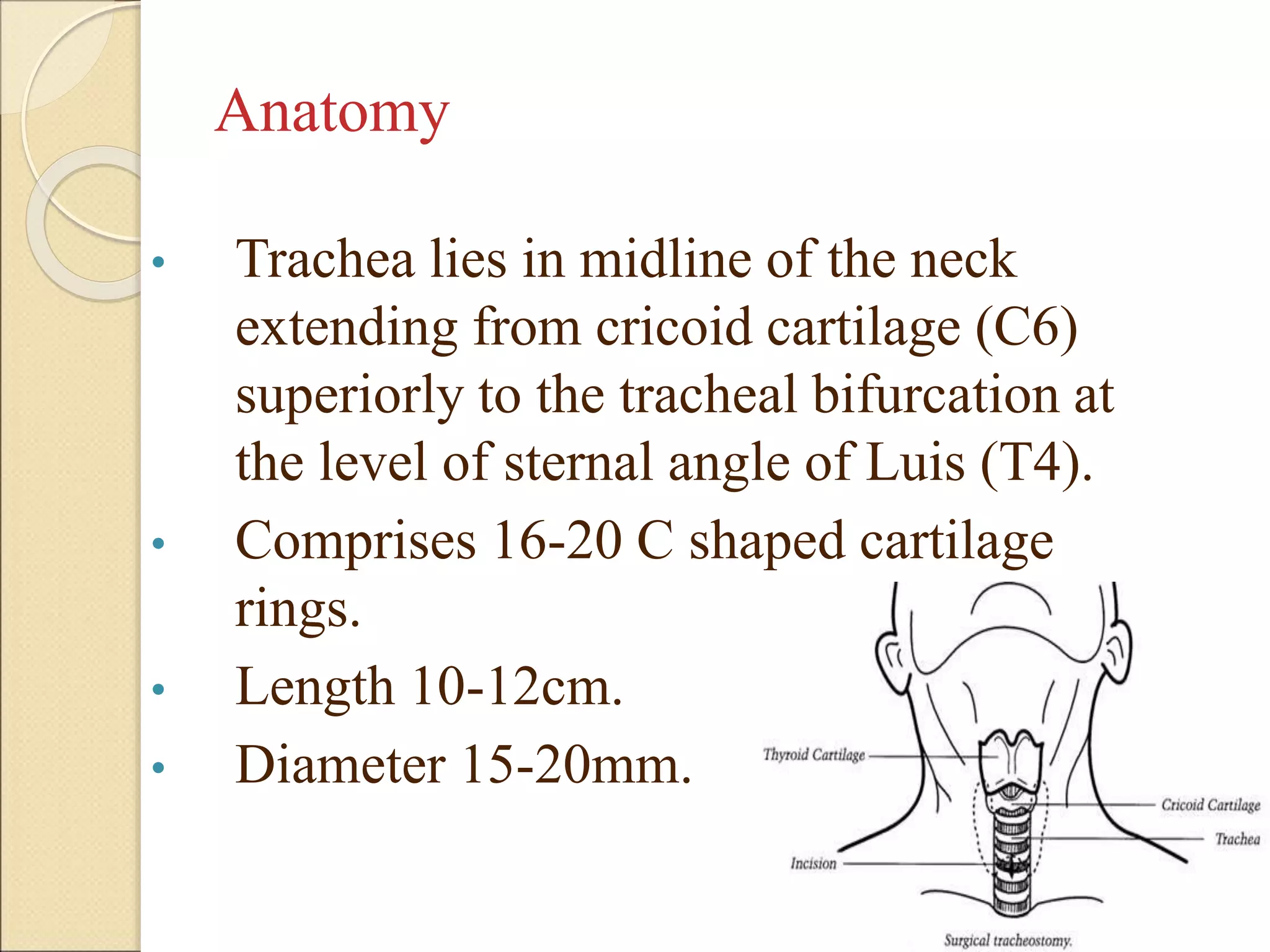
Anatomy
• Trachea lies in midline of the neck
extending from cricoid cartilage (C6)
superiorly to the tracheal bifurcation at
the level of sternal angle of Luis (T4).
• Comprises 16-20 C shaped cartilage
rings.
• Length 10-12cm.
• Diameter 15-20mm.
2nd
3rd
 Patient preparation
Cardiac monitor
Intravenous line
with saline
Oxygen
Pulse oximeter
Ambu bag for
ventilating patient
 Setup
Povidine iodine
solution
Surgical drapes to
enclose the field
Sterile gown
gloves, and mask
Procedure
 Local anesthesia
 10 mL syringe
 1% lidocaine
 18/25 gauge needle
 #11 scalpel blade and
handle
 Two skin forceps
 Eight small curved
hemostats
 Sterile 4x4 gauze
squares, two dozen
 Two Kocher forceps
(if needed, to clamp
the thyroid)
 Frazier suction
catheter with suction
tubing
Cont
 Suture ligatures (3–0
chromic, 3–0 silk, 3–
0 nylon)
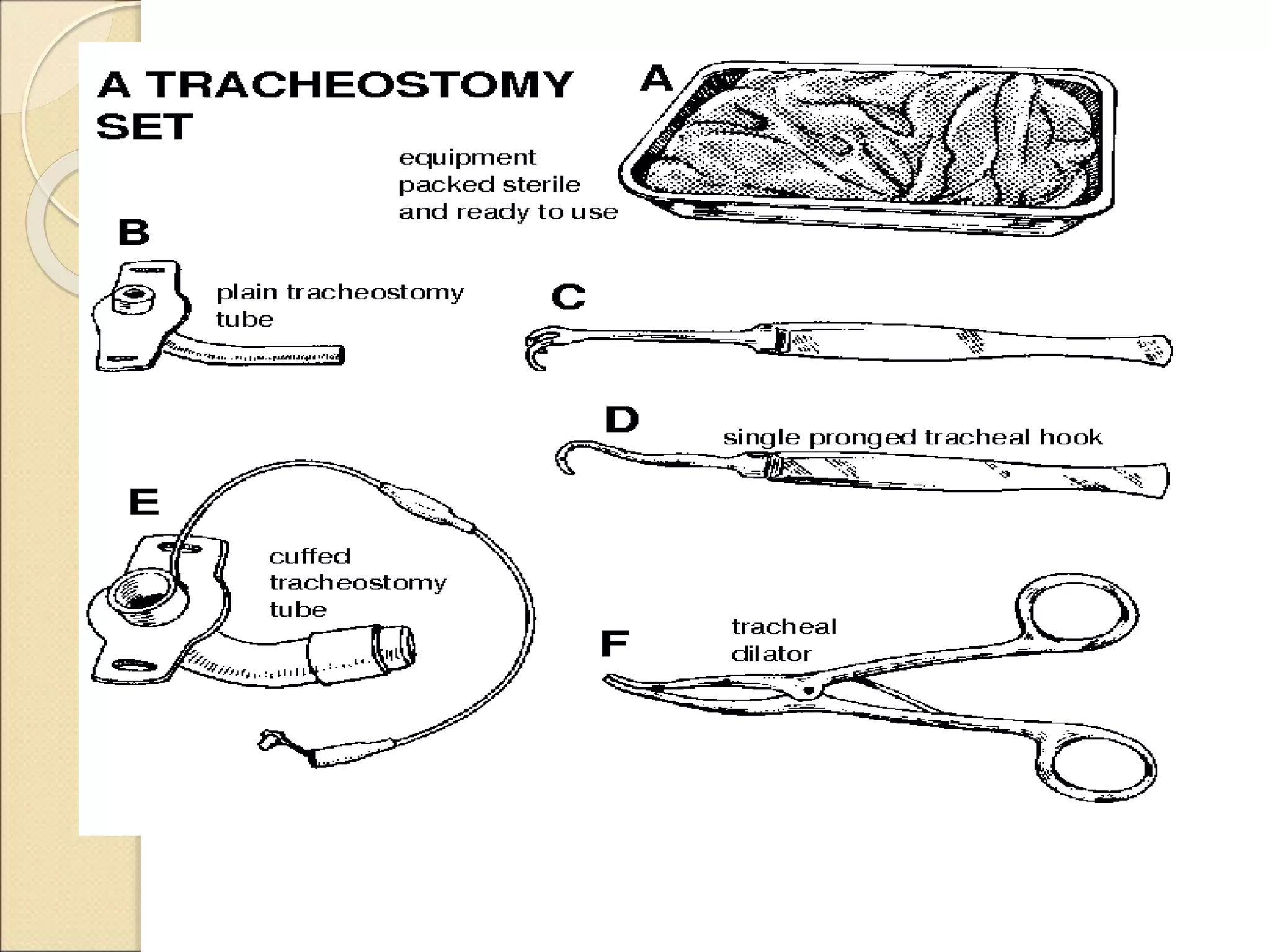
 Tracheostomy tube,
appropriate size for
patient
 Water-soluble
lubricant or
anesthetic jelly
 Suction source and
tubing
 Two pairs of scissors,
one straight and one
curved
 Two tissue forceps
without teeth
 Two Allis forceps, to
grasp the trachea
 Two small rakes, for
exposure
 Mastoid retractor
 Trousseau dilator
 Two tracheal hooks
 Umbilical tape
 Needle holder
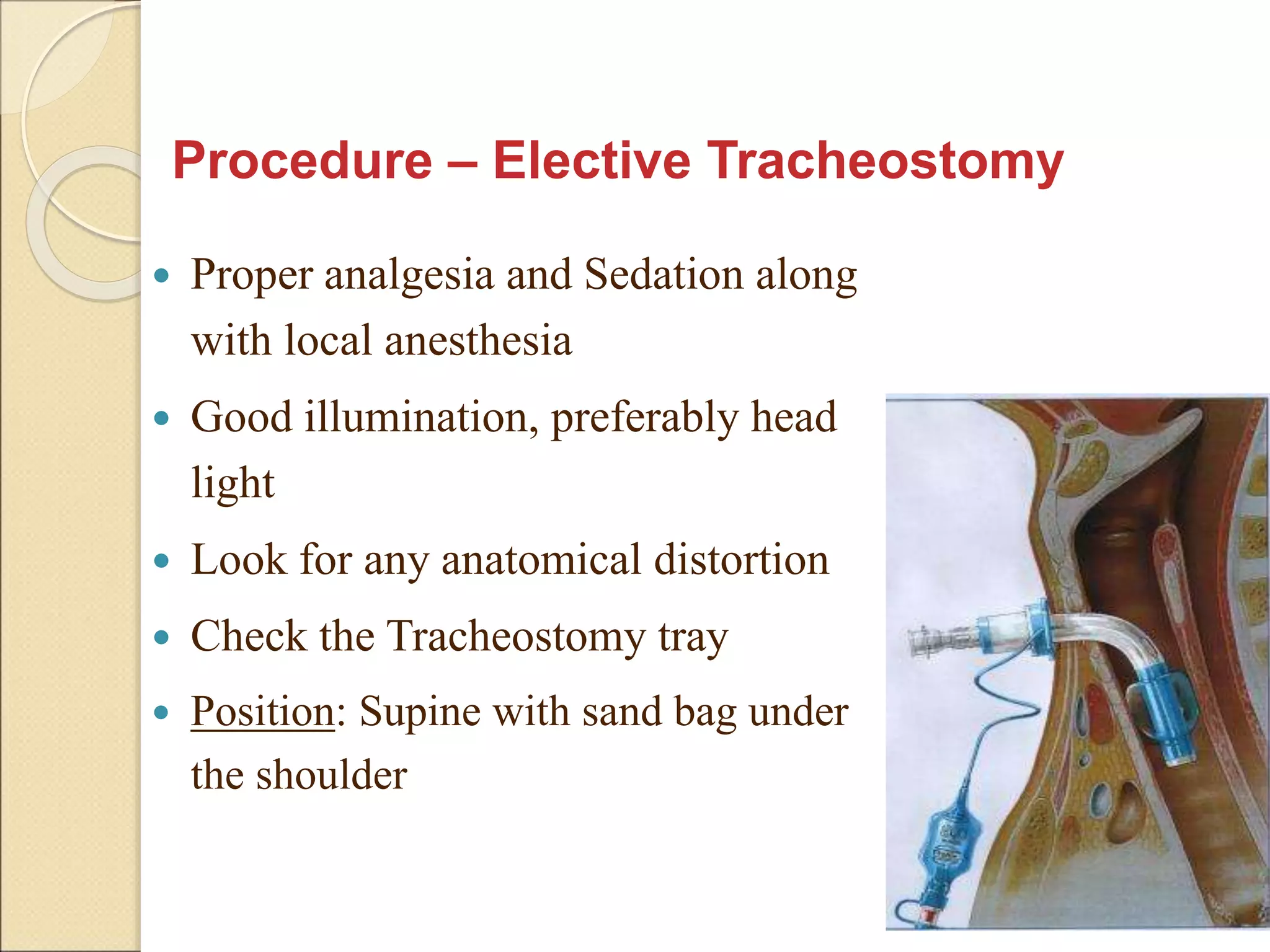
Procedure – Elective Tracheostomy
 Proper analgesia and Sedation along
with local anesthesia
 Good illumination, preferably head
light
 Look for any anatomical distortion
 Check the Tracheostomy tray
 Position: Supine with sand bag under
the shoulder
 Skin – 5 cm incision midway b/w cricoid cartilage and
suprasternal notch (Horizontal cosmetically better &
vertical avoids injuring vessel and bleeding)
 Subcutaneous tissue & deep fascia – use
electrocoagulation
 Anterior jugular vein – may require ligation (extend
the incision to entire length up to two edges of skin
and do not work in a small hole)
Cont
 Pretracheal muscle – split it at midline
 Thyroid isthmus – Retract upward and
may require ligation & division
 Pretracheal fascia - dissect it with
electrocoagulation and expose 2nd – 5th
rings
 Secure 2 stay sutures with prolene 2-0
on either side of trachea over 3rd or 4th
ring
Cont
 Place the hook to 1st ring & pull it forward
and upward, along with 2 stay sutures
 Deflate the ET tube now
 Trachea is incised with no.11 blade
between 2nd and 4th ring by 3 ways (never
use electrocoagulation as O2 contact may
lead to explosion)
Cont
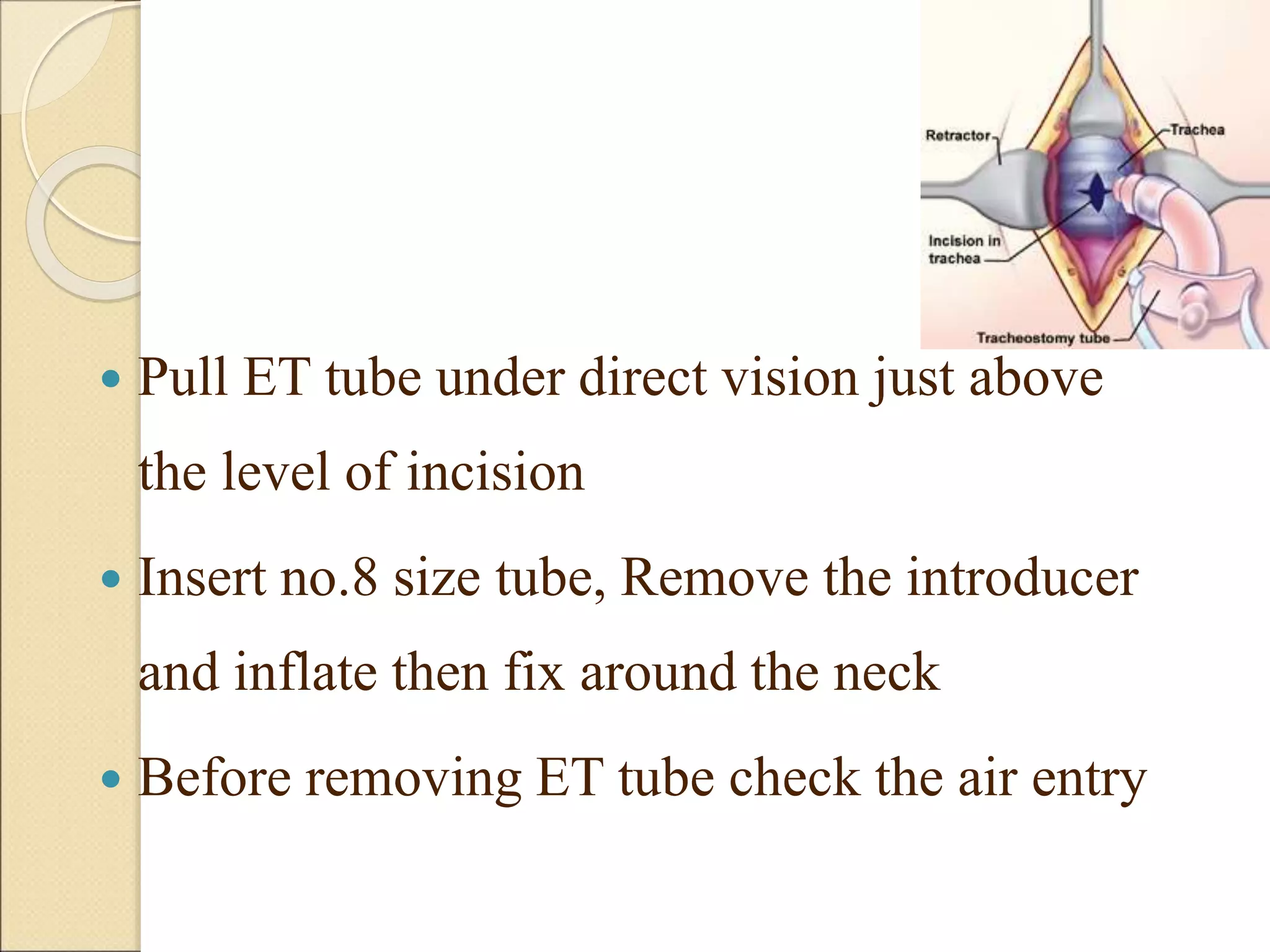
 Pull ET tube under direct vision just above
the level of incision
 Insert no.8 size tube, Remove the introducer
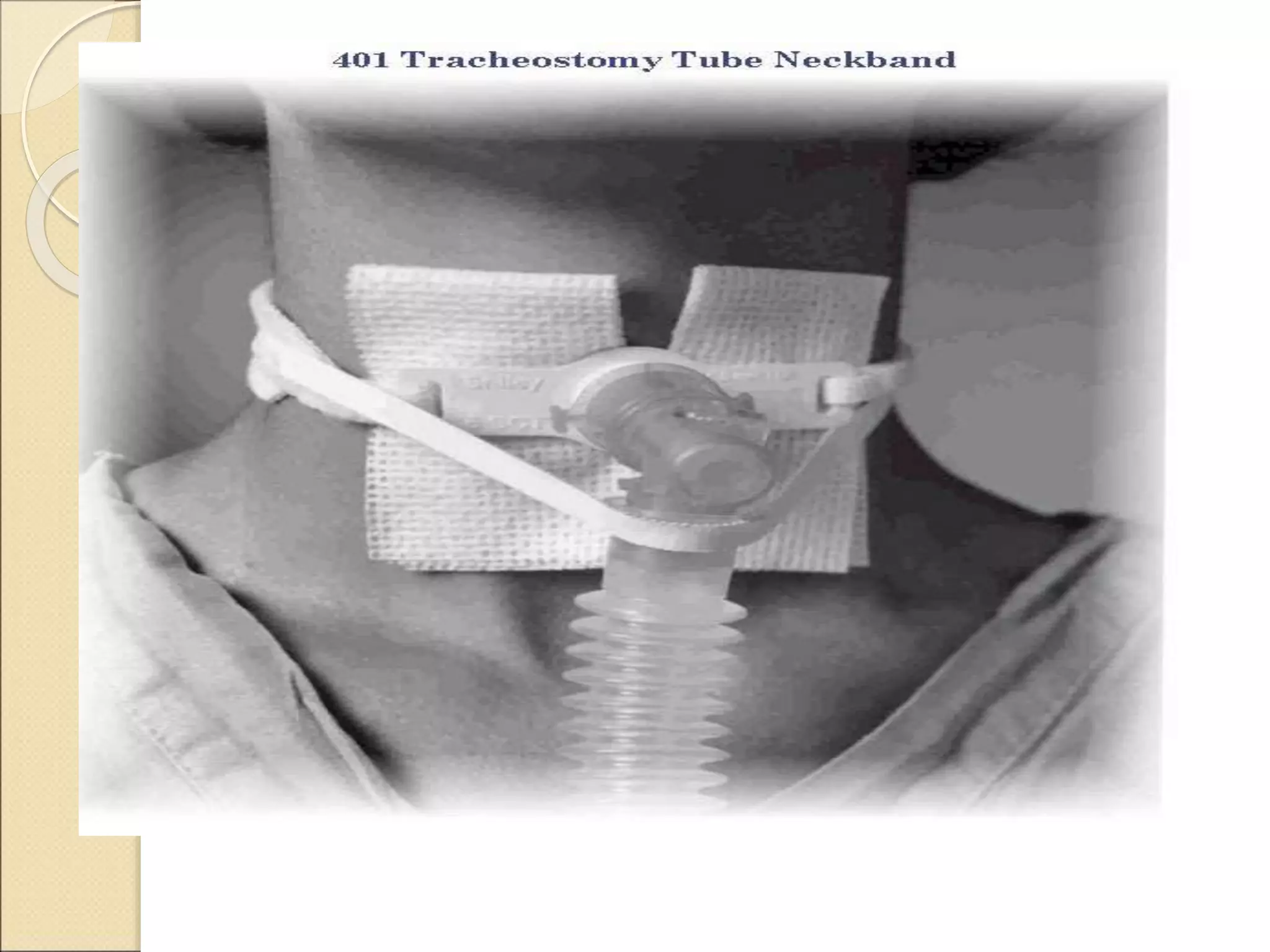
and inflate then fix around the neck
 Before removing ET tube check the air entry
• Within 2-4 mints with vertical incision
Emergency Tracheostomy
Cricothyroidotomy / Mini tracheostomy
Transverse incision over the cricothyroid membrane.
Needle or tube Cricothyroidotomy
Percutaneus Dilational
Tracheostomy
 ICU Bed SideTracheostomy
 Use of guide wire and Dilators
 May be under the vision of Bronchoscope
through endotracheal tube
 Less time ,Less Expensive
 Not suitable for thick neck and in
emergency situation
PERCUTANEOUS TRACHEOSTOMY
INSERTION KIT
PERCUTANEOUS TRACHEOSTOMY KIT
Complications of Tracheostomy
Intraopertaive Complications:
 Loss of airway
 Bleeding and injury to big vessels
 Injury to tracheoesophageal wall
 Pneumothorax
 Aspiration
Early Complications:
 Bleeding and local hematoma
 Tracheostomy tube obstruction and desaturation
 Tracheostomy tube displacement
 Infection
 Surgical emphysema
Late Complications:
 Tracheal or subglottic Stenosis
 Granulation tissue
 Tracheocutaneus fistula
 Tracheo – esophageal fistula
 Dislocation of tracheostomy tube
 Bleeding from stoma or during suction
 Blockage of Tracheostomy tube
 Laryngeal injury or alteration of phonation
Tracheostomy Tubes
 Plastic (Protex) / Metal
 Fenestrated / Nonfenestrated
 Cuffed / Uncuffed
TYPES OF TRACHEOSTOMY
TUBE
 Uncuffed
TYPES OF TRACHEOSTOMY
TUBE
 Cuffed
TYPES OF TRACHEOSTOMY
TUBE
 Fenestrated
Components of Tracheostomy Tube
 SIZES RANGE FROM
2.5MM TO 11 MM
 CURVED TUBE
 INFLATABLE CUFF
 FLANGES WITH HOLES
 TUBE BLADDER
Suction technique
 Suction pressure (20kPa/150mmHg)
 Suction OFF on entry, ON for withdrawal
of catheter
 Quickly – patient can’t breathe!
 Circular motion in tracheostomy tube only
Care Of The Patient With A
Tracheostomy
 SAFETY FIRST
 CARE OF THE STOMA
 COMMUNICATION
 PSYCHOLOGICAL
 NUTRITION
 INFECTION CONTROL
SAFETY FIRST
When caring for a patient with a tracheostomy you must
ensure that:-
 There Are Spare Tracheostomies Available
close by 1 The same size and the other a size
smaller
 A Tracheal dilitation kit is close by
 Suction Equipment is available
 Different size suction catheters available
 Oxygen is available
 Emergency equipment is available including
a resuscitation Bag and Mask and
defibrillator and emergency drugs
Care of the stoma / Infection control
 It needs to be cleaned and
inspected 2-3 times a day
 It should be cleaned using
aseptic technique and
appropriate dressings applied
to aid healing
 Once tube is removed the
stoma will close
spontaneously over a few
days
PSYCHOLOGICAL /
COMMUNICATION
 Patients and family require
reassurance and support
 Alternative methods of
communication should be
sought
 Provide stimulation in the form
of television, radio,
newspapers, etc
NUTRITION
 Check local policy on eating and drinking
with tracheostomies
 some trusts allow patients to eat and
drink
 Others DO NOT!!
 Usual ways of feeding include oral,
nasogastric or parenteral.
Changing the Tube – railroad
technique
 Cut both ends off largest possible suction catheter
 Insert suction catheter down trache tube
(warn patient re coughing)
 Remove tube over catheter, maintaining catheter
position in airway
 Insert new tube over catheter
 Remove catheter
 Beware false track anterior to trachea
Checking tube position
 Feel air flow from tube on your arm as patient exhales
 Observe patient’s breathing - noisy? difficult? use of
accessory muscles?
 Observe patient’s colour
 If any doubt, fibreoptic scope can be passed down tube
for direct vision of position
 X-ray not generally helpful
HOME CARE PLAN
1. Education and training of the attendant.
2. Supply of dressing, suction catheters and
suction machine.
3. When to come to the hospital.
4. Visit by community nurse.
Tracheostomy
Tracheostomy
Tracheostomy
Tracheostomy

Tracheostomy

  • 1.
    Tracheostomy Mr. Manikandan.T, RN., RM.,M.Sc(N)., D.C.A .,(Ph.D) Assistant Professor, Dept. of Medical Surgical Nursing, VMCON, Puducherry.
  • 2.
    Definition  A Artificial(Usually) surgically created airway fashioned by making a hole in the anterior wall of the trachea & the insertion of a tracheostomy tube, which may or may not be permanent
  • 3.
    Types of Surgicalairway 1. Elective Tracheostomy 2. Emergency Tracheostomy 3. Cricothyroidotomy (Mini Tracheostomy) 4. Percutaneous Dilational Tracheostomy
  • 4.
    Tracheostomy Indications • Upper AirwayObstruction. • Pulmonary Ventilation. • Pulmonary Toilet. • Elective Procedure
  • 5.
    1. Upper AirwayObstruction a. Trauma b. Foreign body c. Infections d. Malignant lesions e. Vocal cord palsy
  • 6.
    2. Pulmonary Ventilation Tracheostomyshould be performed in a patient still requiring ventilation through an endotracheal tube for more than a one week.
  • 7.
    3. Pulmonary Toilet •Those who cannot cough and clear their chest. • Prevent aspiration by low pressure high volume cuff tracheostomy tube.
  • 8.
    4. Elective Procedures •For major head and neck operations.
  • 9.
    Anatomy • Trachea liesin midline of the neck extending from cricoid cartilage (C6) superiorly to the tracheal bifurcation at the level of sternal angle of Luis (T4). • Comprises 16-20 C shaped cartilage rings. • Length 10-12cm. • Diameter 15-20mm.
  • 10.
  • 13.
     Patient preparation Cardiacmonitor Intravenous line with saline Oxygen Pulse oximeter Ambu bag for ventilating patient  Setup Povidine iodine solution Surgical drapes to enclose the field Sterile gown gloves, and mask
  • 14.
    Procedure  Local anesthesia 10 mL syringe  1% lidocaine  18/25 gauge needle  #11 scalpel blade and handle  Two skin forceps  Eight small curved hemostats  Sterile 4x4 gauze squares, two dozen  Two Kocher forceps (if needed, to clamp the thyroid)  Frazier suction catheter with suction tubing
  • 15.
    Cont  Suture ligatures(3–0 chromic, 3–0 silk, 3– 0 nylon)  Tracheostomy tube, appropriate size for patient  Water-soluble lubricant or anesthetic jelly  Suction source and tubing  Two pairs of scissors, one straight and one curved  Two tissue forceps without teeth  Two Allis forceps, to grasp the trachea  Two small rakes, for exposure  Mastoid retractor  Trousseau dilator  Two tracheal hooks  Umbilical tape  Needle holder
  • 16.
    Procedure – ElectiveTracheostomy  Proper analgesia and Sedation along with local anesthesia  Good illumination, preferably head light  Look for any anatomical distortion  Check the Tracheostomy tray  Position: Supine with sand bag under the shoulder
  • 17.
     Skin –5 cm incision midway b/w cricoid cartilage and suprasternal notch (Horizontal cosmetically better & vertical avoids injuring vessel and bleeding)  Subcutaneous tissue & deep fascia – use electrocoagulation  Anterior jugular vein – may require ligation (extend the incision to entire length up to two edges of skin and do not work in a small hole)
  • 18.
    Cont  Pretracheal muscle– split it at midline  Thyroid isthmus – Retract upward and may require ligation & division  Pretracheal fascia - dissect it with electrocoagulation and expose 2nd – 5th rings  Secure 2 stay sutures with prolene 2-0 on either side of trachea over 3rd or 4th ring
  • 20.
    Cont  Place thehook to 1st ring & pull it forward and upward, along with 2 stay sutures  Deflate the ET tube now  Trachea is incised with no.11 blade between 2nd and 4th ring by 3 ways (never use electrocoagulation as O2 contact may lead to explosion)
  • 21.
  • 22.
     Pull ETtube under direct vision just above the level of incision  Insert no.8 size tube, Remove the introducer and inflate then fix around the neck  Before removing ET tube check the air entry
  • 30.
    • Within 2-4mints with vertical incision Emergency Tracheostomy
  • 31.
    Cricothyroidotomy / Minitracheostomy Transverse incision over the cricothyroid membrane. Needle or tube Cricothyroidotomy
  • 32.
    Percutaneus Dilational Tracheostomy  ICUBed SideTracheostomy  Use of guide wire and Dilators  May be under the vision of Bronchoscope through endotracheal tube  Less time ,Less Expensive  Not suitable for thick neck and in emergency situation
  • 33.
  • 34.
  • 35.
    Complications of Tracheostomy IntraopertaiveComplications:  Loss of airway  Bleeding and injury to big vessels  Injury to tracheoesophageal wall  Pneumothorax  Aspiration
  • 36.
    Early Complications:  Bleedingand local hematoma  Tracheostomy tube obstruction and desaturation  Tracheostomy tube displacement  Infection  Surgical emphysema
  • 37.
    Late Complications:  Trachealor subglottic Stenosis  Granulation tissue  Tracheocutaneus fistula  Tracheo – esophageal fistula  Dislocation of tracheostomy tube  Bleeding from stoma or during suction  Blockage of Tracheostomy tube  Laryngeal injury or alteration of phonation
  • 39.
    Tracheostomy Tubes  Plastic(Protex) / Metal  Fenestrated / Nonfenestrated  Cuffed / Uncuffed
  • 40.
  • 41.
  • 42.
  • 43.
    Components of TracheostomyTube  SIZES RANGE FROM 2.5MM TO 11 MM  CURVED TUBE  INFLATABLE CUFF  FLANGES WITH HOLES  TUBE BLADDER
  • 53.
    Suction technique  Suctionpressure (20kPa/150mmHg)  Suction OFF on entry, ON for withdrawal of catheter  Quickly – patient can’t breathe!  Circular motion in tracheostomy tube only
  • 55.
    Care Of ThePatient With A Tracheostomy  SAFETY FIRST  CARE OF THE STOMA  COMMUNICATION  PSYCHOLOGICAL  NUTRITION  INFECTION CONTROL
  • 56.
    SAFETY FIRST When caringfor a patient with a tracheostomy you must ensure that:-  There Are Spare Tracheostomies Available close by 1 The same size and the other a size smaller  A Tracheal dilitation kit is close by  Suction Equipment is available  Different size suction catheters available  Oxygen is available  Emergency equipment is available including a resuscitation Bag and Mask and defibrillator and emergency drugs
  • 57.
    Care of thestoma / Infection control  It needs to be cleaned and inspected 2-3 times a day  It should be cleaned using aseptic technique and appropriate dressings applied to aid healing  Once tube is removed the stoma will close spontaneously over a few days
  • 58.
    PSYCHOLOGICAL / COMMUNICATION  Patientsand family require reassurance and support  Alternative methods of communication should be sought  Provide stimulation in the form of television, radio, newspapers, etc
  • 59.
    NUTRITION  Check localpolicy on eating and drinking with tracheostomies  some trusts allow patients to eat and drink  Others DO NOT!!  Usual ways of feeding include oral, nasogastric or parenteral.
  • 60.
    Changing the Tube– railroad technique  Cut both ends off largest possible suction catheter  Insert suction catheter down trache tube (warn patient re coughing)  Remove tube over catheter, maintaining catheter position in airway  Insert new tube over catheter  Remove catheter  Beware false track anterior to trachea
  • 61.
    Checking tube position Feel air flow from tube on your arm as patient exhales  Observe patient’s breathing - noisy? difficult? use of accessory muscles?  Observe patient’s colour  If any doubt, fibreoptic scope can be passed down tube for direct vision of position  X-ray not generally helpful
  • 65.
    HOME CARE PLAN 1.Education and training of the attendant. 2. Supply of dressing, suction catheters and suction machine. 3. When to come to the hospital. 4. Visit by community nurse.