TRACHEOSTOMY
Dr. Ritesh Mahajan
MBBS, MS (ENT)
DEFINATION :-
 Tracheotomy : Surgical opening of the trachea.
 Tracheostomy : Creation of a stoma at the skin surface
which leads into the trachea.
 It is a surgically created airway fashioned by making a
hole in the anterior wall of the trachea.
TRACHEOSTOMA
HISTORY :-
 Tracheostomy is one of the oldest surgical procedures.
 The first successful tracheostomy was performed by
Brasovala in the 15th century.
 Sheldon : Percutaneous tracheostomy in 1957.
 In 1909, Chevalier Jackson : Guidelines for safe
tracheostomy.
TEMPORARY TRACHEOSTOMY
 Temporary tracheostomy may be either elective or
emergency.
 An elective temporary tracheostomy may be part of a
planned procedure, such as a major head and neck
operation.
 An emergency temporary tracheostomy is a rare
procedure and is indicative in some certain conditions.
PERMANENT TRACHEOSTOMY
 Permanent tracheostomy is an elective procedure
carried out as part of an operation involving larynx or
trachea.
 The trachea is permanently disconnected from the
pharynx and the proximal end of the trachea is sutured
to the skin.
 In a permanent tracheostomy the only access to the
lower airway is via the tracheostome.
EFFECTS AND FUNCTIONS :-
 Alternative pathway for breathing.
 Laryngeal bypass - All of the normal laryngeal
functions are lost, the patient is unable to cough or
phonate.
 Improves alveolar ventilation.
 Protects the airways - By using cuffed tube.
EFFECTS AND FUNCTIONS :-
 The filtration of particulate matter and humidification
of inspired air by the nasal mucosa is lost.
 An increased risk of infection.
 Permits removal of tracheobronchial secretions.
 To administer anesthesia and IPPR.
INDICATIONS :-
 Upper Airway obstruction secondary to –
trauma, burns
corrosive poisoning,
laryngeal dysfunction, foreign body,
infections, inflammatory conditions, Neoplasms,
Postoperatively , obstructive sleep apnea
 Access for pulmonary toilet
 Prolonged ventilatory support
 Airway protection in head injured or comatose patient
and in postoperative neurosurgical patients
ANATOMY
 The trachea is a fibro muscular tube supported by 20 hyaline
cartilages.
 The soft tissue posterior wall is in contact with the oesophagus.
 Trachea lies in midline of the neck extending from cricoid
cartilage (C6) superiorly to the tracheal bifurcation at the level of
sternal angle (T5).
ANATOMY :-
Adults - 12-16 cms long and
16-20 mm wide.
Blood supply -
bracheocephalic artery and
through the inferior thyroid
and bronchial arteries.
Parasympathetic supply to
the trachea is by the
recurrent laryngeal nerve
TECHNIQUES
 Cricothyroidotomy
 For Urgent Procedures
 PercutaneousTracheostomy
 Can be done in the ICU at the bedside
 SurgicalTracheostomy
CRICOTHYROIDOTOMY / MINITRACHEOSTOMY
 The patient lies supine with the neck extended over a pillow.
 Ascertain the correct anatomical landmarks by palpation.
 The thyroid cartilage is gripped between the thumb and middle finger
of the left hand; in this position the index finger can be used to palpate
the cricothyroid membrane.
 Airway is entered using a needle and cannula attached to a 10 ml
syringe half full of saline.
 The needle is angled in a caudal direction and the cannula is passed
over the needle into the trachea.
CRICOTHYROIDOTOMY / MINITRACHEOSTOMY
 Connect the cannula to an ambu bag using a syringe with a 7-mm
endotracheal tube adaptor.
 CO2 is not cleared effectively.
PERCUTANEOUS TRACHEOSTOMY
 1955, Shelden et al - cutting trocar into the trachea.
 Ciaglia, in 1986 -wire-guided technique.
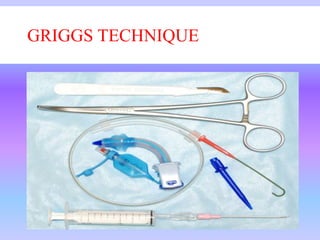
 1990, Griggs et al - the guide wire dilating forceps.
 Others -
using a single tapered dilator (BlueRhino)
 passing the dilator from inside the trachea to the
outside (Fantoni’s technique).
 using a screw like device to open the trachea wall
(PercTwist).
TECHNIQUE
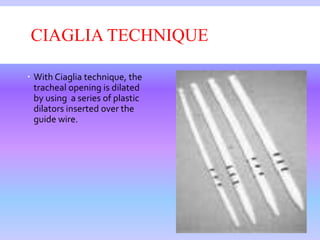
CIAGLIA TECHNIQUE
 With Ciaglia technique, the
tracheal opening is dilated
by using a series of plastic
dilators inserted over the
guide wire.
GRIGGS TECHNIQUE
BLUE RHINO DILATOR
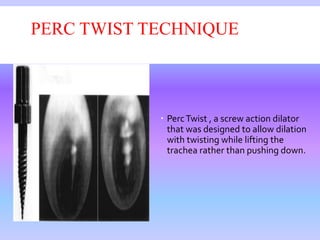
PERC TWIST TECHNIQUE
 PercTwist , a screw action dilator
that was designed to allow dilation
with twisting while lifting the
trachea rather than pushing down.
SURGICAL TRACHEOSTOMY
 Surgical tracheostomy (ST) is usually performed in the
operating room on a patient under general anesthesia,
but it may be performed at the bedside in the intensive
care unit.
 The patient’s shoulders are elevated with head extension
(unless cervical disease or injury is present), elevating the
larynx and exposing more of the upper trachea.
 Local anesthesia with a vasoconstrictor is usually
infiltrated into the skin and deeper tissues
SURGICAL TRACHEOSTOMY
 The skin of the neck over the 2nd
tracheal ring is identified, and a
vertical
incision about 2–3 cm in length
is created.
 Sharp dissection following the
skin incision is used to cut across
the platysma muscle, and
bleeding controlled by
hemostats and ties or
electocautery.
SURGICAL TRACHEOSTOMY
 Blunt dissection parallel to
the long axis of the trachea is
then used to spread the
submuscular tissues until the
thyroid isthmus is identified
 If the gland lies superior to
the 3rd tracheal ring, it can
be bluntly undermined and
retracted superiorly to gain
access to the trachea
SURGICAL TRACHEOSTOMY
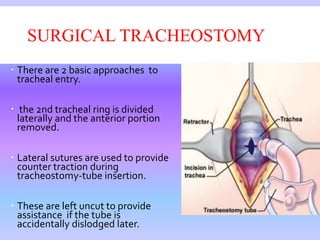
 There are 2 basic approaches to
tracheal entry.
 the 2nd tracheal ring is divided
laterally and the anterior portion
removed.
 Lateral sutures are used to provide
counter traction during
tracheostomy-tube insertion.
 These are left uncut to provide
assistance if the tube is
accidentally dislodged later.
TRACHEOSTOMY TUBES
 Tracheostomy tubes are available in a variety of sizes and
styles, from several manufacturers.
 Dimensions of tracheostomy tubes are given by their inner
diameter (ID), outer diameter (OD), length, and curvature.
 Cuffs on tracheostomy tubes include high-volume low-pressure
cuffs, tight-to shaft cuffs, and foam cuffs.
TRACHEOSTOMY TUBES
METAL VS PLASTIC TRACHEOSTOMY
TUBES
 Tracheostomy tubes can be of either metal or plastic.
 Metal tubes are constructed of silver or stainless steel.
 Metal tubes are not used commonly because they are
→ rigid construction
→ uncuffed
→lack a 15 mm connector for attachment to a ventillator
METAL VS PLASTIC
TRACHEOSTOMY TUBES
 Plastic tubes are most commonly used and are made
from polyvinyl chloride or silicone.
 Polyvinyl chloride softens at body temperature
(thermolabile), adjustable to patient’s tracheal
anatomy and centering the distal tip in the trachea.
TRACHEOSTOMY TUBES :
 If the ID is too small, it will
→increase the resistance through the tube,
→make airway clearance difficult,
→ increase the cuff pressure required to create a
seal
 If the OD is too large,
→ Difficulty in speech
→difficult to pass through the stoma.
→may not conform to the shape of the trachea,
→compression of the membranous trachea,
CUFFED TRACHEOSTOMY TUBE
 Cuffed tracheostomy tubes
→allow airway clearance,
→protection from aspiration
→ positive pressure ventilation
 It is recommended that cuff pressure be maintained at 20–
25 mmHg (25–35 cm H2O) to
minimize the risks for both
tracheal wall injury and aspiration.
CUFFED TRACHEOSTOMY
TUBE
FENESTRATED TRACHEOSTOMY
TUBES
 The fenestrated tracheostomy tube is similar in construction to
standard tracheostomy tubes, with the addition of an opening
in the posterior portion of the tube above the cuff.
 With the inner cannula removed, the cuff deflated, and the
tracheostomy air passage occluded, the patient can inhale and
exhale through the fenestration and around the tube.
FENESTRATED TRACHEOSTOMY
TUBES
FENESTRATED TRACHEOSTOMY
TUBES
 This allows for assessment of the patient’s ability to
breathe through the normal oral/nasal route
→ preparing the patient for decannulation
→ allowing phonation
 Supplemental oxygen administration to the upper airway
(eg, nasal cannula) may be necessary if the tube is capped.
COMPLICATIONS :-
 IMMEDIATE:-
 anesthetic complications.
 air embolism.
 apnoea.
 cardiac arrest.
 Hemorrhage- thyroid veins; jugular veins; arteries.
 local damage- thyroid cartilage; cricoid cartilage; recurrent laryngeal
nerve.
COMPLICATIONS :-
 INTERMEDIATE:
 - displacement of the tube.
 - surgical emphysema.
 - pneumothorax /pneumomediastinum.
 - infection: perichondritis.
 - tube obstruction by secretions or crusts.
 - tracheal necrosis.
 - tracheoarterial fistula.
 - tracheo-oesophageal fistula.
 - dysphagia.
COMPLICATIONS :-
 LONGTERM:
 - stenosis.
 - decannulation problems.
 - tracheocutaneous fistula.
 - disfiguring scar.
TRACHEOSTOMY CARE :-
 Humidification
 Tube position -To prevent decubitus of trachea.
 Suctioning and Inner tube care - Daily to remove and clean
crusts
 Skin care - To prevent irritation and secondary
inflammation due to discharge
TRACHEOSTOMY AND
WEANING
 Advantages of early tracheostomy
 reduced dead space
 decreased airway resistance,
 decreased work of breathing,
 better secretion clearance by suctioning,
 reduced requirements of sedatives and MR
 better glottic function with
 reduced risk of aspiration, atelectasis,pneumonia
 shortened ICU stay.
DECANNULATION
 Decannulation should be approached in a stepwise fashion.
 if the initial cuffed tube has been changed there should be
enough airflow around the tube to allow the patient to breath
easily with the tube lumen occluded.
 Block the tube during the daytime initially, and then for a full
24 hours, followed by decannulation.
DECANNULATION
 Once the tube has been removed the stoma must be occluded with
an airtight dressing.
 Change the dressing whenever an air leak becomes apparent to avoid
a persistent tracheocutaneous fistula.
 Psychologically dependent patients require longer duration for
decannulation.
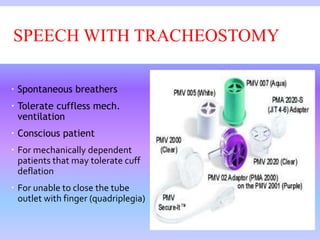
SPEECH WITH TRACHEOSTOMY
 Spontaneous breathers
 Tolerate cuffless mech.
ventilation
 Conscious patient
 For mechanically dependent
patients that may tolerate cuff
deflation
 For unable to close the tube
outlet with finger (quadriplegia)
SPEECH WITHTRACHEOSTOMY
 A tracheostomy speaking valve is
a one-way valve, allows air in, but
not out.
 This forces air around the
tracheostomy tube, through the
vocal cords and the mouth upon
expiration, enabling the patient
to vocalize .
THANK YOU

Tracheostomy

  • 1.
  • 2.
    DEFINATION :-  Tracheotomy: Surgical opening of the trachea.  Tracheostomy : Creation of a stoma at the skin surface which leads into the trachea.  It is a surgically created airway fashioned by making a hole in the anterior wall of the trachea.
  • 3.
  • 4.
    HISTORY :-  Tracheostomyis one of the oldest surgical procedures.  The first successful tracheostomy was performed by Brasovala in the 15th century.  Sheldon : Percutaneous tracheostomy in 1957.  In 1909, Chevalier Jackson : Guidelines for safe tracheostomy.
  • 5.
    TEMPORARY TRACHEOSTOMY  Temporarytracheostomy may be either elective or emergency.  An elective temporary tracheostomy may be part of a planned procedure, such as a major head and neck operation.  An emergency temporary tracheostomy is a rare procedure and is indicative in some certain conditions.
  • 6.
    PERMANENT TRACHEOSTOMY  Permanenttracheostomy is an elective procedure carried out as part of an operation involving larynx or trachea.  The trachea is permanently disconnected from the pharynx and the proximal end of the trachea is sutured to the skin.  In a permanent tracheostomy the only access to the lower airway is via the tracheostome.
  • 7.
    EFFECTS AND FUNCTIONS:-  Alternative pathway for breathing.  Laryngeal bypass - All of the normal laryngeal functions are lost, the patient is unable to cough or phonate.  Improves alveolar ventilation.  Protects the airways - By using cuffed tube.
  • 8.
    EFFECTS AND FUNCTIONS:-  The filtration of particulate matter and humidification of inspired air by the nasal mucosa is lost.  An increased risk of infection.  Permits removal of tracheobronchial secretions.  To administer anesthesia and IPPR.
  • 9.
    INDICATIONS :-  UpperAirway obstruction secondary to – trauma, burns corrosive poisoning, laryngeal dysfunction, foreign body, infections, inflammatory conditions, Neoplasms, Postoperatively , obstructive sleep apnea  Access for pulmonary toilet  Prolonged ventilatory support  Airway protection in head injured or comatose patient and in postoperative neurosurgical patients
  • 10.
    ANATOMY  The tracheais a fibro muscular tube supported by 20 hyaline cartilages.  The soft tissue posterior wall is in contact with the oesophagus.  Trachea lies in midline of the neck extending from cricoid cartilage (C6) superiorly to the tracheal bifurcation at the level of sternal angle (T5).
  • 11.
    ANATOMY :- Adults -12-16 cms long and 16-20 mm wide. Blood supply - bracheocephalic artery and through the inferior thyroid and bronchial arteries. Parasympathetic supply to the trachea is by the recurrent laryngeal nerve
  • 12.
    TECHNIQUES  Cricothyroidotomy  ForUrgent Procedures  PercutaneousTracheostomy  Can be done in the ICU at the bedside  SurgicalTracheostomy
  • 13.
    CRICOTHYROIDOTOMY / MINITRACHEOSTOMY The patient lies supine with the neck extended over a pillow.  Ascertain the correct anatomical landmarks by palpation.  The thyroid cartilage is gripped between the thumb and middle finger of the left hand; in this position the index finger can be used to palpate the cricothyroid membrane.  Airway is entered using a needle and cannula attached to a 10 ml syringe half full of saline.  The needle is angled in a caudal direction and the cannula is passed over the needle into the trachea.
  • 14.
    CRICOTHYROIDOTOMY / MINITRACHEOSTOMY Connect the cannula to an ambu bag using a syringe with a 7-mm endotracheal tube adaptor.  CO2 is not cleared effectively.
  • 15.
    PERCUTANEOUS TRACHEOSTOMY  1955,Shelden et al - cutting trocar into the trachea.  Ciaglia, in 1986 -wire-guided technique.  1990, Griggs et al - the guide wire dilating forceps.  Others - using a single tapered dilator (BlueRhino)  passing the dilator from inside the trachea to the outside (Fantoni’s technique).  using a screw like device to open the trachea wall (PercTwist).
  • 16.
  • 17.
    CIAGLIA TECHNIQUE  WithCiaglia technique, the tracheal opening is dilated by using a series of plastic dilators inserted over the guide wire.
  • 18.
  • 19.
  • 20.
    PERC TWIST TECHNIQUE PercTwist , a screw action dilator that was designed to allow dilation with twisting while lifting the trachea rather than pushing down.
  • 21.
    SURGICAL TRACHEOSTOMY  Surgicaltracheostomy (ST) is usually performed in the operating room on a patient under general anesthesia, but it may be performed at the bedside in the intensive care unit.  The patient’s shoulders are elevated with head extension (unless cervical disease or injury is present), elevating the larynx and exposing more of the upper trachea.  Local anesthesia with a vasoconstrictor is usually infiltrated into the skin and deeper tissues
  • 22.
    SURGICAL TRACHEOSTOMY  Theskin of the neck over the 2nd tracheal ring is identified, and a vertical incision about 2–3 cm in length is created.  Sharp dissection following the skin incision is used to cut across the platysma muscle, and bleeding controlled by hemostats and ties or electocautery.
  • 23.
    SURGICAL TRACHEOSTOMY  Bluntdissection parallel to the long axis of the trachea is then used to spread the submuscular tissues until the thyroid isthmus is identified  If the gland lies superior to the 3rd tracheal ring, it can be bluntly undermined and retracted superiorly to gain access to the trachea
  • 24.
    SURGICAL TRACHEOSTOMY  Thereare 2 basic approaches to tracheal entry.  the 2nd tracheal ring is divided laterally and the anterior portion removed.  Lateral sutures are used to provide counter traction during tracheostomy-tube insertion.  These are left uncut to provide assistance if the tube is accidentally dislodged later.
  • 25.
    TRACHEOSTOMY TUBES  Tracheostomytubes are available in a variety of sizes and styles, from several manufacturers.  Dimensions of tracheostomy tubes are given by their inner diameter (ID), outer diameter (OD), length, and curvature.  Cuffs on tracheostomy tubes include high-volume low-pressure cuffs, tight-to shaft cuffs, and foam cuffs.
  • 26.
  • 27.
    METAL VS PLASTICTRACHEOSTOMY TUBES  Tracheostomy tubes can be of either metal or plastic.  Metal tubes are constructed of silver or stainless steel.  Metal tubes are not used commonly because they are → rigid construction → uncuffed →lack a 15 mm connector for attachment to a ventillator
  • 28.
    METAL VS PLASTIC TRACHEOSTOMYTUBES  Plastic tubes are most commonly used and are made from polyvinyl chloride or silicone.  Polyvinyl chloride softens at body temperature (thermolabile), adjustable to patient’s tracheal anatomy and centering the distal tip in the trachea.
  • 29.
    TRACHEOSTOMY TUBES : If the ID is too small, it will →increase the resistance through the tube, →make airway clearance difficult, → increase the cuff pressure required to create a seal  If the OD is too large, → Difficulty in speech →difficult to pass through the stoma. →may not conform to the shape of the trachea, →compression of the membranous trachea,
  • 30.
    CUFFED TRACHEOSTOMY TUBE Cuffed tracheostomy tubes →allow airway clearance, →protection from aspiration → positive pressure ventilation  It is recommended that cuff pressure be maintained at 20– 25 mmHg (25–35 cm H2O) to minimize the risks for both tracheal wall injury and aspiration.
  • 31.
  • 32.
    FENESTRATED TRACHEOSTOMY TUBES  Thefenestrated tracheostomy tube is similar in construction to standard tracheostomy tubes, with the addition of an opening in the posterior portion of the tube above the cuff.  With the inner cannula removed, the cuff deflated, and the tracheostomy air passage occluded, the patient can inhale and exhale through the fenestration and around the tube.
  • 33.
  • 34.
    FENESTRATED TRACHEOSTOMY TUBES  Thisallows for assessment of the patient’s ability to breathe through the normal oral/nasal route → preparing the patient for decannulation → allowing phonation  Supplemental oxygen administration to the upper airway (eg, nasal cannula) may be necessary if the tube is capped.
  • 35.
    COMPLICATIONS :-  IMMEDIATE:- anesthetic complications.  air embolism.  apnoea.  cardiac arrest.  Hemorrhage- thyroid veins; jugular veins; arteries.  local damage- thyroid cartilage; cricoid cartilage; recurrent laryngeal nerve.
  • 36.
    COMPLICATIONS :-  INTERMEDIATE: - displacement of the tube.  - surgical emphysema.  - pneumothorax /pneumomediastinum.  - infection: perichondritis.  - tube obstruction by secretions or crusts.  - tracheal necrosis.  - tracheoarterial fistula.  - tracheo-oesophageal fistula.  - dysphagia.
  • 37.
    COMPLICATIONS :-  LONGTERM: - stenosis.  - decannulation problems.  - tracheocutaneous fistula.  - disfiguring scar.
  • 38.
    TRACHEOSTOMY CARE :- Humidification  Tube position -To prevent decubitus of trachea.  Suctioning and Inner tube care - Daily to remove and clean crusts  Skin care - To prevent irritation and secondary inflammation due to discharge
  • 40.
    TRACHEOSTOMY AND WEANING  Advantagesof early tracheostomy  reduced dead space  decreased airway resistance,  decreased work of breathing,  better secretion clearance by suctioning,  reduced requirements of sedatives and MR  better glottic function with  reduced risk of aspiration, atelectasis,pneumonia  shortened ICU stay.
  • 41.
    DECANNULATION  Decannulation shouldbe approached in a stepwise fashion.  if the initial cuffed tube has been changed there should be enough airflow around the tube to allow the patient to breath easily with the tube lumen occluded.  Block the tube during the daytime initially, and then for a full 24 hours, followed by decannulation.
  • 42.
    DECANNULATION  Once thetube has been removed the stoma must be occluded with an airtight dressing.  Change the dressing whenever an air leak becomes apparent to avoid a persistent tracheocutaneous fistula.  Psychologically dependent patients require longer duration for decannulation.
  • 43.
    SPEECH WITH TRACHEOSTOMY Spontaneous breathers  Tolerate cuffless mech. ventilation  Conscious patient  For mechanically dependent patients that may tolerate cuff deflation  For unable to close the tube outlet with finger (quadriplegia)
  • 44.
    SPEECH WITHTRACHEOSTOMY  Atracheostomy speaking valve is a one-way valve, allows air in, but not out.  This forces air around the tracheostomy tube, through the vocal cords and the mouth upon expiration, enabling the patient to vocalize .
  • 45.