 Definition
 Indications
 Procedure
 Types of tracheostomy tubes
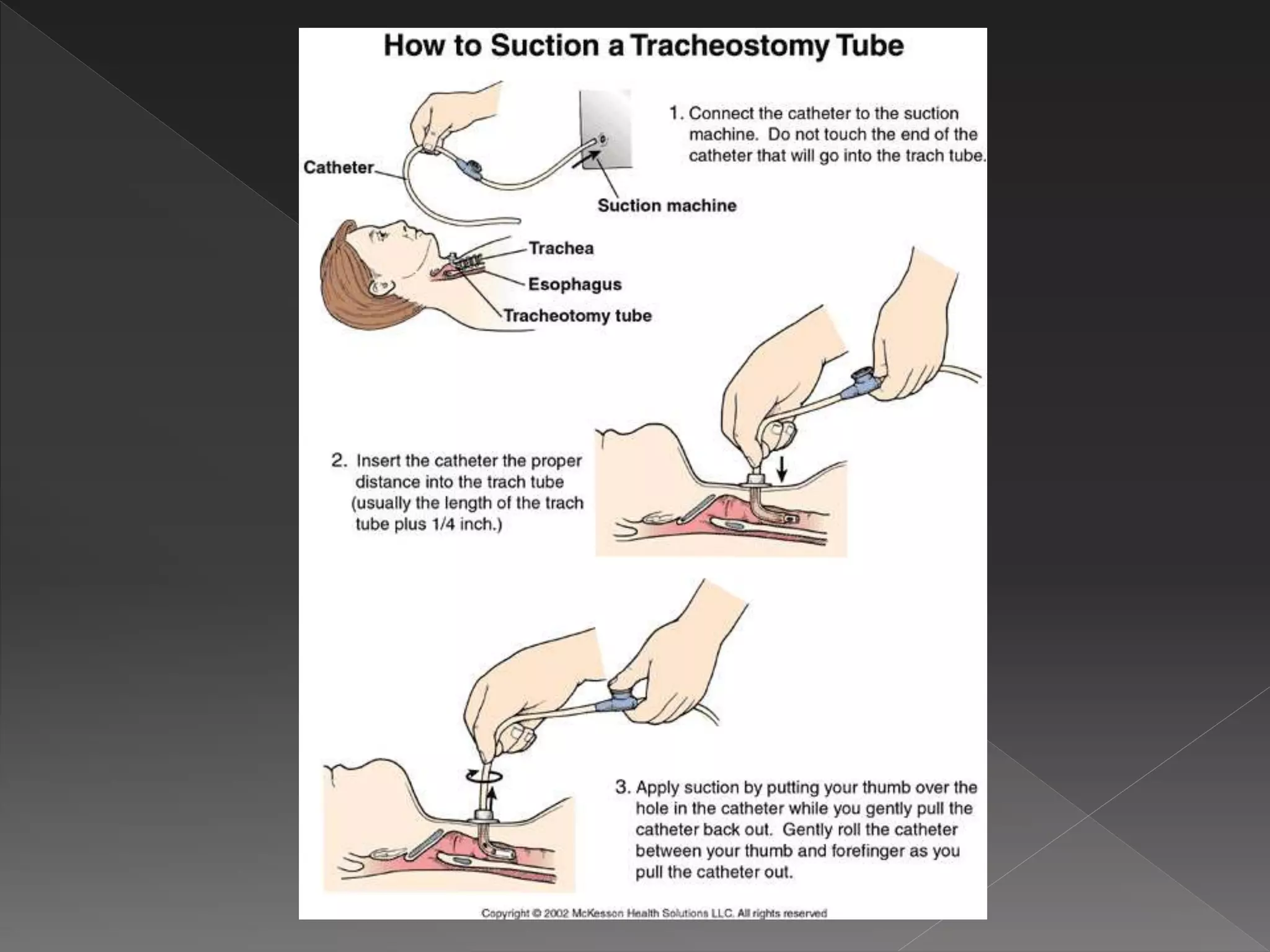
 Tracheostomy care
 Complications
 Cricothyrotomy
 Percutaneous tracheostomy
 Decannulation
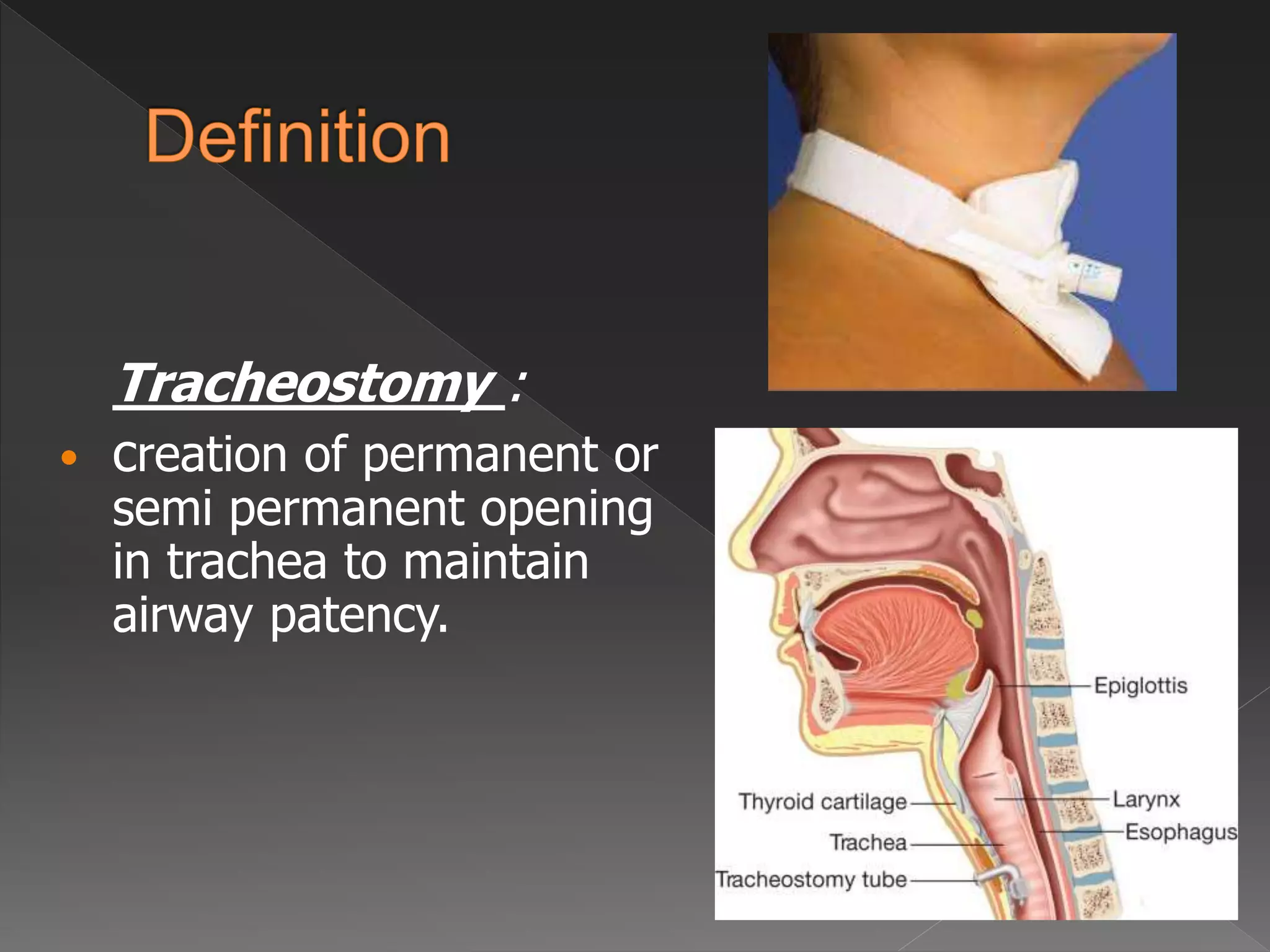
Tracheostomy :
• creation of permanent or
semi permanent opening
in trachea to maintain
airway patency.
 First mentiones in Rig Veda – 2000 BC
 Egyptian manuscipts- 3500 yrs ago.
 Fabricius (1617) & Habicot (1620)- first
technical descriptions.
 Heister (1718) – introduced term
“tracheotomy”
 Negus (1938)- coined term “tracheostomy”
 Temporary
Temp or permanent
Elective or emergency
 Permanent
Laryngectomy
Diversion procedure
1. Impending upper airway obstruction
2. Major laryngeal trauma
3. Prolonged intermittent positive pressure ventilation
4. Inability to intubate or perform cricothyrotomy
5. Laryngeal foreign body or pathology
6. Hypercarbia/ hypoxemia due to flail chest/ lung
contusions.
7. When IPPV- for control of cerebral edema in head
injuries.
PROTECTION of AIRWAY
› Neurological Diseases(Polyneuritis eg GBS, MN
Diseases)
› Coma (GCS<8, risk of aspiration)
RESPIRATORY FAILURE
› Pulmonary Disease
› Flail Chest
RETENTION of SECRETIONS
› In acute resp. infection, pulmonary disease etc
Elective Tracheostomy as Adjunct to H&N
surgeries
› >21 days on ETT
› <14 days on ETT(relative)
Anaesthesia
› LA
› GA
Incision
› Transverse
› Longitudinal
Positioning
› Supine
› Shoulder pad
› Head ring
Skin Prep with
povidine iodine,
chlorohexidine(sa
vlon)
Draping
Good light source
and suction
machine ready
and tested to be
functional
Blunt dissection of
subcut tissue
Transversely
Retracted as shown
Transverse Incision
2-4cm below cricoid
cart/ 2-4cm above
suprasternal notch
Incision length=
anterior border of
SCM msc lateral
Blunt dissection of
subcut
Strap msc is
divided
longitudinally
at midline
Langerbeck
retractor used to
retract laterally
Thyroid isthmus is
divided at midline
by 2 haemostat
and cut edge
secured by 2/0
vicryl
Thyroid retracted
superiorly
Depending on the
the TT size abt 4cm
longitudinal opening
is made to trachea
below 2nd ring
Negus
tracheal
dilator
applied and
TT inserted
in between
Tube is
anchored
 Vertical incision in trachea b/w 2nd and 3rd
ring.
 No excision of ant. Wall of trachea
 Secure the tube with neck by two sutures
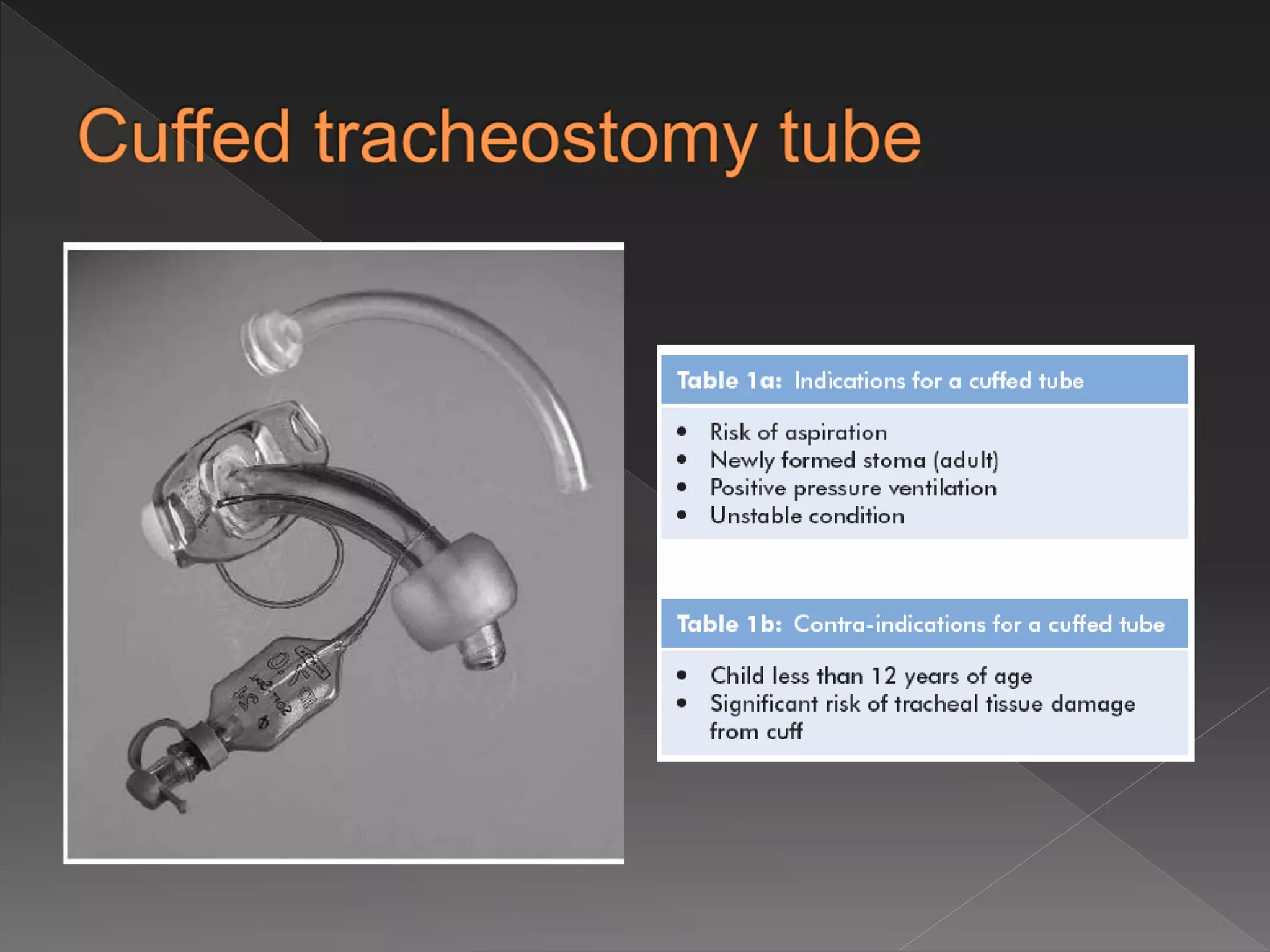
 Cuffed tubes
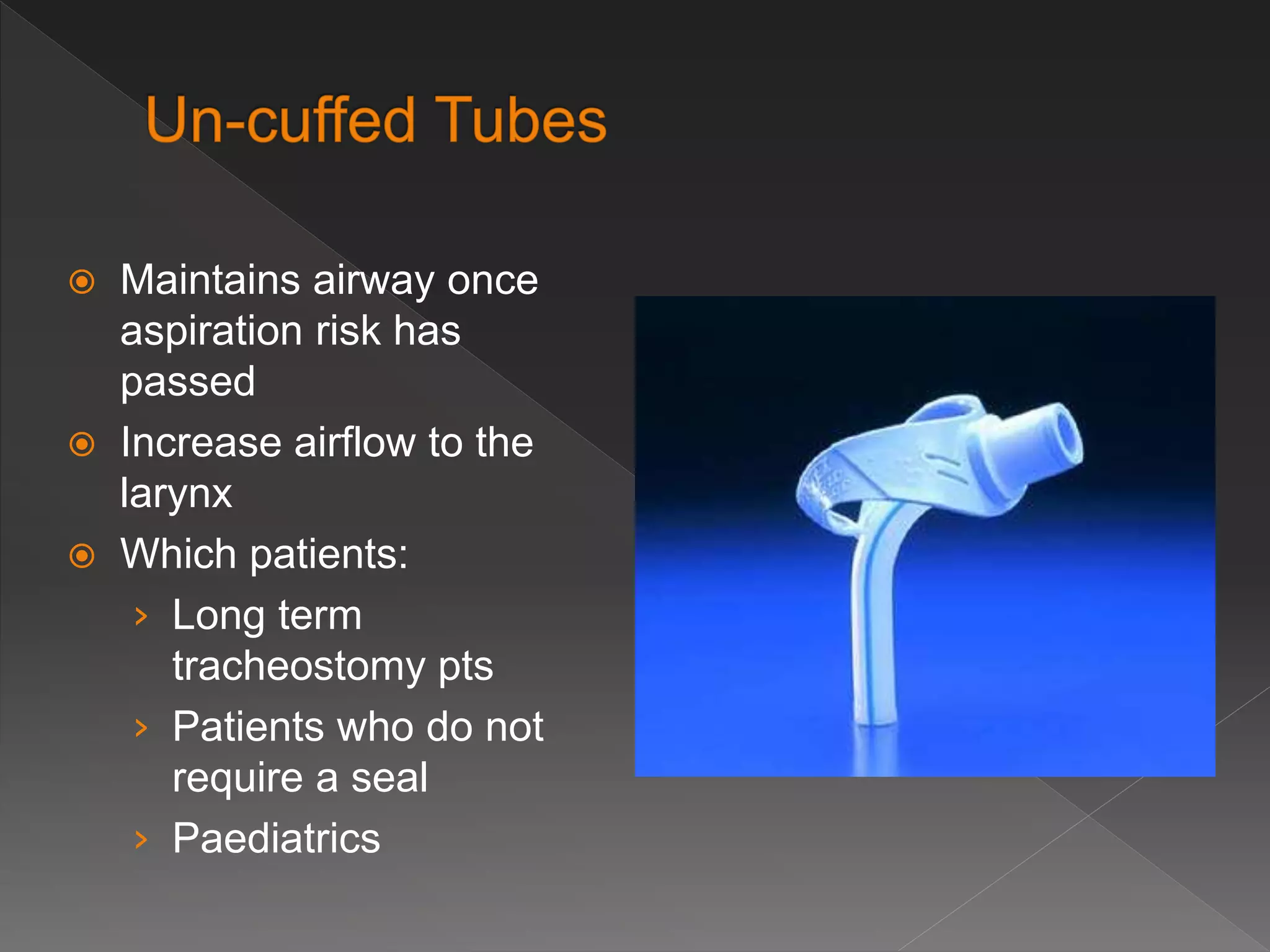
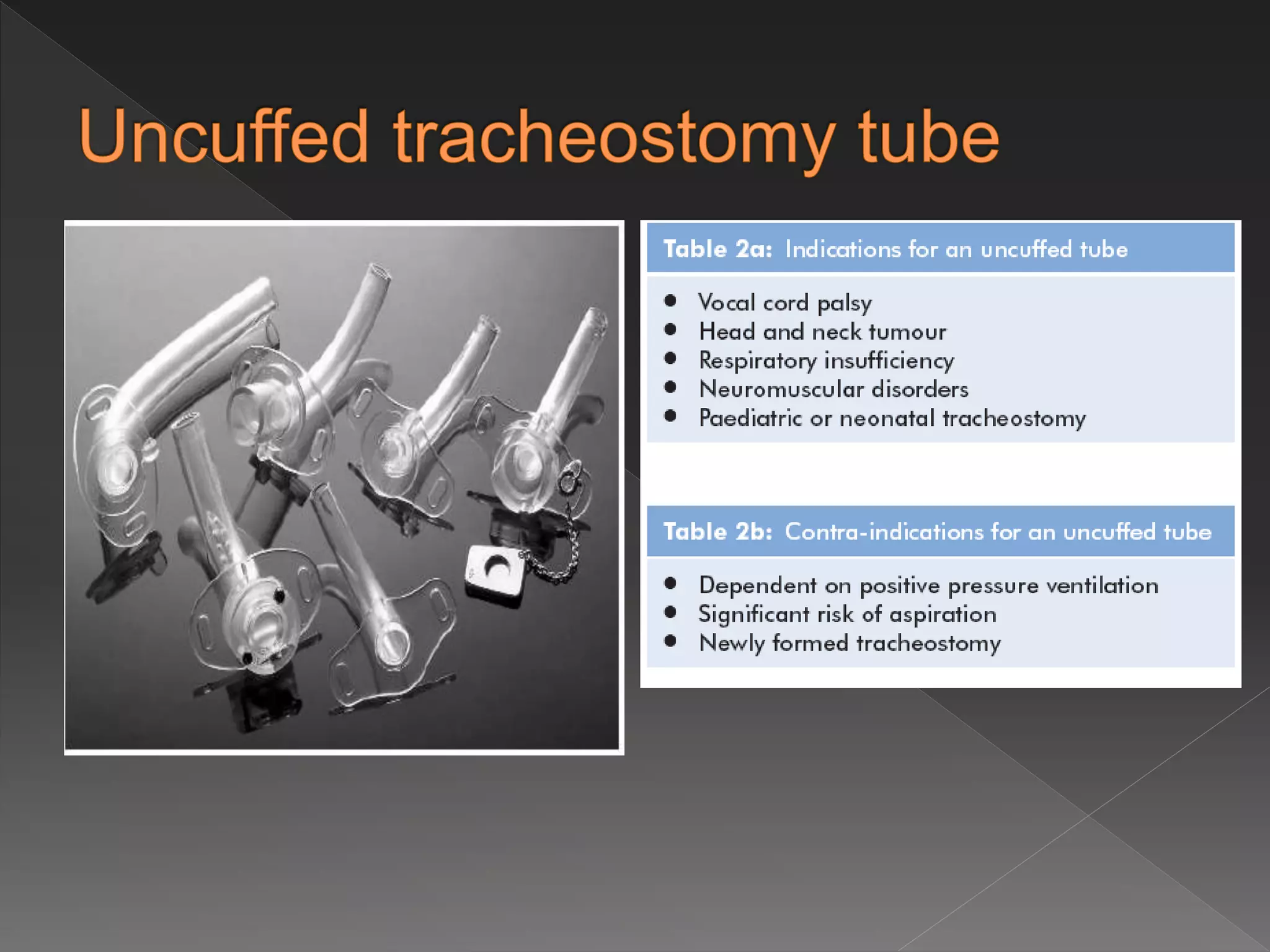
 Un-cuffed
 Fenestrated
 Inner cannula
 Adjustable flange
 PVC, Silver, Silicone and Rubber
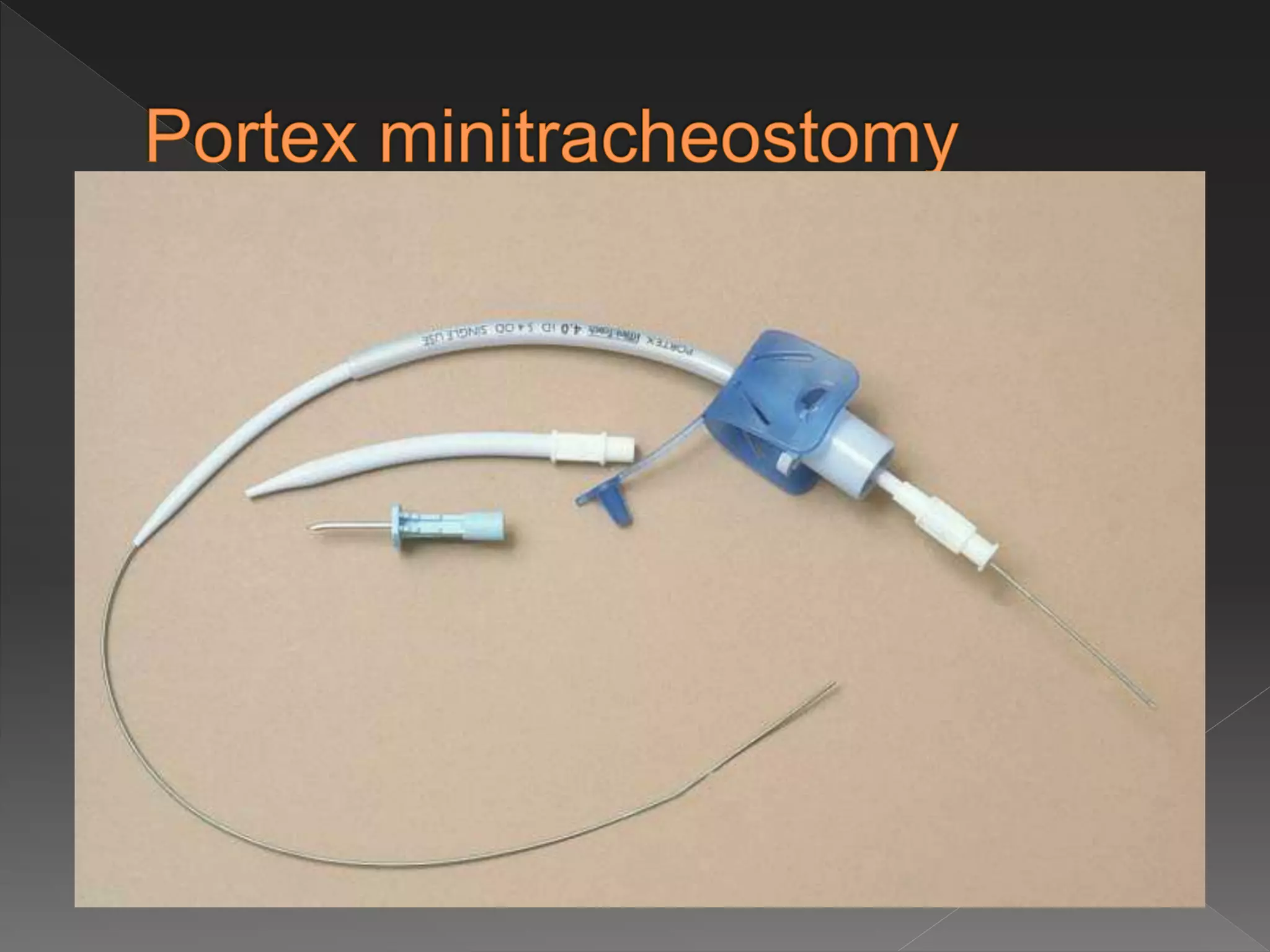
 Mini Tracheostomies
Metallic tube
Fenestrated
tracheal tube
 Allow patient to
ventilate past tube via
upper airway
 Allow speech
 Allows ventilation and
prevents aspiration
 High cuff pressure can
be damaging
 Check pilot cuff
 DO NOT BLOCK THIS
TUBE
 Maintains airway once
aspiration risk has
passed
 Increase airflow to the
larynx
 Which patients:
› Long term
tracheostomy pts
› Patients who do not
require a seal
› Paediatrics
Neck collar
Thyroid cartilage
Cricothyroid
membrane
Crycoid cartilage
1 2 3
4 5
› Convert to trach
› Keep only for 3-5 days
› Complications –
 Subglottic oedema
 Surgical emphysema
 Perichondritis
 Infection
 VC injury
 Stenosis
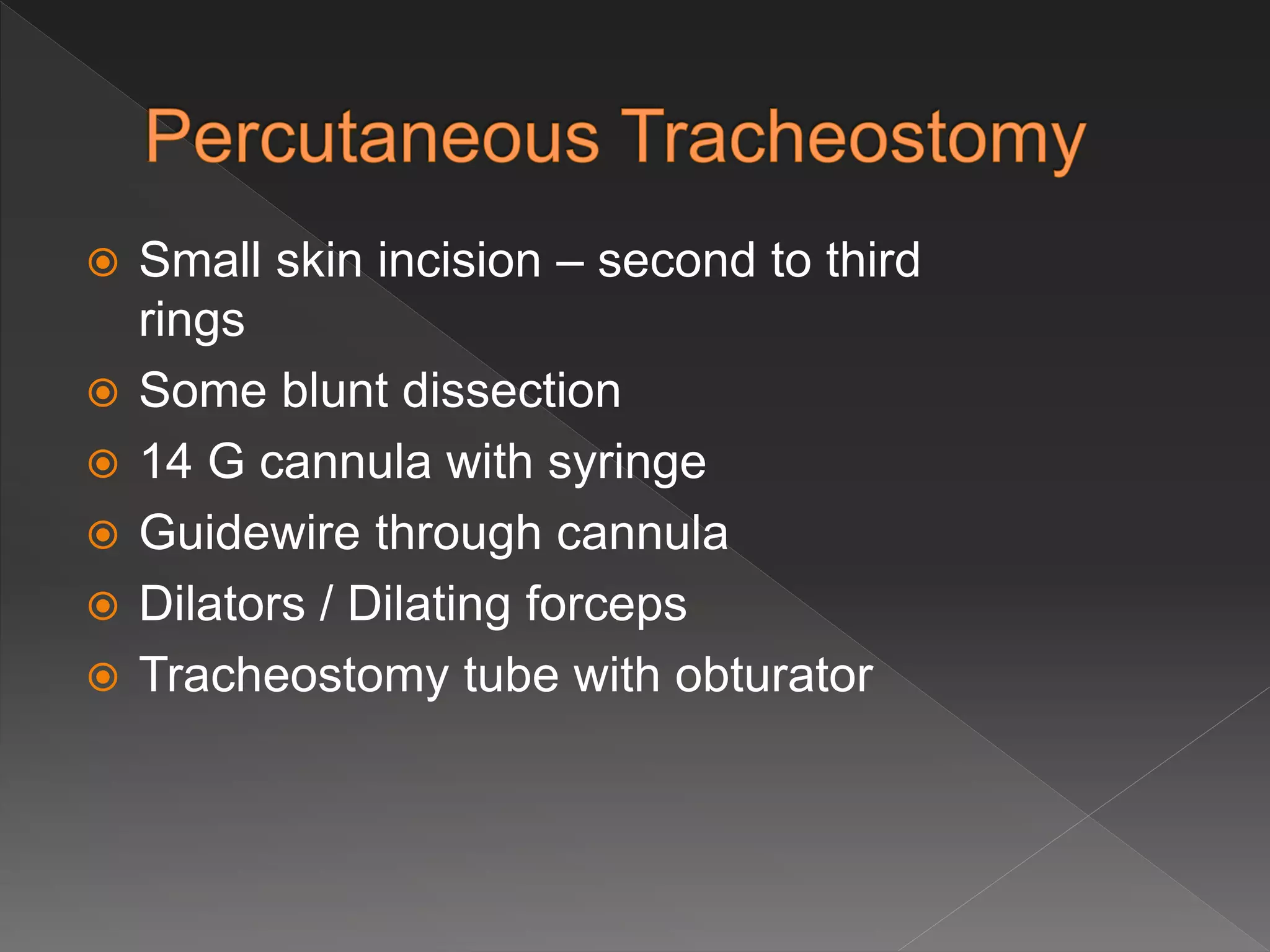
 Small skin incision – second to third
rings
 Some blunt dissection
 14 G cannula with syringe
 Guidewire through cannula
 Dilators / Dilating forceps
 Tracheostomy tube with obturator
 Contraindications
› Children
› Bleeding diathesis
› Previous surgery
› Infection
 Dangerous in :
› Short neck
› Thick & fat neck
› Enlarged thyroid /
swelling
Intraopertaive Complications
 Bleeding and injury to big vessels
 Injury to tracheoesophageal wall
 Pneumothorax
 Apnea
 Cardiac arrest
Early Complications
 Bleeding
 Tracheostomy tube obstruction
 Tracheostomy tube displacement
 Infection
Late Complications
 Tracheal Stenosis
 Granulation tissue
 Tracheocutaneus fistula
 Tracheo - inominate fistula
 Stepwise
 Uncuff ,
 Downsizing if neccessary
 Airtight dressing
tracheostomy.pptx

tracheostomy.pptx