DONE BY
P.SHRAVAN
CRI
 Tracheotomy : Surgical opening of the trachea.
 Tracheostomy : Creation of a stoma at the skin
surface which leads into the trachea.
 It is a surgically created airway fashioned by
making a hole in the anterior wall of the trachea.
 Tracheostomy is one of the oldest surgical
procedures.
 The first successful tracheostomy was
performed by Brasovala in the 15th century.
 In 1909, Chevalier Jackson : Guidelines for safe
tracheostomy.
 Temporary tracheostomy may be either elective
or emergency.
 An elective temporary tracheostomy may be
part of a planned procedure, such as a major
head and neck operation.
 An emergency temporary tracheostomy is a
rare procedure and is indicative in some certain
conditions.
 Permanent tracheostomy is an elective
procedure carried out as part of an operation
involving larynx or trachea.
 The trachea is permanently disconnected from
the pharynx and the proximal end of the trachea
is sutured to the skin.
 In a permanent tracheostomy the only access to
the lower airway is via the tracheostome.
Tracheotomy Indications
To bypass obstruction
Tracheotomy Indications
- Need for prolonged respiratory support, such as in
Bronchopulmonary Dysplasia
- To reduce anatomic dead space and increase the chance for
mechanical ventilation withdrawal
- To improve the patient`s quality of life (easier toilet,
ability to speak and eat, increase the mobility)
- Neuromuscular diseases paralyzing or weakening chest
muscles and diaphragm
Tracheotomy Indications
Miscellaneous
-Congenital abnormalities. (Pierre Robin, Triecher
Collins
syndromes)
- Obstructive Sleep Apnea Syndrome.
- Aspirations related to muscle or sensory problems.
-Prophylaxis (as preparation for extensive H&N
procedures, before radiotherapy for H&N CA)
-Cervical spinal cord injuries with respiratory muscles
paralysis.
 No absolute contraindications exist to
tracheostomy
 RELATIVE
 Laryngeal CA(strong)
 it may lead to increased incidence of stomal
recurrence(a diffuse infiltrate of neoplastic tissue at the junction
of the amputated trachea and skin )
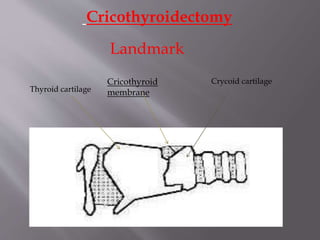
Cricothyroidectomy
Cricothyroid
membrane
Crycoid cartilage
Thyroid cartilage
Landmark
 The patient lies supine with the neck extended over
a pillow.
 Ascertain the correct anatomical landmarks by palpation.
 The thyroid cartilage is gripped between the thumb and
middle finger of the left hand; in this position the index finger
can be used to palpate the cricothyroid membrane.
 Airway is entered using a needle and cannula attached to a 10
ml syringe half full of saline.
 The needle is angled in a caudal direction and the cannula is
passed over the needle into the trachea.
 Connect the cannula to an ambu bag using a syringe with a 7-mm
endotracheal tube adaptor.
 CO2 is not cleared effectively.
 Surgical tracheostomy (ST) is usually performed
in the operating room on a patient under general
anesthesia, but it may be performed at the bedside
in the intensive care unit.
 The patient’s shoulders are elevated with head
extension (unless cervical disease or injury is
present), elevating the larynx and exposing more
of the upper trachea.
 Local anesthesia with a vasoconstrictor is usually
infiltrated into the skin and deeper tissues
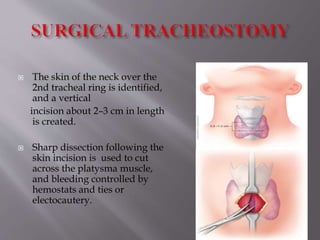
 The skin of the neck over the
2nd tracheal ring is identified,
and a vertical
incision about 2–3 cm in length
is created.
 Sharp dissection following the
skin incision is used to cut
across the platysma muscle,
and bleeding controlled by
hemostats and ties or
electocautery.
 Blunt dissection parallel
to the long axis of the
trachea is then used to
spread the submuscular
tissues until the thyroid
isthmus is identified
 If the gland lies superior
to the 3rd tracheal ring,
it can be bluntly
undermined and
retracted superiorly to
gain access to the
trachea
 There are 2 basic approaches
to tracheal entry.
 the 2nd tracheal ring is
divided laterally and the
anterior portion removed.
 Lateral sutures are used to
provide counter traction
during tracheostomy-tube
insertion.
 These are left uncut to
provide assistance if the
tube is accidentally
dislodged later.
 Tracheostomy tubes are available in a variety of sizes
and styles, from several manufacturers.
 Dimensions of tracheostomy tubes are given by their
inner diameter (ID), outer diameter (OD), length, and
curvature.
 Cuffs on tracheostomy tubes include high-volume low-
pressure cuffs, tight-to shaft cuffs, and foam cuffs.
 Tracheostomy tubes can be of either metal or
plastic.
 Metal tubes are constructed of silver or stainless
steel.
 Metal tubes are not used commonly because they
are
→ rigid construction
→ uncuffed
→lack a 15 mm connector for attachment to a
ventillator
 Plastic tubes are most commonly used and are
made from polyvinyl chloride or silicone.
 Polyvinyl chloride softens at body temperature
(thermolabile), adjustable to patient’s tracheal
anatomy and centering the distal tip in the
trachea.
 Cuffed tracheostomy tubes
→allow airway clearance,
→protection from aspiration
→ positive pressure ventilation
 It is recommended that cuff pressure be maintained
at 20–25 mmHg (25–35 cm H2O) to
minimize the risks for both
tracheal wall injury and aspiration.
Repeat X-Ray soft tissue neck
Strong Analgesia
Antibiotics
IV fluid until able to tolerate orally
 IMMEDIATE:-
 anesthetic complications.
 air embolism.
 apnoea.
 cardiac arrest.
 Hemorrhage- thyroid veins; jugular veins; arteries.
 local damage- thyroid cartilage; cricoid cartilage;
recurrent laryngeal nerve.
 INTERMEDIATE:
 - displacement of the tube.
 - surgical emphysema.
 - pneumothorax /pneumomediastinum.
 - infection: perichondritis.
 - tube obstruction by secretions or crusts.
 - tracheal necrosis.
 - tracheoarterial fistula.
 - tracheo-oesophageal fistula.
 - dysphagia.
 LONG TERM:
 - stenosis.
 - decannulation problems.
 - tracheocutaneous fistula.
 - disfiguring scar.
• Secretions in the trachea
• Suspected aspiration of gastric or upper airway
secretions
• Increase in peak airway pressures when on
ventilator
• Increase in respirations or sustained cough or
both
• Gradual or sudden decrease in ABG
• Sudden onset of respiratory distress when
airway patency is questioned
Indications For Suctioning
 After the track is formed – 4-5 days after
the operation.
 Rate of exchange depends on clinical
situation of the specific patient – type of
discharge, type of tube, medical status,
age..
 Usually every 14 days.
 Should be done by experienced staff.
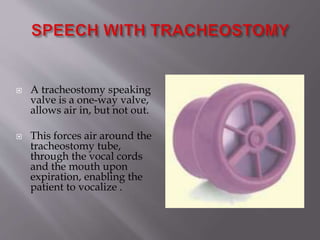
 A tracheostomy speaking
valve is a one-way valve,
allows air in, but not out.
 This forces air around the
tracheostomy tube,
through the vocal cords
and the mouth upon
expiration, enabling the
patient to vocalize .
 Decannulation should be approached in a stepwise
fashion.
 if the initial cuffed tube has been changed there should
be enough airflow around the tube to allow the patient
to breath easily with the tube lumen occluded.
 Block the tube during the daytime initially, and then for
a full 24 hours, followed by decannulation.
 Once the tube has been removed the stoma must
be occluded with an airtight dressing.
 Change the dressing whenever an air leak
becomes apparent to avoid a persistent
tracheocutaneous fistula.
 Psychologically dependent patients require
longer duration for decannulation.
Tracheostomy -INDICATIONS,CONTRAINDICATIONS,PROCEDURE,COMPLICATIONS

Tracheostomy -INDICATIONS,CONTRAINDICATIONS,PROCEDURE,COMPLICATIONS

  • 1.
  • 2.
     Tracheotomy :Surgical opening of the trachea.  Tracheostomy : Creation of a stoma at the skin surface which leads into the trachea.  It is a surgically created airway fashioned by making a hole in the anterior wall of the trachea.
  • 4.
     Tracheostomy isone of the oldest surgical procedures.  The first successful tracheostomy was performed by Brasovala in the 15th century.  In 1909, Chevalier Jackson : Guidelines for safe tracheostomy.
  • 7.
     Temporary tracheostomymay be either elective or emergency.  An elective temporary tracheostomy may be part of a planned procedure, such as a major head and neck operation.  An emergency temporary tracheostomy is a rare procedure and is indicative in some certain conditions.
  • 8.
     Permanent tracheostomyis an elective procedure carried out as part of an operation involving larynx or trachea.  The trachea is permanently disconnected from the pharynx and the proximal end of the trachea is sutured to the skin.  In a permanent tracheostomy the only access to the lower airway is via the tracheostome.
  • 9.
  • 10.
    Tracheotomy Indications - Needfor prolonged respiratory support, such as in Bronchopulmonary Dysplasia - To reduce anatomic dead space and increase the chance for mechanical ventilation withdrawal - To improve the patient`s quality of life (easier toilet, ability to speak and eat, increase the mobility) - Neuromuscular diseases paralyzing or weakening chest muscles and diaphragm
  • 11.
    Tracheotomy Indications Miscellaneous -Congenital abnormalities.(Pierre Robin, Triecher Collins syndromes) - Obstructive Sleep Apnea Syndrome. - Aspirations related to muscle or sensory problems. -Prophylaxis (as preparation for extensive H&N procedures, before radiotherapy for H&N CA) -Cervical spinal cord injuries with respiratory muscles paralysis.
  • 12.
     No absolutecontraindications exist to tracheostomy  RELATIVE  Laryngeal CA(strong)  it may lead to increased incidence of stomal recurrence(a diffuse infiltrate of neoplastic tissue at the junction of the amputated trachea and skin )
  • 13.
  • 14.
     The patientlies supine with the neck extended over a pillow.  Ascertain the correct anatomical landmarks by palpation.  The thyroid cartilage is gripped between the thumb and middle finger of the left hand; in this position the index finger can be used to palpate the cricothyroid membrane.  Airway is entered using a needle and cannula attached to a 10 ml syringe half full of saline.  The needle is angled in a caudal direction and the cannula is passed over the needle into the trachea.
  • 15.
     Connect thecannula to an ambu bag using a syringe with a 7-mm endotracheal tube adaptor.  CO2 is not cleared effectively.
  • 16.
     Surgical tracheostomy(ST) is usually performed in the operating room on a patient under general anesthesia, but it may be performed at the bedside in the intensive care unit.  The patient’s shoulders are elevated with head extension (unless cervical disease or injury is present), elevating the larynx and exposing more of the upper trachea.  Local anesthesia with a vasoconstrictor is usually infiltrated into the skin and deeper tissues
  • 17.
     The skinof the neck over the 2nd tracheal ring is identified, and a vertical incision about 2–3 cm in length is created.  Sharp dissection following the skin incision is used to cut across the platysma muscle, and bleeding controlled by hemostats and ties or electocautery.
  • 18.
     Blunt dissectionparallel to the long axis of the trachea is then used to spread the submuscular tissues until the thyroid isthmus is identified  If the gland lies superior to the 3rd tracheal ring, it can be bluntly undermined and retracted superiorly to gain access to the trachea
  • 19.
     There are2 basic approaches to tracheal entry.  the 2nd tracheal ring is divided laterally and the anterior portion removed.  Lateral sutures are used to provide counter traction during tracheostomy-tube insertion.  These are left uncut to provide assistance if the tube is accidentally dislodged later.
  • 20.
     Tracheostomy tubesare available in a variety of sizes and styles, from several manufacturers.  Dimensions of tracheostomy tubes are given by their inner diameter (ID), outer diameter (OD), length, and curvature.  Cuffs on tracheostomy tubes include high-volume low- pressure cuffs, tight-to shaft cuffs, and foam cuffs.
  • 22.
     Tracheostomy tubescan be of either metal or plastic.  Metal tubes are constructed of silver or stainless steel.  Metal tubes are not used commonly because they are → rigid construction → uncuffed →lack a 15 mm connector for attachment to a ventillator
  • 23.
     Plastic tubesare most commonly used and are made from polyvinyl chloride or silicone.  Polyvinyl chloride softens at body temperature (thermolabile), adjustable to patient’s tracheal anatomy and centering the distal tip in the trachea.
  • 24.
     Cuffed tracheostomytubes →allow airway clearance, →protection from aspiration → positive pressure ventilation  It is recommended that cuff pressure be maintained at 20–25 mmHg (25–35 cm H2O) to minimize the risks for both tracheal wall injury and aspiration.
  • 26.
    Repeat X-Ray softtissue neck Strong Analgesia Antibiotics IV fluid until able to tolerate orally
  • 27.
     IMMEDIATE:-  anestheticcomplications.  air embolism.  apnoea.  cardiac arrest.  Hemorrhage- thyroid veins; jugular veins; arteries.  local damage- thyroid cartilage; cricoid cartilage; recurrent laryngeal nerve.
  • 28.
     INTERMEDIATE:  -displacement of the tube.  - surgical emphysema.  - pneumothorax /pneumomediastinum.  - infection: perichondritis.  - tube obstruction by secretions or crusts.  - tracheal necrosis.  - tracheoarterial fistula.  - tracheo-oesophageal fistula.  - dysphagia.
  • 29.
     LONG TERM: - stenosis.  - decannulation problems.  - tracheocutaneous fistula.  - disfiguring scar.
  • 30.
    • Secretions inthe trachea • Suspected aspiration of gastric or upper airway secretions • Increase in peak airway pressures when on ventilator • Increase in respirations or sustained cough or both • Gradual or sudden decrease in ABG • Sudden onset of respiratory distress when airway patency is questioned Indications For Suctioning
  • 31.
     After thetrack is formed – 4-5 days after the operation.  Rate of exchange depends on clinical situation of the specific patient – type of discharge, type of tube, medical status, age..  Usually every 14 days.  Should be done by experienced staff.
  • 32.
     A tracheostomyspeaking valve is a one-way valve, allows air in, but not out.  This forces air around the tracheostomy tube, through the vocal cords and the mouth upon expiration, enabling the patient to vocalize .
  • 33.
     Decannulation shouldbe approached in a stepwise fashion.  if the initial cuffed tube has been changed there should be enough airflow around the tube to allow the patient to breath easily with the tube lumen occluded.  Block the tube during the daytime initially, and then for a full 24 hours, followed by decannulation.
  • 34.
     Once thetube has been removed the stoma must be occluded with an airtight dressing.  Change the dressing whenever an air leak becomes apparent to avoid a persistent tracheocutaneous fistula.  Psychologically dependent patients require longer duration for decannulation.