TRACHEOSTOMY
DR NIZAMUDEEN A S
Anatomy
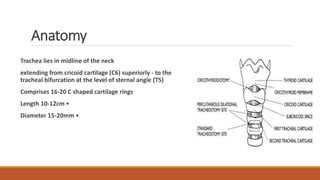
Trachea lies in midline of the neck
extending from cricoid cartilage (C6) superiorly - to the
tracheal bifurcation at the level of sternal angle (T5)
Comprises 16-20 C shaped cartilage rings
Length 10-12cm •
Diameter 15-20mm •
Indications
Upper Airway Obstruction ( Trauma, Foreign body, Infections, Malignant lesions)
Pulmonary Ventilation
Pulmonary Toilet
Elective Procedure
Types of Tracheostomy
• Emergency tracheostomy -It is employed when airway obstruction is complete or almost
complete and there is an urgent need to establish the airway.Intubation or laryngotomy are
either not possible or feasible in such cases. Within 2-4 mints with vertical incision
• Elective or tranquil tracheostomy
• Permanent tracheostomy -bilateral abductor paralysis & laryngeal stenosis
• Percutaneous dilatational tracheostomy
• Mini tracheostomy (cricothyroidotomy)
Elective Tracheostomy
Anaesthesia: G A
Position: Supine with sand bag under the shoulder
Incision :horizontal incision b/w cricoid cartilage and suprasternal notch Division /retraction of
thyroid isthmus
Opening of Trachea and insertion of tube
(a) Therapeutic, to relieve respiratory obstruction, remove tracheobronchial secretions or give
assisted ventilation.
(b) Prophylactic, to guard against anticipated respiratory obstruction or aspiration of blood or
pharyngeal secretions such as in extensive surgery of tongue, floor of mouth, mandibular
resection or laryngofissure.
Permanent tracheostomy:bilateral abductor paralysis &
laryngeal stenosis. (THYROIDisthmusliesagainstII,IIIand IVtracheal rings).
High- above hyroid isthmus via 1st tracheal ring
perichondritis of the cricoid cartilage and subglottic stenosis and is always avoided.
Only indication } carcinoma of larynx because in such cases, total larynx anyway would
ultimately be removed and a fresh tracheostome made in a clean area lower down
Mid- preferred one
Through the II or III rings and would entail division of the thyroid isthmus or its retraction
upwards or downwards to expose this part of trachea.
 Low- below level of isthmus Trachea is deep at this level and close to several large vessels; also
there are difficulties with tracheostomy tube which impinges on suprasternal notch.
Pediatric
Tracheostom
Vertical incision in trachea b/w 2nd and 3rd ring
No excision of ant. Wall of trachea
Secure the tube with neck by two sutures
• ICU Bed SideTracheostomy
• Use of guide wire and Dilators
• Under the vision of Bronchoscope through endotracheal
tube
• Less time ,Less Expensive
• Not suitable for thick neck and in emergency
Percutaneus Dilational
Tracheostomy
Technique
• Whenever possible, endotracheal intubation should be done before tracheostomy. This is
specially important in infants and children.
Position: supine with a pillow under the shoulders so that neck is extended.
Anaesthesia: No anaesthesia }unconscious patients/ emergency procedure. conscious
patients, 1-2% lignocaine with epinephrine; GA with intubation+/-
1. A vertical incision in the midline of neck, extending from cricoid cartilage to just above the
sternal notch.This is the most favoured incision and can be used in emergency and elective
procedures.It gives rapid access with minimum of bleeding and tissue dissection.
2. A transverse incision, 5 cm long, made 2 fingers' breadth above the sternal notch can be
used in elective procedures. It has the advantage of a cosmetically better scar
3. After incision, tissues are dissected in the midline. Dilated veins are either displaced or
ligated.
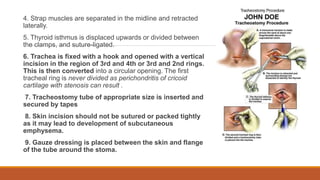
4. Strap muscles are separated in the midline and retracted
laterally.
5. Thyroid isthmus is displaced upwards or divided between
the clamps, and suture-ligated.
6. Trachea is fixed with a hook and opened with a vertical
incision in the region of 3rd and 4th or 3rd and 2nd rings.
This is then converted into a circular opening. The first
tracheal ring is never divided as perichondritis of cricoid
cartilage with stenosis can result .
7. Tracheostomy tube of appropriate size is inserted and
secured by tapes
8. Skin incision should not be sutured or packed tightly
as it may lead to development of subcutaneous
emphysema.
9. Gauze dressing is placed between the skin and flange
of the tube around the stoma.
Cricothyrotomy or laryngotomy or mini
tracheostomy
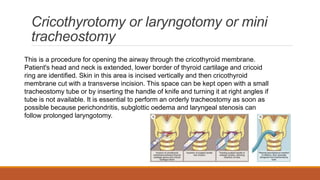
This is a procedure for opening the airway through the cricothyroid membrane.
Patient's head and neck is extended, lower border of thyroid cartilage and cricoid
ring are identified. Skin in this area is incised vertically and then cricothyroid
membrane cut with a transverse incision. This space can be kept open with a small
tracheostomy tube or by inserting the handle of knife and turning it at right angles if
tube is not available. It is essential to perform an orderly tracheostomy as soon as
possible because perichondritis, subglottic oedema and laryngeal stenosis can
follow prolonged laryngotomy.
Complications
A. Immediate (at the time of operation):
1. Haemorrhage.
2. Apnoea. This follows opening of trachea in a patient who had prolonged
respiratory obstruction. This is due to sudden washing out of CO2 which was
acting as a respiratory stimulus. Treatment is to administer 5% CO2 in oxygen or
assisted ventilation.
3. Pneumothorax due to injury to apical pleura.
4. Injury to recurrent laryngeal nerves.
5. Aspiration of blood.
6. Injury to oesophagus. This can occur with tip of knife while incising the
trachea and may result in tracheo-oesophageal fistula.
B. Intermediate(during first few hours or days):
1. Bleeding, reactionary or secondary.
2. Displacement of tube.
3. Blocking of tube.
4. Subcutaneous emphysema.
5. Tracheitis and tracheobronchitis with crusting in trachea.
6. Atelectasis and lung abscess.
7. Local wound infection and granulations.
C. Late(with prolonged use of tube for weeks and months):
1. Haemorrhage, due to erosion of major vessel.
2. Laryngeal stenosis, due to perichondritis of cricoid cartilage.
3. Tracheal stenosis, due to tracheal ulceration and infection.
4. Tracheo-oesophageal fistula, due to prolonged use of cuffed tube or erosion of trachea by
the tip of tracheostomy tube.
5. Problems of decannulation. Seen commonly in infants and children.
6. Persistent tracheocutaneous fistula.
7. Problems of tracheostomy scar. Keloid or unsightly scar.
8. Corrosion of tracheostomy tube and aspiration of its fragments into the tracheobronchial
tree.
Thank you…

Tracheostomy

  • 1.
  • 2.
    Anatomy Trachea lies inmidline of the neck extending from cricoid cartilage (C6) superiorly - to the tracheal bifurcation at the level of sternal angle (T5) Comprises 16-20 C shaped cartilage rings Length 10-12cm • Diameter 15-20mm •
  • 3.
    Indications Upper Airway Obstruction( Trauma, Foreign body, Infections, Malignant lesions) Pulmonary Ventilation Pulmonary Toilet Elective Procedure
  • 4.
    Types of Tracheostomy •Emergency tracheostomy -It is employed when airway obstruction is complete or almost complete and there is an urgent need to establish the airway.Intubation or laryngotomy are either not possible or feasible in such cases. Within 2-4 mints with vertical incision • Elective or tranquil tracheostomy • Permanent tracheostomy -bilateral abductor paralysis & laryngeal stenosis • Percutaneous dilatational tracheostomy • Mini tracheostomy (cricothyroidotomy)
  • 5.
    Elective Tracheostomy Anaesthesia: GA Position: Supine with sand bag under the shoulder Incision :horizontal incision b/w cricoid cartilage and suprasternal notch Division /retraction of thyroid isthmus Opening of Trachea and insertion of tube (a) Therapeutic, to relieve respiratory obstruction, remove tracheobronchial secretions or give assisted ventilation. (b) Prophylactic, to guard against anticipated respiratory obstruction or aspiration of blood or pharyngeal secretions such as in extensive surgery of tongue, floor of mouth, mandibular resection or laryngofissure.
  • 6.
    Permanent tracheostomy:bilateral abductorparalysis & laryngeal stenosis. (THYROIDisthmusliesagainstII,IIIand IVtracheal rings). High- above hyroid isthmus via 1st tracheal ring perichondritis of the cricoid cartilage and subglottic stenosis and is always avoided. Only indication } carcinoma of larynx because in such cases, total larynx anyway would ultimately be removed and a fresh tracheostome made in a clean area lower down Mid- preferred one Through the II or III rings and would entail division of the thyroid isthmus or its retraction upwards or downwards to expose this part of trachea.  Low- below level of isthmus Trachea is deep at this level and close to several large vessels; also there are difficulties with tracheostomy tube which impinges on suprasternal notch.
  • 7.
    Pediatric Tracheostom Vertical incision intrachea b/w 2nd and 3rd ring No excision of ant. Wall of trachea Secure the tube with neck by two sutures • ICU Bed SideTracheostomy • Use of guide wire and Dilators • Under the vision of Bronchoscope through endotracheal tube • Less time ,Less Expensive • Not suitable for thick neck and in emergency Percutaneus Dilational Tracheostomy
  • 8.
    Technique • Whenever possible,endotracheal intubation should be done before tracheostomy. This is specially important in infants and children. Position: supine with a pillow under the shoulders so that neck is extended. Anaesthesia: No anaesthesia }unconscious patients/ emergency procedure. conscious patients, 1-2% lignocaine with epinephrine; GA with intubation+/- 1. A vertical incision in the midline of neck, extending from cricoid cartilage to just above the sternal notch.This is the most favoured incision and can be used in emergency and elective procedures.It gives rapid access with minimum of bleeding and tissue dissection. 2. A transverse incision, 5 cm long, made 2 fingers' breadth above the sternal notch can be used in elective procedures. It has the advantage of a cosmetically better scar 3. After incision, tissues are dissected in the midline. Dilated veins are either displaced or ligated.
  • 9.
    4. Strap musclesare separated in the midline and retracted laterally. 5. Thyroid isthmus is displaced upwards or divided between the clamps, and suture-ligated. 6. Trachea is fixed with a hook and opened with a vertical incision in the region of 3rd and 4th or 3rd and 2nd rings. This is then converted into a circular opening. The first tracheal ring is never divided as perichondritis of cricoid cartilage with stenosis can result . 7. Tracheostomy tube of appropriate size is inserted and secured by tapes 8. Skin incision should not be sutured or packed tightly as it may lead to development of subcutaneous emphysema. 9. Gauze dressing is placed between the skin and flange of the tube around the stoma.
  • 10.
    Cricothyrotomy or laryngotomyor mini tracheostomy This is a procedure for opening the airway through the cricothyroid membrane. Patient's head and neck is extended, lower border of thyroid cartilage and cricoid ring are identified. Skin in this area is incised vertically and then cricothyroid membrane cut with a transverse incision. This space can be kept open with a small tracheostomy tube or by inserting the handle of knife and turning it at right angles if tube is not available. It is essential to perform an orderly tracheostomy as soon as possible because perichondritis, subglottic oedema and laryngeal stenosis can follow prolonged laryngotomy.
  • 11.
    Complications A. Immediate (atthe time of operation): 1. Haemorrhage. 2. Apnoea. This follows opening of trachea in a patient who had prolonged respiratory obstruction. This is due to sudden washing out of CO2 which was acting as a respiratory stimulus. Treatment is to administer 5% CO2 in oxygen or assisted ventilation. 3. Pneumothorax due to injury to apical pleura. 4. Injury to recurrent laryngeal nerves. 5. Aspiration of blood. 6. Injury to oesophagus. This can occur with tip of knife while incising the trachea and may result in tracheo-oesophageal fistula.
  • 12.
    B. Intermediate(during firstfew hours or days): 1. Bleeding, reactionary or secondary. 2. Displacement of tube. 3. Blocking of tube. 4. Subcutaneous emphysema. 5. Tracheitis and tracheobronchitis with crusting in trachea. 6. Atelectasis and lung abscess. 7. Local wound infection and granulations.
  • 13.
    C. Late(with prolongeduse of tube for weeks and months): 1. Haemorrhage, due to erosion of major vessel. 2. Laryngeal stenosis, due to perichondritis of cricoid cartilage. 3. Tracheal stenosis, due to tracheal ulceration and infection. 4. Tracheo-oesophageal fistula, due to prolonged use of cuffed tube or erosion of trachea by the tip of tracheostomy tube. 5. Problems of decannulation. Seen commonly in infants and children. 6. Persistent tracheocutaneous fistula. 7. Problems of tracheostomy scar. Keloid or unsightly scar. 8. Corrosion of tracheostomy tube and aspiration of its fragments into the tracheobronchial tree.
  • 15.