J.CHAMA
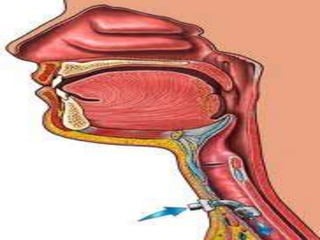
CRICOTHYROIDOTOMY
/TRACHEOSTOMY
Introduction
 Cricothyroidotomy, also known as cricothyrotomy,
is an emergency procedure
 It is used to obtain an airway when other methods
(eg, laryngeal mask airway [LMA] and
endotracheal intubation) are ineffective or
contraindicated.
Cont…
 Establishing an effective airway in the face of
medical emergencies is a skill that healthcare
providers must master to prevent patient
morbidity or mortality.
Indications
Cricothyroidotomy is indicated upon failure to
obtain an airway with traditional methods in the
following situations:
 Trauma causing oral, pharyngeal, or nasal
hemorrhage
 Facial muscle spasms or laryngospasm
 Uncontrollable emesis
 Upper airway stenosis or congenital deformities
 Clenched teeth
 Tumor, cancer, or another disease process or
trauma causing mass effect
Cont…
Airway obstruction indications include the
following:
 Oropharyngeal edema (eg, anaphylaxis)
 Foreign body obstruction
The following are relative indications for
cricothyroidotomy:
Cont…
 Cervical spine immobilization secondary to injury
 Maxillofacial injuries
Non emergent indications include the following:
 Prolonged intubation
 Maxillofacial, laryngeal, or oral surgery
 Bronchoscopy
Contraindications
 The only absolute contraindication to surgical
cricothyroidotomy is age.
 However, the exact age at which a surgical
cricothyrotomy can be safely performed is
controversial and has not been well defined.
Cont…
 Lower age limits for Cricothyrotomy is 12 years
 In patients below this cut off age, needle
cricothyrotomy is indicated because infants and
children younger than 12 years have a smaller
cricothyroid membrane and a more funnel-
shaped, rostral, and compliant larynx
Technical considerations
 A permanent tracheostomy should be placed
within 24 hours.
 Needle cricothyrotomy can be used for
approximately 40 minutes, after which time
carbon dioxide accumulates
Fig 2.
Cont…
 The success rate for cricothyrotomy has been
similarly high (89%-100%) whether in the field or
in the ED
Technique consideration
 There are 3 main approaches to
cricothyroidotomy:
1. Needle cricothyroidotomy
2. Percutaneous cricothyroidotomy using the
Seldinger technique and
3. Surgical cricothyroidotomy
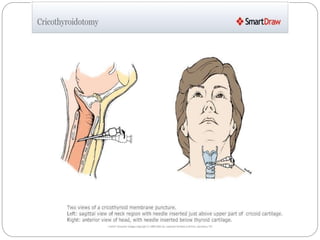
Needle Cricothyroidotomy
 Needle cricothyroidotomy may be divided into the
following steps:
1. Position the patient, apply lidocaine (if indicated),
and prepare a sterile field, including cleansing
with antiseptic solution.
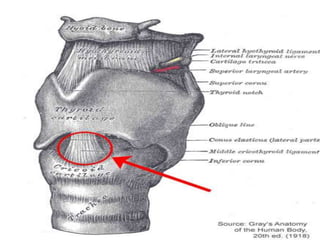
2. Identify anatomic landmarks. Palpate the thyroid
cartilage (the first prominent landmark on the
anterior neck), the cricoid cartilage (caudal to the
thyroid cartilage), and the area between them,
which is the cricothyroid space that contains the
membrane.
Cont…
3. With the dominant hand, insert the angiographic
catheter, attached to the syringe filled with normal
saline, into the cricothyroid membrane, directing it
caudally at a 45o angle.
4. As the needle is advanced, apply negative
pressure to the syringe. A distinct pop can be felt
as the needle traverses the membrane and
enters the trachea. In addition, air bubbles will
appear in the fluid-filled syringe.
Cricothyroidotomy (Seldinger
Technique)
Percutaneous cricothyroidotomy using the
Seldinger technique may be divided into the
following steps:
1. Follow steps 1-4 from needle cricothyroidotomy
substituting a finder needle attached to a syringe
for the angiographic catheter.
2. Remove the syringe from the needle, and
advance the guide wire through the needle.
Remove the needle once the guide wire is in
place.
Cont…
3. Use the scalpel to make a small stab incision in
the skin close to the guide wire.
4. Place the dilator into the airway catheter, and
insert the 2 devices together over the wire.
5. Remove both the dilator and the guide wire once
the airway tube is secured in the trachea.
6. Secure the tube in place with appropriate tape.
Complications
Early complications of cricothyroidotomy may include
the following:
 Bleeding
 Incorrect placement, resulting in possible creation of a
false passage through tissue
 Subcutaneous emphysema
 Obstruction
 Esophageal or mediastinal perforation
 Aspiration
 Vocal cord injury
 Pneumothorax
Cont…
 Laryngeal injury
 Posterior tracheal wall perforation
 Thyroid perforation
 Hypercarbia (needle cricothyroidotomy)
Cont…
Late complications of cricothyroidotomy may include
the following:
 Dysphonia
 Infections
 Hematoma
 Persistent stoma
 Scarring
 Glottic or subglottic stenosis
 Laryngeal stenosis
 Tracheoesophageal fistula
 Tracheomalacia
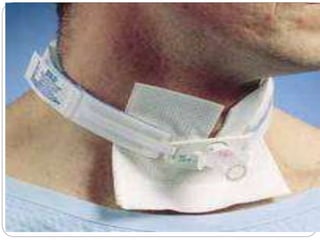
TRACHEOSTOMY
(TRACHEOTOMY)
 Tracheostomy is a surgical opening in the trachea
(windpipe) that forms a temporary or permanent
opening to make breathing easier.
 The terms "tracheotomy" and "tracheostomy" are
used interchangeably
The opening is called a stoma.
 Emergency tracheostomy is performed as a
lifesaving procedure
Indications
 Tracheostomy is done only in those cases in which
intubation by a mouth or nasal tube is not a feasible
option.
 There are broadly four groups of patients on whom
tracheostomy needs to be performed:
1. To relieve breathing difficulties by any blockage in the
airway passages for example-
· Foreign body Impactation in the airways.
· Acute infection of the airways
· Edema of the airways
· Paralysis of vocal cords following injury
· Tumors of the vocal cords
· Trauma in the region
Cont…
2. To improve respiratory functions by reducing the
length of the airway, which may be required in
special lung conditions like-
- Bronchopneumonia
· Bronchitis with Emphysema
· Chest injury
In these conditions the tracheostomy tube also
helps in aspiration of excessive secretion that
may be caused due to infection or injury
Cont…
3. Respiratory nerve damage temporary or permanent
causing paralysis of chest muscles that assist in
breathing. In these situations performing assisted or
positive pressure respirations may be required in
conditions like-
· Unconsciousness associated with head injuries
· Barbiturate poisoning
· Poliomyelitis
· Tetanus
These patients may also aspirate their gastric content
into the lungs and a tracheostomy tube may be
helpful for aspiration these secretions.
Cont…
4. As a preliminary step in certain surgeries on the
upper airway.
Advantages of tracheostomy
- Reduces patient discomfort
· Reduces need for sedation
· Improves ability to maintain oral and bronchial
hygiene
· Reduces risk of trauma to the windpipe and
trachea
· Makes breathing easier with less effort for a sick
patient
· Easier to move off assisted breathing using a
ventilator.
Procedure
 The patient is made to lie down on their back with the
neck & head extended by keeping a pillow under the
shoulder and neck.
 Local anaesthesia or general anaesthesia is used for
the procedure.
 A horizontal cut is made across the neck above the
'sternal notch' using a knife.
 The skin is separated and surrounding tissues are
dissected to expose the trachea.
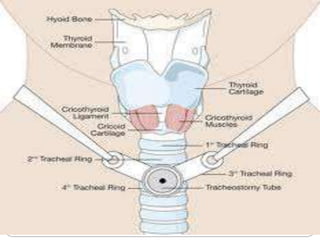
 The 2nd or 3rd of the tracheal ring is incised for the
tracheostomy tube to be placed.
Cont…
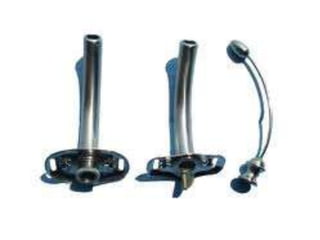
 A suitable size tracheostomy tube is then
introduced inside.
 While choosing the tube, the smallest feasible
tube should be used.
 A general rule is that the tube should be three
fourths of the diameter of the trachea.
 The cuff of the tube is inflated by using 2-5 ml of
air and it is held in place by using a necktie.
 The incision is closed using skin sutures by the
side of the tracheostomy tube.
 Dressing is applied for the wound to heal.
Complications
Common complications with tracheostomy are-
 Wound infections
 Air leakage
 Improper air entry
 Tracheal ring narrowing or Stenosis (usually with
high tracheostomy)
 Ulceration of the trachea or main bronchi
 Entrapment of air under the skin (called surgical
emphysema), this is a self-limiting condition that
resolves spontaneously.
Fig 1.
Fig 2.
Fig. 3
Fig 4.

Lecture 30. CRICOTHYROIDOTOMY.pptxzbendj

  • 1.
  • 2.
    Introduction  Cricothyroidotomy, alsoknown as cricothyrotomy, is an emergency procedure  It is used to obtain an airway when other methods (eg, laryngeal mask airway [LMA] and endotracheal intubation) are ineffective or contraindicated.
  • 3.
    Cont…  Establishing aneffective airway in the face of medical emergencies is a skill that healthcare providers must master to prevent patient morbidity or mortality.
  • 4.
    Indications Cricothyroidotomy is indicatedupon failure to obtain an airway with traditional methods in the following situations:  Trauma causing oral, pharyngeal, or nasal hemorrhage  Facial muscle spasms or laryngospasm  Uncontrollable emesis  Upper airway stenosis or congenital deformities  Clenched teeth  Tumor, cancer, or another disease process or trauma causing mass effect
  • 5.
    Cont… Airway obstruction indicationsinclude the following:  Oropharyngeal edema (eg, anaphylaxis)  Foreign body obstruction The following are relative indications for cricothyroidotomy:
  • 6.
    Cont…  Cervical spineimmobilization secondary to injury  Maxillofacial injuries Non emergent indications include the following:  Prolonged intubation  Maxillofacial, laryngeal, or oral surgery  Bronchoscopy
  • 7.
    Contraindications  The onlyabsolute contraindication to surgical cricothyroidotomy is age.  However, the exact age at which a surgical cricothyrotomy can be safely performed is controversial and has not been well defined.
  • 8.
    Cont…  Lower agelimits for Cricothyrotomy is 12 years  In patients below this cut off age, needle cricothyrotomy is indicated because infants and children younger than 12 years have a smaller cricothyroid membrane and a more funnel- shaped, rostral, and compliant larynx
  • 9.
    Technical considerations  Apermanent tracheostomy should be placed within 24 hours.  Needle cricothyrotomy can be used for approximately 40 minutes, after which time carbon dioxide accumulates
  • 11.
  • 12.
    Cont…  The successrate for cricothyrotomy has been similarly high (89%-100%) whether in the field or in the ED
  • 13.
    Technique consideration  Thereare 3 main approaches to cricothyroidotomy: 1. Needle cricothyroidotomy 2. Percutaneous cricothyroidotomy using the Seldinger technique and 3. Surgical cricothyroidotomy
  • 14.
    Needle Cricothyroidotomy  Needlecricothyroidotomy may be divided into the following steps: 1. Position the patient, apply lidocaine (if indicated), and prepare a sterile field, including cleansing with antiseptic solution. 2. Identify anatomic landmarks. Palpate the thyroid cartilage (the first prominent landmark on the anterior neck), the cricoid cartilage (caudal to the thyroid cartilage), and the area between them, which is the cricothyroid space that contains the membrane.
  • 15.
    Cont… 3. With thedominant hand, insert the angiographic catheter, attached to the syringe filled with normal saline, into the cricothyroid membrane, directing it caudally at a 45o angle. 4. As the needle is advanced, apply negative pressure to the syringe. A distinct pop can be felt as the needle traverses the membrane and enters the trachea. In addition, air bubbles will appear in the fluid-filled syringe.
  • 16.
    Cricothyroidotomy (Seldinger Technique) Percutaneous cricothyroidotomyusing the Seldinger technique may be divided into the following steps: 1. Follow steps 1-4 from needle cricothyroidotomy substituting a finder needle attached to a syringe for the angiographic catheter. 2. Remove the syringe from the needle, and advance the guide wire through the needle. Remove the needle once the guide wire is in place.
  • 17.
    Cont… 3. Use thescalpel to make a small stab incision in the skin close to the guide wire. 4. Place the dilator into the airway catheter, and insert the 2 devices together over the wire. 5. Remove both the dilator and the guide wire once the airway tube is secured in the trachea. 6. Secure the tube in place with appropriate tape.
  • 18.
    Complications Early complications ofcricothyroidotomy may include the following:  Bleeding  Incorrect placement, resulting in possible creation of a false passage through tissue  Subcutaneous emphysema  Obstruction  Esophageal or mediastinal perforation  Aspiration  Vocal cord injury  Pneumothorax
  • 19.
    Cont…  Laryngeal injury Posterior tracheal wall perforation  Thyroid perforation  Hypercarbia (needle cricothyroidotomy)
  • 20.
    Cont… Late complications ofcricothyroidotomy may include the following:  Dysphonia  Infections  Hematoma  Persistent stoma  Scarring  Glottic or subglottic stenosis  Laryngeal stenosis  Tracheoesophageal fistula  Tracheomalacia
  • 21.
    TRACHEOSTOMY (TRACHEOTOMY)  Tracheostomy isa surgical opening in the trachea (windpipe) that forms a temporary or permanent opening to make breathing easier.  The terms "tracheotomy" and "tracheostomy" are used interchangeably The opening is called a stoma.  Emergency tracheostomy is performed as a lifesaving procedure
  • 22.
    Indications  Tracheostomy isdone only in those cases in which intubation by a mouth or nasal tube is not a feasible option.  There are broadly four groups of patients on whom tracheostomy needs to be performed: 1. To relieve breathing difficulties by any blockage in the airway passages for example- · Foreign body Impactation in the airways. · Acute infection of the airways · Edema of the airways · Paralysis of vocal cords following injury · Tumors of the vocal cords · Trauma in the region
  • 23.
    Cont… 2. To improverespiratory functions by reducing the length of the airway, which may be required in special lung conditions like- - Bronchopneumonia · Bronchitis with Emphysema · Chest injury In these conditions the tracheostomy tube also helps in aspiration of excessive secretion that may be caused due to infection or injury
  • 24.
    Cont… 3. Respiratory nervedamage temporary or permanent causing paralysis of chest muscles that assist in breathing. In these situations performing assisted or positive pressure respirations may be required in conditions like- · Unconsciousness associated with head injuries · Barbiturate poisoning · Poliomyelitis · Tetanus These patients may also aspirate their gastric content into the lungs and a tracheostomy tube may be helpful for aspiration these secretions.
  • 25.
    Cont… 4. As apreliminary step in certain surgeries on the upper airway.
  • 26.
    Advantages of tracheostomy -Reduces patient discomfort · Reduces need for sedation · Improves ability to maintain oral and bronchial hygiene · Reduces risk of trauma to the windpipe and trachea · Makes breathing easier with less effort for a sick patient · Easier to move off assisted breathing using a ventilator.
  • 27.
    Procedure  The patientis made to lie down on their back with the neck & head extended by keeping a pillow under the shoulder and neck.  Local anaesthesia or general anaesthesia is used for the procedure.  A horizontal cut is made across the neck above the 'sternal notch' using a knife.  The skin is separated and surrounding tissues are dissected to expose the trachea.  The 2nd or 3rd of the tracheal ring is incised for the tracheostomy tube to be placed.
  • 28.
    Cont…  A suitablesize tracheostomy tube is then introduced inside.  While choosing the tube, the smallest feasible tube should be used.  A general rule is that the tube should be three fourths of the diameter of the trachea.  The cuff of the tube is inflated by using 2-5 ml of air and it is held in place by using a necktie.  The incision is closed using skin sutures by the side of the tracheostomy tube.  Dressing is applied for the wound to heal.
  • 29.
    Complications Common complications withtracheostomy are-  Wound infections  Air leakage  Improper air entry  Tracheal ring narrowing or Stenosis (usually with high tracheostomy)  Ulceration of the trachea or main bronchi  Entrapment of air under the skin (called surgical emphysema), this is a self-limiting condition that resolves spontaneously.
  • 30.
  • 31.
  • 32.
  • 33.