Tracheostomy
DR. ISA BASUKI
DEPARTMENT OF SURGERY AWS GENERAL HOSPITAL
FACULTY OF MEDICINE MULAWARMAN UNIVERSITY
Etymology and terminology



tracheotomy comes from two Greek words
the root tom- (from Greek τομή) meaning "to cut“



the word trachea (Greek τραχεία)



Tracheostomy meaning "mouth," refers to the making of
a semi-permanent or permanent opening, and to the
opening itself



Definition: surgical procedure to bypass the airway in
the patient with upper airway obstruction, to make
tracheobronchial toliet easier in the patient with
decreased consciousness or for need of ventilator
installation
Indicaton: General
to bypass an obstructed upper
airway;
2. to clean and remove secretions from
the airway;
3. to more easily, and usually more
safely, deliver oxygen to the lungs.
1.
Indications: Spesific
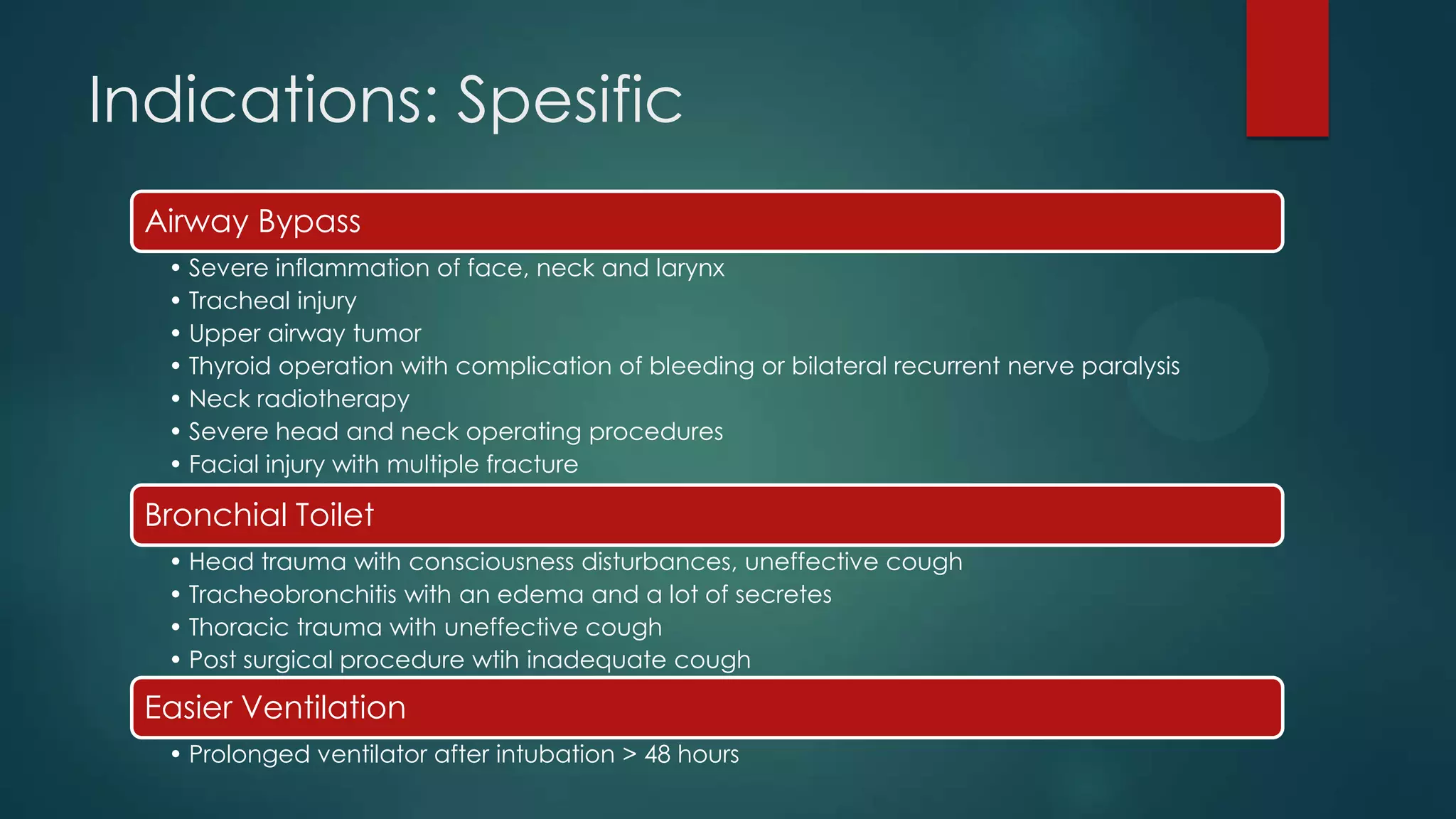
Airway Bypass
• Severe inflammation of face, neck and larynx
• Tracheal injury
• Upper airway tumor
• Thyroid operation with complication of bleeding or bilateral recurrent nerve paralysis
• Neck radiotherapy
• Severe head and neck operating procedures
• Facial injury with multiple fracture

Bronchial Toilet
• Head trauma with consciousness disturbances, uneffective cough
• Tracheobronchitis with an edema and a lot of secretes
• Thoracic trauma with uneffective cough
• Post surgical procedure wtih inadequate cough

Easier Ventilation
• Prolonged ventilator after intubation > 48 hours
Contraindication

No

contraindication
especially for
emergency case
Differential Diagnosis

For

upper airway
obstruction:
Pneumonia

Acidosis
Radiologic Examination
X-ray

of the neck AP/Lateral
Anatomy of the Neck
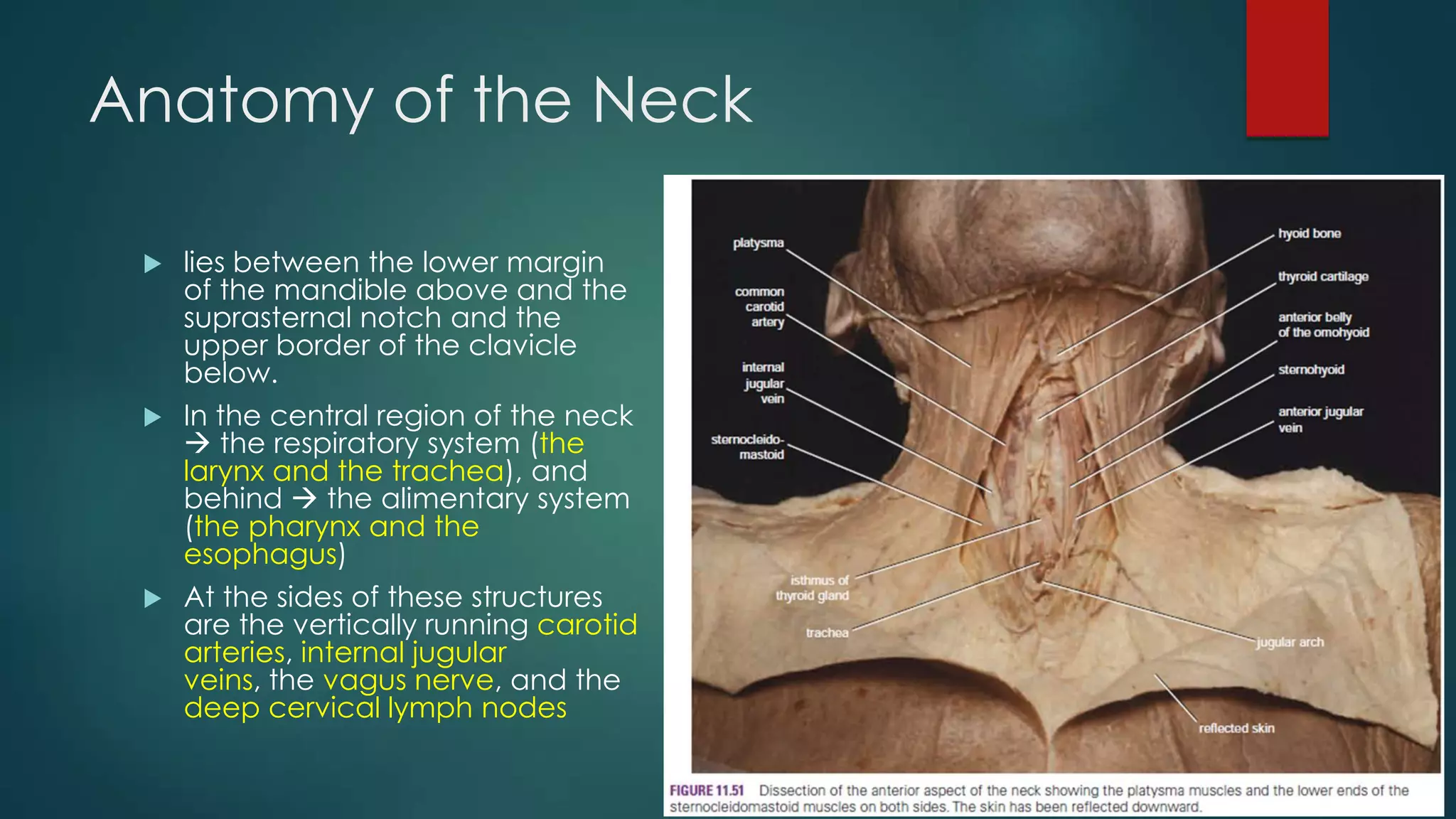
lies between the lower margin
of the mandible above and the
suprasternal notch and the
upper border of the clavicle
below.
 In the central region of the neck
 the respiratory system (the
larynx and the trachea), and
behind  the alimentary system
(the pharynx and the
esophagus)
 At the sides of these structures
are the vertically running carotid
arteries, internal jugular
veins, the vagus nerve, and the
deep cervical lymph nodes

Cont’d


Superficial Fascia





thin layer that encloses the platysma
muscle
embedded in it are the cutaneous
nerves, the superficial veins, and the
superficial lymph nodes

Platysma




a thin but clinically important
muscular sheet embedded in the
superficial fascia

Superficial Veins


External Jugular Vein



Tributaries



Anterior Jugular Vein
Cont’d


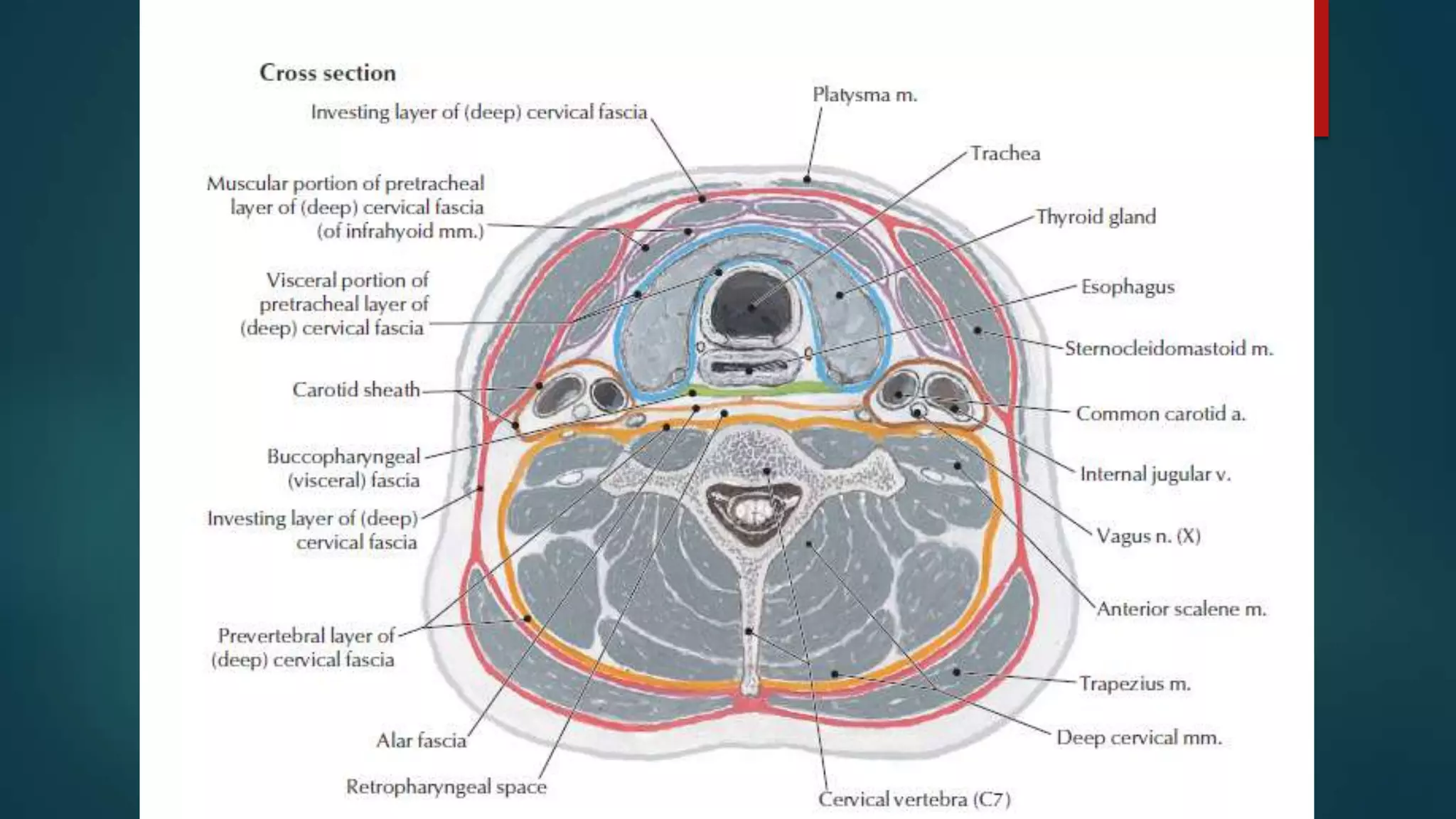
Deep Cervical Fascia


Investing Layer




Pretracheal Layer




thin layer that is attached above to the laryngeal cartilages surrounds the thyroid
and the parathyroid glands and encloses the infrahyoid muscles

Prevertebral Layer




thick layer that encircles the neck, splits to enclose the trapezius and the
sternocleidomastoid muscles

thick layer that passes like a septum across the neck behind the pharynx and the
esophagus and in front of the prevertebral muscles and the vertebral column

Carotid Sheath


local condensation of the prevertebral, the pretracheal, and the investing layers
of the deep fascia that surround the common and internal carotid arteries, the
internal jugular vein, the vagus nerve, and the deep cervical lymph nodes
SURGICAL ANATOMY
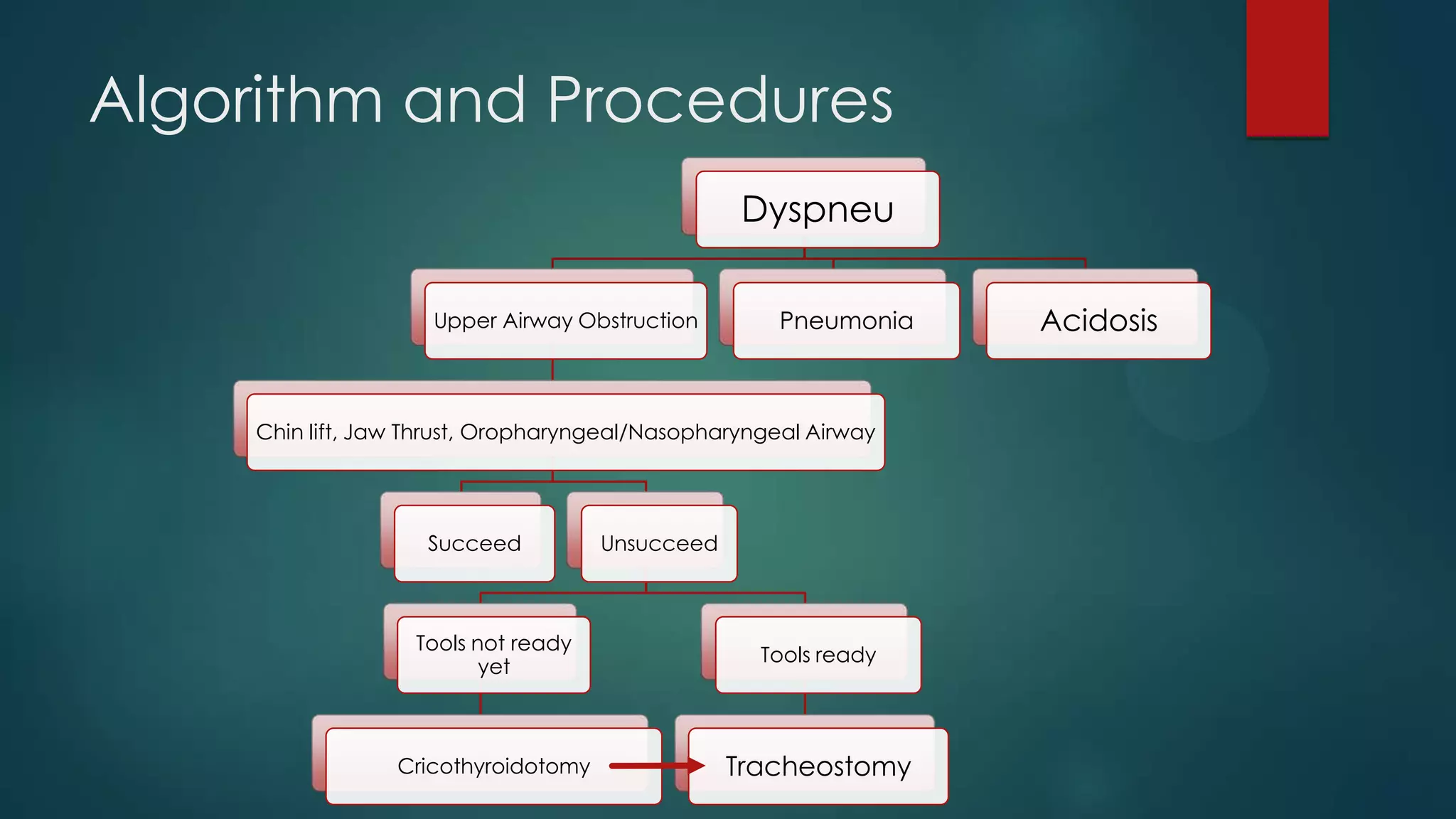
Algorithm and Procedures
Dyspneu
Upper Airway Obstruction

Pneumonia

Chin lift, Jaw Thrust, Oropharyngeal/Nasopharyngeal Airway

Succeed

Unsucceed

Tools not ready
yet

Tools ready

Cricothyroidotomy

Tracheostomy

Acidosis
Pre Operative


Informed consent  explain about:


Operating procedures



Loss of voices when tracheostomy canule still in the trachea



Complication of operation



Should be done in the operating theatre as much as
possible



Adequate lightning



One assistant required



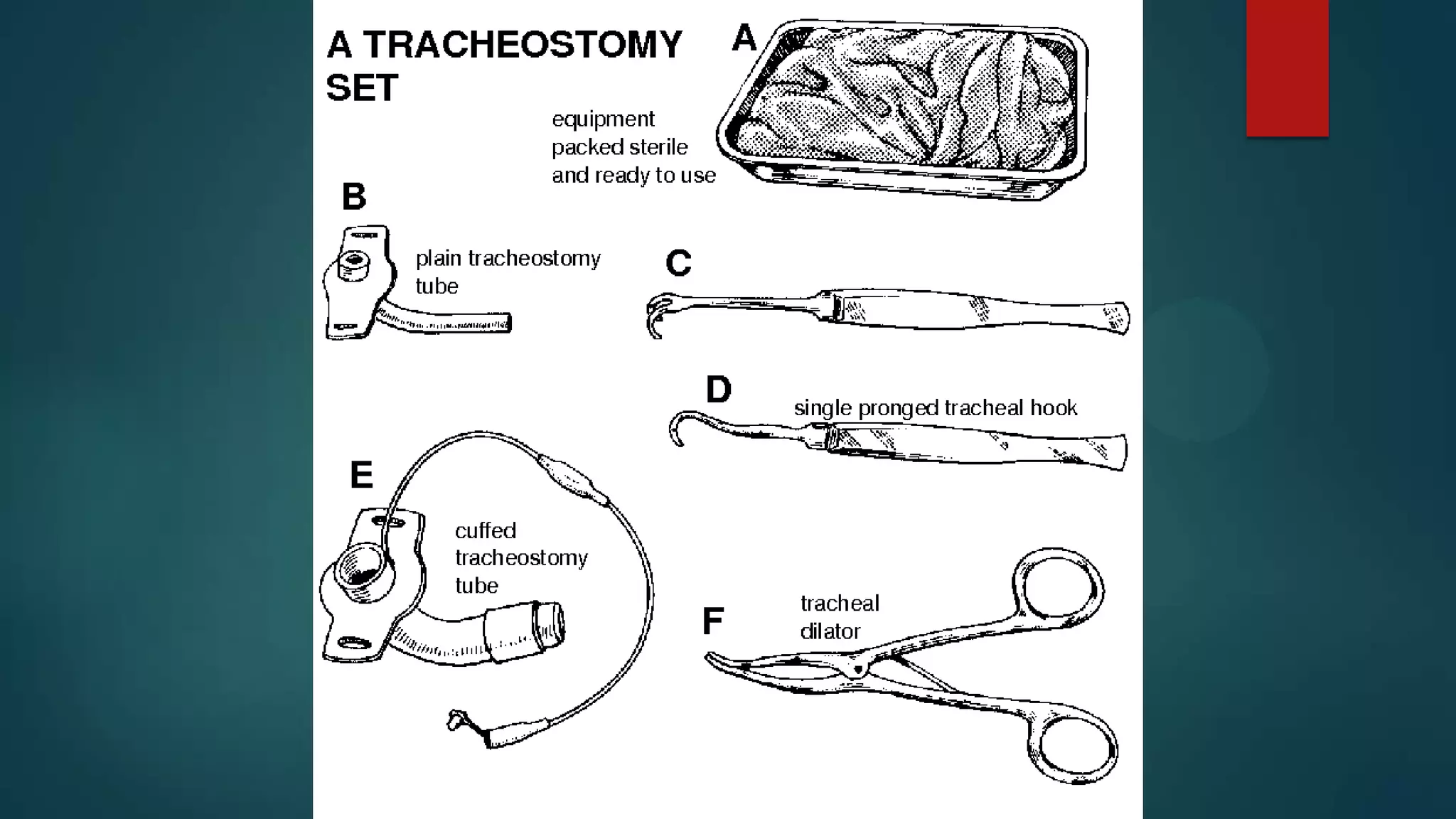
Tracheostomy set
Cont’d
Plastic or metal canule preparation
 Prophylactic antibiotic: Cefazolin or combination of
Clindamycin and Garamycin
 Anaesthetic preparation:








Local or general anasthesia  local anasthesia with lidocain
(max dose 7 mg/kgBW)

Patient’s position is supine with hyperextension of the
head  give a cushion below the shoulder  trachea
will be exposed to the anterior
Give the head a “doughnut” cushion
Types of Tracheostomy Tubes

Cuffed Tube with
Disposable Inner
Cannula

Cuffed Tube with
Reusable Inner
Cannula

Cuffless Tube with
Disposable Inner
Cannula

Used to obtain a closed circuit
for ventilation

Used to obtain a closed circuit
for ventilation

Used for patients with tracheal
problems

Used for patients who are
ready for decannulation
Cont’d

Cuffed Tube with
Reusable Inner
Cannula
Used for patients with tracheal
problems
Used for patients who are
ready for decannulation

Fenestrated
Cuffed
Tracheostomy
Tube

Fenestrated
Cuffless
Tracheostomy
Tube

Used for patients who are on
the ventilator but are not able
to tolerate a speaking valve to
speak

Used for patients who have
difficulty using a speaking valve
Cont’d

Metal
Tracheostomy
Tube
Not used as frequently
anymore. Many of the patients
who received a tracheostomy
years ago still choose to
continue using the metal
tracheostomy tubes.
Steps of Procedures
1.

Desinfection with povidone - iodine 10% or with Hibitane – alcohol
70% at operating area (from lower lips – chin – neck until ICS 2, left
and right until the anterior border of trapezius muscle)

2.

Operation area is narrowed by sterile linen

3.

Identification of trachea with palpation, starting from thyroid
cartilage to jugular notch

4.

Perform a local anasthesia with lidocain 1% or 2% injection
subcutaneously

5.

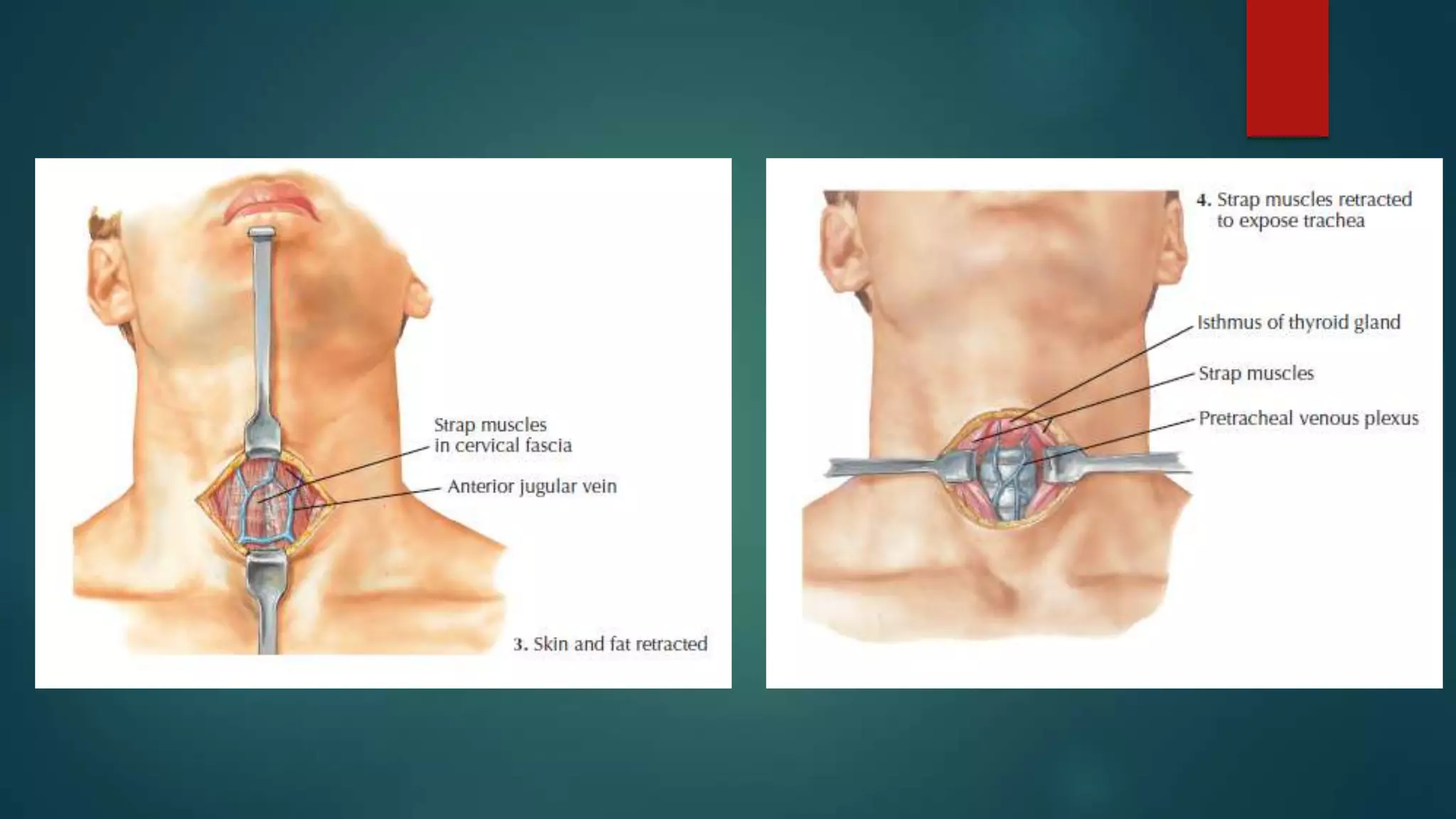
Vertical incision 3-4 cm (emergency case) or horizontal or collar
incision (elective case), incision is deepened by cutting subcutis,
fascia of neck superficial at the midline on the incision site
Cont’d
6.

Hemostasis

7.

Put Langenbeck to the left and the right, balanced traction to
mantain trachea in the midline. If theisthmus of the thyroid gland
stand in the way, set aside the isthmus to the caudal and hold it
with blunt hook. Identification of trachea, put sharp-one-tooth
hook between cricoid and 1st tracheal ring

8.

Tracheal ring was cut vertically using No. 11 knife blade with a
sharp edge facing up and direction of the incision to the cranial
(2nd – 3rd ring for high tracheostomy; 4th – 5th ring for low
tracheostomy)
Cont’d
9.

Trachea maintained open with a blunt tooth hooks on the right
and left side, clean the existing secretions by using a suction
cannula and alternating with oxygenation

10.

secretions were taken for culture and sensitivity test (for diphteria
patients)

11.

Insert the cannula tracheostomy carefully, at the time of inserting
the tip, position of the axis perpendicular to the tracheal
cannula, after entering surely turn the direction parallel to the axis
of the trachea, proceed to thrust according the curve of cannula
tracheostomy into the lumen of the trachea.
Cont’d
12.

check cannula into the lumen of the trachea, feel the breath of
the hole cannula tracheostomy, or use the end of the string that
vibrates at the blast of breath

13.

the whole latch is released, assistant hold the cannula, cannula is
fixed with sutures at the right and left lobes of cannula to the skin of
the neck and installing a ribbon strap around the neck.

14.

If the incision is too wide, skin is sutured loosely (don’t be too tight:
can cause skin emphysem)

15.

Between cannula lobes and skin, put a sterile gauze cushion
Video
Complication


Intraoperative


Bleeding



Reccurent laryngela nerve injury  small risk



Pneumothorax



Cricoid cartilage injury



Esophageal perforation



Tracheoesophageal fistula



Vocal cord injury
Complication


Post Operative


Early



Bleeding,



Infection at operation site,





Impaired swallowing function because of tracheostomy cuff

Subcutaneous emphysema,

Late


Granuloma



Tracheoesophageal fistula



Tracheocutaneous fistula



Laryngotracheal stenosis
Post Operative Management


Observation for the first 24 hours



Treatment for primary disease



Tracheostomy cannula management:


Suction of the secrete / hour



Cleanse the smaller cannula / 6 hours



Nebulizer with warm air for 15 minutes /6 hours



Treat tracheostomy wound with gauze replacement every treatment
References


Boldenham A, Whiteley S. Respiratory Emergencies. In Ellis BW, Brown
SP eds. Hamilton Bailey’s Emergency Surgery 13th ed. Varghese Co.
2000, 43 – 45.



Shires GT, Thal ER, Jones RC. Trauma in Principle of Surgery Schwartz
8th ed. McGraw Hill Inc. 2005, 338 – 339



Cobb JP. Critical care: a system – oriented approach. In Norton ed.
Surgery Basic Science and Clinical Evidence. Springer, 2001, 282



Zollinger, J.R., Ellison, E., 2010. Zollinger’s Atlas of Surgical
Operations, Ninth Edition, 9th ed. McGraw Hill Professional.
Thank You

Tracheostomy Operating Technique

  • 1.
    Tracheostomy DR. ISA BASUKI DEPARTMENTOF SURGERY AWS GENERAL HOSPITAL FACULTY OF MEDICINE MULAWARMAN UNIVERSITY
  • 2.
    Etymology and terminology   tracheotomycomes from two Greek words the root tom- (from Greek τομή) meaning "to cut“  the word trachea (Greek τραχεία)  Tracheostomy meaning "mouth," refers to the making of a semi-permanent or permanent opening, and to the opening itself  Definition: surgical procedure to bypass the airway in the patient with upper airway obstruction, to make tracheobronchial toliet easier in the patient with decreased consciousness or for need of ventilator installation
  • 3.
    Indicaton: General to bypassan obstructed upper airway; 2. to clean and remove secretions from the airway; 3. to more easily, and usually more safely, deliver oxygen to the lungs. 1.
  • 4.
    Indications: Spesific Airway Bypass •Severe inflammation of face, neck and larynx • Tracheal injury • Upper airway tumor • Thyroid operation with complication of bleeding or bilateral recurrent nerve paralysis • Neck radiotherapy • Severe head and neck operating procedures • Facial injury with multiple fracture Bronchial Toilet • Head trauma with consciousness disturbances, uneffective cough • Tracheobronchitis with an edema and a lot of secretes • Thoracic trauma with uneffective cough • Post surgical procedure wtih inadequate cough Easier Ventilation • Prolonged ventilator after intubation > 48 hours
  • 5.
  • 6.
  • 7.
  • 8.
    Anatomy of theNeck lies between the lower margin of the mandible above and the suprasternal notch and the upper border of the clavicle below.  In the central region of the neck  the respiratory system (the larynx and the trachea), and behind  the alimentary system (the pharynx and the esophagus)  At the sides of these structures are the vertically running carotid arteries, internal jugular veins, the vagus nerve, and the deep cervical lymph nodes 
  • 9.
    Cont’d  Superficial Fascia    thin layerthat encloses the platysma muscle embedded in it are the cutaneous nerves, the superficial veins, and the superficial lymph nodes Platysma   a thin but clinically important muscular sheet embedded in the superficial fascia Superficial Veins  External Jugular Vein  Tributaries  Anterior Jugular Vein
  • 10.
    Cont’d  Deep Cervical Fascia  InvestingLayer   Pretracheal Layer   thin layer that is attached above to the laryngeal cartilages surrounds the thyroid and the parathyroid glands and encloses the infrahyoid muscles Prevertebral Layer   thick layer that encircles the neck, splits to enclose the trapezius and the sternocleidomastoid muscles thick layer that passes like a septum across the neck behind the pharynx and the esophagus and in front of the prevertebral muscles and the vertebral column Carotid Sheath  local condensation of the prevertebral, the pretracheal, and the investing layers of the deep fascia that surround the common and internal carotid arteries, the internal jugular vein, the vagus nerve, and the deep cervical lymph nodes
  • 12.
  • 13.
    Algorithm and Procedures Dyspneu UpperAirway Obstruction Pneumonia Chin lift, Jaw Thrust, Oropharyngeal/Nasopharyngeal Airway Succeed Unsucceed Tools not ready yet Tools ready Cricothyroidotomy Tracheostomy Acidosis
  • 14.
    Pre Operative  Informed consent explain about:  Operating procedures  Loss of voices when tracheostomy canule still in the trachea  Complication of operation  Should be done in the operating theatre as much as possible  Adequate lightning  One assistant required  Tracheostomy set
  • 15.
    Cont’d Plastic or metalcanule preparation  Prophylactic antibiotic: Cefazolin or combination of Clindamycin and Garamycin  Anaesthetic preparation:     Local or general anasthesia  local anasthesia with lidocain (max dose 7 mg/kgBW) Patient’s position is supine with hyperextension of the head  give a cushion below the shoulder  trachea will be exposed to the anterior Give the head a “doughnut” cushion
  • 18.
    Types of TracheostomyTubes Cuffed Tube with Disposable Inner Cannula Cuffed Tube with Reusable Inner Cannula Cuffless Tube with Disposable Inner Cannula Used to obtain a closed circuit for ventilation Used to obtain a closed circuit for ventilation Used for patients with tracheal problems Used for patients who are ready for decannulation
  • 19.
    Cont’d Cuffed Tube with ReusableInner Cannula Used for patients with tracheal problems Used for patients who are ready for decannulation Fenestrated Cuffed Tracheostomy Tube Fenestrated Cuffless Tracheostomy Tube Used for patients who are on the ventilator but are not able to tolerate a speaking valve to speak Used for patients who have difficulty using a speaking valve
  • 20.
    Cont’d Metal Tracheostomy Tube Not used asfrequently anymore. Many of the patients who received a tracheostomy years ago still choose to continue using the metal tracheostomy tubes.
  • 21.
    Steps of Procedures 1. Desinfectionwith povidone - iodine 10% or with Hibitane – alcohol 70% at operating area (from lower lips – chin – neck until ICS 2, left and right until the anterior border of trapezius muscle) 2. Operation area is narrowed by sterile linen 3. Identification of trachea with palpation, starting from thyroid cartilage to jugular notch 4. Perform a local anasthesia with lidocain 1% or 2% injection subcutaneously 5. Vertical incision 3-4 cm (emergency case) or horizontal or collar incision (elective case), incision is deepened by cutting subcutis, fascia of neck superficial at the midline on the incision site
  • 23.
    Cont’d 6. Hemostasis 7. Put Langenbeck tothe left and the right, balanced traction to mantain trachea in the midline. If theisthmus of the thyroid gland stand in the way, set aside the isthmus to the caudal and hold it with blunt hook. Identification of trachea, put sharp-one-tooth hook between cricoid and 1st tracheal ring 8. Tracheal ring was cut vertically using No. 11 knife blade with a sharp edge facing up and direction of the incision to the cranial (2nd – 3rd ring for high tracheostomy; 4th – 5th ring for low tracheostomy)
  • 25.
    Cont’d 9. Trachea maintained openwith a blunt tooth hooks on the right and left side, clean the existing secretions by using a suction cannula and alternating with oxygenation 10. secretions were taken for culture and sensitivity test (for diphteria patients) 11. Insert the cannula tracheostomy carefully, at the time of inserting the tip, position of the axis perpendicular to the tracheal cannula, after entering surely turn the direction parallel to the axis of the trachea, proceed to thrust according the curve of cannula tracheostomy into the lumen of the trachea.
  • 26.
    Cont’d 12. check cannula intothe lumen of the trachea, feel the breath of the hole cannula tracheostomy, or use the end of the string that vibrates at the blast of breath 13. the whole latch is released, assistant hold the cannula, cannula is fixed with sutures at the right and left lobes of cannula to the skin of the neck and installing a ribbon strap around the neck. 14. If the incision is too wide, skin is sutured loosely (don’t be too tight: can cause skin emphysem) 15. Between cannula lobes and skin, put a sterile gauze cushion
  • 28.
  • 29.
    Complication  Intraoperative  Bleeding  Reccurent laryngela nerveinjury  small risk  Pneumothorax  Cricoid cartilage injury  Esophageal perforation  Tracheoesophageal fistula  Vocal cord injury
  • 30.
    Complication  Post Operative  Early   Bleeding,  Infection atoperation site,   Impaired swallowing function because of tracheostomy cuff Subcutaneous emphysema, Late  Granuloma  Tracheoesophageal fistula  Tracheocutaneous fistula  Laryngotracheal stenosis
  • 31.
    Post Operative Management  Observationfor the first 24 hours  Treatment for primary disease  Tracheostomy cannula management:  Suction of the secrete / hour  Cleanse the smaller cannula / 6 hours  Nebulizer with warm air for 15 minutes /6 hours  Treat tracheostomy wound with gauze replacement every treatment
  • 33.
    References  Boldenham A, WhiteleyS. Respiratory Emergencies. In Ellis BW, Brown SP eds. Hamilton Bailey’s Emergency Surgery 13th ed. Varghese Co. 2000, 43 – 45.  Shires GT, Thal ER, Jones RC. Trauma in Principle of Surgery Schwartz 8th ed. McGraw Hill Inc. 2005, 338 – 339  Cobb JP. Critical care: a system – oriented approach. In Norton ed. Surgery Basic Science and Clinical Evidence. Springer, 2001, 282  Zollinger, J.R., Ellison, E., 2010. Zollinger’s Atlas of Surgical Operations, Ninth Edition, 9th ed. McGraw Hill Professional.
  • 34.