Dr.Faten Abdo Hassan
Phylum : Sarcomastigophora
Subphylum : Mastigophora
Class : Kinetoplastidea
Order : Trypanosomatida
Family : Trypanosomatidae
Classification of Trypanosome
African Trypanosomiasis, also known as
"sleeping sickness” . - Caused by microscopic
parasites of the species Trypanosoma brucei. - It
is transmitted by the tsetse fly (Glossina
species), which is found only in rural Africa. - It
has been a serious public health problem in
some regions of sub-Saharan Africa. - The other
human form of trypanosomiasis, called Chagas
disease
Introduction
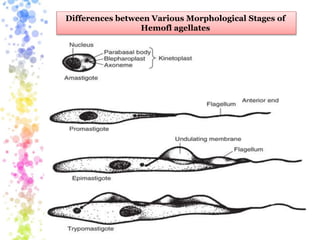
Differences between Various Morphological Stages of
Hemofl agellates
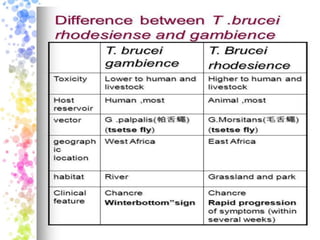
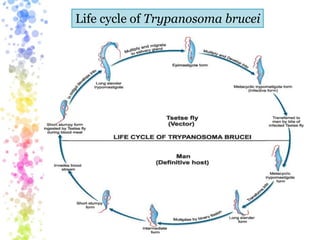
T. brucei gambiense passes its life cycle in 2 hosts.
Vertebrate host: Man, game animals, and other
domestic animals.
Invertebrate host: Tsetse fly.
Both male and female tsetse fly of Glossina species
(G. palpalis) are capable of transmitting the disease
to humans.
These flies dwell on the banks of shaded streams,
wooded savanna, and agricultural areas.
The principal vector of T. brucei rhodesiense is G.
morisitans, G. palpalis, and G. Swynnertoni, which
live in the open savannah countries.
Life cycle of Trypanosoma brucei
Infective form: Metacyclic trypomastigote
forms are infective to humans.
Mode of transmission:
By bite of tsetse fly
Congenital transmission has also been
recorded.
Reservoirs: Man is the only reservoir host,
although pigs and others domestic animals can
act as chronic asymptomatic carriers of the
parasite
Life cycle of Trypanosoma brucei
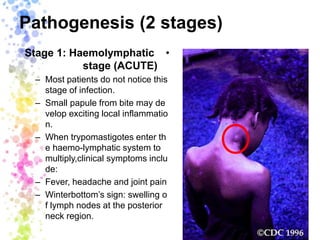
Pathogenesis (2 stages)
•Stage 1: Haemolymphatic
stage (ACUTE)
– Most patients do not notice this
stage of infection.
– Small papule from bite may de
velop exciting local inflammatio
n.
– When trypomastigotes enter th
e haemo-lymphatic system to
multiply,clinical symptoms inclu
de:
– Fever, headache and joint pain
– Winterbottom’s sign: swelling o
f lymph nodes at the posterior
neck region.
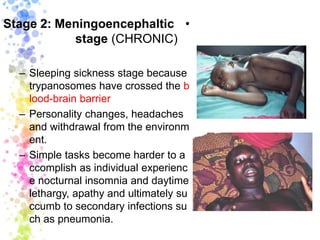
•Stage 2: Meningoencephaltic
stage (CHRONIC)
– Sleeping sickness stage because
trypanosomes have crossed the b
lood-brain barrier
– Personality changes, headaches
and withdrawal from the environm
ent.
– Simple tasks become harder to a
ccomplish as individual experienc
e nocturnal insomnia and daytime
lethargy, apathy and ultimately su
ccumb to secondary infections su
ch as pneumonia.
Control is based on early diagnosis and treatment
of cases to reduce the reservoir of infection.
Control of tsetse fl y population (most important
preventive measure) by wide spraying of insecticides,
traps, and baits impregnated with insecticides.
No vaccine is available.
Prophylaxis
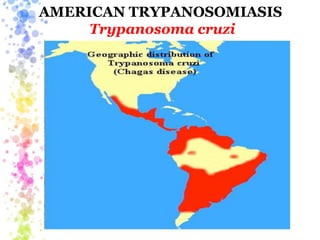
AMERICAN TRYPANOSOMIASIS
Trypanosoma cruzi
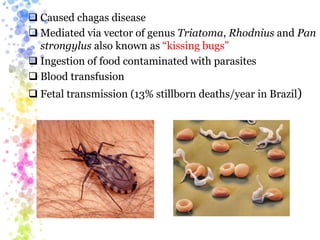
 Caused chagas disease
 Mediated via vector of genus Triatoma, Rhodnius and Pan
strongylus also known as “kissing bugs”
 Ingestion of food contaminated with parasites
 Blood transfusion
 Fetal transmission (13% stillborn deaths/year in Brazil)
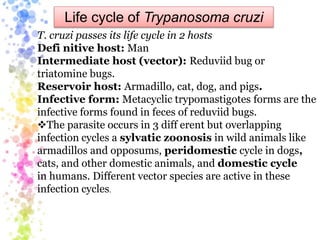
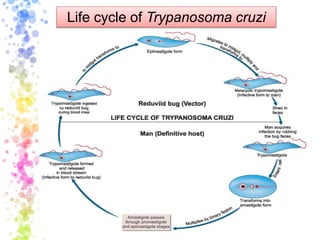
T. cruzi passes its life cycle in 2 hosts
Defi nitive host: Man
Intermediate host (vector): Reduviid bug or
triatomine bugs.
Reservoir host: Armadillo, cat, dog, and pigs.
Infective form: Metacyclic trypomastigotes forms are the
infective forms found in feces of reduviid bugs.
The parasite occurs in 3 diff erent but overlapping
infection cycles a sylvatic zoonosis in wild animals like
armadillos and opposums, peridomestic cycle in dogs,
cats, and other domestic animals, and domestic cycle
in humans. Different vector species are active in these
infection cycles.
Life cycle of Trypanosoma cruzi
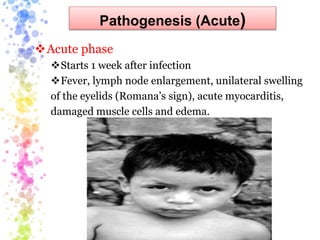
Pathogenesis (Acute)
Acute phase
Starts 1 week after infection
Fever, lymph node enlargement, unilateral swelling
of the eyelids (Romana’s sign), acute myocarditis,
damaged muscle cells and edema.
Pathogenesis (Chronic)
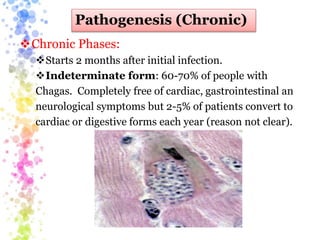
Chronic Phases:
Starts 2 months after initial infection.
Indeterminate form: 60-70% of people with
Chagas. Completely free of cardiac, gastrointestinal an
neurological symptoms but 2-5% of patients convert to
cardiac or digestive forms each year (reason not clear).
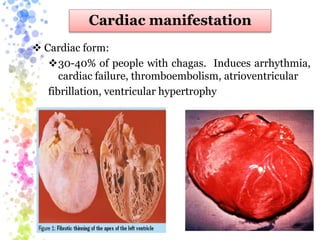
Cardiac manifestation
 Cardiac form:
30-40% of people with chagas. Induces arrhythmia,
cardiac failure, thromboembolism, atrioventricular
fibrillation, ventricular hypertrophy
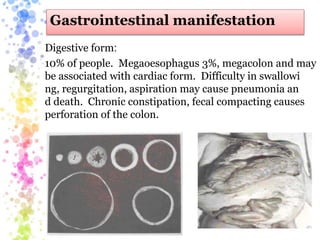
Gastrointestinal manifestation
Digestive form:
10% of people. Megaoesophagus 3%, megacolon and may
be associated with cardiac form. Difficulty in swallowi
ng, regurgitation, aspiration may cause pneumonia an
d death. Chronic constipation, fecal compacting causes
perforation of the colon.
Prevention
 Elimination of “kissing bug” environment with building
structures that discourage the bug’s habitation.
 Avoid pets in the home environment to limit attraction.
 Avoid building homes with palm roofs and cracks.
 Use of insecticides.
 Mechanical elimination of the vector (ie. squish it).
 Education.

Trypanosoma

  • 1.
  • 2.
    Phylum : Sarcomastigophora Subphylum: Mastigophora Class : Kinetoplastidea Order : Trypanosomatida Family : Trypanosomatidae Classification of Trypanosome
  • 3.
    African Trypanosomiasis, alsoknown as "sleeping sickness” . - Caused by microscopic parasites of the species Trypanosoma brucei. - It is transmitted by the tsetse fly (Glossina species), which is found only in rural Africa. - It has been a serious public health problem in some regions of sub-Saharan Africa. - The other human form of trypanosomiasis, called Chagas disease Introduction
  • 5.
    Differences between VariousMorphological Stages of Hemofl agellates
  • 6.
    T. brucei gambiensepasses its life cycle in 2 hosts. Vertebrate host: Man, game animals, and other domestic animals. Invertebrate host: Tsetse fly. Both male and female tsetse fly of Glossina species (G. palpalis) are capable of transmitting the disease to humans. These flies dwell on the banks of shaded streams, wooded savanna, and agricultural areas. The principal vector of T. brucei rhodesiense is G. morisitans, G. palpalis, and G. Swynnertoni, which live in the open savannah countries. Life cycle of Trypanosoma brucei
  • 7.
    Infective form: Metacyclictrypomastigote forms are infective to humans. Mode of transmission: By bite of tsetse fly Congenital transmission has also been recorded. Reservoirs: Man is the only reservoir host, although pigs and others domestic animals can act as chronic asymptomatic carriers of the parasite
  • 8.
    Life cycle ofTrypanosoma brucei
  • 9.
    Pathogenesis (2 stages) •Stage1: Haemolymphatic stage (ACUTE) – Most patients do not notice this stage of infection. – Small papule from bite may de velop exciting local inflammatio n. – When trypomastigotes enter th e haemo-lymphatic system to multiply,clinical symptoms inclu de: – Fever, headache and joint pain – Winterbottom’s sign: swelling o f lymph nodes at the posterior neck region.
  • 10.
    •Stage 2: Meningoencephaltic stage(CHRONIC) – Sleeping sickness stage because trypanosomes have crossed the b lood-brain barrier – Personality changes, headaches and withdrawal from the environm ent. – Simple tasks become harder to a ccomplish as individual experienc e nocturnal insomnia and daytime lethargy, apathy and ultimately su ccumb to secondary infections su ch as pneumonia.
  • 12.
    Control is basedon early diagnosis and treatment of cases to reduce the reservoir of infection. Control of tsetse fl y population (most important preventive measure) by wide spraying of insecticides, traps, and baits impregnated with insecticides. No vaccine is available. Prophylaxis
  • 13.
  • 14.
     Caused chagasdisease  Mediated via vector of genus Triatoma, Rhodnius and Pan strongylus also known as “kissing bugs”  Ingestion of food contaminated with parasites  Blood transfusion  Fetal transmission (13% stillborn deaths/year in Brazil)
  • 15.
    T. cruzi passesits life cycle in 2 hosts Defi nitive host: Man Intermediate host (vector): Reduviid bug or triatomine bugs. Reservoir host: Armadillo, cat, dog, and pigs. Infective form: Metacyclic trypomastigotes forms are the infective forms found in feces of reduviid bugs. The parasite occurs in 3 diff erent but overlapping infection cycles a sylvatic zoonosis in wild animals like armadillos and opposums, peridomestic cycle in dogs, cats, and other domestic animals, and domestic cycle in humans. Different vector species are active in these infection cycles. Life cycle of Trypanosoma cruzi
  • 16.
    Life cycle ofTrypanosoma cruzi
  • 17.
    Pathogenesis (Acute) Acute phase Starts1 week after infection Fever, lymph node enlargement, unilateral swelling of the eyelids (Romana’s sign), acute myocarditis, damaged muscle cells and edema.
  • 18.
    Pathogenesis (Chronic) Chronic Phases: Starts2 months after initial infection. Indeterminate form: 60-70% of people with Chagas. Completely free of cardiac, gastrointestinal an neurological symptoms but 2-5% of patients convert to cardiac or digestive forms each year (reason not clear).
  • 19.
    Cardiac manifestation  Cardiacform: 30-40% of people with chagas. Induces arrhythmia, cardiac failure, thromboembolism, atrioventricular fibrillation, ventricular hypertrophy
  • 20.
    Gastrointestinal manifestation Digestive form: 10%of people. Megaoesophagus 3%, megacolon and may be associated with cardiac form. Difficulty in swallowi ng, regurgitation, aspiration may cause pneumonia an d death. Chronic constipation, fecal compacting causes perforation of the colon.
  • 21.
    Prevention  Elimination of“kissing bug” environment with building structures that discourage the bug’s habitation.  Avoid pets in the home environment to limit attraction.  Avoid building homes with palm roofs and cracks.  Use of insecticides.  Mechanical elimination of the vector (ie. squish it).  Education.