HAEMOFLAGELLATES
SHILPA.K
MICROBIOLOGY TUTOR
AIMSRC
HAEMOFLAGELLATES
INTRODUCTION :
These are the flagellates lie in the blood or tissues of
man or animals as the definitive hosts.
• Kingdom: Protista
• Phylum: Sarcomastigophora
• Class: Zoomastigophora
• Order: Kinetoplastida
• Family: Trypanosomatidae
• Genus: Trypanosoma
• Species: brucei, cruzi, rangeli
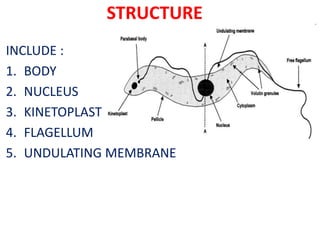
STRUCTURE
INCLUDE :
1. BODY
2. NUCLEUS
3. KINETOPLAST
4. FLAGELLUM
5. UNDULATING MEMBRANE
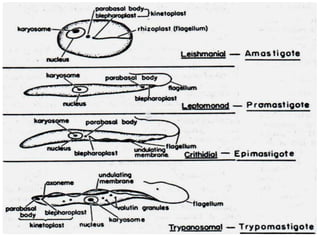
Developmental stages
2. Promastigote - elongated form
and kinetoplast anterior to
nucleus ; flagellum arising
near it and emerging from the
anterior end of body;
e.g. Leptomonas
1. Amastigote - rounded or oval
forms devoid of external flagellum;
e.g. Leishmania
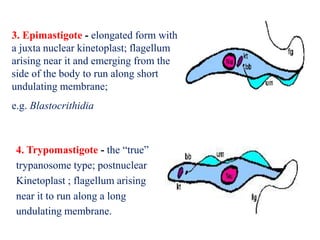
4. Trypomastigote - the “true”
trypanosome type; postnuclear
Kinetoplast ; flagellum arising
near it to run along a long
undulating membrane.
3. Epimastigote - elongated form with
a juxta nuclear kinetoplast; flagellum
arising near it and emerging from the
side of the body to run along short
undulating membrane;
e.g. Blastocrithidia
Generalized life cycle of the Trypanosoma spp
Pathogenesis
• T. brucei primarily invade the blood, lymph, and spinal fluid.
• The course of T. brucei infections depend on the susceptibility of the
animals involved.
• Horses, mules, and even dogs are acute sufferers and can die within 2
weeks of infection.
• Symptoms of the infection include: anemia, edema and fever.
• Cattle suffer the same kinds of symptoms but often live a few extra
months.
• Pigs can recover from the infection.
Trypanosomes
Salivarian trypanosomes
(African trypanosomiasis )
Stercorarian Trypanosomes
(South american trypanosomiasis)
Sleeping sickness Chag’s disease
West African
(Gambian)
East African
(Rhodesian)
1- Trypanosoma brucei gambiense (West African)
2- Trypanosoma brucei rhodesiense (East African)
• Definitive Host: Humans, Not
pathogenic to any other species.
Native ruminates serve as
reservoirs for T.b.rhodesiense , but
not T.b.gambiense.
• Intermediate Host: Tsetse fly
(Glossina)
• Mode of transmission: Bite of
infected tsetse fly.
Tsetse fly (Glossina)
Geographic Distribution
T. b. gambiense :
Found in west central
and central Africa.
T. b. rhodesiense :
Found in central and east
central Africa
T. b. gambiense
T. b. rhodesiense
1- Trypanosoma brucei gambiense (West African)
2- Trypanosoma brucei rhodesiense (East African)
• Location: Throughout the body in the blood and
tissues.
• Pathology: Both subspecies cause African Sleeping
Sickness.
T.b. gambiense causes chronic, long-term form.
T.b. rhodesiense causes an acute form.
• Starts with a small sore at bite.
• Trypimastigotes divide rapidly and spread
throughout body.
Life cycle of Trypanosoma brucei
Clinical Disease
Trypanosoma brucei gambiense (West African) :
• frequently goes to CNS
• Causes the chronic, sleepiness associated with African Sleeping
Sickness
• Apathy, mental dullness, disturbance of coordination
Increase in sleepiness, finally to coma, and death.
• Death may also occur from malnutrition, falling, or other
infections
• 2- Trypanosoma brucei rhodesiense (East African)
• rarely invade the CNS but causes death much faster.
Usually due to invasion of heart tissue
• Both subspecies produce intermittent periods of fever,
particularly in early stages.
Due to antigen shifts of the parasite.
They can also take antigens from host body and put them on their
body
Much pathology may be due to heightened immune response killing
uninfected body cells.
Lab diagnosis
1. Examination of Blood :
a) Thick and Thin Blood Films.
b) Triple Centrifugation Technique.
c) Miniature anion-exchange centrifugation
technique.
d) Buffy Coat Examination.
2. Examination of Lymph Gland Aspirates.
3. Examination of CSF.
4. Detection of trypanosomal antibodies in the serum.
Trypansoma brucei
sp. in thick blood
smears stained with
Giemsa.
Trypanosoma brucei sp. in a thin blood smear
stained with Giemsa. The trypomastigote is
beginning to divide; dividing forms are seen
in African trypanosomes, but not in
American trypanosomes.
T. b. gambiense and
rhodesiense: two forms of
trypomastigote can be seen
in peripheral blood:
Trypanosoma brucei
gambiense and rhodesiense:
the terminal stage of the
infection ("sleeping
sickness") is the result of a
chronic
meningoencephalomyelitis.
(H&E stain).
Treatment
• Trypan blue and trypan red
• Suramin sodium
• Melarsoprol
• Difluoromethylornithine
• Eflornithine
Prevention
• Bug control.
• eradication of nests.
• Treating infected person & exclusion of donors by
screening blood.
• Development of vaccine.
• Using dichlorodiphenyltrichloroethane (DDT).
American Trypanosomiasis
(Chag’s disease )
• Definitive Host:
Humans, dogs, cats, opossums, armadillos, and wood rats.
• Intermediate Host:
Reduviid bugs (Kissing bug or assassin bugs).
• Location in the Definitive Host:
a) Throughout the body.
b) Trypomastigotes in blood.
c) Amastigotes most common in spleen,
liver, and muscles, including heart.
• Mode of Transmission:
a) Invertebrate hosts.
b) Blood transfusion.
c) Sexual and congenital transmission.
Geographic Distribution
• Throughout much of central and
South America.
• 12-19 million infected Annually.
• 2-3 million with chronic symptoms.
• 45,000 die from disease every year.
• A few cases in U.S. in Maryland,
Georgia, Florida, Texas, Arizona,
New Mexico, California, Alabama,
and Louisiana.
Life cycle of Trypanosoma cruzi
Clinical Syndrome
1.Acute stage:
• Immediate reaction to infection.
• Only occurs in about1% of people infected.
• Swelling of the eye, tiredness, fever, rash,
loss of appetite.
• Can be fatal for infants, young children and
immuno compromised recipients.
2.Intermediate:
• 8 to 10 weeks after infection No symptoms.
3. Chronic:
• 10 to 20 years after infection.
• Enlarged heart and digestive tract.
• Can result in heart failure.
• Little effective therapy (toxic drugs/low cure
rates)
Lab diagnosis
1. Examination of blood :
• Thick and thin blood films.
• Buffy coat examination.
• Trypanosoma cruzi can often be seen in C, U or S shapes in stained
films.
2. Xenodiagnosis
3. Blood Culture
4. Serology Tests :
• IFAT indirect fluorescence antibody test
• CFT complement fixation test
• IHAT indirect hem agglutination test
• ELISA enzyme linked immunoabsorbent assay
Lab diagnosis
T. cruzi in blood sample,
Giemsa stain .
T. cruzi amastigotes within host cell.
Giemsa stain
T. cruzi
trypomastigote in
cerebrospinal fluid
(CSF) stained with
Giemsa.
immunofluorescence assay showing
T.cruzi amastigotes after treatment
with anti-T. cruzi polyclonal mouse
sera.
Treatment
• Nifurtimox
• Allupurinol
• Benznidazole
• Diuretic treatment
• Surgical intervention
Control
• Bug control.
• eradication of nests.
• Treating infected person & exclusion of donors by
screening blood.
• Development of vaccine.
• Using dichlorodiphenyltrichloroethane (DDT)
References :
• Hemoflagellates
Cultivation of Clinically Significant
10.1128/CMR.15.3.374-389.2002.
Clin. Microbiol. Rev. 2002, 15(3):374. DOI:
Frederick L. Schuster and James J. Sullivan.

Haemoflagellates

  • 1.
  • 2.
    HAEMOFLAGELLATES INTRODUCTION : These arethe flagellates lie in the blood or tissues of man or animals as the definitive hosts.
  • 3.
    • Kingdom: Protista •Phylum: Sarcomastigophora • Class: Zoomastigophora • Order: Kinetoplastida • Family: Trypanosomatidae • Genus: Trypanosoma • Species: brucei, cruzi, rangeli
  • 4.
    STRUCTURE INCLUDE : 1. BODY 2.NUCLEUS 3. KINETOPLAST 4. FLAGELLUM 5. UNDULATING MEMBRANE
  • 5.
    Developmental stages 2. Promastigote- elongated form and kinetoplast anterior to nucleus ; flagellum arising near it and emerging from the anterior end of body; e.g. Leptomonas 1. Amastigote - rounded or oval forms devoid of external flagellum; e.g. Leishmania
  • 6.
    4. Trypomastigote -the “true” trypanosome type; postnuclear Kinetoplast ; flagellum arising near it to run along a long undulating membrane. 3. Epimastigote - elongated form with a juxta nuclear kinetoplast; flagellum arising near it and emerging from the side of the body to run along short undulating membrane; e.g. Blastocrithidia
  • 8.
    Generalized life cycleof the Trypanosoma spp
  • 9.
    Pathogenesis • T. bruceiprimarily invade the blood, lymph, and spinal fluid. • The course of T. brucei infections depend on the susceptibility of the animals involved. • Horses, mules, and even dogs are acute sufferers and can die within 2 weeks of infection. • Symptoms of the infection include: anemia, edema and fever. • Cattle suffer the same kinds of symptoms but often live a few extra months. • Pigs can recover from the infection.
  • 10.
    Trypanosomes Salivarian trypanosomes (African trypanosomiasis) Stercorarian Trypanosomes (South american trypanosomiasis) Sleeping sickness Chag’s disease West African (Gambian) East African (Rhodesian)
  • 11.
    1- Trypanosoma bruceigambiense (West African) 2- Trypanosoma brucei rhodesiense (East African) • Definitive Host: Humans, Not pathogenic to any other species. Native ruminates serve as reservoirs for T.b.rhodesiense , but not T.b.gambiense. • Intermediate Host: Tsetse fly (Glossina) • Mode of transmission: Bite of infected tsetse fly. Tsetse fly (Glossina)
  • 12.
    Geographic Distribution T. b.gambiense : Found in west central and central Africa. T. b. rhodesiense : Found in central and east central Africa T. b. gambiense T. b. rhodesiense
  • 13.
    1- Trypanosoma bruceigambiense (West African) 2- Trypanosoma brucei rhodesiense (East African) • Location: Throughout the body in the blood and tissues. • Pathology: Both subspecies cause African Sleeping Sickness. T.b. gambiense causes chronic, long-term form. T.b. rhodesiense causes an acute form. • Starts with a small sore at bite. • Trypimastigotes divide rapidly and spread throughout body.
  • 14.
    Life cycle ofTrypanosoma brucei
  • 15.
    Clinical Disease Trypanosoma bruceigambiense (West African) : • frequently goes to CNS • Causes the chronic, sleepiness associated with African Sleeping Sickness • Apathy, mental dullness, disturbance of coordination Increase in sleepiness, finally to coma, and death. • Death may also occur from malnutrition, falling, or other infections
  • 16.
    • 2- Trypanosomabrucei rhodesiense (East African) • rarely invade the CNS but causes death much faster. Usually due to invasion of heart tissue • Both subspecies produce intermittent periods of fever, particularly in early stages. Due to antigen shifts of the parasite. They can also take antigens from host body and put them on their body Much pathology may be due to heightened immune response killing uninfected body cells.
  • 17.
    Lab diagnosis 1. Examinationof Blood : a) Thick and Thin Blood Films. b) Triple Centrifugation Technique. c) Miniature anion-exchange centrifugation technique. d) Buffy Coat Examination. 2. Examination of Lymph Gland Aspirates. 3. Examination of CSF. 4. Detection of trypanosomal antibodies in the serum.
  • 18.
    Trypansoma brucei sp. inthick blood smears stained with Giemsa. Trypanosoma brucei sp. in a thin blood smear stained with Giemsa. The trypomastigote is beginning to divide; dividing forms are seen in African trypanosomes, but not in American trypanosomes.
  • 19.
    T. b. gambienseand rhodesiense: two forms of trypomastigote can be seen in peripheral blood: Trypanosoma brucei gambiense and rhodesiense: the terminal stage of the infection ("sleeping sickness") is the result of a chronic meningoencephalomyelitis. (H&E stain).
  • 20.
    Treatment • Trypan blueand trypan red • Suramin sodium • Melarsoprol • Difluoromethylornithine • Eflornithine
  • 21.
    Prevention • Bug control. •eradication of nests. • Treating infected person & exclusion of donors by screening blood. • Development of vaccine. • Using dichlorodiphenyltrichloroethane (DDT).
  • 22.
  • 23.
    American Trypanosomiasis (Chag’s disease) • Definitive Host: Humans, dogs, cats, opossums, armadillos, and wood rats. • Intermediate Host: Reduviid bugs (Kissing bug or assassin bugs). • Location in the Definitive Host: a) Throughout the body. b) Trypomastigotes in blood. c) Amastigotes most common in spleen, liver, and muscles, including heart. • Mode of Transmission: a) Invertebrate hosts. b) Blood transfusion. c) Sexual and congenital transmission.
  • 24.
    Geographic Distribution • Throughoutmuch of central and South America. • 12-19 million infected Annually. • 2-3 million with chronic symptoms. • 45,000 die from disease every year. • A few cases in U.S. in Maryland, Georgia, Florida, Texas, Arizona, New Mexico, California, Alabama, and Louisiana.
  • 25.
    Life cycle ofTrypanosoma cruzi
  • 26.
    Clinical Syndrome 1.Acute stage: •Immediate reaction to infection. • Only occurs in about1% of people infected. • Swelling of the eye, tiredness, fever, rash, loss of appetite. • Can be fatal for infants, young children and immuno compromised recipients. 2.Intermediate: • 8 to 10 weeks after infection No symptoms. 3. Chronic: • 10 to 20 years after infection. • Enlarged heart and digestive tract. • Can result in heart failure. • Little effective therapy (toxic drugs/low cure rates)
  • 27.
    Lab diagnosis 1. Examinationof blood : • Thick and thin blood films. • Buffy coat examination. • Trypanosoma cruzi can often be seen in C, U or S shapes in stained films. 2. Xenodiagnosis 3. Blood Culture 4. Serology Tests : • IFAT indirect fluorescence antibody test • CFT complement fixation test • IHAT indirect hem agglutination test • ELISA enzyme linked immunoabsorbent assay
  • 28.
    Lab diagnosis T. cruziin blood sample, Giemsa stain . T. cruzi amastigotes within host cell. Giemsa stain
  • 29.
    T. cruzi trypomastigote in cerebrospinalfluid (CSF) stained with Giemsa.
  • 30.
    immunofluorescence assay showing T.cruziamastigotes after treatment with anti-T. cruzi polyclonal mouse sera.
  • 31.
    Treatment • Nifurtimox • Allupurinol •Benznidazole • Diuretic treatment • Surgical intervention
  • 32.
    Control • Bug control. •eradication of nests. • Treating infected person & exclusion of donors by screening blood. • Development of vaccine. • Using dichlorodiphenyltrichloroethane (DDT)
  • 33.
    References : • Hemoflagellates Cultivationof Clinically Significant 10.1128/CMR.15.3.374-389.2002. Clin. Microbiol. Rev. 2002, 15(3):374. DOI: Frederick L. Schuster and James J. Sullivan.