Toxoplasmosis
Toxoplasma gondii
Toxoplasma gondii
 Phylum apicomplexa
 Discovered in 1908 in small rodent
 Worldwide in distribution
 Obligate intracellular parasite
 Morphological forms
Tachyzoites
Tissue cyst
Oocyst
Toxoplasma gondii Morphology
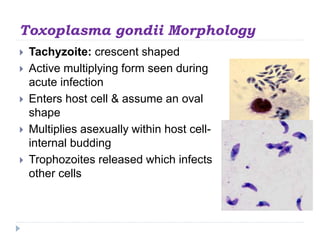
 Tachyzoite: crescent shaped
 Active multiplying form seen during
acute infection
 Enters host cell & assume an oval
shape
 Multiplies asexually within host cell-
internal budding
 Trophozoites released which infects
other cells
Toxoplasma gondii Morphology
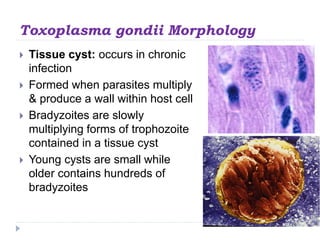
 Tissue cyst: occurs in chronic
infection
 Formed when parasites multiply
& produce a wall within host cell
 Bradyzoites are slowly
multiplying forms of trophozoite
contained in a tissue cyst
 Young cysts are small while
older contains hundreds of
bradyzoites
Toxoplasma gondii Morphology
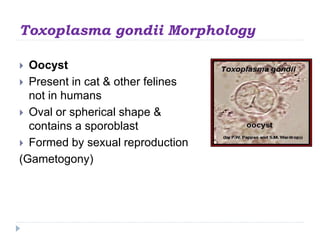
 Oocyst
 Present in cat & other felines
not in humans
 Oval or spherical shape &
contains a sporoblast
 Formed by sexual reproduction
(Gametogony)
Life Cycle
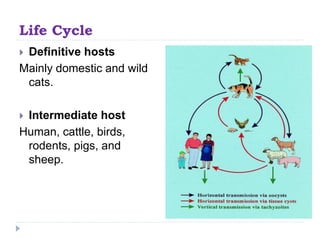
 Definitive hosts
Mainly domestic and wild
cats.
 Intermediate host
Human, cattle, birds,
rodents, pigs, and
sheep.
Life Cycle
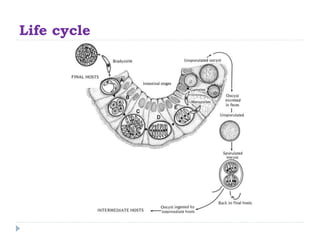
 Enteric cycle: Occurs in cats & felines
 Both asexual multiplication & sexual reproduction
within mucosal epithelial cells of small intestine
 Ingestion of any of 3 infectious stages, invades
mucosal cells of cat’s small intestine & undergoes
asexual generation before sexual cycle begins
Life Cycle
 Fertilization of male & female gametes- oocyst
develop exit from host cell into gut lumen & pass out
in feces
 Develops in soil for few days & become infectious
 Sporoblast divides into 2- sporocyst
 Four sporozoites develops into each sporocyst
 Mature oocyst having 8 sporozoites is infective form
of parasite.
Life cycle
Life cycle
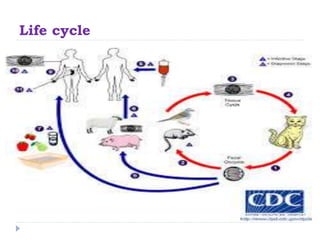
 Exoenteric cycle: Intermediate hosts acquires
infection by ingestion of sporulated cyst & by
ingestion of undercooked meat containing tissue cyst
 In duodenum oocyst release sporozoites & tissue
cyst releases bradyzoites
 Pass through gut wall, circulate in body, invades
various cells especially macrophages-form
tachyzoites
 Multiply ,break out & spread infection
Life cycle
Life cycle
 In the macrophage tachyzoites develop and travel to
various parts of the body via blood stream (Heart,
spleen, liver and brain).
 once immune response is trigered, tachyzoites
encyst into zoitocysts and pseudocysts which
contain bradyzoites(inactive).
Pathogenesis
1) Acquired toxoplasmosis
 Mild lymphatic inflammation
2) Congenital toxoplasmosis
Pathogenesis
 Congenital toxoplasmosis
 Foetus infected by focal lesions in placenta
 Generalized infection then clears from visceral &
may localize in CNS
 During first trimester-major CNS anomalies
 Second & 3rd trimester- less severe neurological
damage
Pathogenesis
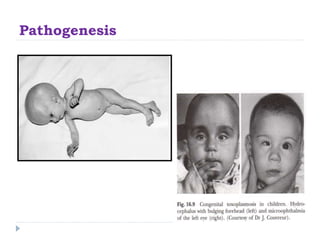
Congenital toxoplasmosis
1. Intracerebral calcification
2. Chorioretinitis (Ocular toxoplasmosis)
3. Hydrocephaly
4. Microcephaly
5. Convulsions
6. Mental retardation
7. Cardiomegaly
Pathogenesis
Pathogenesis
 Acquired toxoplasmosis
• Les severe than congenital toxoplasmosis
• Commonest manifestation is lymphadenopathy
• Most frequently deep cervical lymph nodes
• Fever ,malaise, headache, muscle pain, fatigue & sore
throat
• Rarely pneumonitis, myocarditis, meningoencephalitis
• In Immunocompromised patients Encephalitis is most
frequent manifestation
• Acute infection can produce psychotic symptoms- like
schizophrenia
Pathogenesis
 Immunocompromised patients: CNS primarily
involved
• Diffuse encephalopathy
• Meningoencephalitis
• Altered mental state, motor impairment, seizures,
abnormal reflexes
Immunity
 Both humoral & cellular immune response
 T lymphocytes mediate most immunity to T.gondii via
macrophage activation.

Toxoplasmosis

  • 1.
  • 2.
    Toxoplasma gondii  Phylumapicomplexa  Discovered in 1908 in small rodent  Worldwide in distribution  Obligate intracellular parasite  Morphological forms Tachyzoites Tissue cyst Oocyst
  • 3.
    Toxoplasma gondii Morphology Tachyzoite: crescent shaped  Active multiplying form seen during acute infection  Enters host cell & assume an oval shape  Multiplies asexually within host cell- internal budding  Trophozoites released which infects other cells
  • 4.
    Toxoplasma gondii Morphology Tissue cyst: occurs in chronic infection  Formed when parasites multiply & produce a wall within host cell  Bradyzoites are slowly multiplying forms of trophozoite contained in a tissue cyst  Young cysts are small while older contains hundreds of bradyzoites
  • 5.
    Toxoplasma gondii Morphology Oocyst  Present in cat & other felines not in humans  Oval or spherical shape & contains a sporoblast  Formed by sexual reproduction (Gametogony)
  • 6.
    Life Cycle  Definitivehosts Mainly domestic and wild cats.  Intermediate host Human, cattle, birds, rodents, pigs, and sheep.
  • 7.
    Life Cycle  Entericcycle: Occurs in cats & felines  Both asexual multiplication & sexual reproduction within mucosal epithelial cells of small intestine  Ingestion of any of 3 infectious stages, invades mucosal cells of cat’s small intestine & undergoes asexual generation before sexual cycle begins
  • 8.
    Life Cycle  Fertilizationof male & female gametes- oocyst develop exit from host cell into gut lumen & pass out in feces  Develops in soil for few days & become infectious  Sporoblast divides into 2- sporocyst  Four sporozoites develops into each sporocyst  Mature oocyst having 8 sporozoites is infective form of parasite.
  • 9.
  • 10.
    Life cycle  Exoentericcycle: Intermediate hosts acquires infection by ingestion of sporulated cyst & by ingestion of undercooked meat containing tissue cyst  In duodenum oocyst release sporozoites & tissue cyst releases bradyzoites  Pass through gut wall, circulate in body, invades various cells especially macrophages-form tachyzoites  Multiply ,break out & spread infection
  • 11.
  • 12.
    Life cycle  Inthe macrophage tachyzoites develop and travel to various parts of the body via blood stream (Heart, spleen, liver and brain).  once immune response is trigered, tachyzoites encyst into zoitocysts and pseudocysts which contain bradyzoites(inactive).
  • 13.
    Pathogenesis 1) Acquired toxoplasmosis Mild lymphatic inflammation 2) Congenital toxoplasmosis
  • 14.
    Pathogenesis  Congenital toxoplasmosis Foetus infected by focal lesions in placenta  Generalized infection then clears from visceral & may localize in CNS  During first trimester-major CNS anomalies  Second & 3rd trimester- less severe neurological damage
  • 15.
    Pathogenesis Congenital toxoplasmosis 1. Intracerebralcalcification 2. Chorioretinitis (Ocular toxoplasmosis) 3. Hydrocephaly 4. Microcephaly 5. Convulsions 6. Mental retardation 7. Cardiomegaly
  • 16.
  • 17.
    Pathogenesis  Acquired toxoplasmosis •Les severe than congenital toxoplasmosis • Commonest manifestation is lymphadenopathy • Most frequently deep cervical lymph nodes • Fever ,malaise, headache, muscle pain, fatigue & sore throat • Rarely pneumonitis, myocarditis, meningoencephalitis • In Immunocompromised patients Encephalitis is most frequent manifestation • Acute infection can produce psychotic symptoms- like schizophrenia
  • 18.
    Pathogenesis  Immunocompromised patients:CNS primarily involved • Diffuse encephalopathy • Meningoencephalitis • Altered mental state, motor impairment, seizures, abnormal reflexes
  • 19.
    Immunity  Both humoral& cellular immune response  T lymphocytes mediate most immunity to T.gondii via macrophage activation.