Prepared by:
NOE P. MENDEZ
CENTRAL MINDANAO UNIVERSITY (CMU)
npolomendez@gmail.com
REFERENCES/LITERATURE CITED
 BARRAGAN, A and L.D. SIBLEY. 2003. Migration of Toxoplasma gondii across
biological barriers. Trends Microbiology. 11:426-30.
 COHEN, B.A. 1999. Neurologic manifestations of toxoplasmosis in AIDS. Semin
Neurol. 19:201-11.
 FROMONT, E.G., M. LELU, M.L. DARDE, C. RICHOMME, D. AUBERT, E.
AFONSO, A. MERCIER, C. GOTTELAND and I. VILLENA. 2012. The Life Cycle
of Toxoplasma gondii in the Natural Environment.
 NICOLLE C. and L. MANCEAUX. 1909. Sur um protozoaire nouveau du gondii.
Paris. 147:763-6.
 PEYRON, F., A.B. ATEBA, M. WALLON, et al. 2003. Congenital toxoplasmosis in
twins: a report of fourteen consecutive cases and a comparison with published data.
Pediatrics Infection Diseases J. 22:695-01.
 SILVEIRA, C., R. JR. BELFORT, C. MUCCIOLI and M.T. ABREU, et al. 2001. A
follow-up study of Toxoplasma gondii infection in southern Brazil. Am J Ophth.
131:351-4.
 TENTER, A.M., A.R. HECKEROTH and L.M. WEISS. 2000. Toxoplasma gondii:
from animals to humans. Int. j. parasitology. 30: 1217-1258.
 VOLLAIRE, M.R. et al. 2005. Seroprevalence of Toxoplasma gondii antibodies in
clinically ill cats in the United States. Am. J. Vet. Res. 66, 874–877.
 Protozoan parasite
Toxoplasma
toxon (bow)
plasmid (form)
 The most prevalent parasites in the global
human population
 The most successful parasites
THE ORGANISM
Tenter (2000); Fromont (2012)
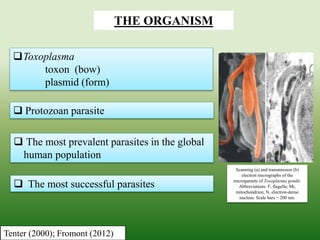
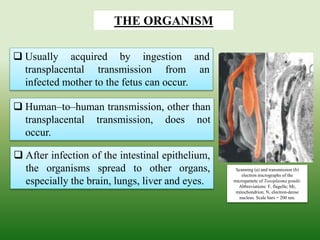
Scanning (a) and transmission (b)
electron micrographs of the
microgamete of Toxoplasma gondii.
Abbreviations: F, flagella; Mi,
mitochondrion; N, electron-dense
nucleus. Scale bars = 200 nm.
 Human–to–human transmission, other than
transplacental transmission, does not
occur.
 Usually acquired by ingestion and
transplacental transmission from an
infected mother to the fetus can occur.
 After infection of the intestinal epithelium,
the organisms spread to other organs,
especially the brain, lungs, liver and eyes.
THE ORGANISM
Scanning (a) and transmission (b)
electron micrographs of the
microgamete of Toxoplasma gondii.
Abbreviations: F, flagella; Mi,
mitochondrion; N, electron-dense
nucleus. Scale bars = 200 nm.
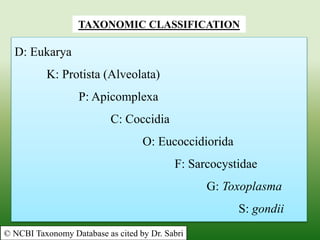
TAXONOMIC CLASSIFICATION
D: Eukarya
K: Protista (Alveolata)
P: Apicomplexa
C: Coccidia
O: Eucoccidiorida
F: Sarcocystidae
G: Toxoplasma
S: gondii
© NCBI Taxonomy Database as cited by Dr. Sabri
 Widely-distributed zoonosis caused by T.
gondii protozoa.
TOXOPLASMOSIS
Nicolle and Manceaux (1909)
 The definitive host is the domestic cat and
other felines.
 Humans and other mammals are
intermediate hosts.
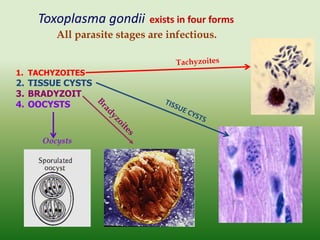
Toxoplasma gondii exists in four forms
All parasite stages are infectious.
1. TACHYZOITES
2. TISSUE CYSTS
3. BRADYZOIT
4. OOCYSTS
Oocysts
 Cysts in cat feces (oocysts) are 10-13 µ in
diameter
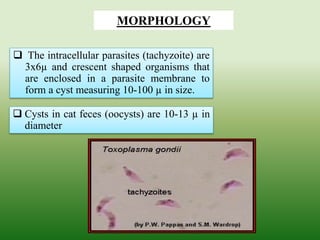
 The intracellular parasites (tachyzoite) are
3x6µ and crescent shaped organisms that
are enclosed in a parasite membrane to
form a cyst measuring 10-100 µ in size.
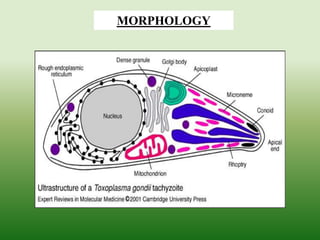
MORPHOLOGY
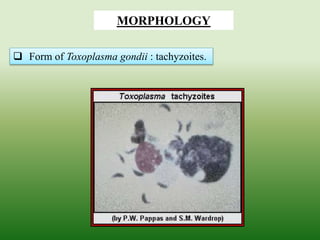
 Form of Toxoplasma gondii : tachyzoites.
MORPHOLOGY
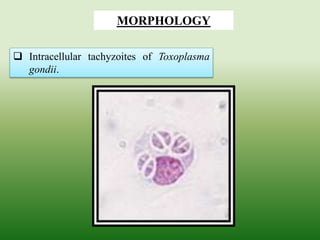
 Intracellular tachyzoites of Toxoplasma
gondii.
MORPHOLOGY
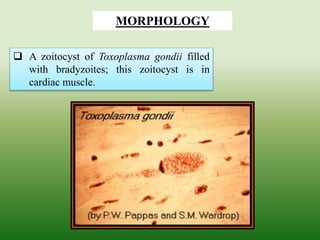
 A zoitocyst of Toxoplasma gondii filled
with bradyzoites; this zoitocyst is in
cardiac muscle.
MORPHOLOGY
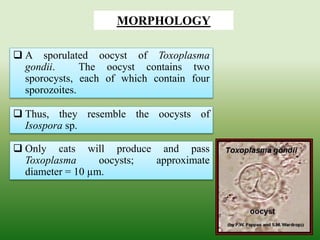
 A sporulated oocyst of Toxoplasma
gondii. The oocyst contains two
sporocysts, each of which contain four
sporozoites.
MORPHOLOGY
 Thus, they resemble the oocysts of
Isospora sp.
 Only cats will produce and pass
Toxoplasma oocysts; approximate
diameter = 10 µm.
MORPHOLOGY
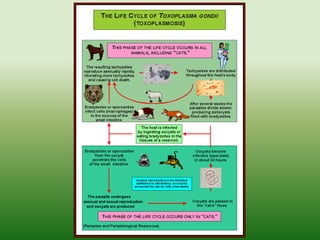
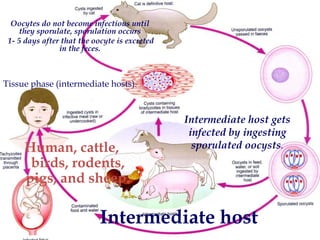
Tissue phase (intermediate hosts).
Intermediate host gets
infected by ingesting
sporulated oocysts.
Oocytes do not become infectious until
they sporulate, sporulation occurs
1- 5 days after that the oocyte is excreted
in the feces.
Intermediate host
Human, cattle,
birds, rodents,
pigs, and sheep.
Common symptoms of T. gondii
infection in cats includes:
Fever;
Ocular inflammation;
Anorexia;
Lethargy;
Abdominal discomfort; and
Neurologic abnormalities (Vollaire).
SYMPTOMS
 Both humoral and cell mediated
immune responses are stimulated in
normal individuals.
IMMUNOLOGY
Confirmation by isolation of
organism from tonsil or lymph gland
biopsy.
DIAGNOSIS
 Acute infections benefit from
pyrimethamine or sulphadiazine.
TREATMENT
 Spiramycin is a successful alternative.
 Pregnant women are advised to avoid cat
litter, handle uncooked meat carefully and
undercooked meat.
 Pregnant women are advised to avoid cat
litter, handle uncooked meat carefully and
undercooked meat.
NOE P. MENDEZ
Central Mindanao University
npolomendez@gmail.com

Toxoplasma gondii

  • 1.
    Prepared by: NOE P.MENDEZ CENTRAL MINDANAO UNIVERSITY (CMU) npolomendez@gmail.com
  • 2.
    REFERENCES/LITERATURE CITED  BARRAGAN,A and L.D. SIBLEY. 2003. Migration of Toxoplasma gondii across biological barriers. Trends Microbiology. 11:426-30.  COHEN, B.A. 1999. Neurologic manifestations of toxoplasmosis in AIDS. Semin Neurol. 19:201-11.  FROMONT, E.G., M. LELU, M.L. DARDE, C. RICHOMME, D. AUBERT, E. AFONSO, A. MERCIER, C. GOTTELAND and I. VILLENA. 2012. The Life Cycle of Toxoplasma gondii in the Natural Environment.  NICOLLE C. and L. MANCEAUX. 1909. Sur um protozoaire nouveau du gondii. Paris. 147:763-6.  PEYRON, F., A.B. ATEBA, M. WALLON, et al. 2003. Congenital toxoplasmosis in twins: a report of fourteen consecutive cases and a comparison with published data. Pediatrics Infection Diseases J. 22:695-01.  SILVEIRA, C., R. JR. BELFORT, C. MUCCIOLI and M.T. ABREU, et al. 2001. A follow-up study of Toxoplasma gondii infection in southern Brazil. Am J Ophth. 131:351-4.  TENTER, A.M., A.R. HECKEROTH and L.M. WEISS. 2000. Toxoplasma gondii: from animals to humans. Int. j. parasitology. 30: 1217-1258.  VOLLAIRE, M.R. et al. 2005. Seroprevalence of Toxoplasma gondii antibodies in clinically ill cats in the United States. Am. J. Vet. Res. 66, 874–877.
  • 3.
     Protozoan parasite Toxoplasma toxon(bow) plasmid (form)  The most prevalent parasites in the global human population  The most successful parasites THE ORGANISM Tenter (2000); Fromont (2012) Scanning (a) and transmission (b) electron micrographs of the microgamete of Toxoplasma gondii. Abbreviations: F, flagella; Mi, mitochondrion; N, electron-dense nucleus. Scale bars = 200 nm.
  • 4.
     Human–to–human transmission,other than transplacental transmission, does not occur.  Usually acquired by ingestion and transplacental transmission from an infected mother to the fetus can occur.  After infection of the intestinal epithelium, the organisms spread to other organs, especially the brain, lungs, liver and eyes. THE ORGANISM Scanning (a) and transmission (b) electron micrographs of the microgamete of Toxoplasma gondii. Abbreviations: F, flagella; Mi, mitochondrion; N, electron-dense nucleus. Scale bars = 200 nm.
  • 5.
    TAXONOMIC CLASSIFICATION D: Eukarya K:Protista (Alveolata) P: Apicomplexa C: Coccidia O: Eucoccidiorida F: Sarcocystidae G: Toxoplasma S: gondii © NCBI Taxonomy Database as cited by Dr. Sabri
  • 7.
     Widely-distributed zoonosiscaused by T. gondii protozoa. TOXOPLASMOSIS Nicolle and Manceaux (1909)  The definitive host is the domestic cat and other felines.  Humans and other mammals are intermediate hosts.
  • 8.
    Toxoplasma gondii existsin four forms All parasite stages are infectious. 1. TACHYZOITES 2. TISSUE CYSTS 3. BRADYZOIT 4. OOCYSTS Oocysts
  • 9.
     Cysts incat feces (oocysts) are 10-13 µ in diameter  The intracellular parasites (tachyzoite) are 3x6µ and crescent shaped organisms that are enclosed in a parasite membrane to form a cyst measuring 10-100 µ in size. MORPHOLOGY
  • 10.
     Form ofToxoplasma gondii : tachyzoites. MORPHOLOGY
  • 11.
     Intracellular tachyzoitesof Toxoplasma gondii. MORPHOLOGY
  • 12.
     A zoitocystof Toxoplasma gondii filled with bradyzoites; this zoitocyst is in cardiac muscle. MORPHOLOGY
  • 13.
     A sporulatedoocyst of Toxoplasma gondii. The oocyst contains two sporocysts, each of which contain four sporozoites. MORPHOLOGY  Thus, they resemble the oocysts of Isospora sp.  Only cats will produce and pass Toxoplasma oocysts; approximate diameter = 10 µm.
  • 14.
  • 16.
    Tissue phase (intermediatehosts). Intermediate host gets infected by ingesting sporulated oocysts. Oocytes do not become infectious until they sporulate, sporulation occurs 1- 5 days after that the oocyte is excreted in the feces. Intermediate host Human, cattle, birds, rodents, pigs, and sheep.
  • 17.
    Common symptoms ofT. gondii infection in cats includes: Fever; Ocular inflammation; Anorexia; Lethargy; Abdominal discomfort; and Neurologic abnormalities (Vollaire). SYMPTOMS
  • 18.
     Both humoraland cell mediated immune responses are stimulated in normal individuals. IMMUNOLOGY
  • 19.
    Confirmation by isolationof organism from tonsil or lymph gland biopsy. DIAGNOSIS
  • 20.
     Acute infectionsbenefit from pyrimethamine or sulphadiazine. TREATMENT  Spiramycin is a successful alternative.  Pregnant women are advised to avoid cat litter, handle uncooked meat carefully and undercooked meat.  Pregnant women are advised to avoid cat litter, handle uncooked meat carefully and undercooked meat.
  • 21.
    NOE P. MENDEZ CentralMindanao University npolomendez@gmail.com