Presented by
S.Hemapriya
II-M.Sc.,Applied Microbiology
K.M.G College Of Arts and Science
TOXOPLASMOSIS
 A disease of the blood and lymphatic system.
 Cats are a critical part of the life cycle.
 It is usually acquired by eating undercooked
meats but can also be acquired by contact with
cat feces.
 Primary problem is a congenital infection of
fetus, resulting in either stillbirth or a child with
severe brain damage or vision problems.
TOXOPLASMA GONDII
 Toxoplasmosis infection is caused by a parasite
called Toxoplasma gondii.
 Toxoplasma gondii was first discovered in
1908.
 Toxoplasma gondii is an intracellular parasite
in intestinal epithelium and muscle.
 Infects most species of warm-blooded animals,
including humans.
MORPHOLOGY
 Toxoplasma gondii occurs in three forms:
Trophozoite
Tissue cyst
Oocyst
TROPHOZOITE
 The trophozoite is crescent shaped, with one
end pointed and the other end rounded.
 It measures 3-7 µm in length.The nucleus is
ovoid and is situated at the blunt end of the
parasite.
 Electron microscopy reveals as apical complex
at the pointed end.
 The trophozoite stains well Giemsa stain, the
cytoplasm appearing azure blue and the nucleus
red.
TROPHOZOITE OF T.GONDII
TISSUE CYST
 Tissue cyst are the resting form of the parasite.
 They are found during chronic stage of the
infection and can be found in the brain(most
common site),skeletal muscles and various
other organs.
 The cyst wall is eosinophilic and stains with
silver,in contrast to the pseudocyst.
 With periodic acid-Schiff(PAS) stain,the cyst
wall stains weakly,and the parasites inside are
stained deeply.The slowly multiplying parasites
within the cyst are called Bradizoites.
TISSUE CYST OF T.GONDII
OOCYST
 Oocysts develop only in definitive hosts in the
intestine of cats and other felines but not in
humans.
 It is oval in shape and measures 10-12 µm in
diameter.Each cyst is surrounded by a thick
resistant wall.
 The oocysts are formed by sexual reproduction
(gametogony).
 When the infective oocyst is ingested,it releases
sporozoites in the intestine,which initiates
infection.
OOCYST OF T.GONDII
LIFE CYCLE OF T.GONDII
PATHOGENICITY AND
CLINICAL FEATURES
 The outcome of Toxoplasma infection depends
on the immune status of the infected person.
 Active progression of infection is more likely in
immunocompromised individuals.
Toxoplasmosis has acquired great importance
as one of the major fatal complication in
Acquired Immunodeficiency Syndrome
(AIDS).
 Most human infections are asymptomatic.
 Clinical toxoplasmosis may be congenital or
required.
LABORATORY DIAGNOSIS OF
T.GONDII
TREATMENT
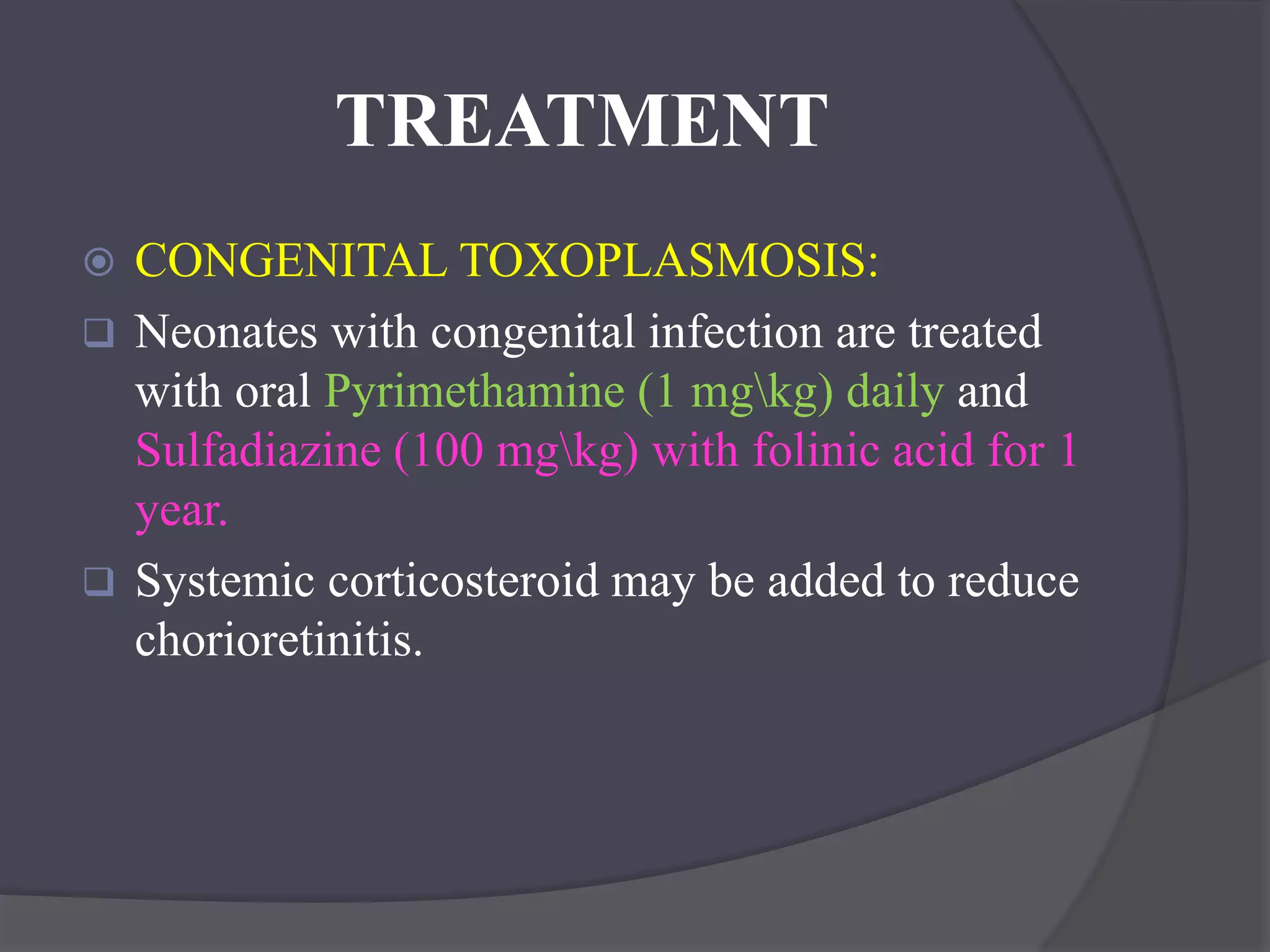
 CONGENITAL TOXOPLASMOSIS:
 Neonates with congenital infection are treated
with oral Pyrimethamine (1 mgkg) daily and
Sulfadiazine (100 mgkg) with folinic acid for 1
year.
 Systemic corticosteroid may be added to reduce
chorioretinitis.
TREATMENT
 IMMUNOCOMPETENT PATIENTS:
 Patients with ocular toxoplasmosis are treated
for 1 month with Pyrimethamine plus either
Sulfadiazine or Clindamycin (600 mg QID).
 Folinic acid should be administered
concomitantly to avoid marrow suppressive
effect of Pyrimethamine.
TREATMENT
 IMMUNOCOMPROMISED PATIENTS:
 Trimethoprim-Sulfamethoxazole is the drug of
choice.If Trimethoprim-Sulfamethoxazole
cannot be tolerated by patients,Dapsone-
Pyrimethamine is the recommended alternative
drug of choice.
 Prophylaxis against Toxoplasma encephalitis
should be discontinued in patients who have
responded to Anti Retroviral Therapy (ART)
and whose CD4+ T-lymphocyte count has been
above 200µL for 3 months.
PROPHYLAXIS
 Individuals at risk,particularly pregnant
women,children and immunocompromised
persons should avoid contact with cat and its
feces.
 Proper cooking of meal.
 Proper washing of hands and washing of
vegetables and fruits before eating.
 Blood or blood products from seropositive
persons should not be given and screening for
T.gondii antibody should be done in all blood
banks.
CONTROL
 It is difficult to control toxoplasmosis because
of wide range of animal
reservoirs.Currently,there is no effective
vaccine available for humans.A genetically
engineered vaccine is under development for
use in cats.
Toxoplasmosis PPt (Hemapriya-II PG).pptx

Toxoplasmosis PPt (Hemapriya-II PG).pptx

  • 1.
  • 3.
    TOXOPLASMOSIS  A diseaseof the blood and lymphatic system.  Cats are a critical part of the life cycle.  It is usually acquired by eating undercooked meats but can also be acquired by contact with cat feces.  Primary problem is a congenital infection of fetus, resulting in either stillbirth or a child with severe brain damage or vision problems.
  • 4.
    TOXOPLASMA GONDII  Toxoplasmosisinfection is caused by a parasite called Toxoplasma gondii.  Toxoplasma gondii was first discovered in 1908.  Toxoplasma gondii is an intracellular parasite in intestinal epithelium and muscle.  Infects most species of warm-blooded animals, including humans.
  • 5.
    MORPHOLOGY  Toxoplasma gondiioccurs in three forms: Trophozoite Tissue cyst Oocyst
  • 6.
    TROPHOZOITE  The trophozoiteis crescent shaped, with one end pointed and the other end rounded.  It measures 3-7 µm in length.The nucleus is ovoid and is situated at the blunt end of the parasite.  Electron microscopy reveals as apical complex at the pointed end.  The trophozoite stains well Giemsa stain, the cytoplasm appearing azure blue and the nucleus red.
  • 7.
  • 8.
    TISSUE CYST  Tissuecyst are the resting form of the parasite.  They are found during chronic stage of the infection and can be found in the brain(most common site),skeletal muscles and various other organs.  The cyst wall is eosinophilic and stains with silver,in contrast to the pseudocyst.  With periodic acid-Schiff(PAS) stain,the cyst wall stains weakly,and the parasites inside are stained deeply.The slowly multiplying parasites within the cyst are called Bradizoites.
  • 9.
  • 10.
    OOCYST  Oocysts developonly in definitive hosts in the intestine of cats and other felines but not in humans.  It is oval in shape and measures 10-12 µm in diameter.Each cyst is surrounded by a thick resistant wall.  The oocysts are formed by sexual reproduction (gametogony).  When the infective oocyst is ingested,it releases sporozoites in the intestine,which initiates infection.
  • 11.
  • 12.
    LIFE CYCLE OFT.GONDII
  • 13.
    PATHOGENICITY AND CLINICAL FEATURES The outcome of Toxoplasma infection depends on the immune status of the infected person.  Active progression of infection is more likely in immunocompromised individuals. Toxoplasmosis has acquired great importance as one of the major fatal complication in Acquired Immunodeficiency Syndrome (AIDS).  Most human infections are asymptomatic.  Clinical toxoplasmosis may be congenital or required.
  • 14.
  • 15.
    TREATMENT  CONGENITAL TOXOPLASMOSIS: Neonates with congenital infection are treated with oral Pyrimethamine (1 mgkg) daily and Sulfadiazine (100 mgkg) with folinic acid for 1 year.  Systemic corticosteroid may be added to reduce chorioretinitis.
  • 16.
    TREATMENT  IMMUNOCOMPETENT PATIENTS: Patients with ocular toxoplasmosis are treated for 1 month with Pyrimethamine plus either Sulfadiazine or Clindamycin (600 mg QID).  Folinic acid should be administered concomitantly to avoid marrow suppressive effect of Pyrimethamine.
  • 17.
    TREATMENT  IMMUNOCOMPROMISED PATIENTS: Trimethoprim-Sulfamethoxazole is the drug of choice.If Trimethoprim-Sulfamethoxazole cannot be tolerated by patients,Dapsone- Pyrimethamine is the recommended alternative drug of choice.  Prophylaxis against Toxoplasma encephalitis should be discontinued in patients who have responded to Anti Retroviral Therapy (ART) and whose CD4+ T-lymphocyte count has been above 200µL for 3 months.
  • 18.
    PROPHYLAXIS  Individuals atrisk,particularly pregnant women,children and immunocompromised persons should avoid contact with cat and its feces.  Proper cooking of meal.  Proper washing of hands and washing of vegetables and fruits before eating.  Blood or blood products from seropositive persons should not be given and screening for T.gondii antibody should be done in all blood banks.
  • 19.
    CONTROL  It isdifficult to control toxoplasmosis because of wide range of animal reservoirs.Currently,there is no effective vaccine available for humans.A genetically engineered vaccine is under development for use in cats.