Urban morphology
refers to
- the physical arrangement or structure of
    towns and cities.

-   involves the mapping and description of
    patterns of internal land use,

-   and includes street patterns, individual
    buildings ,building blocks, densities

-   and the different functions of the town or city
Urban morphology

Factors Influencing Urban Morphology
- Site factors
- Historical and cultural factors
- Functional factors
- Government influence
- Social values
- Economic forces
  *economic circulation
  *economic accessibility / urban land rents
Urban morphology
The Urban Land Rent Concept and Distance Decay
Mechanism
1. Areas of high accessibility
~ centre of the city
~ Major traffic routes
~ major traffic intersections

2. Land values and uses in a city
~ The central Business district
~ Industrial land use
~ residential land use
Models of urban structure
Introduction

   Most western cities exhibit area specialization in
   their internal land use patterns. That means “
   functional areas” or “ functional zones”
Models of urban structure

Stages of urban growth

- Infantile stage

- Juvenile stage

- Adolescent stage

- Early mature stage

- Fully mature stage
Models of urban structure
Land-use models have been put forward on the basis of the idea
-   that towns and cities do not grow in a haphazard
    fashion, rather they tend to develop distinctive
    patterns of land-use as they grow and develop.

-   Land-use models are simplified diagrams which are
    used to represent the pattern of land-use functions
    within a town or city.

-   It should however be remembered that these are
    simplifications of reality and it is unlikely that any
    model will fit every town and city perfectly.
CONCENTRIC GROWTH CONCEPT
E W BURGESS; EARLY 1925
CONCENTRIC GROWTH CONCEPT
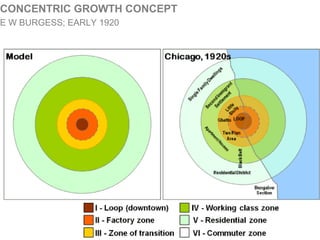
E W BURGESS; EARLY 1920


Zone I: Central Business District (CBD) where most of the tertiary
      employment is located and where the urban transport
      infrastructure is converging, making this zone the most
      accessible.

Zone II: Immediately adjacent to the CBD a zone where many industrial
      activities locate to take advantage of nearby labor and markets.
      Further, most transport terminals, namely port sites and railyards,
      are located adjacent to the central area.

Zone III: This zone is gradually been reconverted to other uses by
      expanding manufacturing / industrial activities. It contains the
      poorest segment of the urban population, notably first generation
      immigrants living, in the lowest housing conditions.

Zone IV: Residential zone dominated by the working class and those
      who were able to move away from the previous zone (often
      second generation immigrants). This zone has the advantage of
      being located near the major zones of employment (I and II) and
      thus represents a low cost location for the working class.

Zone V: Represents higher quality housing linked with longer
      commuting costs.

Zone Va: Mainly high class and expensive housing in a rural,
      suburbanized, setting. The commuting costs are the highest.
      Prior to mass diffusion of the automobile (1930s), most of these
      settlements were located next to rail stations.
CONCENTRIC GROWTH CONCEPT
E W BURGESS; EARLY 1920
CONCENTRIC GROWTH CONCEPT
E W BURGESS; EARLY 1920


ASSUMPTIONS
CONCENTRIC GROWTH CONCEPT
E W BURGESS; EARLY 1920


CRITICISM
CONCENTRIC GROWTH CONCEPT
E W BURGESS; EARLY 1920


CRITICISM
SECTORAL MODEL
HOMER HOYT; 1939


                   Major transport routes
SECTORAL MODEL
HOMER HOYT; 1939


There are three explanations for these land use patterns.
1 Historical
The urban area expanded outwards from the original site which is
    where the city centre is found today.

2 Economic
Rents and rates in the CBD became too expensive for people. In
    the suburbs there was more land and it was cheaper. Only
    businesses could afford to stay in the CBD, but even they
    needed to make the most of expensive land by building
    upwards.

3 Concentrations of similar land uses
One part of the urban area may have all the advantages for
    industrial location so that a lot of factories want to locate
    there; but few people want to live next door to a factory, so
    the residential areas are located elsewhere. Planners also
    prefer this segregation of land uses into definite zones.
SECTORAL MODEL
HOMER HOYT; 1939


ASSUMPTIONS
SECTORAL MODEL
HOMER HOYT; 1939


ASSUMPTIONS
SECTORAL MODEL
HOMER HOYT; 1939


CONCLUSSIONS
SECTORAL MODEL
HOMER HOYT; 1939


CONCLUSSIONS
SECTORAL MODEL
HOMER HOYT; 1939


CRITICISM
MULTIPLE NUCLEI CONCEPT
HARRIS & ULLMAN; 1945
MULTIPLE NUCLEI CONCEPT
HARRIS & ULLMAN; 1945


-   land use patterns do not grow from a single
    central point in a city but from multiple points
    or nuclei.
-
    Some of these points existed before the city
    began to grow, while others develop as the
    city grows.

-   Nuclei may include the original retail or
    market area of the city and important
    transport links such as railway stations, ports
    or the airport.
MULTIPLE NUCLEI CONCEPT
HARRIS & ULLMAN; 1945


-   The areas of the city that they recognise are
    similar to the ones noted by Hoyt and Burgess
    but the location of these areas will be different
    in different cities.

-   The central business district will often be
    found near the original retail area of the city.

-   Warehousing and light industrial areas will
    develop adjacent to the CBD and along
    transport links such as railways and roads.
MULTIPLE NUCLEI CONCEPT
HARRIS & ULLMAN; 1945

-   Heavy industry will locate on the outskirts of towns
    or where the outskirts were when the development
    took place, since growth of the urban area may have
    overrun this area by now.

-   Residential areas will be found in the remaining
    space, with high-class housing situated in the better
    areas with good drainage, often on high ground and
    away from nuisances such as noise and poor air
    quality.

-   Lower quality housing will be forced to occupy the
    less attractive areas of the city.
MULTIPLE NUCLEI CONCEPT
HARRIS & ULLMAN; 1945
STUDENTS’ PROJECT
Study of Cities – Past, Present & Future growth
   pattern in terms of –

a.   Transport Network
b.   Commercial Land Use
c.   Industrial Land Use
d.   Residential Land Use

Study Period: 1980 to 2020.
Study Method: For every decade mark on the maps a
   to d mentioned above
STUDENTS’ PROJECT
Cities


GROUP 1     DELHI & NCR

GROUP 2     MUMBAI & MMR

GROUP 3     CHANDIGARH

GROUP 4     BANGALORE

Town planning (4)

  • 1.
    Urban morphology refers to -the physical arrangement or structure of towns and cities. - involves the mapping and description of patterns of internal land use, - and includes street patterns, individual buildings ,building blocks, densities - and the different functions of the town or city
  • 2.
    Urban morphology Factors InfluencingUrban Morphology - Site factors - Historical and cultural factors - Functional factors - Government influence - Social values - Economic forces *economic circulation *economic accessibility / urban land rents
  • 3.
    Urban morphology The UrbanLand Rent Concept and Distance Decay Mechanism 1. Areas of high accessibility ~ centre of the city ~ Major traffic routes ~ major traffic intersections 2. Land values and uses in a city ~ The central Business district ~ Industrial land use ~ residential land use
  • 4.
    Models of urbanstructure Introduction Most western cities exhibit area specialization in their internal land use patterns. That means “ functional areas” or “ functional zones”
  • 5.
    Models of urbanstructure Stages of urban growth - Infantile stage - Juvenile stage - Adolescent stage - Early mature stage - Fully mature stage
  • 6.
    Models of urbanstructure Land-use models have been put forward on the basis of the idea - that towns and cities do not grow in a haphazard fashion, rather they tend to develop distinctive patterns of land-use as they grow and develop. - Land-use models are simplified diagrams which are used to represent the pattern of land-use functions within a town or city. - It should however be remembered that these are simplifications of reality and it is unlikely that any model will fit every town and city perfectly.
  • 7.
    CONCENTRIC GROWTH CONCEPT EW BURGESS; EARLY 1925
  • 8.
    CONCENTRIC GROWTH CONCEPT EW BURGESS; EARLY 1920 Zone I: Central Business District (CBD) where most of the tertiary employment is located and where the urban transport infrastructure is converging, making this zone the most accessible. Zone II: Immediately adjacent to the CBD a zone where many industrial activities locate to take advantage of nearby labor and markets. Further, most transport terminals, namely port sites and railyards, are located adjacent to the central area. Zone III: This zone is gradually been reconverted to other uses by expanding manufacturing / industrial activities. It contains the poorest segment of the urban population, notably first generation immigrants living, in the lowest housing conditions. Zone IV: Residential zone dominated by the working class and those who were able to move away from the previous zone (often second generation immigrants). This zone has the advantage of being located near the major zones of employment (I and II) and thus represents a low cost location for the working class. Zone V: Represents higher quality housing linked with longer commuting costs. Zone Va: Mainly high class and expensive housing in a rural, suburbanized, setting. The commuting costs are the highest. Prior to mass diffusion of the automobile (1930s), most of these settlements were located next to rail stations.
  • 9.
    CONCENTRIC GROWTH CONCEPT EW BURGESS; EARLY 1920
  • 10.
    CONCENTRIC GROWTH CONCEPT EW BURGESS; EARLY 1920 ASSUMPTIONS
  • 11.
    CONCENTRIC GROWTH CONCEPT EW BURGESS; EARLY 1920 CRITICISM
  • 12.
    CONCENTRIC GROWTH CONCEPT EW BURGESS; EARLY 1920 CRITICISM
  • 13.
    SECTORAL MODEL HOMER HOYT;1939 Major transport routes
  • 14.
    SECTORAL MODEL HOMER HOYT;1939 There are three explanations for these land use patterns. 1 Historical The urban area expanded outwards from the original site which is where the city centre is found today. 2 Economic Rents and rates in the CBD became too expensive for people. In the suburbs there was more land and it was cheaper. Only businesses could afford to stay in the CBD, but even they needed to make the most of expensive land by building upwards. 3 Concentrations of similar land uses One part of the urban area may have all the advantages for industrial location so that a lot of factories want to locate there; but few people want to live next door to a factory, so the residential areas are located elsewhere. Planners also prefer this segregation of land uses into definite zones.
  • 15.
  • 16.
  • 17.
    SECTORAL MODEL HOMER HOYT;1939 CONCLUSSIONS
  • 18.
    SECTORAL MODEL HOMER HOYT;1939 CONCLUSSIONS
  • 19.
  • 20.
  • 21.
    MULTIPLE NUCLEI CONCEPT HARRIS& ULLMAN; 1945 - land use patterns do not grow from a single central point in a city but from multiple points or nuclei. - Some of these points existed before the city began to grow, while others develop as the city grows. - Nuclei may include the original retail or market area of the city and important transport links such as railway stations, ports or the airport.
  • 22.
    MULTIPLE NUCLEI CONCEPT HARRIS& ULLMAN; 1945 - The areas of the city that they recognise are similar to the ones noted by Hoyt and Burgess but the location of these areas will be different in different cities. - The central business district will often be found near the original retail area of the city. - Warehousing and light industrial areas will develop adjacent to the CBD and along transport links such as railways and roads.
  • 23.
    MULTIPLE NUCLEI CONCEPT HARRIS& ULLMAN; 1945 - Heavy industry will locate on the outskirts of towns or where the outskirts were when the development took place, since growth of the urban area may have overrun this area by now. - Residential areas will be found in the remaining space, with high-class housing situated in the better areas with good drainage, often on high ground and away from nuisances such as noise and poor air quality. - Lower quality housing will be forced to occupy the less attractive areas of the city.
  • 24.
  • 25.
    STUDENTS’ PROJECT Study ofCities – Past, Present & Future growth pattern in terms of – a. Transport Network b. Commercial Land Use c. Industrial Land Use d. Residential Land Use Study Period: 1980 to 2020. Study Method: For every decade mark on the maps a to d mentioned above
  • 26.
    STUDENTS’ PROJECT Cities GROUP 1 DELHI & NCR GROUP 2 MUMBAI & MMR GROUP 3 CHANDIGARH GROUP 4 BANGALORE