CITY FORM IN THE CONTEXT OF DEVELOPED AND developing COUNTRIES 
Compiled by: 
Jyoti 
Ayush Chaudhary 
Ayush Garg 
Shweta Khatriker 
Vijay Meena 
PLANNING THEORY
Structure 
 Introduction 
 city 
 city forms 
 Types of city forms 
 The Radio centric city 
 The gridiron city 
 The linear city 
 City growth 
 Ecological models of urban land use model 
 Concentric Model 
 Sector Model 
 Multi nuclei Model
Introduction-cities 
 A city is a group of people and a number of permanent structures within a 
limited geographical area, so organized as to facilitate the interchange of 
goods and services among its residents and with the outside world. 
 The settlements grew into villages, villages transformed into cities. 
 Cities created when large number of people live together, in a specific 
geographic location leading to the Creation of urban areas. 
 Cities exist for many reasons, and the diversity of urban forms depends on the 
complex functions that cities perform.
What is Urban Form…? 
 Urban Form refers to the- 
• physical layout and design of the city 
• spatial imprint of an urban transport system 
• adjacent physical infrastructures. 
Jointly, they confer a level of spatial arrangement to cities. 
 Urban form or city form defined as- 
‘ the spatial pattern of human activities at a certain point in time’.
Factors Influencing city form 
geography 
Impact of 
natural 
environment 
Social , political 
and economic 
forces 
development 
Trade 
Period of 
practiced
The Radiocentric city 
 Geographical possibilities of spreading in all directions. 
 Radio centric - Radiate outward from a common centre. 
 Inner Outer ring roads linked by radiating roads. 
 Core has business area. 
 Industrial area interspersed within the residential. 
 Periphery has green belts. 
 Example : Washington DC, Pre-industrial Baghdad in Iraq. 
Advantages- 
• A direct line of travel for centrally 
directed flows, 
• economics of a single- centralised 
terminal or origin point. 
Disadvantages- 
• Central congestion , 
• local flow problems , 
• difficult building sites
CASE STUDY-RADIOCENTRIC 
CITY 
MOSCOW
The Radial city: Moscow 
 Moscow, the world biggest 
Megapolis (Russian Moskva) is the 
capital of Russia. 
 The city grew in a pattern of rings 
and radials that marked Moscow's 
growth from ancient time to modern 
layout. 
 The center of all rings is Moscow 
Kremlin and famous Red Square. 
Moscow, 1893
Moscow, At Present 
• Successive epochs of development 
are traced by the 
• The Boulevard Ring and 
• The Garden Ring, 
• The Moscow Little Ring Railway, 
• And the Moscow Ring Road.
The Grid Iron city 
 It is composed of straight streets crossing at right angles to create many regular city 
blocks. 
 This form is typical of cities built after the industrial revolution – because only then 
did cities place such importance on economic activity. 
 A city grid iron plan facilitates the movement of people and product throughout the 
city. 
Advantages 
• High accessibility, 
• minimum disruption of flow, 
• expansion flexibility, 
• excellent psychological orientation, 
adaptability to level or moderately 
rolling terrain. 
Disadvantages 
• Requires flow hierarchies, 
• limited in its adaptability to the 
terrain, 
• potentially monotonous
CASE STUDY 
GRID IRON PATTERN
CHANDIGARH 
 The primary module of city’s design is a Sector, a 
neighbourhood unit of size 800 m X1200 m. 
 It is a self-sufficient unit having shops, school, 
health centres and places of recreations . 
 The population of a sector varies between 3000- 
20000 depending upon sizes of plots and 
topography of the area. 
 The shopping street of each sector is linked to the 
adjoining sectors thus forming one long, 
continuous ribbon . 
 The central green of each Sector also stretches to 
the green of the next sector
The Grid Iron city: San Francisco 
San Francisco was designed to accommodate 
outrageous number of people that came to the city 
during the Gold Rush. 
It was laid out in a grid pattern imposed on a city of 
hills built on the end of a peninsula. 
Both grids and irregular forms can be seen in San 
Francisco. 
 Downtown San Francisco is extremely dense. The 
planning commission split downtown into four 
separate zones with different purposes. 
 Office District 
 Retail District 
 General Commercial District 
 Support District
The Linear city 
 Initially proposed by Soria Y Mata. 
 Expand the city along the spine of transport 
 The Linear City concept is a Conscious Form Of Urban Development with 
Housing And Industry Growing Along The Highway Between existing cities 
and contained by the continuous open space of the rural countryside. 
Advantages 
• High accessibility 
• adaptability to linear growth 
• useful along the limited edge. 
Disadvantages 
• Very sensitive to blockage 
requires control of growth 
• lacks focus, 
• The choice of connection or of 
direction of movement are much 
less.
Navi Mumbai 
Alternative to Mumbai 
http://www.cidco.maharashtra.gov.in/img/Navi_Mumbai/Development_Plan_Ma 
p.jpg
The Linear City: Navi Mumbai 
 The growth of Mumbai city is constrained by sea at 
south, east and west. As a result total land area available 
for development of Mumbai is limited. 
 The cost of real estate and housing in Navi Mumbai is 
much less than costs in Mumbai and sub-urban areas. 
 Many government and corporate offices have been 
shifted from Mumbai to Navi Mumbai . 
 the Taloja and Thane Belapur Industrial Belt of Navi 
Mumbai offer job opportunities of every conceivable kind 
- from engineers to mechanics to clerks to peons. As a 
result a large population of service class and middle class 
population shifted to Navi Mumbai. 
http://www.nmmconline.com/web/guest/history1
City growth 
 According to urbanist Hans Blumenfeld, cities can grow in any of three ways: 
Outward (expanding horizontally) 
Upward (expanding vertically) 
Toward greater density (expanding interstitially) 
 As long as intra city traffic moved only by foot or hoof, possibilities of horizontal and 
vertical expansion were strictly limited. 
 Growth was mainly interstitial, filling up every square yard of vacant land left between 
buildings. 
 With the advent of the elevator and the steel frame, the vertical growth of skyscrapers 
began. 
 Suburbs spread out horizontally along streetcar and bus lines and around suburban 
railroad stations, surrounded by wide-open spaces.
Ecological urban land-use 
. Model
Concentric zone model 
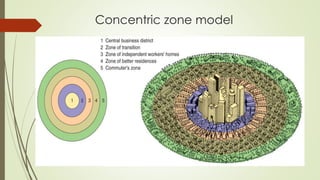
Developed in 1925 by Ernest w. Burgess. 
 Cities grow radially outward away from a single centre. 
 Different land uses are distributed like concentric rings around the city centre. 
 They are: CBD, zone in transition, low-class residential zone, middle-class residential zone, 
high-class residential zone. 
 Criticisms about concentric zone theory 
• Physical features - land may restrict growth of certain sectors 
• Commuter villages defy the theory, being in the commuter zone but located far from the 
city 
• Decentralization of shops, manufacturing industry, and entertainment 
• It assumes an isotropic plain - an even, unchanging landscape
Concentric zone model
Sector Model 
 Developed in 1939 by Homer Hoyt ,states that a city develops in sectors, not rings 
 All land uses except the CBD form sectors around the city centre. 
 The land use zones are influenced by radial transport routes. 
 High-rental and low-rental areas repel one another. 
 Criticisms about sector model 
 Applies well to Chicago. 
 Low cost housing is near industry and transportation proving Hoyt’s model 
 Theory based on 20th century and does not take into account cars which make commerce easier 
 With cars, people can live anywhere and further from the city and still travel to the CBD using 
their car. Not only do high-class residents have cars, but also middle and lower class people may 
have cars.
Sector Model
Sector Model: Gandhinagar 
Gandhinagar is planned to function mainly as 
administrative center for the state. 
 The sectors are numbered from 1 to 30 and they are 
formed by seven roads running in each direction and 
cutting each other perpendicularly. 
 They are planned on the neighborhood concept in two 
phases: 
First Phase - The basic amenities were constructed. 
Second phase - constructions of capital complex, sports 
complex, town halls, research institution, cinemas, 
cultural centers, residential bungalows etc.
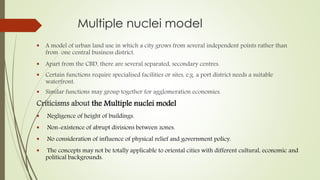
Multiple nuclei model 
 A model of urban land use in which a city grows from several independent points rather than 
from one central business district. 
 Apart from the CBD, there are several separated, secondary centres. 
 Certain functions require specialised facilities or sites, e.g. a port district needs a suitable 
waterfront. 
 Similar functions may group together for agglomeration economies. 
Criticisms about the Multiple nuclei model 
 Negligence of height of buildings. 
 Non-existence of abrupt divisions between zones. 
 No consideration of influence of physical relief and government policy. 
 The concepts may not be totally applicable to oriental cities with different cultural, economic and 
political backgrounds.
Multiple nuclei model
Multi-nuclei Model 
Advantages 
• Optional locations for focal 
activities and system 
terminals , 
• good psychological 
orientation 
• adaptability to existing 
conditions 
Disadvantages 
• Depends on stability to key 
points, 
• potential accessibility 
problems 
• tendency to dilute focal 
activities
Delhi 
Radial to multi-nuclei or polycentric city form Delhi
References 
 Cities and Urban Life – By John J. Macionis And Vincent N. Parrillo 
 Good City Form – Kelvin Lynch 
 www.urbanform.org 
 www.cityform.mit.edu 
 www.ocw.mit.edu › Courses › Architecture 
 www.urbanmodel.com 
 www.cs.toronto.edu/~mes/russia/moscow/description.html 
 www.sf-planning.org 
 jnnurm.nic.in/wp-content/uploads/2010/12/CDP_Delhi.pdf 
 chandigarh.gov.in/knowchd_gen_plan.htm 
 www.cidco.maharashtra.gov.in/NM_Developmentplan.aspx
City forms

City forms

  • 1.
    CITY FORM INTHE CONTEXT OF DEVELOPED AND developing COUNTRIES Compiled by: Jyoti Ayush Chaudhary Ayush Garg Shweta Khatriker Vijay Meena PLANNING THEORY
  • 2.
    Structure  Introduction  city  city forms  Types of city forms  The Radio centric city  The gridiron city  The linear city  City growth  Ecological models of urban land use model  Concentric Model  Sector Model  Multi nuclei Model
  • 3.
    Introduction-cities  Acity is a group of people and a number of permanent structures within a limited geographical area, so organized as to facilitate the interchange of goods and services among its residents and with the outside world.  The settlements grew into villages, villages transformed into cities.  Cities created when large number of people live together, in a specific geographic location leading to the Creation of urban areas.  Cities exist for many reasons, and the diversity of urban forms depends on the complex functions that cities perform.
  • 4.
    What is UrbanForm…?  Urban Form refers to the- • physical layout and design of the city • spatial imprint of an urban transport system • adjacent physical infrastructures. Jointly, they confer a level of spatial arrangement to cities.  Urban form or city form defined as- ‘ the spatial pattern of human activities at a certain point in time’.
  • 5.
    Factors Influencing cityform geography Impact of natural environment Social , political and economic forces development Trade Period of practiced
  • 6.
    The Radiocentric city  Geographical possibilities of spreading in all directions.  Radio centric - Radiate outward from a common centre.  Inner Outer ring roads linked by radiating roads.  Core has business area.  Industrial area interspersed within the residential.  Periphery has green belts.  Example : Washington DC, Pre-industrial Baghdad in Iraq. Advantages- • A direct line of travel for centrally directed flows, • economics of a single- centralised terminal or origin point. Disadvantages- • Central congestion , • local flow problems , • difficult building sites
  • 7.
  • 8.
    The Radial city:Moscow  Moscow, the world biggest Megapolis (Russian Moskva) is the capital of Russia.  The city grew in a pattern of rings and radials that marked Moscow's growth from ancient time to modern layout.  The center of all rings is Moscow Kremlin and famous Red Square. Moscow, 1893
  • 9.
    Moscow, At Present • Successive epochs of development are traced by the • The Boulevard Ring and • The Garden Ring, • The Moscow Little Ring Railway, • And the Moscow Ring Road.
  • 10.
    The Grid Ironcity  It is composed of straight streets crossing at right angles to create many regular city blocks.  This form is typical of cities built after the industrial revolution – because only then did cities place such importance on economic activity.  A city grid iron plan facilitates the movement of people and product throughout the city. Advantages • High accessibility, • minimum disruption of flow, • expansion flexibility, • excellent psychological orientation, adaptability to level or moderately rolling terrain. Disadvantages • Requires flow hierarchies, • limited in its adaptability to the terrain, • potentially monotonous
  • 11.
    CASE STUDY GRIDIRON PATTERN
  • 12.
    CHANDIGARH  Theprimary module of city’s design is a Sector, a neighbourhood unit of size 800 m X1200 m.  It is a self-sufficient unit having shops, school, health centres and places of recreations .  The population of a sector varies between 3000- 20000 depending upon sizes of plots and topography of the area.  The shopping street of each sector is linked to the adjoining sectors thus forming one long, continuous ribbon .  The central green of each Sector also stretches to the green of the next sector
  • 13.
    The Grid Ironcity: San Francisco San Francisco was designed to accommodate outrageous number of people that came to the city during the Gold Rush. It was laid out in a grid pattern imposed on a city of hills built on the end of a peninsula. Both grids and irregular forms can be seen in San Francisco.  Downtown San Francisco is extremely dense. The planning commission split downtown into four separate zones with different purposes.  Office District  Retail District  General Commercial District  Support District
  • 14.
    The Linear city  Initially proposed by Soria Y Mata.  Expand the city along the spine of transport  The Linear City concept is a Conscious Form Of Urban Development with Housing And Industry Growing Along The Highway Between existing cities and contained by the continuous open space of the rural countryside. Advantages • High accessibility • adaptability to linear growth • useful along the limited edge. Disadvantages • Very sensitive to blockage requires control of growth • lacks focus, • The choice of connection or of direction of movement are much less.
  • 15.
    Navi Mumbai Alternativeto Mumbai http://www.cidco.maharashtra.gov.in/img/Navi_Mumbai/Development_Plan_Ma p.jpg
  • 16.
    The Linear City:Navi Mumbai  The growth of Mumbai city is constrained by sea at south, east and west. As a result total land area available for development of Mumbai is limited.  The cost of real estate and housing in Navi Mumbai is much less than costs in Mumbai and sub-urban areas.  Many government and corporate offices have been shifted from Mumbai to Navi Mumbai .  the Taloja and Thane Belapur Industrial Belt of Navi Mumbai offer job opportunities of every conceivable kind - from engineers to mechanics to clerks to peons. As a result a large population of service class and middle class population shifted to Navi Mumbai. http://www.nmmconline.com/web/guest/history1
  • 17.
    City growth According to urbanist Hans Blumenfeld, cities can grow in any of three ways: Outward (expanding horizontally) Upward (expanding vertically) Toward greater density (expanding interstitially)  As long as intra city traffic moved only by foot or hoof, possibilities of horizontal and vertical expansion were strictly limited.  Growth was mainly interstitial, filling up every square yard of vacant land left between buildings.  With the advent of the elevator and the steel frame, the vertical growth of skyscrapers began.  Suburbs spread out horizontally along streetcar and bus lines and around suburban railroad stations, surrounded by wide-open spaces.
  • 18.
  • 19.
    Concentric zone model Developed in 1925 by Ernest w. Burgess.  Cities grow radially outward away from a single centre.  Different land uses are distributed like concentric rings around the city centre.  They are: CBD, zone in transition, low-class residential zone, middle-class residential zone, high-class residential zone.  Criticisms about concentric zone theory • Physical features - land may restrict growth of certain sectors • Commuter villages defy the theory, being in the commuter zone but located far from the city • Decentralization of shops, manufacturing industry, and entertainment • It assumes an isotropic plain - an even, unchanging landscape
  • 20.
  • 21.
    Sector Model Developed in 1939 by Homer Hoyt ,states that a city develops in sectors, not rings  All land uses except the CBD form sectors around the city centre.  The land use zones are influenced by radial transport routes.  High-rental and low-rental areas repel one another.  Criticisms about sector model  Applies well to Chicago.  Low cost housing is near industry and transportation proving Hoyt’s model  Theory based on 20th century and does not take into account cars which make commerce easier  With cars, people can live anywhere and further from the city and still travel to the CBD using their car. Not only do high-class residents have cars, but also middle and lower class people may have cars.
  • 22.
  • 23.
    Sector Model: Gandhinagar Gandhinagar is planned to function mainly as administrative center for the state.  The sectors are numbered from 1 to 30 and they are formed by seven roads running in each direction and cutting each other perpendicularly.  They are planned on the neighborhood concept in two phases: First Phase - The basic amenities were constructed. Second phase - constructions of capital complex, sports complex, town halls, research institution, cinemas, cultural centers, residential bungalows etc.
  • 24.
    Multiple nuclei model  A model of urban land use in which a city grows from several independent points rather than from one central business district.  Apart from the CBD, there are several separated, secondary centres.  Certain functions require specialised facilities or sites, e.g. a port district needs a suitable waterfront.  Similar functions may group together for agglomeration economies. Criticisms about the Multiple nuclei model  Negligence of height of buildings.  Non-existence of abrupt divisions between zones.  No consideration of influence of physical relief and government policy.  The concepts may not be totally applicable to oriental cities with different cultural, economic and political backgrounds.
  • 25.
  • 26.
    Multi-nuclei Model Advantages • Optional locations for focal activities and system terminals , • good psychological orientation • adaptability to existing conditions Disadvantages • Depends on stability to key points, • potential accessibility problems • tendency to dilute focal activities
  • 27.
    Delhi Radial tomulti-nuclei or polycentric city form Delhi
  • 28.
    References  Citiesand Urban Life – By John J. Macionis And Vincent N. Parrillo  Good City Form – Kelvin Lynch  www.urbanform.org  www.cityform.mit.edu  www.ocw.mit.edu › Courses › Architecture  www.urbanmodel.com  www.cs.toronto.edu/~mes/russia/moscow/description.html  www.sf-planning.org  jnnurm.nic.in/wp-content/uploads/2010/12/CDP_Delhi.pdf  chandigarh.gov.in/knowchd_gen_plan.htm  www.cidco.maharashtra.gov.in/NM_Developmentplan.aspx

Editor's Notes

  • #7 Because the shortest route to the center of a circle is a straight line ,people build access roads to the city as directly as possibleAs any city grows , people want to be as close to the center as possible to make travel easier. radiocentric- they radiate outward from a common center
  • #11 Gridiron layouts are often criticized for their wastefulness when all streets are bought to the same standard, for their heedless butchery of terrain and natural features, and for their visual monotony and lack of focus.
  • #14 Mainly high rise office and corporate buildings Shopping centers Hotels, entertainment, restaurant : Institutions, parking, small area for growth
  • #15 The form is based on a continuous transport line along which front all the intensive uses of production, residence, commerce, and service. Less intensive, or more obnoxious, uses occupy parallel bands of space to the rear. The linear form does appear at smaller scales , such as the commercial strip. It is like one of the radial arc of the star, endlessly extended. There are no dominant centers; everyone has equal access to services, jobs, and open land.
  • #17 Hence, developmental planners, in late 1960s started exploiting alternative for dispersal and control of Mumbai population. Eminent architects, Charles Coria, Shirish Patel and Pravin Mehta suggested Navi Mumbai as alternative to Mumbai. Navi Mumbai has been planned and developed by CIDCO to meet the infrastructural needs of a modern metropolis. CIDCO prepared developmental plan for Navi Mumbai covering 95 villages from Thane and Raigad district covering total area of 343.70 sq km (table below). This was approved by the Government of Maharashtra in August 1979. Mumbai has been developed as an environment friendly, beautifully landscaped area with parks, gardens and promenades along waterfronts, as a counter magnet for Mumbai
  • #20 city grows outward in concentric rings -city has a single centre, otherwise known as the CBD (Central Business District) -Around the business centre is an area of older industry and beyond that are residential areas -it is assumed that the poor cannot afford to commute long distances, and also that they must live in the older and cheaper houses near the centre, so low class residential are near the CBD -the wealthy live in a commuter zone outside the city proper -best describes the pre-automobile (pre 1920) pattern of North American cities but is still useful today in describing patterns in the older parts of our towns
  • #24 supply, roads, drainage and electricity besides library building, staff quarters, school, colleges, hospitals, dispensaries, shopping centers etc. and as such, the principal employer of the town is the state Government. The town is planned on the principle of sectors, each measuring about 1 km in length and 0.75km in width.