Theories & Concepts (Part II)
Nor Suzylah Sohaimi, PhD.
School of Government
Universiti Utara Malaysia
Kedah, Malaysia
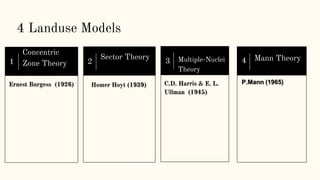
4 Landuse Models
1
Concentric
Zone Theory
Ernest Burgess (1926)
2
Homer Hoyt (1939)
3
C.D. Harris & E. L.
Ullman (1945)
Sector Theory 4
Multiple-Nuclei
Theory
Mann Theory
P.Mann (1965)
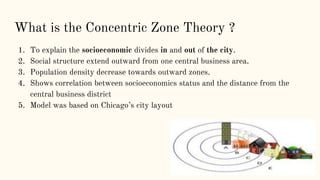
What is the Concentric Zone Theory ?
1. To explain the socioeconomic divides in and out of the city.
2. Social structure extend outward from one central business area.
3. Population density decrease towards outward zones.
4. Shows correlation between socioeconomics status and the distance from the
central business district
5. Model was based on Chicago’s city layout
Ernest Burgess describes a
city composed of several
layers of circles @ zone:
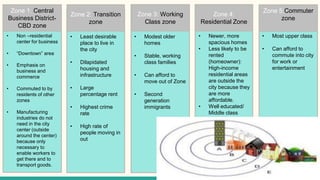
Zone 1 : Central Business
District-CBD – in central city.
Zone 2: The transition zone of
mixed residential and business
area.
Zone 3: Areas of workers -
housing for moderate and low-
income groups
Zone 4: The better housing
Zone 5 : Commuter zone
Zone 1: Central
Business District-
CBD zone
Zone 2: Transition
zone
Zone 3: Working
Class zone
Zone 4:
Residential Zone
Zone 5:Commuter
zone
• Non –residential
center for business
• “Downtown” area
• Emphasis on
business and
commerce
• Commuted to by
residents of other
zones
• Manufacturing
industries do not
need in the city
center (outside
around the center)
because only
necessary to
enable workers to
get there and to
transport goods.
• Least desirable
place to live in
the city
• Dilapidated
housing and
infrastructure
• Large
percentage rent
• Highest crime
rate
• High rate of
people moving in
out
• Modest older
homes
• Stable, working
class families
• Can afford to
move out of Zone
• Second
generation
immigrants
• Newer, more
spacious homes
• Less likely to be
rented
(homeowner):
High-income
residential areas
are outside the
city because they
are more
affordable.
• Well educated/
Middle class
• Most upper class
• Can afford to
commute into city
for work or
entertainment
• Burgess found - there is a relationship between the distance and the
wealth of well-occupied
• The rich people live farther from the center and a low
income live near the city and the workplace. Why ???
• Automobile and transportation factors into comparison.
• Urbanization causes the circle to expand and push out the layout of the
zone above.
• Introducing "Bid-rent Curve"
• City circle rate depends on
who wants to be expensed
by someone.
• Depending on the profits
going to be generated from
business activities.
• In the most expensive area
of ​​the city center has many
activities for the business.
The bid rent theory is a geographical economic theory that refers to how the price and demand for real estate
change as the distance from the central business district (CBD) increases. It states that different land users will
compete with one another for land close to the city center.
Problems with
the theory !
● Does not work with more
modern cities. Not reflect in
situation of cities in many
countries.
● Assumes an unchanging
landscape.
● Assumes flat land, without
geographic features inhibiting
growth
● Decentralization of business
areas.
Sector
Theory
Introduced by the Homer Hoyt (1939) also describes the
land use in the city.
Presenting the idea that the city grew along
railways, highways and the other transport
channels @ "highway induced development"
Using Chicago as a model, by observation - the tendency of
low-income housing groups are located along railroads.
Key points ?
Transportation & Industry
Cities grow oval / elongated by sector
of the city center along the road
outside.
The main business remained in the
city, but the manufacturing industry
located along the road outside the city
center.
Developing luxury housing along the
road away from the industrial area.
When a land use has taken over an
area, the same functionality will be
expanded in the area.
Alternative model to Burgess (CZT),
also known as the Hoyt model.
Multiple
Nuclei
Model
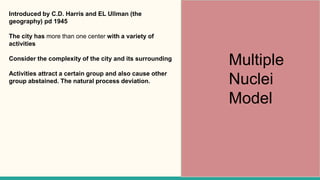
Introduced by C.D. Harris and EL Ullman (the
geography) pd 1945
The city has more than one center with a variety of
activities
Consider the complexity of the city and its surrounding
Activities attract a certain group and also cause other
group abstained. The natural process deviation.
● Example - the university attract students, certain people and certain types of businesses to the
area.
● At the airport - hotel and warehouse logistics.
● Inappropriate land use avoid grouping activities.
● Example - industrial and luxury residential areas are not located in the same area.
● Some activities can not be conducted in the area of high value - high rental prices.
● The industrial area is located near the area of low-cost housing for the convenience of shuttle
workers.
● Widely used in urban planning land use policy
● It is still a simplification of the urban landscape
Mann
Model
• Introduced by P Mann in 1965.
• Mix two models - concentric Zone and Sector Theory.
• There are four sectors - the middle class, lower middle class, working
class and the working class.
• Each sector there are 4 zones
1. City Center zone,
2. transition zone,
3. small house zone
4. houses built after 1918 (outer) zone
• Mann’s model is based on studies of medium-sized cities in northern
England which were not parts of conurbations.
• The model also incorporated a climatic consideration relevant to the UK
by assuming a prevailing wind from the west.
• But which were large enough to show distinct functional zones.
• Example: Huddersfield, Nottingham and Sheffield (model of studies)
The features of this model are :
1.The best residential area (A) is located
on the western fringe of the city, upwind
and on the opposite side of town from the
industrial sector (D).
2.The areas of the working class and the
main council estates are located close to
the industrial zone.
3.The lower middle class housing (B)
borders on each side of the best residential
area.

Landuse Models

  • 1.
    Theories & Concepts(Part II) Nor Suzylah Sohaimi, PhD. School of Government Universiti Utara Malaysia Kedah, Malaysia
  • 2.
    4 Landuse Models 1 Concentric ZoneTheory Ernest Burgess (1926) 2 Homer Hoyt (1939) 3 C.D. Harris & E. L. Ullman (1945) Sector Theory 4 Multiple-Nuclei Theory Mann Theory P.Mann (1965)
  • 3.
    What is theConcentric Zone Theory ? 1. To explain the socioeconomic divides in and out of the city. 2. Social structure extend outward from one central business area. 3. Population density decrease towards outward zones. 4. Shows correlation between socioeconomics status and the distance from the central business district 5. Model was based on Chicago’s city layout
  • 4.
    Ernest Burgess describesa city composed of several layers of circles @ zone: Zone 1 : Central Business District-CBD – in central city. Zone 2: The transition zone of mixed residential and business area. Zone 3: Areas of workers - housing for moderate and low- income groups Zone 4: The better housing Zone 5 : Commuter zone
  • 5.
    Zone 1: Central BusinessDistrict- CBD zone Zone 2: Transition zone Zone 3: Working Class zone Zone 4: Residential Zone Zone 5:Commuter zone • Non –residential center for business • “Downtown” area • Emphasis on business and commerce • Commuted to by residents of other zones • Manufacturing industries do not need in the city center (outside around the center) because only necessary to enable workers to get there and to transport goods. • Least desirable place to live in the city • Dilapidated housing and infrastructure • Large percentage rent • Highest crime rate • High rate of people moving in out • Modest older homes • Stable, working class families • Can afford to move out of Zone • Second generation immigrants • Newer, more spacious homes • Less likely to be rented (homeowner): High-income residential areas are outside the city because they are more affordable. • Well educated/ Middle class • Most upper class • Can afford to commute into city for work or entertainment
  • 6.
    • Burgess found- there is a relationship between the distance and the wealth of well-occupied • The rich people live farther from the center and a low income live near the city and the workplace. Why ??? • Automobile and transportation factors into comparison. • Urbanization causes the circle to expand and push out the layout of the zone above.
  • 7.
    • Introducing "Bid-rentCurve" • City circle rate depends on who wants to be expensed by someone. • Depending on the profits going to be generated from business activities. • In the most expensive area of ​​the city center has many activities for the business. The bid rent theory is a geographical economic theory that refers to how the price and demand for real estate change as the distance from the central business district (CBD) increases. It states that different land users will compete with one another for land close to the city center.
  • 8.
    Problems with the theory! ● Does not work with more modern cities. Not reflect in situation of cities in many countries. ● Assumes an unchanging landscape. ● Assumes flat land, without geographic features inhibiting growth ● Decentralization of business areas.
  • 9.
    Sector Theory Introduced by theHomer Hoyt (1939) also describes the land use in the city. Presenting the idea that the city grew along railways, highways and the other transport channels @ "highway induced development" Using Chicago as a model, by observation - the tendency of low-income housing groups are located along railroads. Key points ? Transportation & Industry
  • 10.
    Cities grow oval/ elongated by sector of the city center along the road outside. The main business remained in the city, but the manufacturing industry located along the road outside the city center. Developing luxury housing along the road away from the industrial area. When a land use has taken over an area, the same functionality will be expanded in the area. Alternative model to Burgess (CZT), also known as the Hoyt model.
  • 12.
    Multiple Nuclei Model Introduced by C.D.Harris and EL Ullman (the geography) pd 1945 The city has more than one center with a variety of activities Consider the complexity of the city and its surrounding Activities attract a certain group and also cause other group abstained. The natural process deviation.
  • 14.
    ● Example -the university attract students, certain people and certain types of businesses to the area. ● At the airport - hotel and warehouse logistics. ● Inappropriate land use avoid grouping activities. ● Example - industrial and luxury residential areas are not located in the same area. ● Some activities can not be conducted in the area of high value - high rental prices. ● The industrial area is located near the area of low-cost housing for the convenience of shuttle workers. ● Widely used in urban planning land use policy ● It is still a simplification of the urban landscape
  • 15.
    Mann Model • Introduced byP Mann in 1965. • Mix two models - concentric Zone and Sector Theory. • There are four sectors - the middle class, lower middle class, working class and the working class. • Each sector there are 4 zones 1. City Center zone, 2. transition zone, 3. small house zone 4. houses built after 1918 (outer) zone • Mann’s model is based on studies of medium-sized cities in northern England which were not parts of conurbations. • The model also incorporated a climatic consideration relevant to the UK by assuming a prevailing wind from the west. • But which were large enough to show distinct functional zones. • Example: Huddersfield, Nottingham and Sheffield (model of studies)
  • 16.
    The features ofthis model are : 1.The best residential area (A) is located on the western fringe of the city, upwind and on the opposite side of town from the industrial sector (D). 2.The areas of the working class and the main council estates are located close to the industrial zone. 3.The lower middle class housing (B) borders on each side of the best residential area.