Urban Renewal
URBAN RENEWAL – definition
• Local policies and strategies designed to deal with urban decline,
decay or transformation are termed as urban renewal.
• It is a comprehensive and integrated vision and action which leads
to the resolution of urban problems and which seeks to bring
about a lasting improvement in the economic, physical, social
and environmental conditions of an area that has been subject
to change’
• With the decision and authority of a governing municipality, re-
arranging land use, function and ownership features of a socially,
economically or structurally decayed part of a certain city .
• such as slum zones or brown fields, for the purpose of obtaining a
desired, well organized neighbourhood.
UNDERSTANDING URBAN RENEWAL
The term Urban renewal means rebirth or
regeneration of a city or a part of it which has
been plagued by the ills of urbanization
• The planning concept originated in England and
America in 1930’s
• Decayed parts of the city were demolished and
rebuilt.
• Initially referred to slum clearance and housing
but has gradually evolved into a
multidimensional concept.
• These programs were thrust upon the city and
its people and were criticized and halted on
opposition by organized community movements.
• The urban renewal programs taken up later,
involved greater participation of the
communities.
The triggers:-
• Effective functioning of Administrative towns
- ( state HQ, District HQ)
• To accommodate an event of magnitude.
- (Asian games, Common Wealth Games in Delhi, Tri
Centenary Celebrations of consecration of the
Guru Granth Sahib at Nanded)
• Necessity due to natural /man-made calamity
- (Earthquake in Bhuj, Plague in Surat)
• Obsolescence of land uses
- (Shifting of manufacturing industries )
• Market driven change of land use
- (Commercialization of Girgaum,Parel areas of
Mumbai)
• To conserve historic monuments/ environment.
- ( Areas around the Taj Mahal precinct )
• Lack of modern facilities
WHY URBAN RENEWAL?
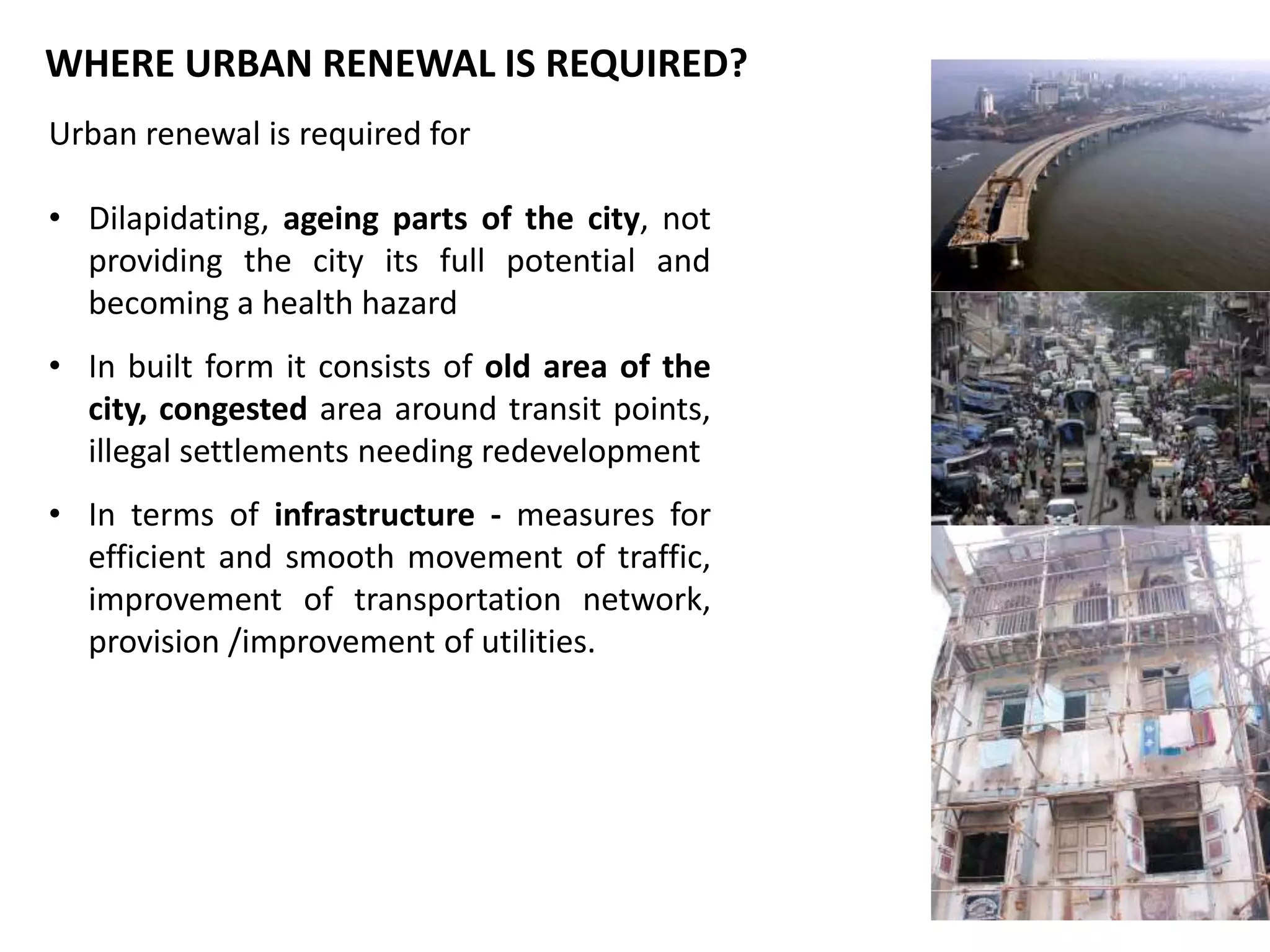
Urban renewal is required for
• Dilapidating, ageing parts of the city, not
providing the city its full potential and
becoming a health hazard
• In built form it consists of old area of the
city, congested area around transit points,
illegal settlements needing redevelopment
• In terms of infrastructure - measures for
efficient and smooth movement of traffic,
improvement of transportation network,
provision /improvement of utilities.
WHERE URBAN RENEWAL IS REQUIRED?
BASIC CONCEPT
• Urban Renewal programs are generally undertaken by public
authorities or by local governments.
• The emphasis is on those parts which have fallen below current
standards of public acceptability. These are commonly to be found
in:
o The residential parts of the inner city
o The central business district itself.
• Indicators for residential parts of inner cities are:
– inadequate housing,
– environmental degradation,
– presence of non-conforming uses.
• Indicators for central business district are:
– traffic problems,
– congestion,
– dilapidated buildings.
TOOLS / APPROACHES
• SLUM CLEARANCE: Demolition of dilapidated dwellings located in a
slum
• REDEVELOPMENT: The demolition of an existing building and its
replacement by a new building
• REHABILITATION : The repair and improvement of existing
structurally sound property
• HOUSING IMPROVEMENT : Improvements of dwellings by
provision of essential basic amenities
• CONSERVATION : To retain intact or unchanged.
• ENVIRONMENTAL IMPROVEMENTS : Main emphasis is to improve
environmental conditions
• ECONOMIC RENEWAL : Improvement of economic conditions of
dwellers
URBAN RENEWAL PROJECTS
• Following Projects fall under Urban Renewal:
– Redevelopment projects
– Economic development strategies
– Housing loans and other financial tools
– Streetscape improvements
– Transportation enhancement
– Historic preservation projects
– Parks and open spaces
Urban Renewal Typologies : Urban Centers
Urban Renewal Typologies : Informal Settlements
Urban Renewal Typologies : Exclusion Areas
Benefits
• Drives urban productivity
Eg:
– Creating mixed use development projects in CBD
– Creating regional hubs just outside of city limits to reduce residential
and commercial pressure on inner city area.
• Creates employment opportunities
• Attracts increased investments
– Intensifying use of land
– Densification of area can create new market for business
• Enhance housing affordability
– Brings key workers closer proximity to employment opportunities
• Capitalize on existing infrastructure
– Improvement of existing infrastructure saves cost of new expensive
infrastructure
• Increases tourism revenue
– Improved infrastructure and services.
• Indian cities have a history that dates back to
centuries
• In the last century cities faced a major
unprecedented force of urbanization which ripped
them
• They have grown exponentially
• Their administration has not been able cope up
with rapid urbanization
• The age old infrastructure is weakened and
decayed leading to degeneration of the core areas
in the city.
• Cities which have survived centuries are now at
critical stage.
• Concept of Urban Renewal – To provide life to the
dying city.
INDIAN CONTEXT

Urban renewal

  • 1.
  • 2.
    URBAN RENEWAL –definition • Local policies and strategies designed to deal with urban decline, decay or transformation are termed as urban renewal. • It is a comprehensive and integrated vision and action which leads to the resolution of urban problems and which seeks to bring about a lasting improvement in the economic, physical, social and environmental conditions of an area that has been subject to change’ • With the decision and authority of a governing municipality, re- arranging land use, function and ownership features of a socially, economically or structurally decayed part of a certain city . • such as slum zones or brown fields, for the purpose of obtaining a desired, well organized neighbourhood.
  • 3.
    UNDERSTANDING URBAN RENEWAL Theterm Urban renewal means rebirth or regeneration of a city or a part of it which has been plagued by the ills of urbanization • The planning concept originated in England and America in 1930’s • Decayed parts of the city were demolished and rebuilt. • Initially referred to slum clearance and housing but has gradually evolved into a multidimensional concept. • These programs were thrust upon the city and its people and were criticized and halted on opposition by organized community movements. • The urban renewal programs taken up later, involved greater participation of the communities.
  • 4.
    The triggers:- • Effectivefunctioning of Administrative towns - ( state HQ, District HQ) • To accommodate an event of magnitude. - (Asian games, Common Wealth Games in Delhi, Tri Centenary Celebrations of consecration of the Guru Granth Sahib at Nanded) • Necessity due to natural /man-made calamity - (Earthquake in Bhuj, Plague in Surat) • Obsolescence of land uses - (Shifting of manufacturing industries ) • Market driven change of land use - (Commercialization of Girgaum,Parel areas of Mumbai) • To conserve historic monuments/ environment. - ( Areas around the Taj Mahal precinct ) • Lack of modern facilities WHY URBAN RENEWAL?
  • 5.
    Urban renewal isrequired for • Dilapidating, ageing parts of the city, not providing the city its full potential and becoming a health hazard • In built form it consists of old area of the city, congested area around transit points, illegal settlements needing redevelopment • In terms of infrastructure - measures for efficient and smooth movement of traffic, improvement of transportation network, provision /improvement of utilities. WHERE URBAN RENEWAL IS REQUIRED?
  • 6.
    BASIC CONCEPT • UrbanRenewal programs are generally undertaken by public authorities or by local governments. • The emphasis is on those parts which have fallen below current standards of public acceptability. These are commonly to be found in: o The residential parts of the inner city o The central business district itself. • Indicators for residential parts of inner cities are: – inadequate housing, – environmental degradation, – presence of non-conforming uses. • Indicators for central business district are: – traffic problems, – congestion, – dilapidated buildings.
  • 7.
    TOOLS / APPROACHES •SLUM CLEARANCE: Demolition of dilapidated dwellings located in a slum • REDEVELOPMENT: The demolition of an existing building and its replacement by a new building • REHABILITATION : The repair and improvement of existing structurally sound property • HOUSING IMPROVEMENT : Improvements of dwellings by provision of essential basic amenities • CONSERVATION : To retain intact or unchanged. • ENVIRONMENTAL IMPROVEMENTS : Main emphasis is to improve environmental conditions • ECONOMIC RENEWAL : Improvement of economic conditions of dwellers
  • 8.
    URBAN RENEWAL PROJECTS •Following Projects fall under Urban Renewal: – Redevelopment projects – Economic development strategies – Housing loans and other financial tools – Streetscape improvements – Transportation enhancement – Historic preservation projects – Parks and open spaces
  • 9.
    Urban Renewal Typologies: Urban Centers
  • 10.
    Urban Renewal Typologies: Urban Centers
  • 11.
    Urban Renewal Typologies: Informal Settlements
  • 12.
    Urban Renewal Typologies: Informal Settlements
  • 13.
    Urban Renewal Typologies: Informal Settlements
  • 14.
    Urban Renewal Typologies: Exclusion Areas
  • 15.
    Urban Renewal Typologies: Exclusion Areas
  • 16.
    Benefits • Drives urbanproductivity Eg: – Creating mixed use development projects in CBD – Creating regional hubs just outside of city limits to reduce residential and commercial pressure on inner city area. • Creates employment opportunities • Attracts increased investments – Intensifying use of land – Densification of area can create new market for business • Enhance housing affordability – Brings key workers closer proximity to employment opportunities • Capitalize on existing infrastructure – Improvement of existing infrastructure saves cost of new expensive infrastructure • Increases tourism revenue – Improved infrastructure and services.
  • 17.
    • Indian citieshave a history that dates back to centuries • In the last century cities faced a major unprecedented force of urbanization which ripped them • They have grown exponentially • Their administration has not been able cope up with rapid urbanization • The age old infrastructure is weakened and decayed leading to degeneration of the core areas in the city. • Cities which have survived centuries are now at critical stage. • Concept of Urban Renewal – To provide life to the dying city. INDIAN CONTEXT