BUR 301:REGIONAL PLANNING
PRINCIPLES AND TECHNIQUES I
NAME: NAIBEI PETER
PRESENTATION ON:
•Need for Regional Planning
•Inter/intra-Regional Planning
•Summary/Conclusion
1.0 THE NEED FOR REGIONAL PLANNING
There is a wider variety of reasons that can necessitate
the government to engage in regional development :
1.
The existence of separate or different cultures and
political identies. Regional planning becomes a response
to strong feeling of regionalism as well as an element of
cohesion.
2.Functional problems which are spatially manifested e.g.
•
Problem of urban regions related to rapid
urbanization, urban sprawl, population growth etc.
•
Problem of depressed industrial and rural areas
suffering from economic malaise.
3. Facilitate national and regional socio-economic
integration by bringing regions to be active
participants in development effort.
4. Mobilization of locals human and financial
resources, governments and donors towards
creation of economic opportunities in different
regions (partnerships)
5. Provision of essential link between national
and local level plans e.g. information giving
6. Regional planning provide policy guiding
framework to both local and plans.
7. Information base for national/local plans
regarding resource and potentials and
priorities of a region- SWOT
8. Provide essential strategic cross-cutting
infrastructure linkages to facilitate inter and
intra regional flow of trade, communication...
9. Responds more effectively respond best to the
needs of the regional and local communities
than the national dev. plan.
10. Promotes community based development
strategy and opportunities for people to
participate more directly in development and
project implementation process.
2.0 APPROACHES TO REGIONAL PLANNING
2.1 INTRA-REGIONAL PLANNING
The problem of an urban region resulting from factors
like population growth, urbanization, increasing
personal mobility give rise to land use planning
approach. This is regarded as intra-regional planning or
planning within regions(Higher level than a single urban
authority)
It objectives/aims to:
1.Achieving satisfaction relationship between people,
jobs and the environment within a region. I.e. housing,
socio-cultural and recreational facilities
2.It is therefore multi- objective and addresses the
multi-cultural sectors needs and interest of a give
region. i.e. social, economic, aesthetic
2.1.1 APPLICATION EXAMPLES .
In the 1960s/70s - National development plans
and the Provincial Regional physical development
plan. e.g. CPPDP
2. During the 1970s, the government also
introduced Regional development authorities.
3. The District focus for Rural development
strategy aimed at strengthening the rural dvt.
4. 1940s in Britain, the turn of the century for
garden cities to deal with problems of
overcrowded cities.
2.2 INTER-REGIONAL PLANNING
This refers to planning between regions mainly from the
result of economic malaise in certain regions. This
approach aims to:
1.Achieve satisfactory relationship or balance between
people and jobs between regions2.At any spatial dimension it aims to achieve:
Economic growth-involves efficient utilization of
resources to achieve a higher rate of output.
Social equity-this is related to full employment equated
with reduction in inter-regional differences in per-capita
income.
Full employment- Both employment and unemployment
have a spatial dimension, and the eradication of major
inequalities in the regional development has been a factor
behind inter-regional planning.
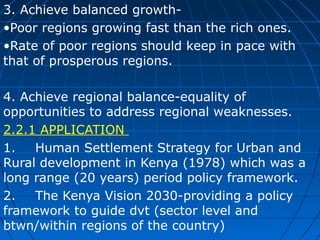
3. Achieve balanced growth•Poor regions growing fast than the rich ones.
•Rate of poor regions should keep in pace with
that of prosperous regions.
4. Achieve regional balance-equality of
opportunities to address regional weaknesses.
2.2.1 APPLICATION
1.
Human Settlement Strategy for Urban and
Rural development in Kenya (1978) which was a
long range (20 years) period policy framework.
2.
The Kenya Vision 2030-providing a policy
framework to guide dvt (sector level and
btwn/within regions of the country)
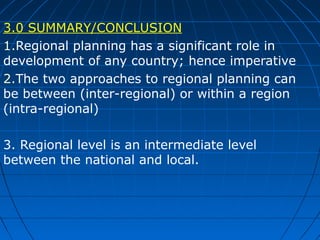
3.0 SUMMARY/CONCLUSION
1.Regional planning has a significant role in
development of any country; hence imperative
2.The two approaches to regional planning can
be between (inter-regional) or within a region
(intra-regional)
3. Regional level is an intermediate level
between the national and local.
Thank You!
petnab09@gmail.com

REGIONAL PLANNING

  • 1.
    BUR 301:REGIONAL PLANNING PRINCIPLESAND TECHNIQUES I NAME: NAIBEI PETER PRESENTATION ON: •Need for Regional Planning •Inter/intra-Regional Planning •Summary/Conclusion
  • 2.
    1.0 THE NEEDFOR REGIONAL PLANNING There is a wider variety of reasons that can necessitate the government to engage in regional development : 1. The existence of separate or different cultures and political identies. Regional planning becomes a response to strong feeling of regionalism as well as an element of cohesion. 2.Functional problems which are spatially manifested e.g. • Problem of urban regions related to rapid urbanization, urban sprawl, population growth etc. • Problem of depressed industrial and rural areas suffering from economic malaise.
  • 3.
    3. Facilitate nationaland regional socio-economic integration by bringing regions to be active participants in development effort. 4. Mobilization of locals human and financial resources, governments and donors towards creation of economic opportunities in different regions (partnerships) 5. Provision of essential link between national and local level plans e.g. information giving 6. Regional planning provide policy guiding framework to both local and plans.
  • 4.
    7. Information basefor national/local plans regarding resource and potentials and priorities of a region- SWOT 8. Provide essential strategic cross-cutting infrastructure linkages to facilitate inter and intra regional flow of trade, communication... 9. Responds more effectively respond best to the needs of the regional and local communities than the national dev. plan. 10. Promotes community based development strategy and opportunities for people to participate more directly in development and project implementation process.
  • 5.
    2.0 APPROACHES TOREGIONAL PLANNING 2.1 INTRA-REGIONAL PLANNING The problem of an urban region resulting from factors like population growth, urbanization, increasing personal mobility give rise to land use planning approach. This is regarded as intra-regional planning or planning within regions(Higher level than a single urban authority) It objectives/aims to: 1.Achieving satisfaction relationship between people, jobs and the environment within a region. I.e. housing, socio-cultural and recreational facilities 2.It is therefore multi- objective and addresses the multi-cultural sectors needs and interest of a give region. i.e. social, economic, aesthetic
  • 6.
    2.1.1 APPLICATION EXAMPLES. In the 1960s/70s - National development plans and the Provincial Regional physical development plan. e.g. CPPDP 2. During the 1970s, the government also introduced Regional development authorities. 3. The District focus for Rural development strategy aimed at strengthening the rural dvt. 4. 1940s in Britain, the turn of the century for garden cities to deal with problems of overcrowded cities.
  • 7.
    2.2 INTER-REGIONAL PLANNING Thisrefers to planning between regions mainly from the result of economic malaise in certain regions. This approach aims to: 1.Achieve satisfactory relationship or balance between people and jobs between regions2.At any spatial dimension it aims to achieve: Economic growth-involves efficient utilization of resources to achieve a higher rate of output. Social equity-this is related to full employment equated with reduction in inter-regional differences in per-capita income. Full employment- Both employment and unemployment have a spatial dimension, and the eradication of major inequalities in the regional development has been a factor behind inter-regional planning.
  • 8.
    3. Achieve balancedgrowth•Poor regions growing fast than the rich ones. •Rate of poor regions should keep in pace with that of prosperous regions. 4. Achieve regional balance-equality of opportunities to address regional weaknesses. 2.2.1 APPLICATION 1. Human Settlement Strategy for Urban and Rural development in Kenya (1978) which was a long range (20 years) period policy framework. 2. The Kenya Vision 2030-providing a policy framework to guide dvt (sector level and btwn/within regions of the country)
  • 9.
    3.0 SUMMARY/CONCLUSION 1.Regional planninghas a significant role in development of any country; hence imperative 2.The two approaches to regional planning can be between (inter-regional) or within a region (intra-regional) 3. Regional level is an intermediate level between the national and local.
  • 10.