URBAN MORPHOLOGY
BY:
NAIBEI PETER
UNIVERSITY OF NAIROBI –KENYA

Comments send to petnab09@gmail.com
CONCEPTS

1.
2.
3.
4.

5.

6.
7.

`Morphology`-is as “the study of form and process, growth and form, form and
function”.
urban morphology (U.M) -is the study of the form of human settlements and their
formation & transformation.
urban form-is the study of the physical characteristics of towns/cities resulting
from an evolutionary process of urban activities and planning action.
Human settlements-is the totality of the human community whether city, town, or
settlementsvillage with all the social, material, organizational spiritual and cultural element
that sustain it.
Urban fabric The physical aspect of urbanism, emphasizing building types,
thoroughfares, open space, frontages, and streetscapes but excluding
environmental, functional, economic and sociocultural aspects
Urban structure... its the physical complexity of various scale, from individual
building, plots, street-blocks, and the street pattern.
urban texture the geometrical structure formed by the spatial distribution of
urban elements expressed as coarse or fine.
OBJECTIVES
1.
2.
3.
4.
5.
6.
7.
8.

Comfort-reduction of stress such as noise, pollution
Accessibility-movement, transport and communication
Adequacy-basic facilities and services
Diversity and choice- variation of facilities and activities.
Adaptability and stability-resilience
Aesthetics and imageability-pleasantness
Interaction and participation-citizen for a, social contact.
Growth and continuity-physical and functional without
disconnect from the related/complimentary functions/areas.

TOOLS OF ANALYSIS
Transect analysis Visual survey Zoning
Texture analysis
Space syntax
analysis
Concentric ring
SPSS analysis

METHODS OF DATA COLLECTION
GIS data Remote sensing Direct
observation Literature review Visual
survey
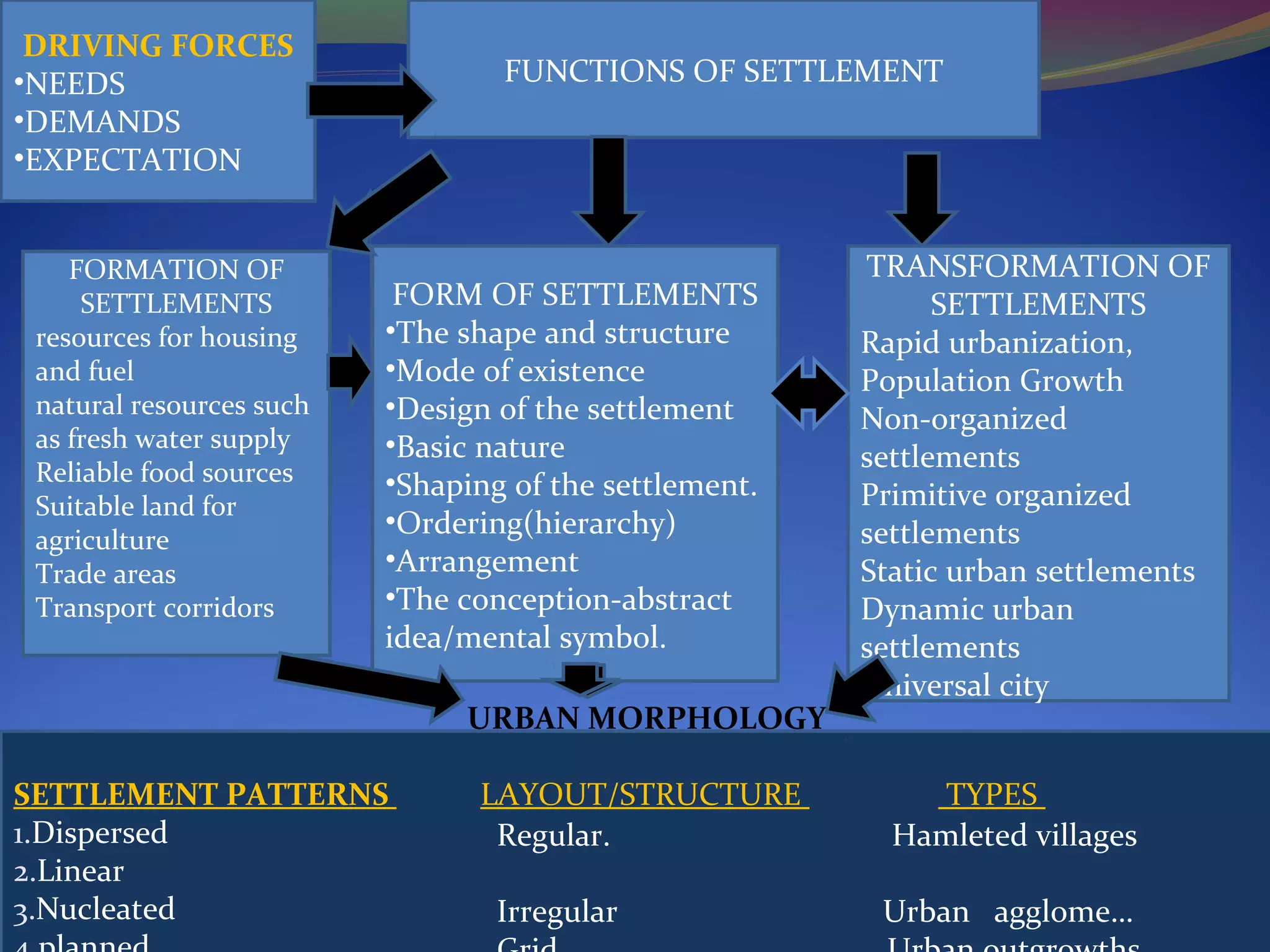
DRIVING FORCES
•NEEDS
•DEMANDS
•EXPECTATION
FORMATION OF
SETTLEMENTS
resources for housing
and fuel
natural resources such
as fresh water supply
Reliable food sources
Suitable land for
agriculture
Trade areas
Transport corridors

FUNCTIONS OF SETTLEMENT

FORM OF SETTLEMENTS
•The shape and structure
•Mode of existence
•Design of the settlement
•Basic nature
•Shaping of the settlement.
•Ordering(hierarchy)
•Arrangement
•The conception-abstract
idea/mental symbol.
URBAN MORPHOLOGY

SETTLEMENT PATTERNS
1.Dispersed
2.Linear
3.Nucleated

LAYOUT/STRUCTURE
Regular.
Irregular

TRANSFORMATION OF
SETTLEMENTS
Rapid urbanization,
Population Growth
Non-organized
settlements
Primitive organized
settlements
Static urban settlements
Dynamic urban
settlements
Universal city
TYPES
Hamleted villages
Urban agglome…
2. FORM
• Refers to the shape and arrangement of human settlement
while structure is the way they are organized. Form may be of:
AS A PRODUCT (state of being)

AS A PROCESS(state of becoming)

1.
2.
3.
4.

The shape and structure
Mode of existence
Design of the human settlement
Basic nature

1.
2.
3.
4.

•

DESCRIPTIVE ASPECTS OF FORM

Shaping of the human settlement.
Ordering(hierarchy)
Arrangement
The conception-abstract idea/mental symbol.

• Size, Density, Grain(coarse or fine), shape,
pattern and focal organization.
•
1.
2.
3.
4.

SETTLEMENT PATTERNS
Dispersed
Linear
Nucleated
planned
LAYOUT/STRUCTURE OF HUMAN SETTLEMENT
•
•
•
•

Regular.
Irregular
Grid
Radial centric

DETERMINANTS OF SETTLEMENT FORM,STRUCTURE AND
PATTERN
PHYSICAL
CONTROL

FUNCTION
AL FRAME

SOCIAL
MILIEU

CULTURAL ECONOMIC
FACTORS FACTORS

NATURAL
Topography
Climate
Geological
factors
MANMADE
Service distr.
Networks,
transportatio
n systems,
housing,
government
policy

• Linkages
• Channels
• Size of
space
• Quality of
space
functions
• Type of
developm
ent

• Level of
social
interactio
n
• institution
s
• Groups
• Social
amenities
and serv.
• Populatio
n

• Common
values
• Religious
/cultural
connotati
on

POLITICAL
AFFLUENCE

Economic
• Degree of
linkages such
dominance
as trading
• Command
centres,
btw
infrastructure
ppl/area
• Regionalis
m
SETTLEMENTS HIERACHY/
Name of
settlement

Size

Services

Hamlet

Very
small

Post office or perhaps none

Village

Small

Church, post office, school,
small shops

Town

Quite
large

Several shops and churches,
doctors/ dentist, bank, high
school, supermarket

City

Very
large

Large railway station,
shopping centre, cathedral,
large hospital, museum, etc
DETERMINANTS OF SETTLEMENT FORM,STRUCTURE AND
PATTERN

Type of
development

relief

Linkages/networks
/connectivity

Social factors
e.g. population

density

Water supply and uses
LAYOUT/STRUCTURE OF HUMAN SETTLEMENT

GRID
GRID

RADIALCENTRIC

IRREGULAR

REGULAR
3. VARIABLES
MACRO- SCALE

NEIGHBOURHOOD
SCALE

MICRO SCALE

•cultural production and
from of the city,

Covers plot,
block,
urban form,
Central Business District,
lot,
neighborhood form and typo
morphology.

Related to function, form,
urban elements, urban solid
and void, aesthetic, pattern,
street, square, open land,
urban structure and volume.

• political control and town
form.
• incremental nature of
urban morphology and
regional change.
• cultural context and
orientation of contemporary
urban planning.
.
Usually these are within
the town/city scale

Generally these concepts
are a transition between
macro and micro scales.
They focused on the
district/ neighbourhoods
level of the urban form.

This kind of concepts
more related to street,
square and open spaces.
CONCLUSION
1.









Urban Morphology is not and end-state by itself rather:
It has forces against which it acts.
It’s a regulator of function and this the morphology orientation
has a set aim to achieve.
It is one of the important variables as a determinant of the
urban pattern, urban form and urban space components.
While the urban form and structure consisted of various
compositions of physical and spatial elements, urban
morphology inquires these forms and relations between
causes and effects of the social forces within.
Expects to explore the differentiation of urban morphological
approaches in different urban space.
It tries to understand the physical or built fabric of urban form,
and the people and process shaping it .
To help predict urban changes i.e. small-scale variations and
peculiarities in the urban fabric e.g. new infrastructure.

Urban morphology

  • 1.
    URBAN MORPHOLOGY BY: NAIBEI PETER UNIVERSITYOF NAIROBI –KENYA Comments send to petnab09@gmail.com
  • 2.
    CONCEPTS 1. 2. 3. 4. 5. 6. 7. `Morphology`-is as “thestudy of form and process, growth and form, form and function”. urban morphology (U.M) -is the study of the form of human settlements and their formation & transformation. urban form-is the study of the physical characteristics of towns/cities resulting from an evolutionary process of urban activities and planning action. Human settlements-is the totality of the human community whether city, town, or settlementsvillage with all the social, material, organizational spiritual and cultural element that sustain it. Urban fabric The physical aspect of urbanism, emphasizing building types, thoroughfares, open space, frontages, and streetscapes but excluding environmental, functional, economic and sociocultural aspects Urban structure... its the physical complexity of various scale, from individual building, plots, street-blocks, and the street pattern. urban texture the geometrical structure formed by the spatial distribution of urban elements expressed as coarse or fine.
  • 3.
    OBJECTIVES 1. 2. 3. 4. 5. 6. 7. 8. Comfort-reduction of stresssuch as noise, pollution Accessibility-movement, transport and communication Adequacy-basic facilities and services Diversity and choice- variation of facilities and activities. Adaptability and stability-resilience Aesthetics and imageability-pleasantness Interaction and participation-citizen for a, social contact. Growth and continuity-physical and functional without disconnect from the related/complimentary functions/areas. TOOLS OF ANALYSIS Transect analysis Visual survey Zoning Texture analysis Space syntax analysis Concentric ring SPSS analysis METHODS OF DATA COLLECTION GIS data Remote sensing Direct observation Literature review Visual survey
  • 4.
    DRIVING FORCES •NEEDS •DEMANDS •EXPECTATION FORMATION OF SETTLEMENTS resourcesfor housing and fuel natural resources such as fresh water supply Reliable food sources Suitable land for agriculture Trade areas Transport corridors FUNCTIONS OF SETTLEMENT FORM OF SETTLEMENTS •The shape and structure •Mode of existence •Design of the settlement •Basic nature •Shaping of the settlement. •Ordering(hierarchy) •Arrangement •The conception-abstract idea/mental symbol. URBAN MORPHOLOGY SETTLEMENT PATTERNS 1.Dispersed 2.Linear 3.Nucleated LAYOUT/STRUCTURE Regular. Irregular TRANSFORMATION OF SETTLEMENTS Rapid urbanization, Population Growth Non-organized settlements Primitive organized settlements Static urban settlements Dynamic urban settlements Universal city TYPES Hamleted villages Urban agglome…
  • 5.
    2. FORM • Refersto the shape and arrangement of human settlement while structure is the way they are organized. Form may be of: AS A PRODUCT (state of being) AS A PROCESS(state of becoming) 1. 2. 3. 4. The shape and structure Mode of existence Design of the human settlement Basic nature 1. 2. 3. 4. • DESCRIPTIVE ASPECTS OF FORM Shaping of the human settlement. Ordering(hierarchy) Arrangement The conception-abstract idea/mental symbol. • Size, Density, Grain(coarse or fine), shape, pattern and focal organization. • 1. 2. 3. 4. SETTLEMENT PATTERNS Dispersed Linear Nucleated planned
  • 6.
    LAYOUT/STRUCTURE OF HUMANSETTLEMENT • • • • Regular. Irregular Grid Radial centric DETERMINANTS OF SETTLEMENT FORM,STRUCTURE AND PATTERN PHYSICAL CONTROL FUNCTION AL FRAME SOCIAL MILIEU CULTURAL ECONOMIC FACTORS FACTORS NATURAL Topography Climate Geological factors MANMADE Service distr. Networks, transportatio n systems, housing, government policy • Linkages • Channels • Size of space • Quality of space functions • Type of developm ent • Level of social interactio n • institution s • Groups • Social amenities and serv. • Populatio n • Common values • Religious /cultural connotati on POLITICAL AFFLUENCE Economic • Degree of linkages such dominance as trading • Command centres, btw infrastructure ppl/area • Regionalis m
  • 7.
    SETTLEMENTS HIERACHY/ Name of settlement Size Services Hamlet Very small Postoffice or perhaps none Village Small Church, post office, school, small shops Town Quite large Several shops and churches, doctors/ dentist, bank, high school, supermarket City Very large Large railway station, shopping centre, cathedral, large hospital, museum, etc
  • 8.
    DETERMINANTS OF SETTLEMENTFORM,STRUCTURE AND PATTERN Type of development relief Linkages/networks /connectivity Social factors e.g. population density Water supply and uses
  • 9.
    LAYOUT/STRUCTURE OF HUMANSETTLEMENT GRID GRID RADIALCENTRIC IRREGULAR REGULAR
  • 10.
    3. VARIABLES MACRO- SCALE NEIGHBOURHOOD SCALE MICROSCALE •cultural production and from of the city, Covers plot, block, urban form, Central Business District, lot, neighborhood form and typo morphology. Related to function, form, urban elements, urban solid and void, aesthetic, pattern, street, square, open land, urban structure and volume. • political control and town form. • incremental nature of urban morphology and regional change. • cultural context and orientation of contemporary urban planning. . Usually these are within the town/city scale Generally these concepts are a transition between macro and micro scales. They focused on the district/ neighbourhoods level of the urban form. This kind of concepts more related to street, square and open spaces.
  • 11.
    CONCLUSION 1.        Urban Morphology isnot and end-state by itself rather: It has forces against which it acts. It’s a regulator of function and this the morphology orientation has a set aim to achieve. It is one of the important variables as a determinant of the urban pattern, urban form and urban space components. While the urban form and structure consisted of various compositions of physical and spatial elements, urban morphology inquires these forms and relations between causes and effects of the social forces within. Expects to explore the differentiation of urban morphological approaches in different urban space. It tries to understand the physical or built fabric of urban form, and the people and process shaping it . To help predict urban changes i.e. small-scale variations and peculiarities in the urban fabric e.g. new infrastructure.