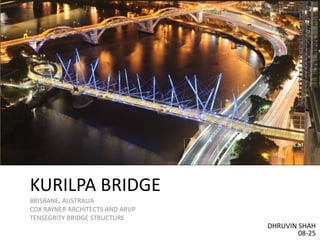
KURILPA BRIDGE
BRISBANE, AUSTRALIA
COX RAYNER ARCHITECTS AND ARUP
TENSEGRITY BRIDGE STRUCTURE
                                 DHRUVIN SHAH
                                         08-25
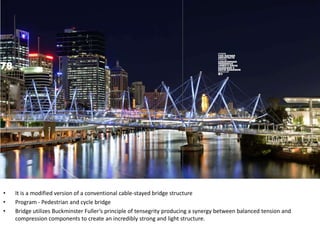
•   It is a modified version of a conventional cable-stayed bridge structure
•   Program - Pedestrian and cycle bridge
•   Bridge utilizes Buckminster Fuller’s principle of tensegrity producing a synergy between balanced tension and
    compression components to create an incredibly strong and light structure.
DESIGN
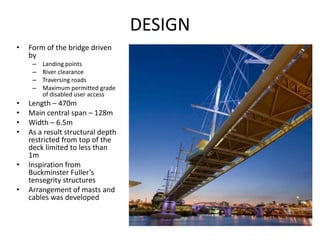
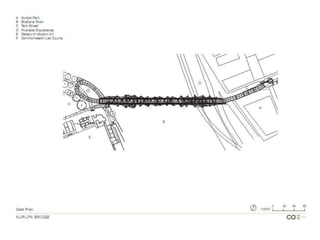
•   Form of the bridge driven
    by
     –   Landing points
     –   River clearance
     –   Traversing roads
     –   Maximum permitted grade
         of disabled user access
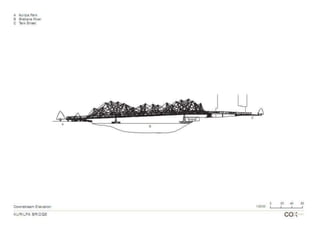
•   Length – 470m
•   Main central span – 128m
•   Width – 6.5m
•   As a result structural depth
    restricted from top of the
    deck limited to less than
    1m
•   Inspiration from
    Buckminster Fuller’s
    tensegrity structures
•   Arrangement of masts and
    cables was developed
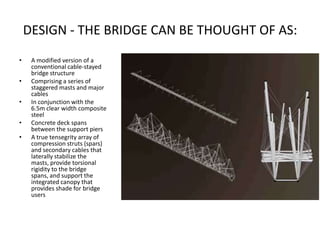
DESIGN - THE BRIDGE CAN BE THOUGHT OF AS:
•    A modified version of a
     conventional cable-stayed
     bridge structure
•    Comprising a series of
     staggered masts and major
     cables
•    In conjunction with the
     6.5m clear width composite
     steel
•    Concrete deck spans
     between the support piers
•    A true tensegrity array of
     compression struts (spars)
     and secondary cables that
     laterally stabilize the
     masts, provide torsional
     rigidity to the bridge
     spans, and support the
     integrated canopy that
     provides shade for bridge
     users
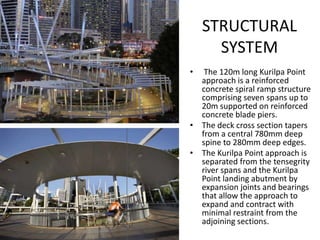
STRUCTURAL
      SYSTEM
•  The 120m long Kurilpa Point
  approach is a reinforced
  concrete spiral ramp structure
  comprising seven spans up to
  20m supported on reinforced
  concrete blade piers.
• The deck cross section tapers
  from a central 780mm deep
  spine to 280mm deep edges.
• The Kurilpa Point approach is
  separated from the tensegrity
  river spans and the Kurilpa
  Point landing abutment by
  expansion joints and bearings
  that allow the approach to
  expand and contract with
  minimal restraint from the
  adjoining sections.
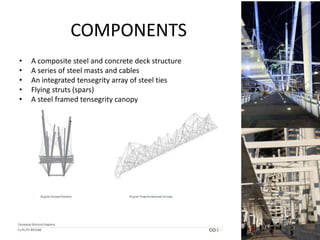
COMPONENTS
•   A composite steel and concrete deck structure
•   A series of steel masts and cables
•   An integrated tensegrity array of steel ties
•   Flying struts (spars)
•   A steel framed tensegrity canopy
CONSTRUCTION
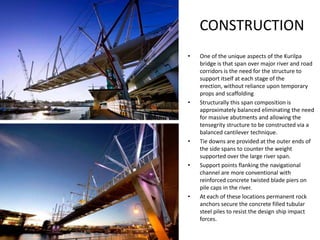
•   One of the unique aspects of the Kurilpa
    bridge is that span over major river and road
    corridors is the need for the structure to
    support itself at each stage of the
    erection, without reliance upon temporary
    props and scaffolding
•   Structurally this span composition is
    approximately balanced eliminating the need
    for massive abutments and allowing the
    tensegrity structure to be constructed via a
    balanced cantilever technique.
•   Tie downs are provided at the outer ends of
    the side spans to counter the weight
    supported over the large river span.
•   Support points flanking the navigational
    channel are more conventional with
    reinforced concrete twisted blade piers on
    pile caps in the river.
•   At each of these locations permanent rock
    anchors secure the concrete filled tubular
    steel piles to resist the design ship impact
    forces.
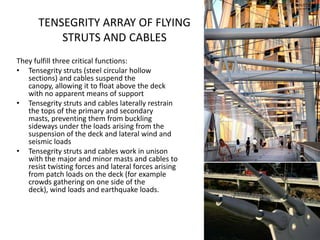
TENSEGRITY ARRAY OF FLYING
           STRUTS AND CABLES
They fulfill three critical functions:
• Tensegrity struts (steel circular hollow
   sections) and cables suspend the
   canopy, allowing it to float above the deck
   with no apparent means of support
• Tensegrity struts and cables laterally restrain
   the tops of the primary and secondary
   masts, preventing them from buckling
   sideways under the loads arising from the
   suspension of the deck and lateral wind and
   seismic loads
• Tensegrity struts and cables work in unison
   with the major and minor masts and cables to
   resist twisting forces and lateral forces arising
   from patch loads on the deck (for example
   crowds gathering on one side of the
   deck), wind loads and earthquake loads.

Dhruvin kurilpa bridge

  • 1.
    KURILPA BRIDGE BRISBANE, AUSTRALIA COXRAYNER ARCHITECTS AND ARUP TENSEGRITY BRIDGE STRUCTURE DHRUVIN SHAH 08-25
  • 2.
    It is a modified version of a conventional cable-stayed bridge structure • Program - Pedestrian and cycle bridge • Bridge utilizes Buckminster Fuller’s principle of tensegrity producing a synergy between balanced tension and compression components to create an incredibly strong and light structure.
  • 3.
    DESIGN • Form of the bridge driven by – Landing points – River clearance – Traversing roads – Maximum permitted grade of disabled user access • Length – 470m • Main central span – 128m • Width – 6.5m • As a result structural depth restricted from top of the deck limited to less than 1m • Inspiration from Buckminster Fuller’s tensegrity structures • Arrangement of masts and cables was developed
  • 5.
    DESIGN - THEBRIDGE CAN BE THOUGHT OF AS: • A modified version of a conventional cable-stayed bridge structure • Comprising a series of staggered masts and major cables • In conjunction with the 6.5m clear width composite steel • Concrete deck spans between the support piers • A true tensegrity array of compression struts (spars) and secondary cables that laterally stabilize the masts, provide torsional rigidity to the bridge spans, and support the integrated canopy that provides shade for bridge users
  • 7.
    STRUCTURAL SYSTEM • The 120m long Kurilpa Point approach is a reinforced concrete spiral ramp structure comprising seven spans up to 20m supported on reinforced concrete blade piers. • The deck cross section tapers from a central 780mm deep spine to 280mm deep edges. • The Kurilpa Point approach is separated from the tensegrity river spans and the Kurilpa Point landing abutment by expansion joints and bearings that allow the approach to expand and contract with minimal restraint from the adjoining sections.
  • 8.
    COMPONENTS • A composite steel and concrete deck structure • A series of steel masts and cables • An integrated tensegrity array of steel ties • Flying struts (spars) • A steel framed tensegrity canopy
  • 9.
    CONSTRUCTION • One of the unique aspects of the Kurilpa bridge is that span over major river and road corridors is the need for the structure to support itself at each stage of the erection, without reliance upon temporary props and scaffolding • Structurally this span composition is approximately balanced eliminating the need for massive abutments and allowing the tensegrity structure to be constructed via a balanced cantilever technique. • Tie downs are provided at the outer ends of the side spans to counter the weight supported over the large river span. • Support points flanking the navigational channel are more conventional with reinforced concrete twisted blade piers on pile caps in the river. • At each of these locations permanent rock anchors secure the concrete filled tubular steel piles to resist the design ship impact forces.
  • 10.
    TENSEGRITY ARRAY OFFLYING STRUTS AND CABLES They fulfill three critical functions: • Tensegrity struts (steel circular hollow sections) and cables suspend the canopy, allowing it to float above the deck with no apparent means of support • Tensegrity struts and cables laterally restrain the tops of the primary and secondary masts, preventing them from buckling sideways under the loads arising from the suspension of the deck and lateral wind and seismic loads • Tensegrity struts and cables work in unison with the major and minor masts and cables to resist twisting forces and lateral forces arising from patch loads on the deck (for example crowds gathering on one side of the deck), wind loads and earthquake loads.