Bid Rent Theory
Presented by
Muhammad Kashif Khan
Department of Urban and Regional Planning
Theory
First theoretician of bid rent effect
was David Ricardo
Later developed by J.H von Thünen,
who combined it with the notion of
transport costs.
This model, introduced by
William Alonso, in 1964
was inspired by Von Thünen's model.
Background
• This theory has been drawn on concept
from microeconomics and is based on
the work of Alonso (1964) & Muth
(1969). This theory focuses on how the
land use patterns are determined by
the land values. these are further
dependent on the transportation costs
& accessibility.
Bid Rent
Theory
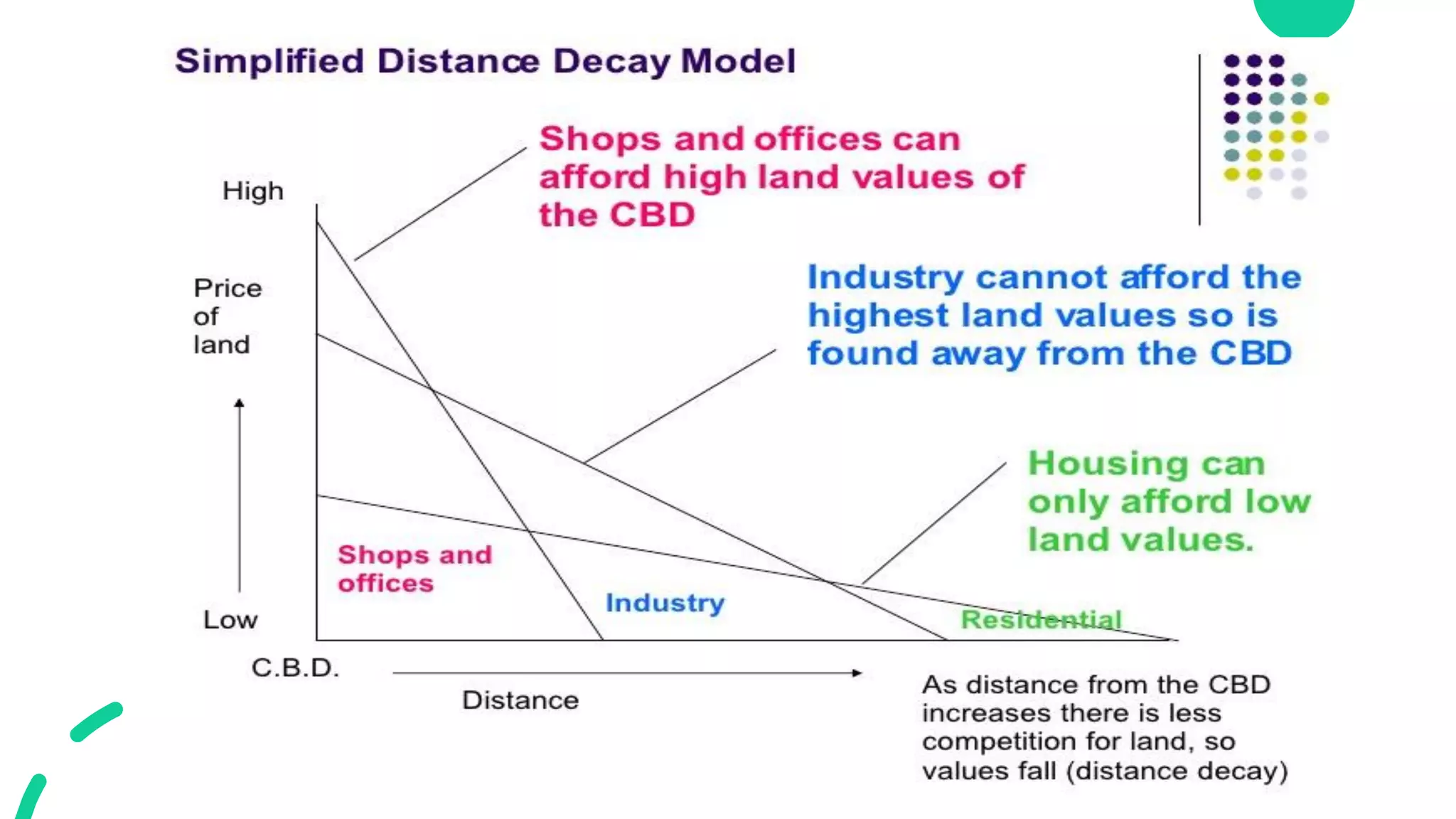
The Bid rent theory is a Geographical economic
theory that refers to how the price and demand
for real estate change as the distance from the
central business district (CBD) increases.
This is based upon the idea that
retail establishment wish to maximize their
profitability, so they are much more willing
to pay more for land close to the CBD and less
for land further away from this area.
This theory is based u[on the
reasoning that the more accessible an area ( i.e.,
the greater the concentration of customers), the
more profitable.
Sectors
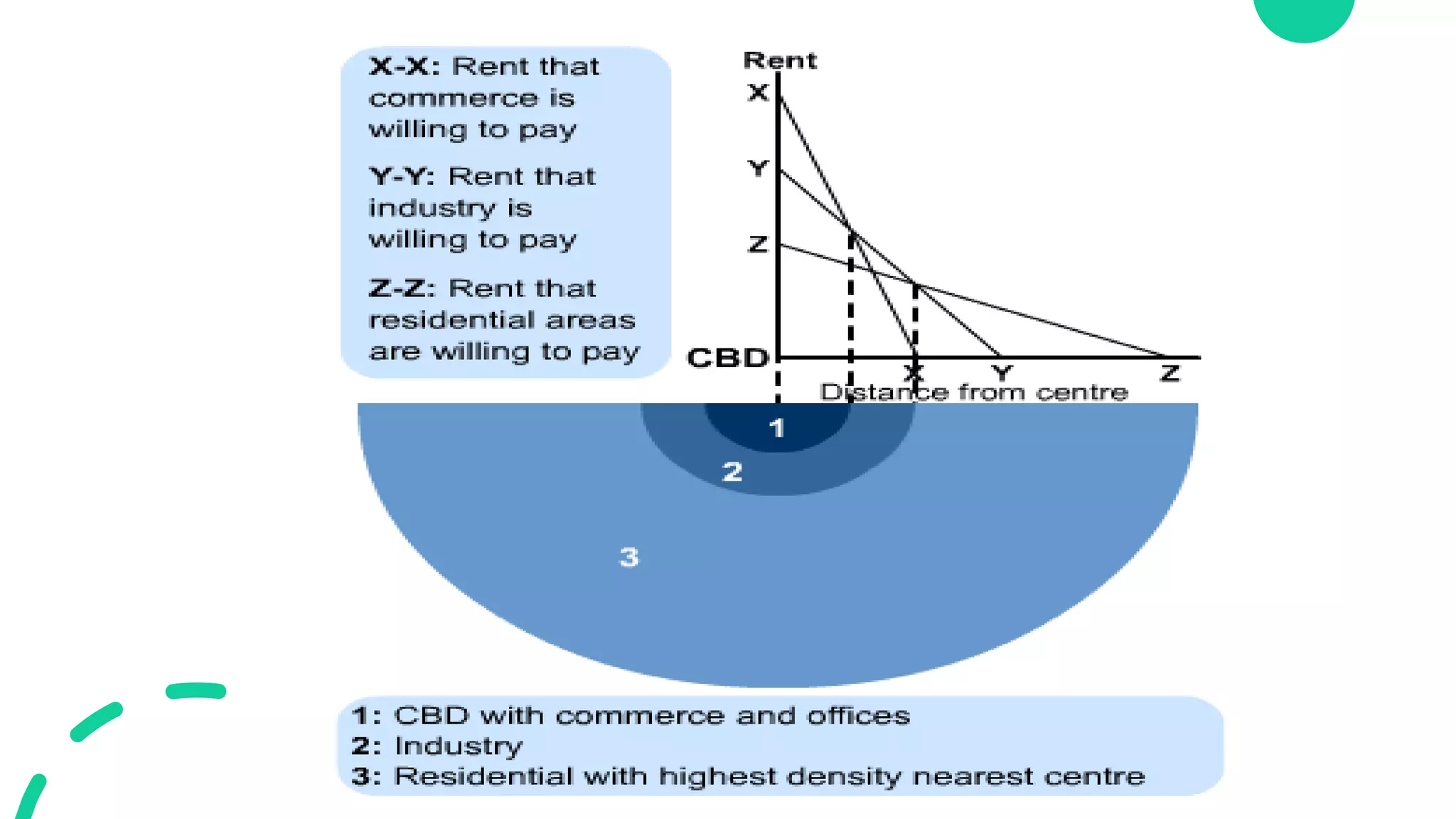
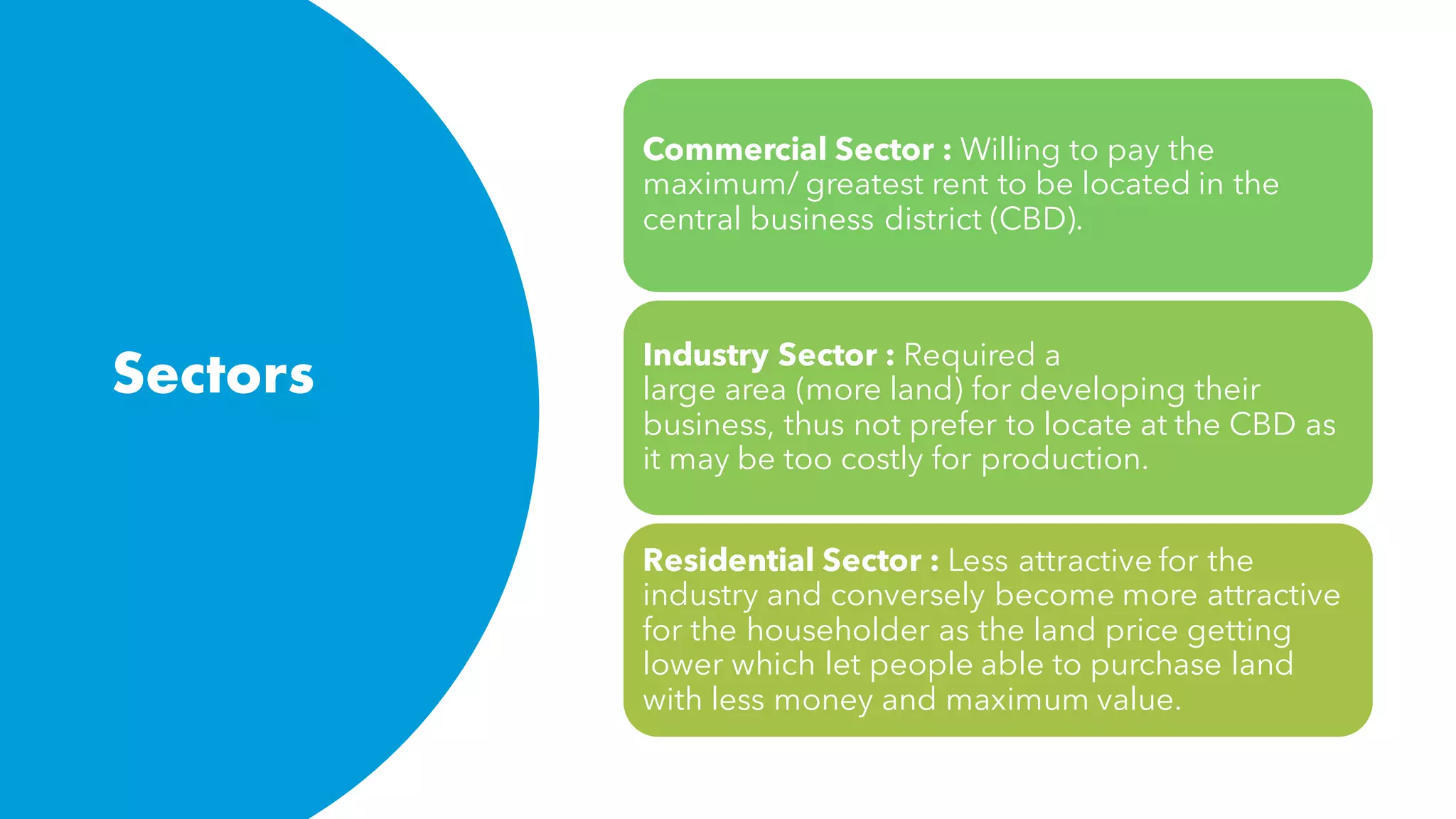
Commercial Sector : Willing to pay the
maximum/ greatest rent to be located in the
central business district (CBD).
Industry Sector : Required a
large area (more land) for developing their
business, thus not prefer to locate at the CBD as
it may be too costly for production.
Residential Sector : Less attractive for the
industry and conversely become more attractive
for the householder as the land price getting
lower which let people able to purchase land
with less money and maximum value.
Characteristics
People are less willing to pay for land which far
away from the CBD and conversely willing to
pay more for land near CBD.
Each form land use such as agricultural, retail,
services, or housing generate different Bid
Rent Curves.
This theory does not concern about relief
variations, planning constraints, lines of
communication and so on.
Curves for residential starts lower which means
that the house owner cannot afford the high
rents that manufacturers can.
Strength of
the Bid
Rent
Theory
Most of the countries follow the
same pattern.
It helps us to understand the
process involved in
the growth of city.
Simple and easy to understand.
Weakness
of the Bid
Rent
Theory
In the traditional "low class" areas, we
a found some of the most expensive
property due to urban regenration
and gentrification or culture variation.
Not all countries have a high demand
for centralized land. Thus we
found that
this theory takes a very broad pattern.
• Industry retailer prefer to rent
the area which are near with a
highway as it have a better
transportation system. The
price of the land held at suburb
area or outer location will be
lower compare with the inner
city.

Bid Rent Theory

  • 1.
    Bid Rent Theory Presentedby Muhammad Kashif Khan Department of Urban and Regional Planning
  • 2.
    Theory First theoretician ofbid rent effect was David Ricardo Later developed by J.H von Thünen, who combined it with the notion of transport costs. This model, introduced by William Alonso, in 1964 was inspired by Von Thünen's model.
  • 3.
    Background • This theoryhas been drawn on concept from microeconomics and is based on the work of Alonso (1964) & Muth (1969). This theory focuses on how the land use patterns are determined by the land values. these are further dependent on the transportation costs & accessibility.
  • 4.
    Bid Rent Theory The Bidrent theory is a Geographical economic theory that refers to how the price and demand for real estate change as the distance from the central business district (CBD) increases. This is based upon the idea that retail establishment wish to maximize their profitability, so they are much more willing to pay more for land close to the CBD and less for land further away from this area. This theory is based u[on the reasoning that the more accessible an area ( i.e., the greater the concentration of customers), the more profitable.
  • 7.
    Sectors Commercial Sector :Willing to pay the maximum/ greatest rent to be located in the central business district (CBD). Industry Sector : Required a large area (more land) for developing their business, thus not prefer to locate at the CBD as it may be too costly for production. Residential Sector : Less attractive for the industry and conversely become more attractive for the householder as the land price getting lower which let people able to purchase land with less money and maximum value.
  • 8.
    Characteristics People are lesswilling to pay for land which far away from the CBD and conversely willing to pay more for land near CBD. Each form land use such as agricultural, retail, services, or housing generate different Bid Rent Curves. This theory does not concern about relief variations, planning constraints, lines of communication and so on. Curves for residential starts lower which means that the house owner cannot afford the high rents that manufacturers can.
  • 9.
    Strength of the Bid Rent Theory Mostof the countries follow the same pattern. It helps us to understand the process involved in the growth of city. Simple and easy to understand.
  • 10.
    Weakness of the Bid Rent Theory Inthe traditional "low class" areas, we a found some of the most expensive property due to urban regenration and gentrification or culture variation. Not all countries have a high demand for centralized land. Thus we found that this theory takes a very broad pattern.
  • 11.
    • Industry retailerprefer to rent the area which are near with a highway as it have a better transportation system. The price of the land held at suburb area or outer location will be lower compare with the inner city.