Urbanization Causes and Effects
Urbanization Urbanization  refers to a process in which an increasing proportion of a society live in cities and the suburbs of cities.  Historically, it has been closely connected with industrialization.   Industrialization is a process that extensively uses inanimate sources of energy to enhance human productivity. Following industrialization, surpluses increased in both agriculture and industry.  Larger and larger proportions of a population could live in cities.   Economic forces were such that cities became the ideal places to locate factories and their workers.
City or Urban Settlement A " city " refers to a place of relatively dense settlement -- dense enough so that city residents can not grow their own food resources.  A city population, therefore, is always dependent upon its " hinterlands " to provide it with food resources. 
Causes of Urbanization Industrial Revolution Industrialization following the Industrial Revolution Emergence of  large manufacturing centers Job Opportunities Availability of easy transportation Migration
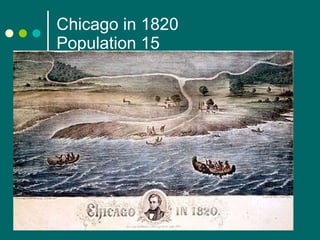
Chicago in 1820 Population 15
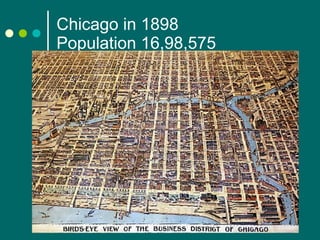
Chicago in 1898 Population 16,98,575
Effects of Urbanization Positive Negative
Pluses Benefits include reduced transport costs, exchange of ideas, and sharing of natural resources.  Cities act as beacons for the rural population because they represent a higher standard of living  Cities offer opportunities to people not available in the countryside
Pluses Social & Religious taboos/ sanctions disappearing Education is a tool to eradicate social evils Industrialization, Urbanization, Education, Legislation, Secularization-sequence of development Diffusion of urban culture to rural areas
Minuses Industrial cities were difficult places to live in due to: Public health issues resulting from contaminated water and air and the spread communicable diseases due to overcrowding.  Unemployment and under employment Severe shortage of housing Transportation-commuting issues, lack of public transport, no adequate investment Social effects - poverty, lack of opportunities, psychological problems, alcoholism, drugs, crime, violence  and other deviant behaviors
Public health Sanitation - the settlements were ill equipped to handle large populations and their sanitation needs Pollution – Caused by effluents, smoke and smog Fire hazards – due to use of flammable materials and proximity/ congestion  Epidemics - due to s pread of communicable diseases  caused by contaminated water &  air
Unemployment Unemployment  is the condition of willing workers lacking jobs or "gainful employment". Before industrialization unemployment has been said not to have been recognized as an issue in rural areas, despite the "disguised unemployment" of rural laborers having little to do, especially in conditions of overpopulation
Impact of unemployment on society Individual – failure to meet financial obligations such as purchasing food to feed oneself and one's family, and paying one's bills, failure to make mortgage payments or to pay rent may lead to homelessness. Societal - rising unemployment increases the crime rate
Housing  Overcrowding Loss of privacy Lack of housing contributes directly to crime, stress, and family breakdown Shortage of livable housing leading to growth of slums Human beings have a right to lead a life of dignity
Transportation Transport  or  transportation  is the movement of people and goods from one place to another.  Because of the much higher densities of people and activities in cities, transportation is a key issue. Inadequate/ lack of public transport creates commuting problems leading to loss of efficiency.
Social Effects - Poverty Poverty is generally defined at the individual or family level as not having enough money to buy basic necessities.  Poverty is caused by lack of opportunities Poverty causes malnutrition and illness; it is a major source of mental stress and loss of self-esteem which may lead to depression, and have a further negative impact on health.
Social Effects - Crime Financial insecurity No welfare systems in place Lack of meaningful work (Low importance to meaningful work and high importance to higher profits and greater efficiency) Anonymity -direct correlation between higher crime rate and higher rootlessness
Urbanization in India
In India, about 38% of the population lives in cities. The process of urbanization is still nascent in the Indian context.
Ancient India was a civilized society with many urban centers and centers of learning. Early Urbanization - Mohenjodaro   Harappa Capitals   - Kanauj   - Ujjain Religious Centers - Bodh Gaya   - Varanashi University towns  - Takshasila   Nalanda
Mughal Cities Agra Lahore Fatehpur Sikri The seven cities of Delhi
Colonial Cities – Delhi, Pondicherry, Goa Cantonment Towns – Bangalore, Secunderabad, Nagpur,Lucknow Hill Resorts – Shimla, Nainital, Darjeeling, Ooty, Kodaikanal Ports – Surat, Mumbai, Calicut, Kolkatta, Vizag, Chennai
Effects of Colonization Introduction of Western systems of education Macaulization (after Lord Macaulay) of Indian Education Development of labor force- skilled/ unskilled
Independent India Administrative capitals – Center & State Industrial Towns – Bhilai, Rourkela, Jamshedpur, Ahmedabad, Surat, Kolar
Today Megacities – Mumbai, Delhi, Kolkatta, Chennai, Bangalore, Hyderabad Rapid Urbanization- rate of urbanization increasing
The process of urbanization is still nascent in the Indian context. This explains the focus of global attention on the developing nations.  There are huge profits to be made in the process of development.

5.effects of urbanization

  • 1.
  • 2.
    Urbanization Urbanization refers to a process in which an increasing proportion of a society live in cities and the suburbs of cities.  Historically, it has been closely connected with industrialization.  Industrialization is a process that extensively uses inanimate sources of energy to enhance human productivity. Following industrialization, surpluses increased in both agriculture and industry.  Larger and larger proportions of a population could live in cities.   Economic forces were such that cities became the ideal places to locate factories and their workers.
  • 3.
    City or UrbanSettlement A " city " refers to a place of relatively dense settlement -- dense enough so that city residents can not grow their own food resources.  A city population, therefore, is always dependent upon its " hinterlands " to provide it with food resources. 
  • 4.
    Causes of UrbanizationIndustrial Revolution Industrialization following the Industrial Revolution Emergence of large manufacturing centers Job Opportunities Availability of easy transportation Migration
  • 5.
    Chicago in 1820Population 15
  • 6.
    Chicago in 1898Population 16,98,575
  • 7.
    Effects of UrbanizationPositive Negative
  • 8.
    Pluses Benefits includereduced transport costs, exchange of ideas, and sharing of natural resources. Cities act as beacons for the rural population because they represent a higher standard of living Cities offer opportunities to people not available in the countryside
  • 9.
    Pluses Social &Religious taboos/ sanctions disappearing Education is a tool to eradicate social evils Industrialization, Urbanization, Education, Legislation, Secularization-sequence of development Diffusion of urban culture to rural areas
  • 10.
    Minuses Industrial citieswere difficult places to live in due to: Public health issues resulting from contaminated water and air and the spread communicable diseases due to overcrowding. Unemployment and under employment Severe shortage of housing Transportation-commuting issues, lack of public transport, no adequate investment Social effects - poverty, lack of opportunities, psychological problems, alcoholism, drugs, crime, violence and other deviant behaviors
  • 11.
    Public health Sanitation- the settlements were ill equipped to handle large populations and their sanitation needs Pollution – Caused by effluents, smoke and smog Fire hazards – due to use of flammable materials and proximity/ congestion Epidemics - due to s pread of communicable diseases caused by contaminated water & air
  • 12.
    Unemployment Unemployment is the condition of willing workers lacking jobs or "gainful employment". Before industrialization unemployment has been said not to have been recognized as an issue in rural areas, despite the "disguised unemployment" of rural laborers having little to do, especially in conditions of overpopulation
  • 13.
    Impact of unemploymenton society Individual – failure to meet financial obligations such as purchasing food to feed oneself and one's family, and paying one's bills, failure to make mortgage payments or to pay rent may lead to homelessness. Societal - rising unemployment increases the crime rate
  • 14.
    Housing OvercrowdingLoss of privacy Lack of housing contributes directly to crime, stress, and family breakdown Shortage of livable housing leading to growth of slums Human beings have a right to lead a life of dignity
  • 15.
    Transportation Transport or transportation is the movement of people and goods from one place to another. Because of the much higher densities of people and activities in cities, transportation is a key issue. Inadequate/ lack of public transport creates commuting problems leading to loss of efficiency.
  • 16.
    Social Effects -Poverty Poverty is generally defined at the individual or family level as not having enough money to buy basic necessities. Poverty is caused by lack of opportunities Poverty causes malnutrition and illness; it is a major source of mental stress and loss of self-esteem which may lead to depression, and have a further negative impact on health.
  • 17.
    Social Effects -Crime Financial insecurity No welfare systems in place Lack of meaningful work (Low importance to meaningful work and high importance to higher profits and greater efficiency) Anonymity -direct correlation between higher crime rate and higher rootlessness
  • 18.
  • 19.
    In India, about38% of the population lives in cities. The process of urbanization is still nascent in the Indian context.
  • 20.
    Ancient India wasa civilized society with many urban centers and centers of learning. Early Urbanization - Mohenjodaro Harappa Capitals - Kanauj - Ujjain Religious Centers - Bodh Gaya - Varanashi University towns - Takshasila Nalanda
  • 21.
    Mughal Cities AgraLahore Fatehpur Sikri The seven cities of Delhi
  • 22.
    Colonial Cities –Delhi, Pondicherry, Goa Cantonment Towns – Bangalore, Secunderabad, Nagpur,Lucknow Hill Resorts – Shimla, Nainital, Darjeeling, Ooty, Kodaikanal Ports – Surat, Mumbai, Calicut, Kolkatta, Vizag, Chennai
  • 23.
    Effects of ColonizationIntroduction of Western systems of education Macaulization (after Lord Macaulay) of Indian Education Development of labor force- skilled/ unskilled
  • 24.
    Independent India Administrativecapitals – Center & State Industrial Towns – Bhilai, Rourkela, Jamshedpur, Ahmedabad, Surat, Kolar
  • 25.
    Today Megacities –Mumbai, Delhi, Kolkatta, Chennai, Bangalore, Hyderabad Rapid Urbanization- rate of urbanization increasing
  • 26.
    The process ofurbanization is still nascent in the Indian context. This explains the focus of global attention on the developing nations. There are huge profits to be made in the process of development.