Le Corbusier’s Paris

                         AR 0416, Town Planning & Human Settlements,


  Lutyen’s New Delhi


                                    INTRODUCTION
                                              TO
Lucio Costa’s Brasilia
                               TOWN PLANNING AND
                               PLANNING CONCEPTS
                                       CT.Lakshmanan B.Arch., M.C.P.
PRESENTATION STRUCTURE
       INTRODUCTION              PLANNING CONCEPTS
• DEFINITION                  • GARDEN CITY – Sir Ebenezer
• PLANNER”S ROLE               Howard

• AIMS & OBJECTIVES OF TOWN   • GEDDISIAN TRIAD – Patrick Geddes
 PLANNING                     • NEIGHBOURHOOD PLANNING –
• PLANNING PROCESS             C.A.Perry

• URBAN & RURAL IN INDIA      • RADBURN LAYOUT

• TYPES OF SURVEYS            • EKISTICS

• SURVEYING TECHNIQUES        • SATELLITE TOWNS

• DIFFERENT TYPE OF PLANS     • RIBBON DEVELOPMENT
TOWN PLANNING
“A city should be built to give
its inhabitants security and “A place where men
happiness” – Aristotle       had a common life for
                             a noble end” – Plato
people have the right to the
city

                                  Town planning
                                  a mediation of space;
                                  making of a place
WHAT IS TOWN PLANNING ?
The art and science of ordering the
use of land and siting of buildings
and communication routes so as to
secure the maximum practicable
degree of economy, convenience,
and beauty.
An attempt to formulate the principles
that should guide us in creating a
civilized physical background for human
life whose main impetus is thus …
foreseeing and guiding change.
WHAT IS TOWN PLANNING ?
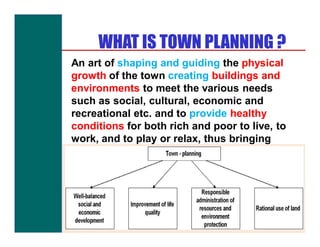
An art of shaping and guiding the physical
growth of the town creating buildings and
environments to meet the various needs
such as social, cultural, economic and
recreational etc. and to provide healthy
conditions for both rich and poor to live, to
work, and to play or relax, thus bringing
about the social and economic well-being
for the majority of mankind.
WHAT IS TOWN PLANNING ?
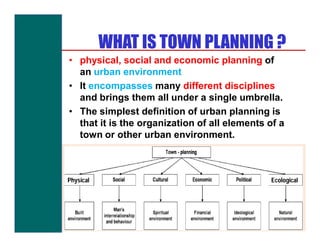
• physical, social and economic planning of
  an urban environment
• It encompasses many different disciplines
  and brings them all under a single umbrella.
• The simplest definition of urban planning is
  that it is the organization of all elements of a
  town or other urban environment.


Physical                                      Ecological
IF PLANNING WAS NOT THERE?
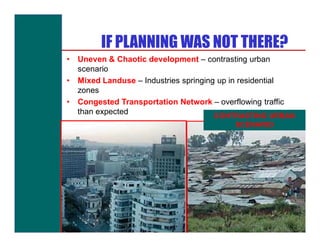
•   Uneven & Chaotic development – contrasting urban
    scenario
•   Mixed Landuse – Industries springing up in residential
    zones
•   Congested Transportation Network – overflowing traffic
    than expected
                                       CONTRASTING URBAN
                                           SCENARIO
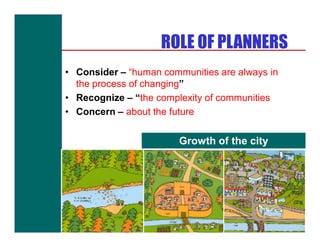
ROLE OF PLANNERS
• Consider – “human communities are always in
  the process of changing”
• Recognize – “the complexity of communities
• Concern – about the future


                        Growth of the city
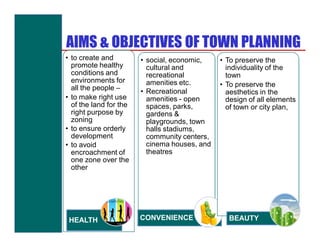
AIMS & OBJECTIVES OF TOWN PLANNING
• to create and         • social, economic,    • To preserve the
  promote healthy         cultural and           individuality of the
  conditions and          recreational           town
  environments for        amenities etc.
  all the people –                             • To preserve the
                        • Recreational           aesthetics in the
• to make right use       amenities - open       design of all elements
  of the land for the     spaces, parks,         of town or city plan,
  right purpose by        gardens &
  zoning                  playgrounds, town
• to ensure orderly       halls stadiums,
  development             community centers,
• to avoid                cinema houses, and
  encroachment of         theatres
  one zone over the
  other


 HEALTH                 CONVENIENCE              BEAUTY
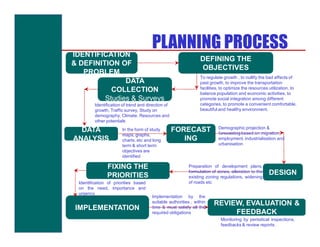
IDENTIFICATION
                                        PLANNING PROCESS
                                                                  DEFINING THE
& DEFINITION OF
                                                                  OBJECTIVES
   PROBLEM
                                                                  To regulate growth , to nullify the bad effects of
               DATA                                               past growth, to improve the transportation
                                                                  facilities, to optimize the resources utilization, to
           COLLECTION                                             balance population and economic activities, to
         Studies & Surveys                                        promote social integration among different
          Identification of trend and direction of                categories, to promote a convenient comfortable,
          growth, Traffic survey, Study on                        beautiful and healthy environment.
          demography, Climate, Resources and
          other potentials
                                                                            Demographic projection &
  DATA                  In the form of study         FORECAST               forecasting based on migration,
                        maps, graphs,
ANALYSIS                charts, etc and long            ING                 employment, industrialisation and
                        term & short term                                   urbanisation
                        objectives are
                        identified

                FIXING THE                                 Preparation of development plans,

                PRIORITIES
                                                           formulation of zones, alteration to the
                                                           existing zoning regulations, widening
                                                                                                       DESIGN
  Identification of priorities based                       of roads etc
  on the need, importance and
  urgency
                                        Implementation by the
                                        suitable authorities , within    REVIEW, EVALUATION &
 IMPLEMENTATION                         time & must satisfy all the
                                        required obligations                  FEEDBACK
                                                                             Monitoring by periodical inspections,
                                                                             feedbacks & review reports.
URBAN & RURAL INDIA
Urban Area – Census of India
• all places with a
  municipality, corporation,
  cantonment board
  or notified town area
  committee;
• all other places which has features as
   – a minimum population of 5000;
   – at least 75% of the male working population
     engaged in non- agricultural pursuits and
   – a density of population of at least
     400 persons per sq. km. and predominantly
     urban way of life (urbanism)
Apart from urban area & urban agglomeration
rest is considered as Rural Area.
URBAN & RURAL INDIA
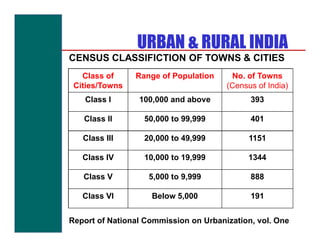
CENSUS CLASSIFICTION OF TOWNS & CITIES
   Class of     Range of Population     No. of Towns
 Cities/Towns                          (Census of India)
    Class I      100,000 and above           393

   Class II       50,000 to 99,999           401

   Class III      20,000 to 49,999           1151

   Class IV       10,000 to 19,999           1344

   Class V         5,000 to 9,999            888

   Class VI         Below 5,000              191


Report of National Commission on Urbanization, vol. One
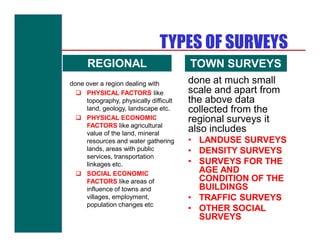
TYPES OF SURVEYS
     REGIONAL                          TOWN SURVEYS
      SURVEYS
done over a region dealing with        done at much small
   PHYSICAL FACTORS like              scale and apart from
    topography, physically difficult   the above data
    land, geology, landscape etc.      collected from the
   PHYSICAL ECONOMIC                  regional surveys it
    FACTORS like agricultural
    value of the land, mineral
                                       also includes
    resources and water gathering      • LANDUSE SURVEYS
    lands, areas with public           • DENSITY SURVEYS
    services, transportation
    linkages etc.                      • SURVEYS FOR THE
   SOCIAL ECONOMIC                      AGE AND
    FACTORS like areas of                CONDITION OF THE
    influence of towns and               BUILDINGS
    villages, employment,              • TRAFFIC SURVEYS
    population changes etc
                                       • OTHER SOCIAL
                                         SURVEYS
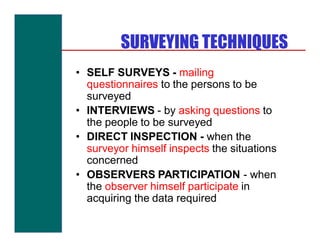
SURVEYING TECHNIQUES
• SELF SURVEYS - mailing
  questionnaires to the persons to be
  surveyed
• INTERVIEWS - by asking questions to
  the people to be surveyed
• DIRECT INSPECTION - when the
  surveyor himself inspects the situations
  concerned
• OBSERVERS PARTICIPATION - when
  the observer himself participate in
  acquiring the data required
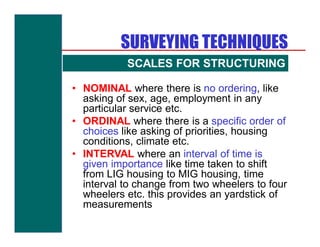
SURVEYING TECHNIQUES
           SCALES FOR STRUCTURING
                    QUESTIONNAIRE
• NOMINAL where there is no ordering, like
  asking of sex, age, employment in any
  particular service etc.
• ORDINAL where there is a specific order of
  choices like asking of priorities, housing
  conditions, climate etc.
• INTERVAL where an interval of time is
  given importance like time taken to shift
  from LIG housing to MIG housing, time
  interval to change from two wheelers to four
  wheelers etc. this provides an yardstick of
  measurements
SURVEYING TECHNIQUES
                         Sample Size – number of persons
SELECTION OF             selected for conducting the survey
SAMPLES
                         Sample – persons that are included
• More disastrous        in the survey
  results - of poor
  information, larger                             TYPES OF
  sample size is                                  SAMPLES
  required.
• For varied expected   • SIMPLE RANDOM SAMPLING -
                          selecting samples at random without any
  responses - larger      criteria to select the samples
  sample size is        • SYSTEMATIC SAMPLING -selection of
  required.               the Kth element along a particular street,
• Larger the total        where k can be any number
  population, smaller   • STRATIFIED SAMPLING - making of a
  the percentage of       homogenous listing of the different sects
  the population are      of the population and collecting a certain
                          percentage at random from each sect
  required to be        • CLUSTERED SAMPLING - when
  surveyed.               samples are selected from clusters and
                          not from a homogeneous listing
DIFFERENT TYPES OF PLANS
Structural                 Comprehensive                     Developmental
plan                       plan                              plan
•   A structure plan        • The                            •   means a plan for
    is one that singles out                                      the development
    for attention of          comprehensive                      or re-
    certain aspect of the       plan seeks to combine in         development or
    environment usually         one document the                 improvement of the
    the land-uses, the main     prescriptions for all            area within the
    movement systems            aspects of city                  jurisdiction of a
    and the location of         development.                     planning authority
    critical facilities and •   It includes an analysis of   •   It includes a
    buildings.
                                the city’s economy, its          regional plan,
•    Such a plan aims to        demographic                      master plan,
    influence certain key       characteristics, and the         detailed
    vocational decisions
                                history of its spatial           development plan
    while recognizing that
                                development as a                 and a new town
    there are many other
    things that can’t and       preface to plan for how          development plan
    perhaps should not be       the city should evolve
    decided at the outset.      over 20 year period

Introduction to town planning

  • 1.
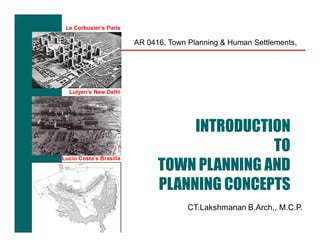
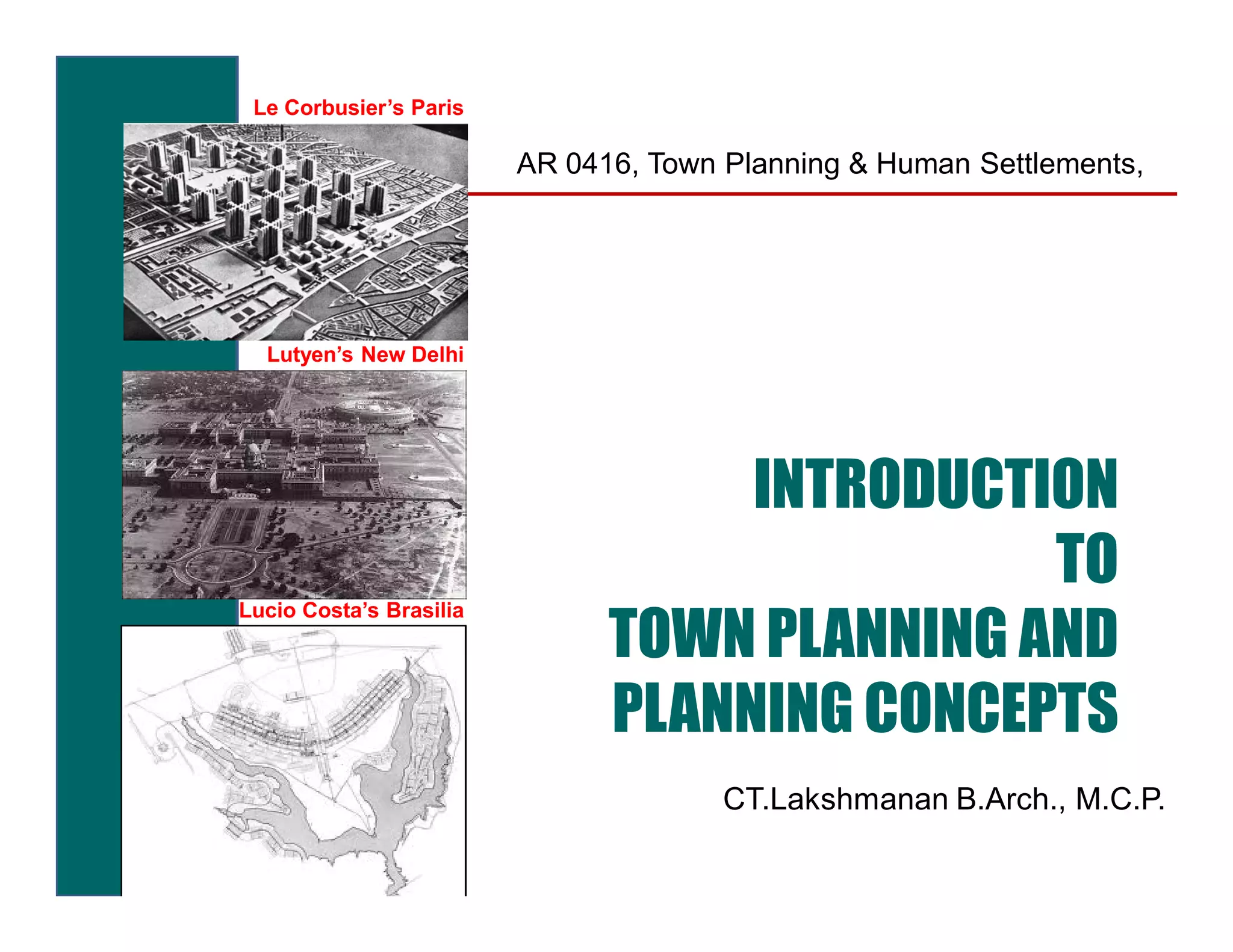
    Le Corbusier’s Paris AR 0416, Town Planning & Human Settlements, Lutyen’s New Delhi INTRODUCTION TO Lucio Costa’s Brasilia TOWN PLANNING AND PLANNING CONCEPTS CT.Lakshmanan B.Arch., M.C.P.
  • 2.
    PRESENTATION STRUCTURE INTRODUCTION PLANNING CONCEPTS • DEFINITION • GARDEN CITY – Sir Ebenezer • PLANNER”S ROLE Howard • AIMS & OBJECTIVES OF TOWN • GEDDISIAN TRIAD – Patrick Geddes PLANNING • NEIGHBOURHOOD PLANNING – • PLANNING PROCESS C.A.Perry • URBAN & RURAL IN INDIA • RADBURN LAYOUT • TYPES OF SURVEYS • EKISTICS • SURVEYING TECHNIQUES • SATELLITE TOWNS • DIFFERENT TYPE OF PLANS • RIBBON DEVELOPMENT
  • 3.
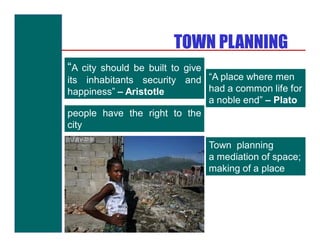
    TOWN PLANNING “A cityshould be built to give its inhabitants security and “A place where men happiness” – Aristotle had a common life for a noble end” – Plato people have the right to the city Town planning a mediation of space; making of a place
  • 4.
    WHAT IS TOWNPLANNING ? The art and science of ordering the use of land and siting of buildings and communication routes so as to secure the maximum practicable degree of economy, convenience, and beauty. An attempt to formulate the principles that should guide us in creating a civilized physical background for human life whose main impetus is thus … foreseeing and guiding change.
  • 5.
    WHAT IS TOWNPLANNING ? An art of shaping and guiding the physical growth of the town creating buildings and environments to meet the various needs such as social, cultural, economic and recreational etc. and to provide healthy conditions for both rich and poor to live, to work, and to play or relax, thus bringing about the social and economic well-being for the majority of mankind.
  • 6.
    WHAT IS TOWNPLANNING ? • physical, social and economic planning of an urban environment • It encompasses many different disciplines and brings them all under a single umbrella. • The simplest definition of urban planning is that it is the organization of all elements of a town or other urban environment. Physical Ecological
  • 7.
    IF PLANNING WASNOT THERE? • Uneven & Chaotic development – contrasting urban scenario • Mixed Landuse – Industries springing up in residential zones • Congested Transportation Network – overflowing traffic than expected CONTRASTING URBAN SCENARIO
  • 8.
    ROLE OF PLANNERS •Consider – “human communities are always in the process of changing” • Recognize – “the complexity of communities • Concern – about the future Growth of the city
  • 9.
    AIMS & OBJECTIVESOF TOWN PLANNING • to create and • social, economic, • To preserve the promote healthy cultural and individuality of the conditions and recreational town environments for amenities etc. all the people – • To preserve the • Recreational aesthetics in the • to make right use amenities - open design of all elements of the land for the spaces, parks, of town or city plan, right purpose by gardens & zoning playgrounds, town • to ensure orderly halls stadiums, development community centers, • to avoid cinema houses, and encroachment of theatres one zone over the other HEALTH CONVENIENCE BEAUTY
  • 10.
    IDENTIFICATION PLANNING PROCESS DEFINING THE & DEFINITION OF OBJECTIVES PROBLEM To regulate growth , to nullify the bad effects of DATA past growth, to improve the transportation facilities, to optimize the resources utilization, to COLLECTION balance population and economic activities, to Studies & Surveys promote social integration among different Identification of trend and direction of categories, to promote a convenient comfortable, growth, Traffic survey, Study on beautiful and healthy environment. demography, Climate, Resources and other potentials Demographic projection & DATA In the form of study FORECAST forecasting based on migration, maps, graphs, ANALYSIS charts, etc and long ING employment, industrialisation and term & short term urbanisation objectives are identified FIXING THE Preparation of development plans, PRIORITIES formulation of zones, alteration to the existing zoning regulations, widening DESIGN Identification of priorities based of roads etc on the need, importance and urgency Implementation by the suitable authorities , within REVIEW, EVALUATION & IMPLEMENTATION time & must satisfy all the required obligations FEEDBACK Monitoring by periodical inspections, feedbacks & review reports.
  • 11.
    URBAN & RURALINDIA Urban Area – Census of India • all places with a municipality, corporation, cantonment board or notified town area committee; • all other places which has features as – a minimum population of 5000; – at least 75% of the male working population engaged in non- agricultural pursuits and – a density of population of at least 400 persons per sq. km. and predominantly urban way of life (urbanism) Apart from urban area & urban agglomeration rest is considered as Rural Area.
  • 12.
    URBAN & RURALINDIA CENSUS CLASSIFICTION OF TOWNS & CITIES Class of Range of Population No. of Towns Cities/Towns (Census of India) Class I 100,000 and above 393 Class II 50,000 to 99,999 401 Class III 20,000 to 49,999 1151 Class IV 10,000 to 19,999 1344 Class V 5,000 to 9,999 888 Class VI Below 5,000 191 Report of National Commission on Urbanization, vol. One
  • 13.
    TYPES OF SURVEYS REGIONAL TOWN SURVEYS SURVEYS done over a region dealing with done at much small  PHYSICAL FACTORS like scale and apart from topography, physically difficult the above data land, geology, landscape etc. collected from the  PHYSICAL ECONOMIC regional surveys it FACTORS like agricultural value of the land, mineral also includes resources and water gathering • LANDUSE SURVEYS lands, areas with public • DENSITY SURVEYS services, transportation linkages etc. • SURVEYS FOR THE  SOCIAL ECONOMIC AGE AND FACTORS like areas of CONDITION OF THE influence of towns and BUILDINGS villages, employment, • TRAFFIC SURVEYS population changes etc • OTHER SOCIAL SURVEYS
  • 14.
    SURVEYING TECHNIQUES • SELFSURVEYS - mailing questionnaires to the persons to be surveyed • INTERVIEWS - by asking questions to the people to be surveyed • DIRECT INSPECTION - when the surveyor himself inspects the situations concerned • OBSERVERS PARTICIPATION - when the observer himself participate in acquiring the data required
  • 15.
    SURVEYING TECHNIQUES SCALES FOR STRUCTURING QUESTIONNAIRE • NOMINAL where there is no ordering, like asking of sex, age, employment in any particular service etc. • ORDINAL where there is a specific order of choices like asking of priorities, housing conditions, climate etc. • INTERVAL where an interval of time is given importance like time taken to shift from LIG housing to MIG housing, time interval to change from two wheelers to four wheelers etc. this provides an yardstick of measurements
  • 16.
    SURVEYING TECHNIQUES Sample Size – number of persons SELECTION OF selected for conducting the survey SAMPLES Sample – persons that are included • More disastrous in the survey results - of poor information, larger TYPES OF sample size is SAMPLES required. • For varied expected • SIMPLE RANDOM SAMPLING - selecting samples at random without any responses - larger criteria to select the samples sample size is • SYSTEMATIC SAMPLING -selection of required. the Kth element along a particular street, • Larger the total where k can be any number population, smaller • STRATIFIED SAMPLING - making of a the percentage of homogenous listing of the different sects the population are of the population and collecting a certain percentage at random from each sect required to be • CLUSTERED SAMPLING - when surveyed. samples are selected from clusters and not from a homogeneous listing
  • 17.
    DIFFERENT TYPES OFPLANS Structural Comprehensive Developmental plan plan plan • A structure plan • The • means a plan for is one that singles out the development for attention of comprehensive or re- certain aspect of the plan seeks to combine in development or environment usually one document the improvement of the the land-uses, the main prescriptions for all area within the movement systems aspects of city jurisdiction of a and the location of development. planning authority critical facilities and • It includes an analysis of • It includes a buildings. the city’s economy, its regional plan, • Such a plan aims to demographic master plan, influence certain key characteristics, and the detailed vocational decisions history of its spatial development plan while recognizing that development as a and a new town there are many other things that can’t and preface to plan for how development plan perhaps should not be the city should evolve decided at the outset. over 20 year period