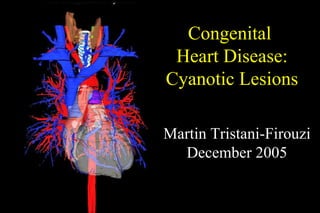
Congenital  Heart Disease: Cyanotic Lesions Martin Tristani-Firouzi December 2005
scenario It’s 2:00 A.M. Your first night on call on your Pediatric rotation. The R.N. in the newborn nursery calls you to see a blue baby. You run.
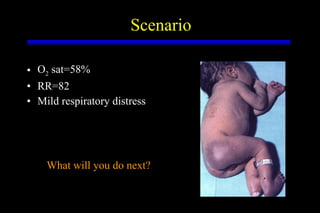
Scenario O 2  sat=58% RR=82 Mild respiratory distress What will you do next?
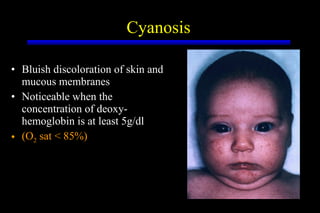
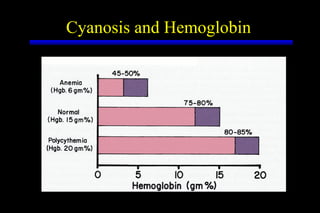
Cyanosis Bluish discoloration of skin and mucous membranes Noticeable when the concentration of deoxy-hemoglobin is at least 5g/dl  (O 2  sat < 85%)
Cyanosis: peripheral vs central peripheral Sluggish blow flow in capillaries  Involves extremities (acrocyanosis) Spares trunk & mucous membranes central Abnl of lungs or heart that interferes w/ O2 transport Involves trunk & mucous membranes
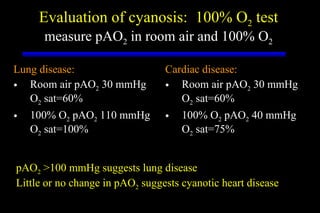
Evaluation of cyanosis:  100% O 2  test measure pAO 2  in room air and 100% O 2 Lung disease: Room air pAO 2  30 mmHg O 2  sat=60% 100% O 2  pAO 2  110 mmHg O 2  sat=100% Cardiac disease: Room air pAO 2  30 mmHg O 2  sat=60% 100% O 2  pAO 2  40 mmHg O 2  sat=75% pAO 2  >100 mmHg suggests lung disease Little or no change in pAO 2  suggests cyanotic heart disease
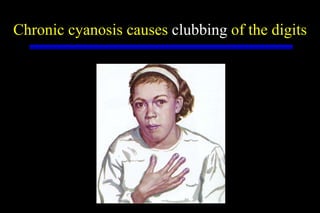
Chronic cyanosis causes  clubbing  of the digits
Prostaglandin (PGE 1 ) Stable derivative of endogenous compound that maintains ductal patency in utero Prevents postnatal ductal closure, improves pulmonary blood flow, improves oxygenation Stabilizes cyanotic neonate so that corrective surgery can be performed “electively” PGE 1  revolutionized the fields of pediatric cardiology and cardiovascular surgery
The basis of congenital heart disease is rooted in an arrest of or deviation in normal cardiac development
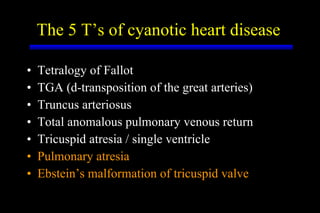
The 5 T’s of cyanotic heart disease Tetralogy of Fallot TGA (d-transposition of the great arteries) Truncus arteriosus Total anomalous pulmonary venous return Tricuspid atresia / single ventricle Pulmonary atresia Ebstein’s malformation of tricuspid valve
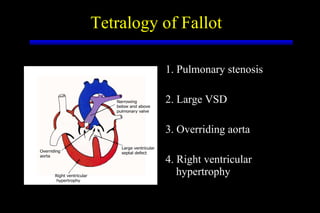
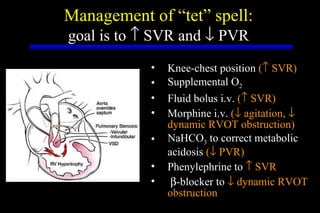
Tetralogy of Fallot 1. Pulmonary stenosis 2. Large VSD 3. Overriding aorta 4. Right ventricular hypertrophy
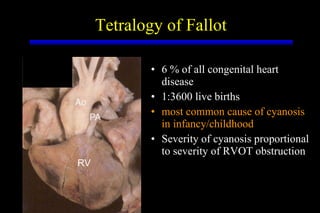
Tetralogy of Fallot 6 % of all congenital heart disease 1:3600 live births most common cause of cyanosis in infancy/childhood Severity of cyanosis proportional to severity of RVOT obstruction RV
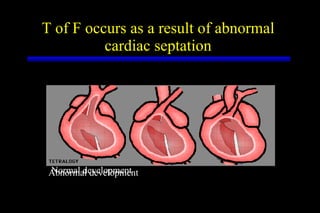
T of F occurs as a result of abnormal  cardiac septation  Normal development Abnormal development
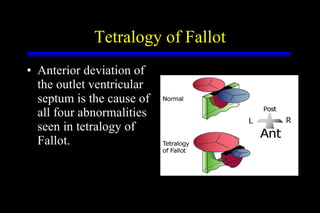
Tetralogy of Fallot Anterior deviation of the outlet ventricular septum is the cause of all four abnormalities seen in tetralogy of Fallot.
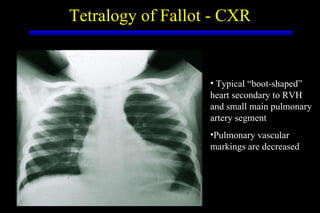
Tetralogy of Fallot - CXR Typical “boot-shaped” heart secondary to RVH and small main pulmonary artery segment Pulmonary vascular markings are decreased
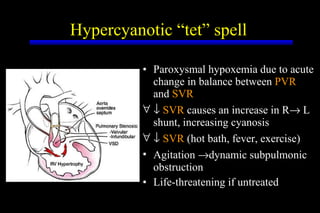
Hypercyanotic “tet” spell Paroxysmal hypoxemia due to acute change in balance between  PVR  and  SVR    SVR  causes an increase in R   L shunt, increasing cyanosis    SVR  (hot bath, fever, exercise) Agitation   dynamic subpulmonic obstruction Life-threatening if untreated
Management of “tet” spell: goal is to    SVR and    PVR Knee-chest position  (   SVR) Supplemental O 2 Fluid bolus i.v.  (   SVR) Morphine i.v.  (   agitation,    dynamic RVOT obstruction) NaHCO 3  to correct metabolic acidosis  (   PVR) Phenylephrine to    SVR  -blocker to    dynamic RVOT obstruction
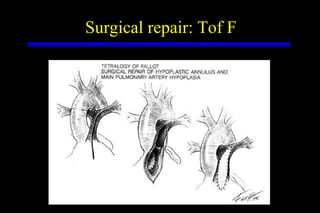
Surgical repair: Tof F
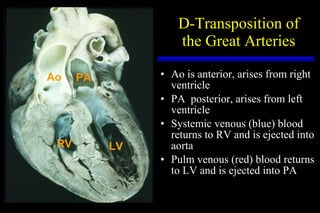
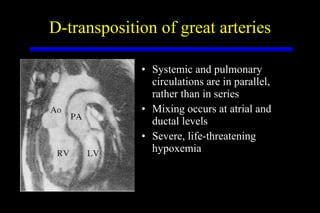
D-Transposition of the Great Arteries Ao is anterior, arises from right ventricle PA  posterior, arises from left ventricle Systemic venous (blue) blood returns to RV and is ejected into aorta Pulm venous (red) blood returns to LV and is ejected into PA RV LV PA Ao
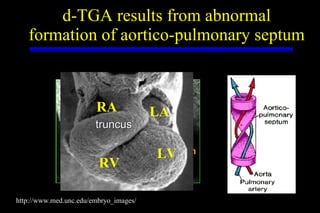
d-TGA results from abnormal formation of aortico-pulmonary septum http://www.med.unc.edu/embryo_images/ PA AO cushion LV RV LA RA truncus
D-transposition of great arteries Systemic and pulmonary circulations are in parallel, rather than in series Mixing occurs at atrial and ductal levels Severe, life-threatening hypoxemia
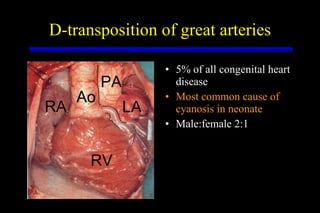
D-transposition of great arteries 5% of all congenital heart disease Most common cause of cyanosis in neonate Male:female 2:1 RV Ao PA RA LA
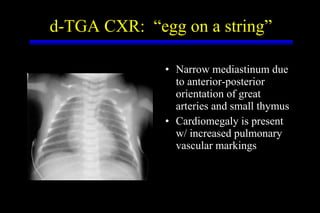
Narrow mediastinum due to anterior-posterior orientation of great arteries and small thymus  Cardiomegaly is present w/ increased pulmonary vascular markings d-TGA CXR:  “egg on a string”
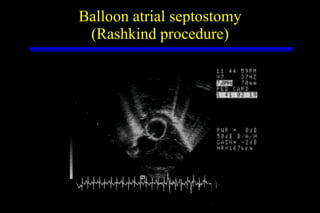
Initial management of d-TGA: goal is to improve mixing Start PGE 1  to prevent ductal closure Open atrial septum to improve mixing at atrial level (Rashkind procedure).
Balloon atrial septostomy (Rashkind procedure)
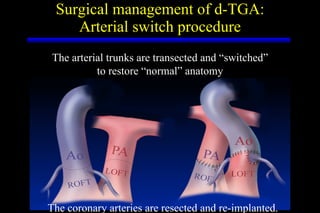
Surgical management of d-TGA: Arterial switch procedure The arterial trunks are transected and “switched” to restore “normal” anatomy The coronary arteries are resected and re-implanted.
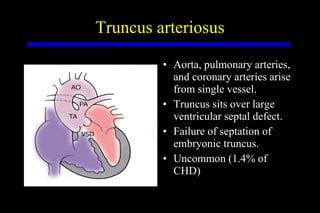
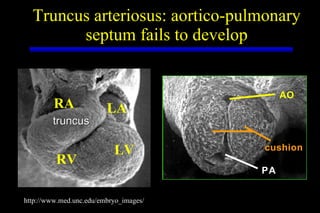
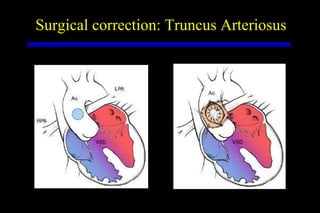
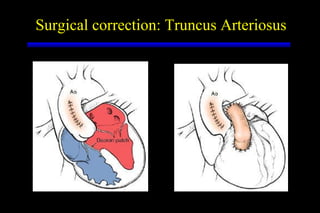
Truncus arteriosus Aorta, pulmonary arteries, and coronary arteries arise from single vessel. Truncus sits over large ventricular septal defect. Failure of septation of embryonic truncus. Uncommon (1.4% of CHD)
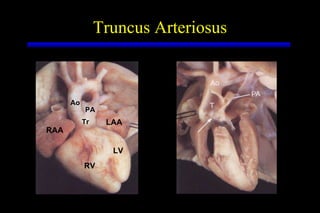
Truncus Arteriosus RV LV RAA LAA PA Ao Tr
Truncus arteriosus: aortico-pulmonary septum fails to develop http://www.med.unc.edu/embryo_images/ PA AO cushion LV RV LA RA truncus
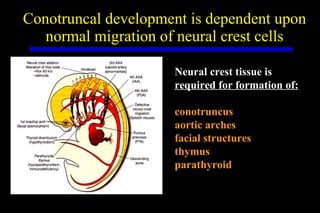
Conotruncal development is dependent upon normal migration of neural crest cells Neural crest tissue is required for formation of: conotruncus aortic arches facial structures thymus parathyroid
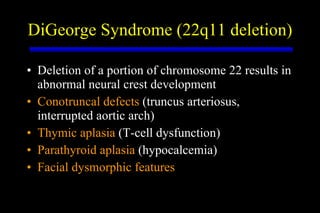
DiGeorge Syndrome (22q11 deletion) Deletion of a portion of chromosome 22 results in abnormal neural crest development Conotruncal defects  (truncus arteriosus, interrupted aortic arch) Thymic aplasia  (T-cell dysfunction) Parathyroid aplasia  (hypocalcemia) Facial dysmorphic features
Surgical correction: Truncus Arteriosus
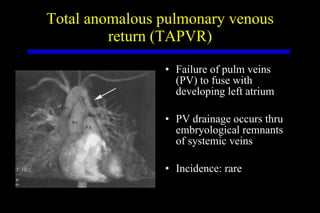
Total anomalous pulmonary venous return (TAPVR) Failure of pulm veins (PV) to fuse with developing left atrium PV drainage occurs thru embryological remnants of systemic veins Incidence: rare
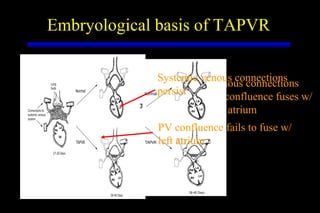
Embryological basis of TAPVR Systemic venous connections reabsorb as PV confluence fuses w/ left atrium PV confluence PV confluence fails to fuse w/ left atrium Systemic venous connections persist
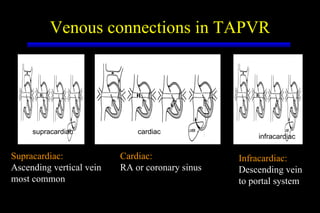
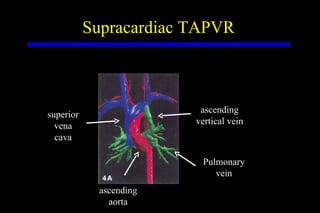
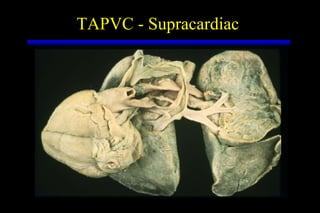
Venous connections in TAPVR Supracardiac: Ascending vertical vein most common Cardiac: RA or coronary sinus Infracardiac: Descending vein to portal system supracardiac cardiac infracardiac
Clinical manifestation of TAPVR Obstructed Severe pulmonary edema, cyanosis, shock Surgical emergency Unobstructed Mild to moderate congestive heart failure and cyanosis Surgery in first 6 mo.
Supracardiac TAPVR Pulmonary vein ascending vertical vein superior vena cava ascending aorta
TAPVC - Supracardiac
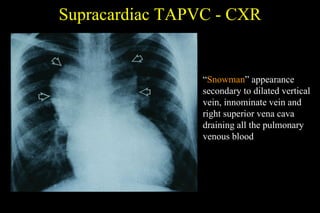
Supracardiac TAPVC - CXR “ Snowman ” appearance secondary to dilated vertical vein, innominate vein and right superior vena cava draining all the pulmonary venous blood
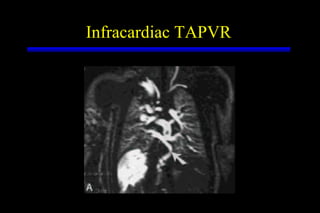
Infracardiac TAPVR
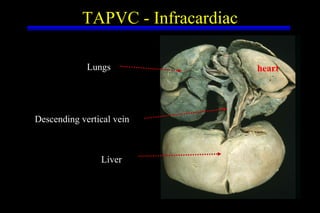
TAPVC - Infracardiac Lungs Descending vertical vein Liver heart
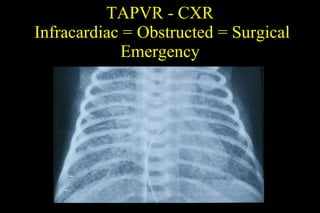
TAPVR - CXR  Infracardiac = Obstructed = Surgical Emergency
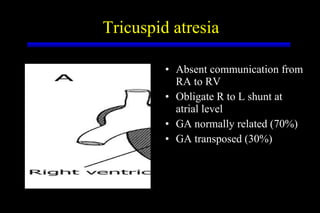
Tricuspid atresia Absent communication from RA to RV Obligate R to L shunt at atrial level GA normally related (70%) GA transposed (30%)
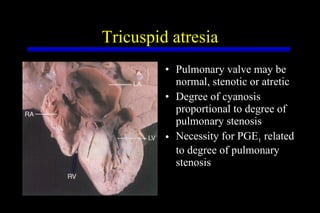
Tricuspid atresia Pulmonary valve may be normal, stenotic or atretic Degree of cyanosis proportional to degree of pulmonary stenosis Necessity for PGE 1  related to degree of pulmonary stenosis
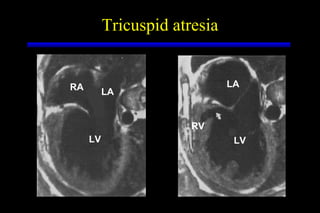
Tricuspid atresia RA LA LV LA LV RV
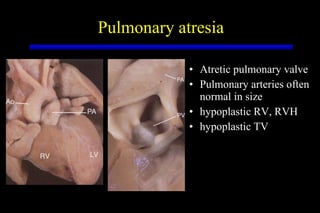
Pulmonary atresia Atretic pulmonary valve Pulmonary arteries often normal in size hypoplastic RV, RVH hypoplastic TV
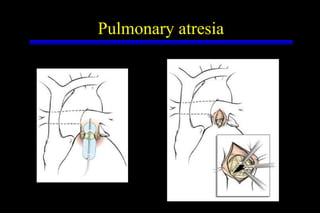
Ductal-dependent lesion Requires PGE 1  to maintain oxygenation Therapy directed at opening atretic valve in cath lab or surgery Prognosis depends upon size and compliance of hypoplastic RV Pulmonary atresia
Pulmonary atresia
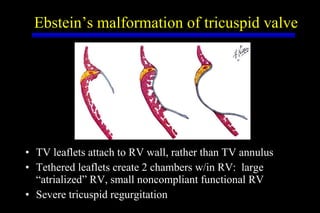
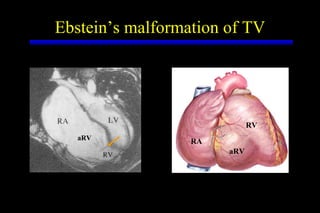
Ebstein’s malformation of tricuspid valve TV leaflets attach to RV wall, rather than TV annulus Tethered leaflets create 2 chambers w/in RV:  large “atrialized” RV, small noncompliant functional RV Severe tricuspid regurgitation
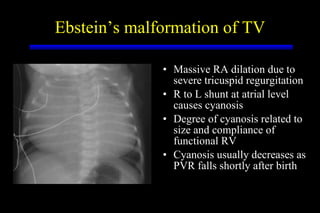
Ebstein’s malformation of TV Massive RA dilation due to severe tricuspid regurgitation R to L shunt at atrial level causes cyanosis Degree of cyanosis related to size and compliance of functional RV Cyanosis usually decreases as PVR falls shortly after birth
Ebstein’s malformation of TV RA aRV RV aRV
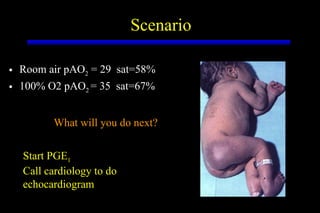
Scenario Room air pAO 2  = 29  sat=58% 100% O2 pAO 2  = 35  sat=67% What will you do next? Start PGE 1 Call cardiology to do echocardiogram
 
Cyanosis and Hemoglobin

Cyanotic Heart Disease

  • 1.
    Congenital HeartDisease: Cyanotic Lesions Martin Tristani-Firouzi December 2005
  • 2.
    scenario It’s 2:00A.M. Your first night on call on your Pediatric rotation. The R.N. in the newborn nursery calls you to see a blue baby. You run.
  • 3.
    Scenario O 2 sat=58% RR=82 Mild respiratory distress What will you do next?
  • 4.
    Cyanosis Bluish discolorationof skin and mucous membranes Noticeable when the concentration of deoxy-hemoglobin is at least 5g/dl (O 2 sat < 85%)
  • 5.
    Cyanosis: peripheral vscentral peripheral Sluggish blow flow in capillaries Involves extremities (acrocyanosis) Spares trunk & mucous membranes central Abnl of lungs or heart that interferes w/ O2 transport Involves trunk & mucous membranes
  • 6.
    Evaluation of cyanosis: 100% O 2 test measure pAO 2 in room air and 100% O 2 Lung disease: Room air pAO 2 30 mmHg O 2 sat=60% 100% O 2 pAO 2 110 mmHg O 2 sat=100% Cardiac disease: Room air pAO 2 30 mmHg O 2 sat=60% 100% O 2 pAO 2 40 mmHg O 2 sat=75% pAO 2 >100 mmHg suggests lung disease Little or no change in pAO 2 suggests cyanotic heart disease
  • 7.
    Chronic cyanosis causes clubbing of the digits
  • 8.
    Prostaglandin (PGE 1) Stable derivative of endogenous compound that maintains ductal patency in utero Prevents postnatal ductal closure, improves pulmonary blood flow, improves oxygenation Stabilizes cyanotic neonate so that corrective surgery can be performed “electively” PGE 1 revolutionized the fields of pediatric cardiology and cardiovascular surgery
  • 9.
    The basis ofcongenital heart disease is rooted in an arrest of or deviation in normal cardiac development
  • 10.
    The 5 T’sof cyanotic heart disease Tetralogy of Fallot TGA (d-transposition of the great arteries) Truncus arteriosus Total anomalous pulmonary venous return Tricuspid atresia / single ventricle Pulmonary atresia Ebstein’s malformation of tricuspid valve
  • 11.
    Tetralogy of Fallot1. Pulmonary stenosis 2. Large VSD 3. Overriding aorta 4. Right ventricular hypertrophy
  • 12.
    Tetralogy of Fallot6 % of all congenital heart disease 1:3600 live births most common cause of cyanosis in infancy/childhood Severity of cyanosis proportional to severity of RVOT obstruction RV
  • 13.
    T of Foccurs as a result of abnormal cardiac septation Normal development Abnormal development
  • 14.
    Tetralogy of FallotAnterior deviation of the outlet ventricular septum is the cause of all four abnormalities seen in tetralogy of Fallot.
  • 15.
    Tetralogy of Fallot- CXR Typical “boot-shaped” heart secondary to RVH and small main pulmonary artery segment Pulmonary vascular markings are decreased
  • 16.
    Hypercyanotic “tet” spellParoxysmal hypoxemia due to acute change in balance between PVR and SVR  SVR causes an increase in R  L shunt, increasing cyanosis  SVR (hot bath, fever, exercise) Agitation  dynamic subpulmonic obstruction Life-threatening if untreated
  • 17.
    Management of “tet”spell: goal is to  SVR and  PVR Knee-chest position (  SVR) Supplemental O 2 Fluid bolus i.v. (  SVR) Morphine i.v. (  agitation,  dynamic RVOT obstruction) NaHCO 3 to correct metabolic acidosis (  PVR) Phenylephrine to  SVR  -blocker to  dynamic RVOT obstruction
  • 18.
  • 19.
    D-Transposition of theGreat Arteries Ao is anterior, arises from right ventricle PA posterior, arises from left ventricle Systemic venous (blue) blood returns to RV and is ejected into aorta Pulm venous (red) blood returns to LV and is ejected into PA RV LV PA Ao
  • 20.
    d-TGA results fromabnormal formation of aortico-pulmonary septum http://www.med.unc.edu/embryo_images/ PA AO cushion LV RV LA RA truncus
  • 21.
    D-transposition of greatarteries Systemic and pulmonary circulations are in parallel, rather than in series Mixing occurs at atrial and ductal levels Severe, life-threatening hypoxemia
  • 22.
    D-transposition of greatarteries 5% of all congenital heart disease Most common cause of cyanosis in neonate Male:female 2:1 RV Ao PA RA LA
  • 23.
    Narrow mediastinum dueto anterior-posterior orientation of great arteries and small thymus Cardiomegaly is present w/ increased pulmonary vascular markings d-TGA CXR: “egg on a string”
  • 24.
    Initial management ofd-TGA: goal is to improve mixing Start PGE 1 to prevent ductal closure Open atrial septum to improve mixing at atrial level (Rashkind procedure).
  • 25.
    Balloon atrial septostomy(Rashkind procedure)
  • 26.
    Surgical management ofd-TGA: Arterial switch procedure The arterial trunks are transected and “switched” to restore “normal” anatomy The coronary arteries are resected and re-implanted.
  • 27.
    Truncus arteriosus Aorta,pulmonary arteries, and coronary arteries arise from single vessel. Truncus sits over large ventricular septal defect. Failure of septation of embryonic truncus. Uncommon (1.4% of CHD)
  • 28.
    Truncus Arteriosus RVLV RAA LAA PA Ao Tr
  • 29.
    Truncus arteriosus: aortico-pulmonaryseptum fails to develop http://www.med.unc.edu/embryo_images/ PA AO cushion LV RV LA RA truncus
  • 30.
    Conotruncal development isdependent upon normal migration of neural crest cells Neural crest tissue is required for formation of: conotruncus aortic arches facial structures thymus parathyroid
  • 31.
    DiGeorge Syndrome (22q11deletion) Deletion of a portion of chromosome 22 results in abnormal neural crest development Conotruncal defects (truncus arteriosus, interrupted aortic arch) Thymic aplasia (T-cell dysfunction) Parathyroid aplasia (hypocalcemia) Facial dysmorphic features
  • 32.
  • 33.
  • 34.
    Total anomalous pulmonaryvenous return (TAPVR) Failure of pulm veins (PV) to fuse with developing left atrium PV drainage occurs thru embryological remnants of systemic veins Incidence: rare
  • 35.
    Embryological basis ofTAPVR Systemic venous connections reabsorb as PV confluence fuses w/ left atrium PV confluence PV confluence fails to fuse w/ left atrium Systemic venous connections persist
  • 36.
    Venous connections inTAPVR Supracardiac: Ascending vertical vein most common Cardiac: RA or coronary sinus Infracardiac: Descending vein to portal system supracardiac cardiac infracardiac
  • 37.
    Clinical manifestation ofTAPVR Obstructed Severe pulmonary edema, cyanosis, shock Surgical emergency Unobstructed Mild to moderate congestive heart failure and cyanosis Surgery in first 6 mo.
  • 38.
    Supracardiac TAPVR Pulmonaryvein ascending vertical vein superior vena cava ascending aorta
  • 39.
  • 40.
    Supracardiac TAPVC -CXR “ Snowman ” appearance secondary to dilated vertical vein, innominate vein and right superior vena cava draining all the pulmonary venous blood
  • 41.
  • 42.
    TAPVC - InfracardiacLungs Descending vertical vein Liver heart
  • 43.
    TAPVR - CXR Infracardiac = Obstructed = Surgical Emergency
  • 44.
    Tricuspid atresia Absentcommunication from RA to RV Obligate R to L shunt at atrial level GA normally related (70%) GA transposed (30%)
  • 45.
    Tricuspid atresia Pulmonaryvalve may be normal, stenotic or atretic Degree of cyanosis proportional to degree of pulmonary stenosis Necessity for PGE 1 related to degree of pulmonary stenosis
  • 46.
    Tricuspid atresia RALA LV LA LV RV
  • 47.
    Pulmonary atresia Atreticpulmonary valve Pulmonary arteries often normal in size hypoplastic RV, RVH hypoplastic TV
  • 48.
    Ductal-dependent lesion RequiresPGE 1 to maintain oxygenation Therapy directed at opening atretic valve in cath lab or surgery Prognosis depends upon size and compliance of hypoplastic RV Pulmonary atresia
  • 49.
  • 50.
    Ebstein’s malformation oftricuspid valve TV leaflets attach to RV wall, rather than TV annulus Tethered leaflets create 2 chambers w/in RV: large “atrialized” RV, small noncompliant functional RV Severe tricuspid regurgitation
  • 51.
    Ebstein’s malformation ofTV Massive RA dilation due to severe tricuspid regurgitation R to L shunt at atrial level causes cyanosis Degree of cyanosis related to size and compliance of functional RV Cyanosis usually decreases as PVR falls shortly after birth
  • 52.
  • 53.
    Scenario Room airpAO 2 = 29 sat=58% 100% O2 pAO 2 = 35 sat=67% What will you do next? Start PGE 1 Call cardiology to do echocardiogram
  • 54.
  • 55.