Ebstein’s anomaly
Ebstein's anomaly
• Ebstein’s anomaly was
named after Wilhelm
Ebstein, who in 1864
described the heart of
the 19 year old Joseph
Prescher.
Incidence/prevalence
• 2.4 per 10,000 live births.
• Accounts for 0.3% to 0.7% of all cases of
congenital heart disease.
• It represents about 40% of congenital
malformations of the Tricuspid valve.
Normal TV
• The semicircular or quadrangular anterior leaflet is the
largest of the three.
• The posterior leaflet is scalloped.
• The septal leaflet attaches chiefly to the ventricular
septum.
• The septal leaflet normally exhibits a slight but distinct
apical displacement of its basal attachment compared
with the mitral valve: 15 mm in children, and 20 mm in
adults.
Basic anatomic anomaly?
Pathological Anatomy
• EA is a malformation of the tricuspid valve and
right ventricle characterized by
(1) Adherence of the septal and posterior
leaflets to the underlying myocardium
(2) Downward(apical) displacement of the
functional annulus (septal>posterior>anterior)
Pathological Anatomy
(3) Dilation of the “atrialized” portion of the
right ventricle, with various degrees of
hypertrophy and thinning of the wall
(4) Redundancy, fenestrations, and tethering of
the anterior leaflet; and
(5) Dilation of the right atrioventricular junction
(true tricuspid annulus)
DELAMINATION
• Normal myocardial development – Delamination
begins at tips of leaflets and reaches toward the
AV junction
• A normal, completely delaminated leaflet wil
have hinge point at or near the anatomic
tricuspid valve
• Failure of delamination (namely splitting of the
tissue by detachment of the inner layer during
embryologic development) results in leaflets that
variably adhere to the underlying myocardium
Downward Displacement
• Functional orifice gets shifted towards RV
apex or into RV outflow tract
• Not just linear shift it is rotational or spiral in
nature
• Adhered portions have little or no motion
• Large coaptation defect – severe TR
• Septal hinge point is inferior to attachment
point of anterior mitral leaflet
Displacement Index
• Distance between the two septal hinges in the
four chamber view is divided by patients body
surface area to caluculate a “Displacement
Index “
• Index values >8 mm/m2 - distinguish EA from
others
• Downward displacement of STL is associated
with discontinuity of central fibrous body and
septal AV ring - potential substrate for
accessory pathways and preexcitation
• Associated with WPW type B – rt sided
pathways are more common
RT Heart – 3 components
• RA Proper
• Inlet portion of RV [Atrialized]
• Trabecular and outlet portion[Functional RV]
• The greater the apical displacement of the
posterior and septal leaflets, the larger the
atrialized RV and the smaller the functional RV.
Atrialized RV
• Thin walled
• Devoid of muscle tissue
• Dilated often aneurysmally[1/2 of RV volume]
• Paradoxical expansion in systole –passive
reservoir
Functional RV
• An absolute decrease in the number of
myocytes .
• An increase in fibrosis
• Both responsible for infundibular dilation
Communication between atrialised RV
and functional RV?
• Free communication
• Slits or perforations in the ATL
• Separated by a muscular partition or shelf that
restricts flow
• Anteromedial commissure is fused and the ATL is
intact, the tricuspid orifice is imperforate.
• Two thirds of hearts - show dilated right
ventricles.
• Dilatation involves not only the atrialized
inlet portion of the right ventricle but also the
functional right ventricular apex and outflow
tract.
• Right ventricular dilatation is so marked that
the ventricular septum bulges leftward,
compressing the left ventricular chamber.
• In extreme cases, episodic left ventricular
outflow tract obstruction can occur.
• Most patients have RV dysfunction (both
atrialized and functional ventricle)
• More than a valve disease – a cardiomyopathy
Anterior leaflet
• Redundant
• Contains muscular strands
• Mobility is impaired – thickening, nodularity,
fibrosis and multiple short chordae
• Described as SAIL – LIKE
Abnormalities of Left heart
• Seen in 39% cases
1. Derangements in left ventricular geometry
2. Impairment of systolic and diastolic function
3. Noncompaction
4. MVP
5. Accessory MV Tissue
6. Bicuspid / atretic AV
7. Subaortic stenosis
Associated cardiac defects
• ASD or PFO
• VSD with or without PA
• RVOTO
• PDA
• COA
• AP 15-20% cases around malformed TVO
• CCTGA Lt sided Ebstenoid TV.
Classification
 Attenhofer Jost CH et al: Based on
mild/moderate/severe apical displacement,TR and
RV size
 Carpentier classification(on surgery table
finding):A,B,C,D
 Danielson GK(Based on Carpentier
classification):I,II,III &IV
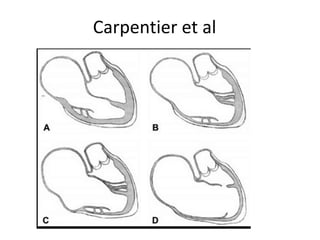
Carpentier et al classification
• Type A – volume of rt ventricle is adequate
• Type B – large atrialised component of the right
ventricle. Anterior leaflet moves freely
• Type C – anterior leaflet is severely restricted and
causes significant obstruction to RVOT
• Type D – complete atrialisation of the ventricle
with the exception of small infundibular
component
Carpentier et al
Danielson GK
I II III IV
The ATL is larger and
mobile but the
posterior and STL are
apically displaced,
dysplastic, or absent.
The ARV size varies
from relatively small
to large.
The anterior,
posterior, and often
septal leaflets are
present, but are
relatively small and
displaced in a spiral
fashion toward the
apex. The atrialized
ventricular chamber
is moderately large.
The ATL is restricted
motion with
shortened, fused,
and tethered
chordae. Direct
insertion of papillary
muscles into the
anterior leaflet is
frequently present.
The posterior and
septal leaflets are
displaced, dysplastic,
and usually not
reconstructable. The
ARV is large.
The ARV is severely
deformed and
displaced into the RV
outflow tract. PTL is
typically dysplastic
or absent, and the
septal leaflet is
represented by a
ridge of fibrous
material descending
apically from the
membranous
septum. TV
displaced into the
RVOT and may cause
obstruction of blood
flow (functional
tricuspid stenosis).
RV=ARV
Physiological consequences-
determinants
• Morphologic derangement of the tricuspid
leaflets
• Hemodynamic burden imposed on an inherently
flawed right ventricle
• Left ventricular function
• Atrial rhythm
• The tricuspid orifice is typically incompetent,
occasionally stenotic, and rarely imperforate.
• The thin-walled atrialized RV is either passive or
functions as an aneurysm –expands paradoxically
in systole.
• Functional impairment of the RV depends on the
severity of TR , size of the RA and atrialized RV
relative to the size of the functional RV.
• Atrial tachyarrhythmias have serious physiologic
implications with Accessory pathways.
Rt to Lt shunt
• Neonates [ high PVR]
• Old age - RV Filling pressure ↑
• Stenotic/imperforate - T.orifice
EM Properties –basis for clinical
diagnosis
Mechanical stimulation of ARV- PVT
• Clusters of ventricular cardiomyocytes are
isolated within a fibrous matrix .
• It prevents spiral/scroll reentrant waves from
anchoring.
• When spiral/scroll waves do not anchor, they
meander erratically as polymorphic
ventricular tachycardia.
LV function affected
• Geometric distortion of the ventricle
• Reduced end-diastolic volume
• Paradoxical motion of the ventricular septum
• An increase in fibrous tissue, and a decrease in
cardiomyocytes in the free wall and septum.
History
• Males and females are equally affected
• Familial Ebstein’s anomaly has been reported( more
common in twins and in those with family history of
CHD
• Relative risk of Ebstein’s anomaly is increased by 28fold
in offspring exposed to in utero lithium carbonate.
• Maternal exposure to benzodiazepines
Genetic factors
• NKX 2.5 mutations
• 10 p13-p14 deletion
• 1p34.3-p36.11 deletion
• MYH7 gene mutation
Clinical presentation
• Most common age related presentations
1 - Detection of anomaly in a routine fetal ECHO
2 - Neonatal cyanosis
3 - Heart failure in infancy
4 - Murmur in childhood
5 - Arrhythmias in adolescents and adults
Clinical Presentation
• Foetus – poor prognosis – cardiomegaly,
hydrops, pulmonary parenchymal
hypoplasia,tachyarrhythmias
• Neonates –congestive heart failure due to
tricuspid valve regurgitation, cyanosis, and
marked cardiomegaly caused by right heart
dilation.
• Neonates – 20 to 40% donot survive 1 month ,
<50% survive – upto 5 years.
• Symptomatic children with Ebstein’s anomaly
may have progressive rightsided heart failure,
but most will reach adolescence and
adulthood
• In subjects <2 years old at presentation, a
haemodynamic problem is more common
than in older patients (72% versus 29%, p
<0.01).
• In subjects >10 years old at presentation, an
electrophysiological problem is more common
than in younger patients
Clinical Presentation
• Adults - arrhythmias , progressive cyanosis,
decreasing exercise tolerance, fatigue, or
right-sided heart failure
• Exercise tolerance depends on – Oxygen
saturation and heart size
SCD
• Threat regardless of severity of the anomaly
• Responsible for the decline in survival rate in the fifth
decade
• WPW - Atrial flutter or fibrillation with accelerated
conduction -major increase in the risk of SCD.
• Arrhythmogenic ARV - Spontaneous VT/fibrillation
looms as a threat.
• The onset of chronic AF prefigures death within 5
years.
Chestpain
• Is an enigma.
• The pain is retrosternal, epigastric or in the right
or left anterior chest.
• It is sharp, stabbing, or shooting, features that
suggest serous surface origin.
• A fibrinous pericardium has been found at
necropsy over the atrialized RV.
Paradoxical Embolisation
• In the presence of an interatrial
communication, the risk of paradoxical
embolisation, brain abscess and sudden death
is increased
Pregnancy
• Poorly tolerated
• Cyanosis may first become manifest.
• Hypoxemia increases the risk of fetal wastage.
• A right-to-left interatrial shunt incurs a puerperal
risk of paradoxical embolization.
• PAT are potential hazards during pregnancy
especially with AP.
Physical appearance
• Growth and development are normal - in patients
asymptomatic as neonates and infants.
• Persistent cyanosis or intermittent exercise-induced
cyanosis occurs in > 50% of cases.
• Clubbing
• Precordial asymmetry - usually left parasternal
prominence, but occasionally the right anterior chest is
prominent( enlarged Rt atrium ).
Pulse
• Pulse is normal
• Decreases when ventricular stroke volume
falls
JVP
• Prominent C wave
• Preserved X descent /normal V waves despite
severe TR – damping effect of rt atrium and
atrialized ventricle ,TR is low pressure and
hypokinetic
• Gaint A wave – stenotic/imperforate TV
• Prominent A and V - RHF
Inspection and palpation
• Precordial asymmetry
• LVI
• Absent systolic impulse over inflow portion of
RV – negative sign
• Systolic impulse –L3ICS-Infundibular dilation.
• RVI ,Tricuspid systolic thrill – neonates.
Percussion
• Cardiac dullness beyond RT parasternal border
by 2-3 cm where it merges with liver dullness
due to RAE
AUSCULTATION
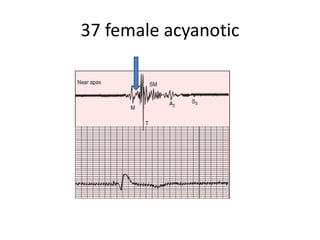
• S1 – Wide split
• M1 – T1 ,Loud and delayed T1[Sail sound]
• Delayed T1 – Complete RBBB, Hypokinetic RV, Large
and increased excursion and tension of ATL .
• PR prolongation – soft M1
• Preexcitation of RV – Early loud T1 /Buried M1
37 female acyanotic
S2
• Often Single – P2 inaudible –low pressure in
PT
• Wide split S2 – complete RBBB
• Little variation with respiration
• Paradoxical split S2 – RV preexcitation
S3 /S4
• Produce a distinctive triple or quadruple
rhythm
• Often summate because of PR interval
prolongation
• May increase during inspiration
• Sometimes sufficiently prolonged to produce
short diastolic murmurs
Opening sounds
• Early diastolic sounds with the timing of
opening snaps have been described .
• Attributed to opening movements of the large
mobile ATL.
Systolic murmur -TR
• Low pressure TR from hypokinetic low
pressure RV
• Soft, decrescendo, medium frequency, grade 2
to 3/6 intensity, prominent leftward location
towards apex, no increase with inspiration
17y old acyanotic /prominent murmur
near apex.
• However, in neonates with Ebstein’s anomaly,
the TR murmur is holosystolic because right
ventricular systolic pressure is elevated.
• The timing and quality of systolic and diastolic
murmurs occasionally create the impression
of a pericardial friction rub.
• Hepatomegaly – uncommon
•

Ebsteins anamoly

  • 1.
  • 2.
    Ebstein's anomaly • Ebstein’sanomaly was named after Wilhelm Ebstein, who in 1864 described the heart of the 19 year old Joseph Prescher.
  • 3.
    Incidence/prevalence • 2.4 per10,000 live births. • Accounts for 0.3% to 0.7% of all cases of congenital heart disease. • It represents about 40% of congenital malformations of the Tricuspid valve.
  • 4.
    Normal TV • Thesemicircular or quadrangular anterior leaflet is the largest of the three. • The posterior leaflet is scalloped. • The septal leaflet attaches chiefly to the ventricular septum. • The septal leaflet normally exhibits a slight but distinct apical displacement of its basal attachment compared with the mitral valve: 15 mm in children, and 20 mm in adults.
  • 5.
  • 6.
    Pathological Anatomy • EAis a malformation of the tricuspid valve and right ventricle characterized by (1) Adherence of the septal and posterior leaflets to the underlying myocardium (2) Downward(apical) displacement of the functional annulus (septal>posterior>anterior)
  • 7.
    Pathological Anatomy (3) Dilationof the “atrialized” portion of the right ventricle, with various degrees of hypertrophy and thinning of the wall (4) Redundancy, fenestrations, and tethering of the anterior leaflet; and (5) Dilation of the right atrioventricular junction (true tricuspid annulus)
  • 8.
    DELAMINATION • Normal myocardialdevelopment – Delamination begins at tips of leaflets and reaches toward the AV junction • A normal, completely delaminated leaflet wil have hinge point at or near the anatomic tricuspid valve • Failure of delamination (namely splitting of the tissue by detachment of the inner layer during embryologic development) results in leaflets that variably adhere to the underlying myocardium
  • 10.
  • 11.
    • Functional orificegets shifted towards RV apex or into RV outflow tract • Not just linear shift it is rotational or spiral in nature • Adhered portions have little or no motion • Large coaptation defect – severe TR • Septal hinge point is inferior to attachment point of anterior mitral leaflet
  • 13.
    Displacement Index • Distancebetween the two septal hinges in the four chamber view is divided by patients body surface area to caluculate a “Displacement Index “ • Index values >8 mm/m2 - distinguish EA from others
  • 15.
    • Downward displacementof STL is associated with discontinuity of central fibrous body and septal AV ring - potential substrate for accessory pathways and preexcitation • Associated with WPW type B – rt sided pathways are more common
  • 16.
    RT Heart –3 components • RA Proper • Inlet portion of RV [Atrialized] • Trabecular and outlet portion[Functional RV] • The greater the apical displacement of the posterior and septal leaflets, the larger the atrialized RV and the smaller the functional RV.
  • 18.
    Atrialized RV • Thinwalled • Devoid of muscle tissue • Dilated often aneurysmally[1/2 of RV volume] • Paradoxical expansion in systole –passive reservoir
  • 19.
    Functional RV • Anabsolute decrease in the number of myocytes . • An increase in fibrosis • Both responsible for infundibular dilation
  • 20.
    Communication between atrialisedRV and functional RV? • Free communication • Slits or perforations in the ATL • Separated by a muscular partition or shelf that restricts flow • Anteromedial commissure is fused and the ATL is intact, the tricuspid orifice is imperforate.
  • 21.
    • Two thirdsof hearts - show dilated right ventricles. • Dilatation involves not only the atrialized inlet portion of the right ventricle but also the functional right ventricular apex and outflow tract.
  • 22.
    • Right ventriculardilatation is so marked that the ventricular septum bulges leftward, compressing the left ventricular chamber. • In extreme cases, episodic left ventricular outflow tract obstruction can occur.
  • 23.
    • Most patientshave RV dysfunction (both atrialized and functional ventricle) • More than a valve disease – a cardiomyopathy
  • 24.
    Anterior leaflet • Redundant •Contains muscular strands • Mobility is impaired – thickening, nodularity, fibrosis and multiple short chordae • Described as SAIL – LIKE
  • 26.
    Abnormalities of Leftheart • Seen in 39% cases 1. Derangements in left ventricular geometry 2. Impairment of systolic and diastolic function 3. Noncompaction 4. MVP 5. Accessory MV Tissue 6. Bicuspid / atretic AV 7. Subaortic stenosis
  • 27.
    Associated cardiac defects •ASD or PFO • VSD with or without PA • RVOTO • PDA • COA • AP 15-20% cases around malformed TVO • CCTGA Lt sided Ebstenoid TV.
  • 28.
    Classification  Attenhofer JostCH et al: Based on mild/moderate/severe apical displacement,TR and RV size  Carpentier classification(on surgery table finding):A,B,C,D  Danielson GK(Based on Carpentier classification):I,II,III &IV
  • 29.
    Carpentier et alclassification • Type A – volume of rt ventricle is adequate • Type B – large atrialised component of the right ventricle. Anterior leaflet moves freely • Type C – anterior leaflet is severely restricted and causes significant obstruction to RVOT • Type D – complete atrialisation of the ventricle with the exception of small infundibular component
  • 30.
  • 31.
    Danielson GK I IIIII IV The ATL is larger and mobile but the posterior and STL are apically displaced, dysplastic, or absent. The ARV size varies from relatively small to large. The anterior, posterior, and often septal leaflets are present, but are relatively small and displaced in a spiral fashion toward the apex. The atrialized ventricular chamber is moderately large. The ATL is restricted motion with shortened, fused, and tethered chordae. Direct insertion of papillary muscles into the anterior leaflet is frequently present. The posterior and septal leaflets are displaced, dysplastic, and usually not reconstructable. The ARV is large. The ARV is severely deformed and displaced into the RV outflow tract. PTL is typically dysplastic or absent, and the septal leaflet is represented by a ridge of fibrous material descending apically from the membranous septum. TV displaced into the RVOT and may cause obstruction of blood flow (functional tricuspid stenosis). RV=ARV
  • 32.
    Physiological consequences- determinants • Morphologicderangement of the tricuspid leaflets • Hemodynamic burden imposed on an inherently flawed right ventricle • Left ventricular function • Atrial rhythm
  • 33.
    • The tricuspidorifice is typically incompetent, occasionally stenotic, and rarely imperforate. • The thin-walled atrialized RV is either passive or functions as an aneurysm –expands paradoxically in systole. • Functional impairment of the RV depends on the severity of TR , size of the RA and atrialized RV relative to the size of the functional RV. • Atrial tachyarrhythmias have serious physiologic implications with Accessory pathways.
  • 34.
    Rt to Ltshunt • Neonates [ high PVR] • Old age - RV Filling pressure ↑ • Stenotic/imperforate - T.orifice
  • 35.
    EM Properties –basisfor clinical diagnosis
  • 36.
    Mechanical stimulation ofARV- PVT • Clusters of ventricular cardiomyocytes are isolated within a fibrous matrix . • It prevents spiral/scroll reentrant waves from anchoring. • When spiral/scroll waves do not anchor, they meander erratically as polymorphic ventricular tachycardia.
  • 37.
    LV function affected •Geometric distortion of the ventricle • Reduced end-diastolic volume • Paradoxical motion of the ventricular septum • An increase in fibrous tissue, and a decrease in cardiomyocytes in the free wall and septum.
  • 38.
    History • Males andfemales are equally affected • Familial Ebstein’s anomaly has been reported( more common in twins and in those with family history of CHD • Relative risk of Ebstein’s anomaly is increased by 28fold in offspring exposed to in utero lithium carbonate. • Maternal exposure to benzodiazepines
  • 39.
    Genetic factors • NKX2.5 mutations • 10 p13-p14 deletion • 1p34.3-p36.11 deletion • MYH7 gene mutation
  • 40.
    Clinical presentation • Mostcommon age related presentations 1 - Detection of anomaly in a routine fetal ECHO 2 - Neonatal cyanosis 3 - Heart failure in infancy 4 - Murmur in childhood 5 - Arrhythmias in adolescents and adults
  • 41.
    Clinical Presentation • Foetus– poor prognosis – cardiomegaly, hydrops, pulmonary parenchymal hypoplasia,tachyarrhythmias • Neonates –congestive heart failure due to tricuspid valve regurgitation, cyanosis, and marked cardiomegaly caused by right heart dilation. • Neonates – 20 to 40% donot survive 1 month , <50% survive – upto 5 years.
  • 42.
    • Symptomatic childrenwith Ebstein’s anomaly may have progressive rightsided heart failure, but most will reach adolescence and adulthood • In subjects <2 years old at presentation, a haemodynamic problem is more common than in older patients (72% versus 29%, p <0.01). • In subjects >10 years old at presentation, an electrophysiological problem is more common than in younger patients
  • 44.
    Clinical Presentation • Adults- arrhythmias , progressive cyanosis, decreasing exercise tolerance, fatigue, or right-sided heart failure • Exercise tolerance depends on – Oxygen saturation and heart size
  • 45.
    SCD • Threat regardlessof severity of the anomaly • Responsible for the decline in survival rate in the fifth decade • WPW - Atrial flutter or fibrillation with accelerated conduction -major increase in the risk of SCD. • Arrhythmogenic ARV - Spontaneous VT/fibrillation looms as a threat. • The onset of chronic AF prefigures death within 5 years.
  • 46.
    Chestpain • Is anenigma. • The pain is retrosternal, epigastric or in the right or left anterior chest. • It is sharp, stabbing, or shooting, features that suggest serous surface origin. • A fibrinous pericardium has been found at necropsy over the atrialized RV.
  • 47.
    Paradoxical Embolisation • Inthe presence of an interatrial communication, the risk of paradoxical embolisation, brain abscess and sudden death is increased
  • 48.
    Pregnancy • Poorly tolerated •Cyanosis may first become manifest. • Hypoxemia increases the risk of fetal wastage. • A right-to-left interatrial shunt incurs a puerperal risk of paradoxical embolization. • PAT are potential hazards during pregnancy especially with AP.
  • 49.
    Physical appearance • Growthand development are normal - in patients asymptomatic as neonates and infants. • Persistent cyanosis or intermittent exercise-induced cyanosis occurs in > 50% of cases. • Clubbing • Precordial asymmetry - usually left parasternal prominence, but occasionally the right anterior chest is prominent( enlarged Rt atrium ).
  • 50.
    Pulse • Pulse isnormal • Decreases when ventricular stroke volume falls
  • 51.
    JVP • Prominent Cwave • Preserved X descent /normal V waves despite severe TR – damping effect of rt atrium and atrialized ventricle ,TR is low pressure and hypokinetic • Gaint A wave – stenotic/imperforate TV • Prominent A and V - RHF
  • 52.
    Inspection and palpation •Precordial asymmetry • LVI • Absent systolic impulse over inflow portion of RV – negative sign • Systolic impulse –L3ICS-Infundibular dilation. • RVI ,Tricuspid systolic thrill – neonates.
  • 53.
    Percussion • Cardiac dullnessbeyond RT parasternal border by 2-3 cm where it merges with liver dullness due to RAE
  • 54.
    AUSCULTATION • S1 –Wide split • M1 – T1 ,Loud and delayed T1[Sail sound] • Delayed T1 – Complete RBBB, Hypokinetic RV, Large and increased excursion and tension of ATL . • PR prolongation – soft M1 • Preexcitation of RV – Early loud T1 /Buried M1
  • 55.
  • 56.
    S2 • Often Single– P2 inaudible –low pressure in PT • Wide split S2 – complete RBBB • Little variation with respiration • Paradoxical split S2 – RV preexcitation
  • 58.
    S3 /S4 • Producea distinctive triple or quadruple rhythm • Often summate because of PR interval prolongation • May increase during inspiration • Sometimes sufficiently prolonged to produce short diastolic murmurs
  • 60.
    Opening sounds • Earlydiastolic sounds with the timing of opening snaps have been described . • Attributed to opening movements of the large mobile ATL.
  • 61.
    Systolic murmur -TR •Low pressure TR from hypokinetic low pressure RV • Soft, decrescendo, medium frequency, grade 2 to 3/6 intensity, prominent leftward location towards apex, no increase with inspiration
  • 62.
    17y old acyanotic/prominent murmur near apex.
  • 63.
    • However, inneonates with Ebstein’s anomaly, the TR murmur is holosystolic because right ventricular systolic pressure is elevated. • The timing and quality of systolic and diastolic murmurs occasionally create the impression of a pericardial friction rub. • Hepatomegaly – uncommon
  • 64.