Acid and Bases -Types of Oxides- Many acids and alkali are formed by  dissolving oxides in water
At the end of this e-learning, you should able to:  Classify oxides as acidic, basic, amphoteric or neutral based on metallic/non-metallic character
What is an oxide? An  oxide  is a compound of oxygen and another element.  Most oxides can be grouped into four types:  acidic  oxides basic  oxides amphoteric  oxides neutral  oxides
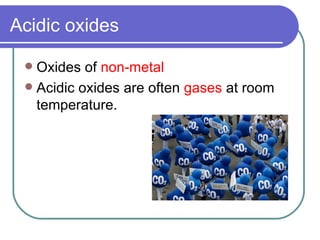
Acidic oxides Oxides of  non-metal Acidic oxides are often  gases  at room temperature.
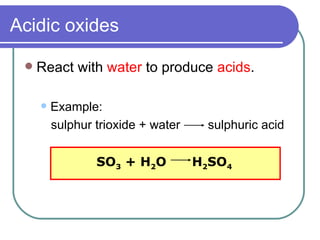
Acidic oxides React with  water  to produce  acids . Example: sulphur trioxide + water  sulphuric acid SO 3  + H 2 O  H 2 SO 4
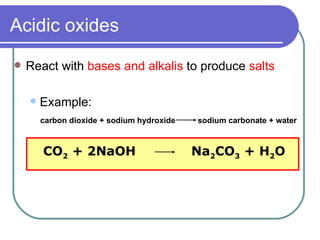
Acidic oxides React with  bases and alkalis  to produce  salts Example: carbon dioxide + sodium hydroxide  sodium carbonate + water CO 2  + 2NaOH  Na 2 CO 3  + H 2 O
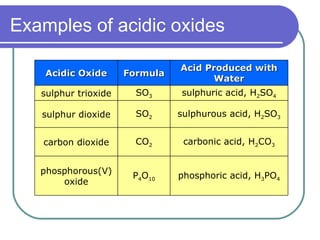
Examples of acidic oxides phosphoric acid, H 3 PO 4 P 4 O 10 phosphorous(V) oxide CO 2 SO 2 SO 3 Formula carbonic acid, H 2 CO 3 sulphurous acid, H 2 SO 3 sulphuric acid, H 2 SO 4 Acid Produced with Water carbon dioxide sulphur dioxide sulphur trioxide Acidic Oxide
Basic oxides Oxides of  metal Basic oxides are often  solids  at room temperature.  Most  basic oxides are  insoluble  in water. Calcium oxide (quicklime)
Basic oxides React with  acids  to produce  salts and water only. Example: Magnesium oxide + hydrochloric acid  magnesium chloride + water MgO + 2HC l   MgC l 2  + H 2 O This is a  neutralisation  reaction
Examples of basic oxides CuO copper(II) oxide CaO Na 2 O MgO Formula calcium oxide sodium oxide magnesium oxide Basic Oxide
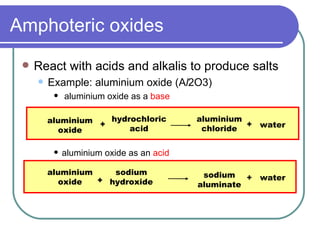
Amphoteric oxides Oxides of  metal Can  behave  as acidic oxides  or as basic oxides Zinc oxide
Amphoteric oxides React with acids and alkalis to produce salts Example: aluminium oxide (A l 2O3) aluminium oxide as a  base aluminium oxide as an  acid hydrochloric acid aluminium chloride water aluminium oxide + + aluminium oxide sodium hydroxide sodium aluminate water + +
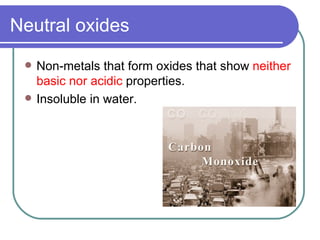
Neutral oxides Non-metals that form oxides that show  neither basic nor acidic  properties. Insoluble in water.
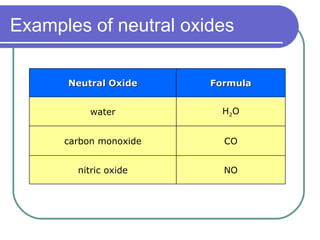
Examples of neutral oxides NO CO H 2 O Formula nitric oxide carbon monoxide water Neutral Oxide
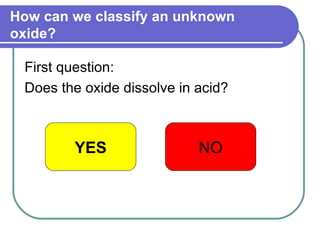
How can we classify an unknown oxide? First question: Does the oxide dissolve in acid? YES NO
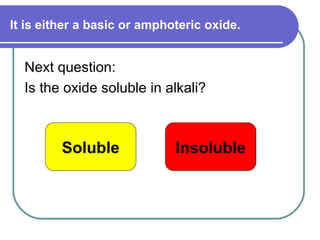
It is either a basic or amphoteric oxide. Next question: Is the oxide soluble in alkali? Soluble Insoluble
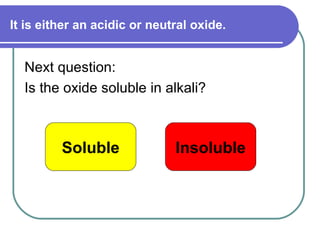
It is either an acidic or neutral oxide. Next question: Is the oxide soluble in alkali? Soluble Insoluble
Amphoteric oxide What is an  amphoteric  oxide? Back to first question
Basic oxide What is a basic oxide? Cook an egg with calcium oxide Back to first question
Acidic oxide What is an acidic oxide? How does acidic oxide affects the atmosphere? Back to first question
Neutral oxide What is an neutral oxide? Back to first question Back to the first slide

Oxides

  • 1.
    Acid and Bases-Types of Oxides- Many acids and alkali are formed by dissolving oxides in water
  • 2.
    At the endof this e-learning, you should able to: Classify oxides as acidic, basic, amphoteric or neutral based on metallic/non-metallic character
  • 3.
    What is anoxide? An oxide is a compound of oxygen and another element. Most oxides can be grouped into four types: acidic oxides basic oxides amphoteric oxides neutral oxides
  • 4.
    Acidic oxides Oxidesof non-metal Acidic oxides are often gases at room temperature.
  • 5.
    Acidic oxides Reactwith water to produce acids . Example: sulphur trioxide + water sulphuric acid SO 3 + H 2 O H 2 SO 4
  • 6.
    Acidic oxides Reactwith bases and alkalis to produce salts Example: carbon dioxide + sodium hydroxide sodium carbonate + water CO 2 + 2NaOH Na 2 CO 3 + H 2 O
  • 7.
    Examples of acidicoxides phosphoric acid, H 3 PO 4 P 4 O 10 phosphorous(V) oxide CO 2 SO 2 SO 3 Formula carbonic acid, H 2 CO 3 sulphurous acid, H 2 SO 3 sulphuric acid, H 2 SO 4 Acid Produced with Water carbon dioxide sulphur dioxide sulphur trioxide Acidic Oxide
  • 8.
    Basic oxides Oxidesof metal Basic oxides are often solids at room temperature. Most basic oxides are insoluble in water. Calcium oxide (quicklime)
  • 9.
    Basic oxides Reactwith acids to produce salts and water only. Example: Magnesium oxide + hydrochloric acid magnesium chloride + water MgO + 2HC l MgC l 2 + H 2 O This is a neutralisation reaction
  • 10.
    Examples of basicoxides CuO copper(II) oxide CaO Na 2 O MgO Formula calcium oxide sodium oxide magnesium oxide Basic Oxide
  • 11.
    Amphoteric oxides Oxidesof metal Can behave as acidic oxides or as basic oxides Zinc oxide
  • 12.
    Amphoteric oxides Reactwith acids and alkalis to produce salts Example: aluminium oxide (A l 2O3) aluminium oxide as a base aluminium oxide as an acid hydrochloric acid aluminium chloride water aluminium oxide + + aluminium oxide sodium hydroxide sodium aluminate water + +
  • 13.
    Neutral oxides Non-metalsthat form oxides that show neither basic nor acidic properties. Insoluble in water.
  • 14.
    Examples of neutraloxides NO CO H 2 O Formula nitric oxide carbon monoxide water Neutral Oxide
  • 15.
    How can weclassify an unknown oxide? First question: Does the oxide dissolve in acid? YES NO
  • 16.
    It is eithera basic or amphoteric oxide. Next question: Is the oxide soluble in alkali? Soluble Insoluble
  • 17.
    It is eitheran acidic or neutral oxide. Next question: Is the oxide soluble in alkali? Soluble Insoluble
  • 18.
    Amphoteric oxide Whatis an amphoteric oxide? Back to first question
  • 19.
    Basic oxide Whatis a basic oxide? Cook an egg with calcium oxide Back to first question
  • 20.
    Acidic oxide Whatis an acidic oxide? How does acidic oxide affects the atmosphere? Back to first question
  • 21.
    Neutral oxide Whatis an neutral oxide? Back to first question Back to the first slide