Formation of Chemical Bondings
K (WALT): The naming system covalent
Compounds/ molecules
U (TIB): The concept of forming covalent compound by
sharing of electrons
D (WILF): Use criss-cross diagram to form ionic
compound and covalent compounds
Properties, naming and Formation of covalent
compound
⮚When atoms of the same or different types
chemically joined together, it is known as
chemical bonding.
⮚Atoms bond together in order to achieve stable
electronic configuration of noble gases.
⮚According to octet rule atoms will lose, gain or
share electrons to achieve full valence shell
K (WALT): The
naming system
covalent
compounds
U (TIB): The
concept of forming
covalent compound
by sharing of
electrons
D (WILF): Use
criss-cross diagram
to form ionic
compound and
covalent
compounds
Chemical Bonding
Formation of Covalent Bonding
K (WALT): The
naming system
covalent
compounds
U (TIB): The
concept of forming
covalent compound
by sharing of
electrons
D (WILF): Use
criss-cross diagram
to form ionic
compound and
covalent
compounds
COVALENT BOND
Bond formed by the sharing
of electrons between non-
metallic elements in group
14-17.
Think about the word
Covalent
share Valence
electron
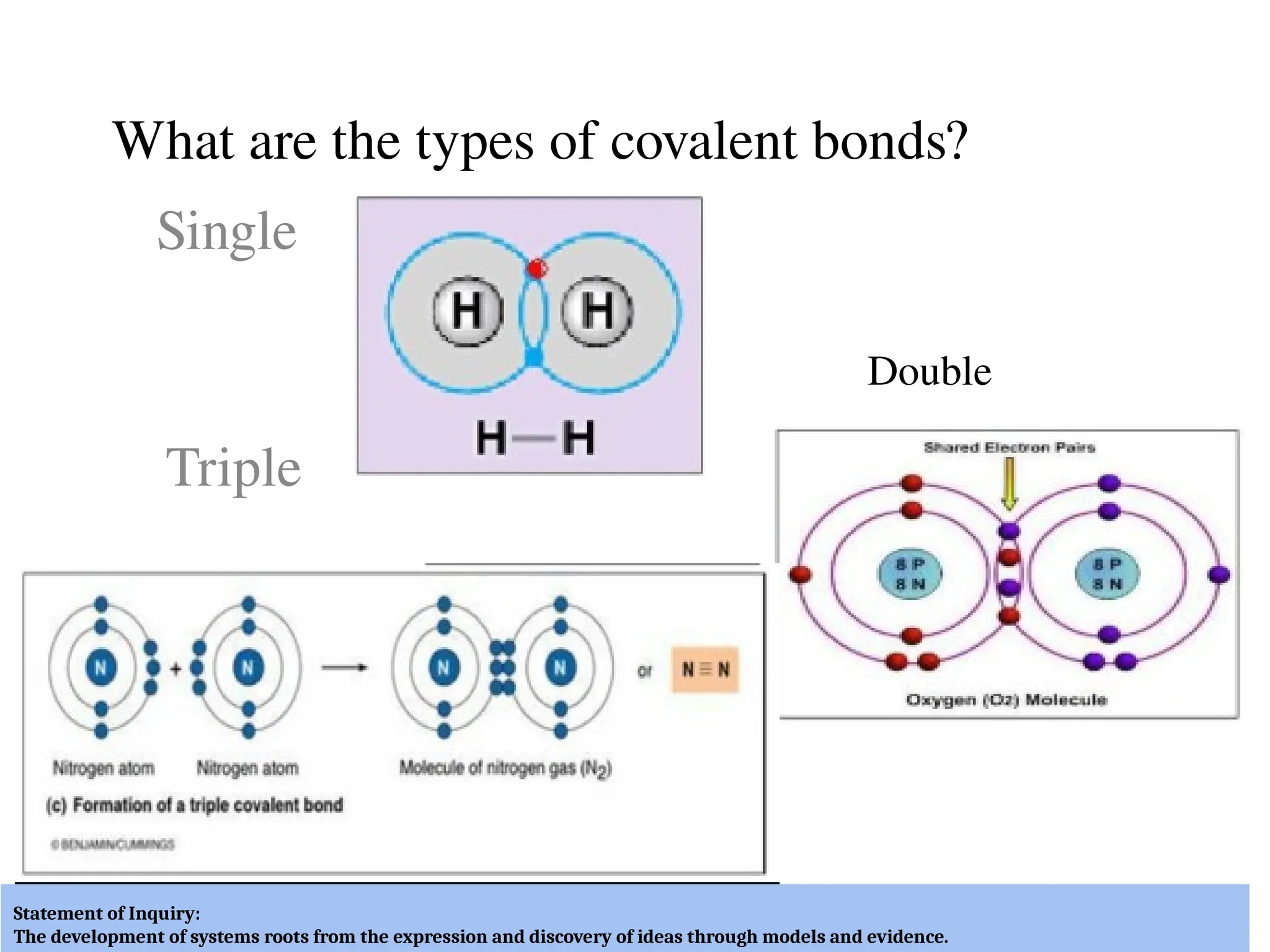
What are the types of covalent bonds?
Single
Triple
Statement of Inquiry:
The development of systems roots from the expression and discovery of ideas through models and evidence.
Double
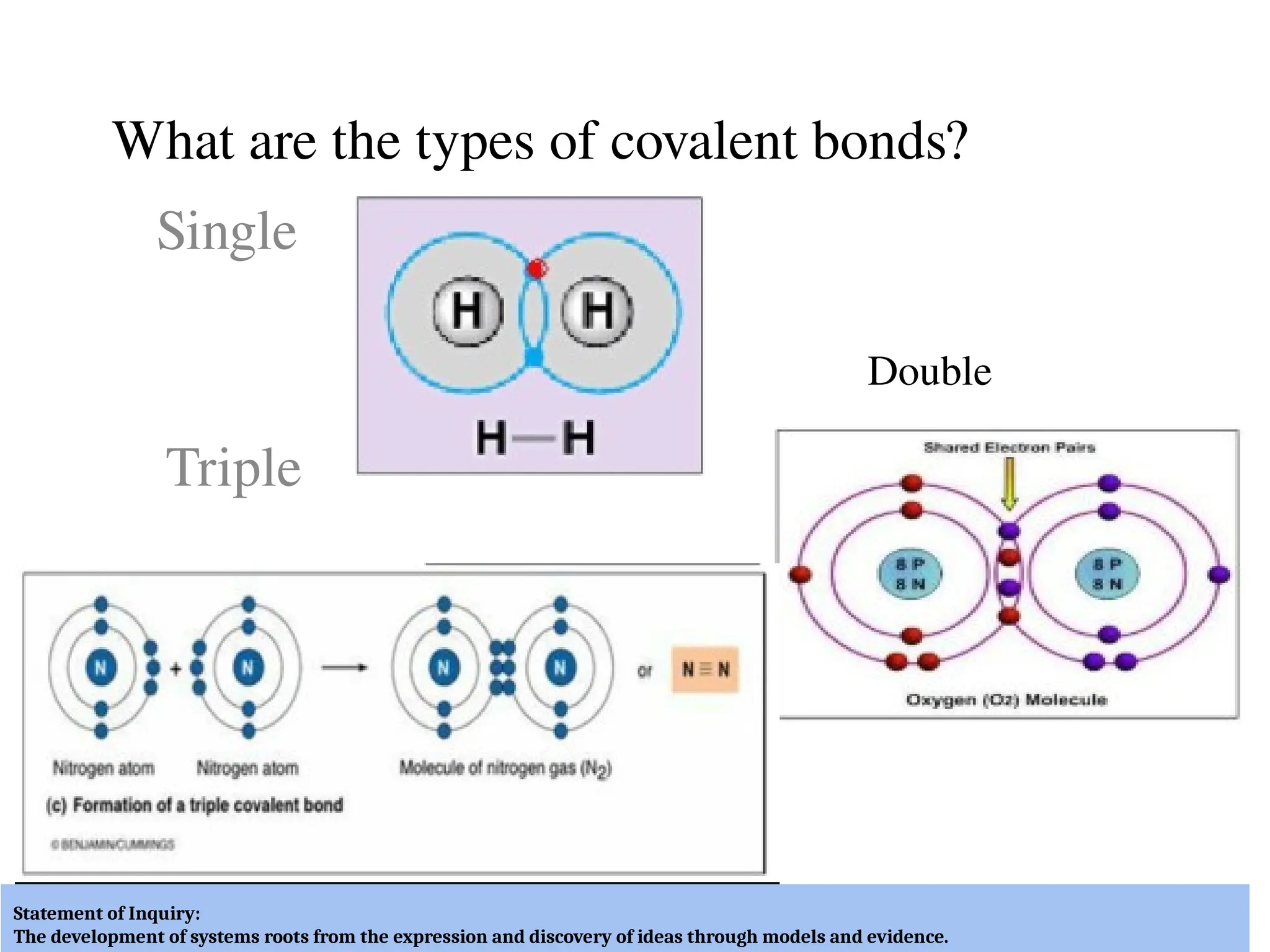
What are the types of covalent bonds?
Single
Triple
Statement of Inquiry:
The development of systems roots from the expression and discovery of ideas through models and evidence.
Double
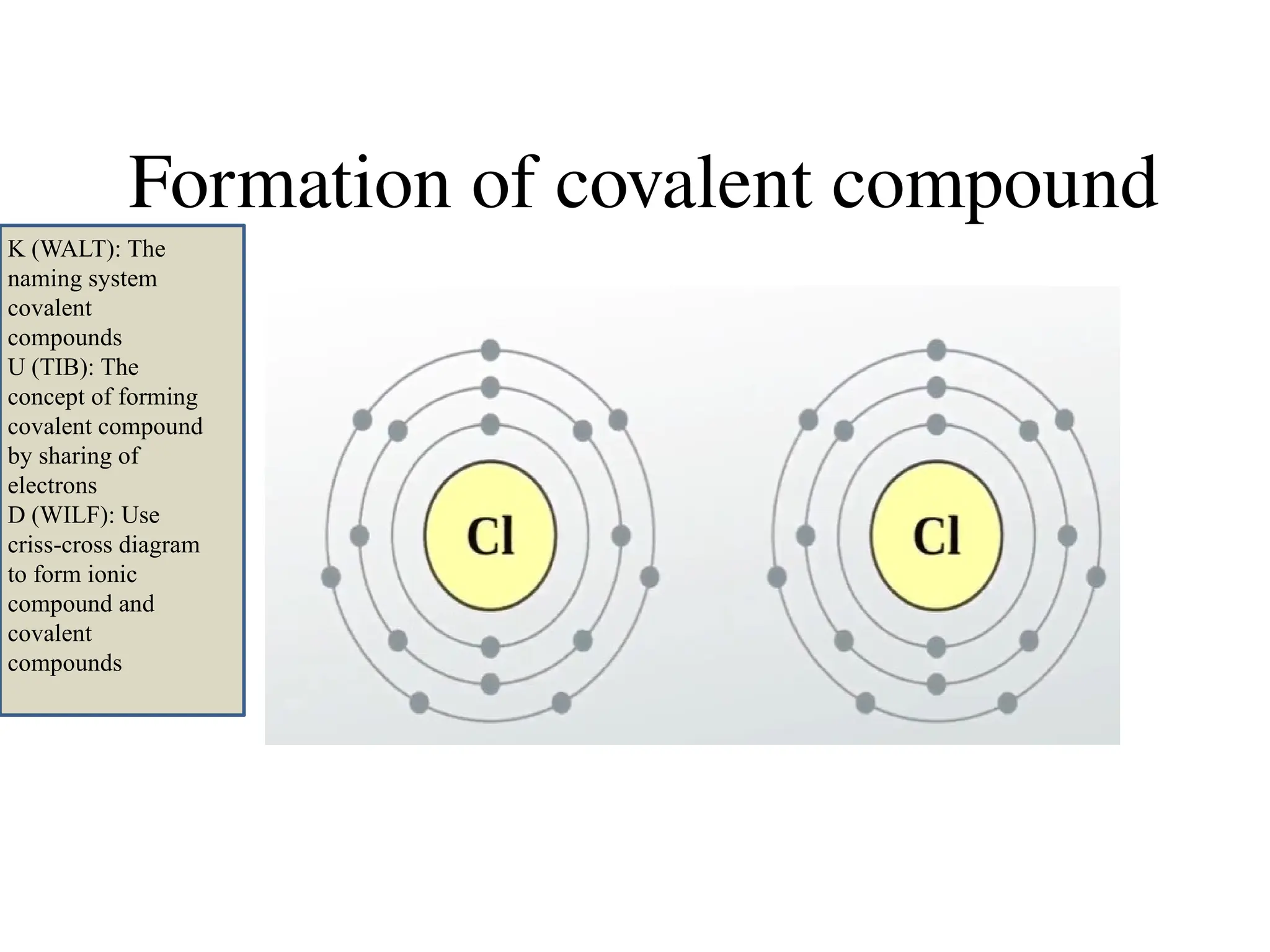
Formation of covalent compound
Positive end of a magnet attracted to negative end of another magnet. Same
principle is applied in formation of covalent bond
Formation of covalent compound
K (WALT): The
naming system
covalent
compounds
U (TIB): The
concept of forming
covalent compound
by sharing of
electrons
D (WILF): Use
criss-cross diagram
to form ionic
compound and
covalent
compounds
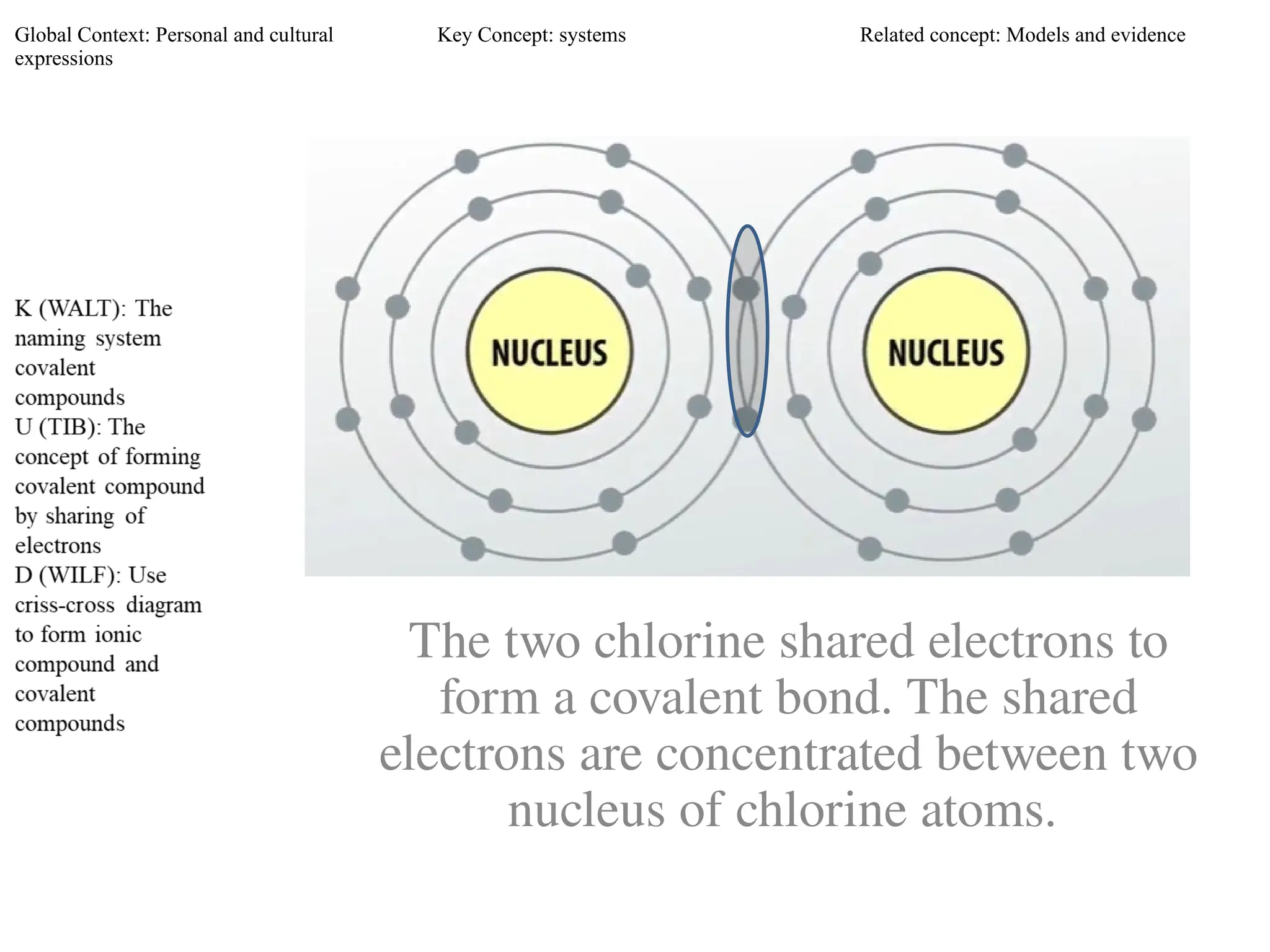
The two chlorine shared electrons to
form a covalent bond. The shared
electrons are concentrated between two
nucleus of chlorine atoms.
The two chlorine shared electrons to
form a covalent bond. The shared
electrons are concentrated between two
nucleus of chlorine atoms.
Global Context: Personal and cultural
expressions
Key Concept: systems Related concept: Models and evidence
M4 Bonding: Covalent Bonding
Single Covalent Bond
• Other elements that share two electrons between themselves and
form a diatomic molecule are:
– The rest of the halogens (Chlorine, Bromine, and Iodine)
– Oxygen
– Nitrogen
• Hydrogen and halogens (fluorine, chlorine, bromine and iodine)
share only two electrons between the atoms bonded together.
A covalent bond consisting of only two shared electrons it is referred
to as a single bond.
Oxygen and nitrogen however share 4 and 6 electrons respectively.
Can you guess why? (Hint: How many electrons do oxygen and
nitrogen atoms need to have a full valence shell?)
M4 Bonding: Covalent Bonding
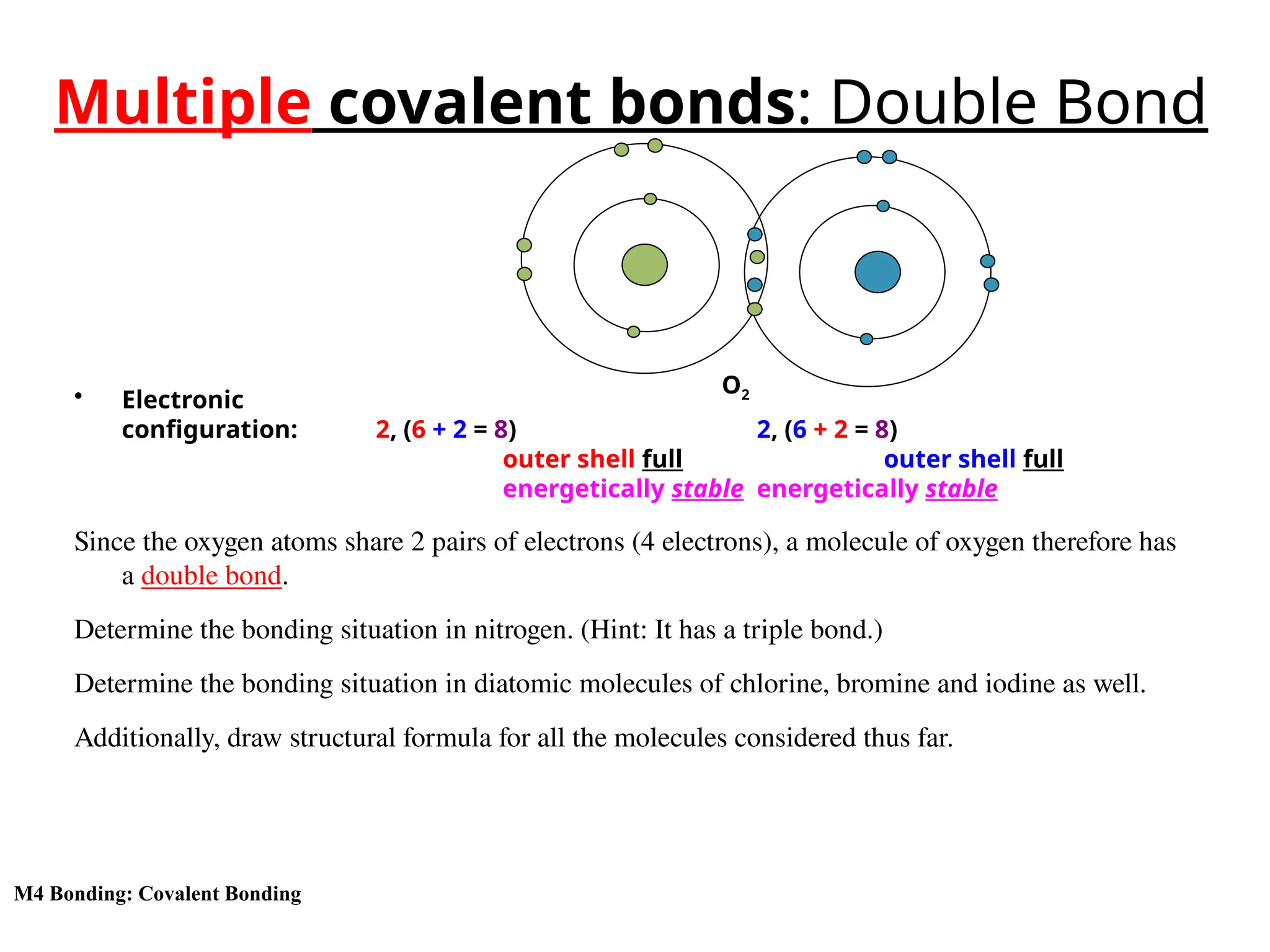
Multiple covalent bonds: Double Bond
• Electronic
configuration: 2, (6 + 2 = 8) 2, (6 + 2 = 8)
outer shell full outer shell full
energetically stable energetically stable
Since the oxygen atoms share 2 pairs of electrons (4 electrons), a molecule of oxygen therefore has
a double bond.
Determine the bonding situation in nitrogen. (Hint: It has a triple bond.)
Determine the bonding situation in diatomic molecules of chlorine, bromine and iodine as well.
Additionally, draw structural formula for all the molecules considered thus far.
O2
M4 Bonding: Covalent Bonding
Multiple covalent bonds: Triple Bond
• Nitrogen is another non-metal. A structure for
nitrogen is given to the right.
How many electrons does it need to have a completely filled outer
shell and become energetically stable?
If two nitrogen atoms are to combine and form a diatomic
molecule, and become stable, how many electrons must they
each contribute to the bond then?
How many electrons must they share between them?
2, 5
5
3
6
3
What is the electronic configuration of
nitrogen?
How many electrons does its outer shell
have?
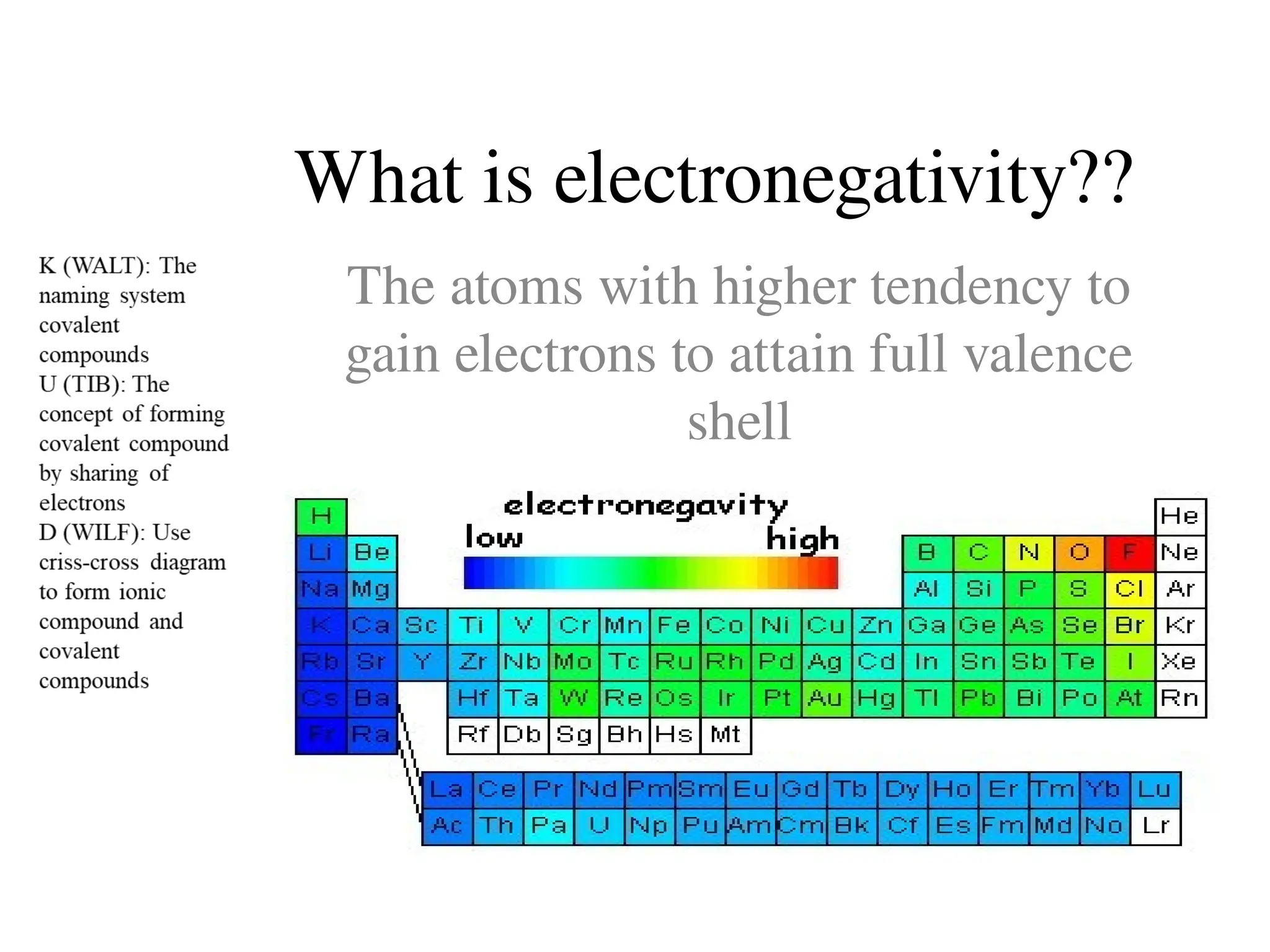
What is electronegativity??
The atoms with higher tendency to
gain electrons to attain full valence
shell
What is electronegativity??
If the attraction is between more
electronegative atoms and less electrogative
atom, the electrons will not be shared evenly.
Uneven charge distribution causes the
formation of dipole
What is DIPOLE??
• Separation of the charges between two
covalently bonded atoms
• The more electronegative atom attract
electrons of bonded atom more strongly .
• The resulting bonding is described as
‘polar’- unequal sharing of electrons gives
it ‘direction’
Simple concept behind polar and
non-polar covalent bond
Non-polar
Simple concept behind polar and
polar covalent bond
Statement of Inquiry:
The development of systems roots from the expression and discovery of ideas through models and evidence.
Polar
Probability representations of the electron sharing in HF. (a) What the probability
map would look like if the two electrons in the H–F bond were shared equally. (b)
The actual situation, where the shared pair spends more time close to the fluorine
atom than to the hydrogen atom.
Global Context: Personal and cultural
expressions
Key Concept: systems Related concept: Models and evidence
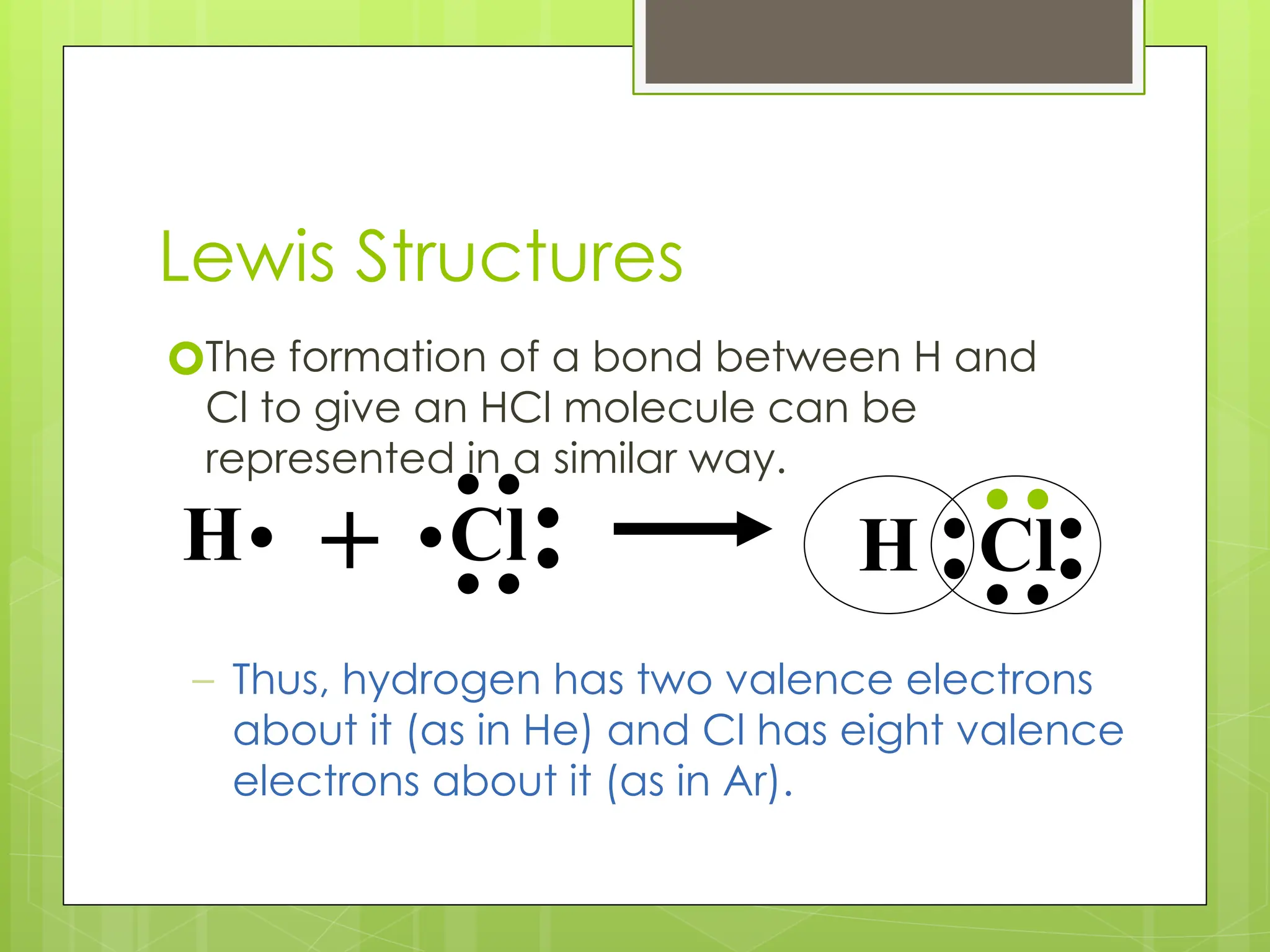
Lewis Structures
🞇The formation of a bond between H and
Cl to give an HCl molecule can be
represented in a similar way.
– Thus, hydrogen has two valence electrons
about it (as in He) and Cl has eight valence
electrons about it (as in Ar).
:
H
:
:
:
Cl
H. .
:
:
Cl:
+
Lewis Structures
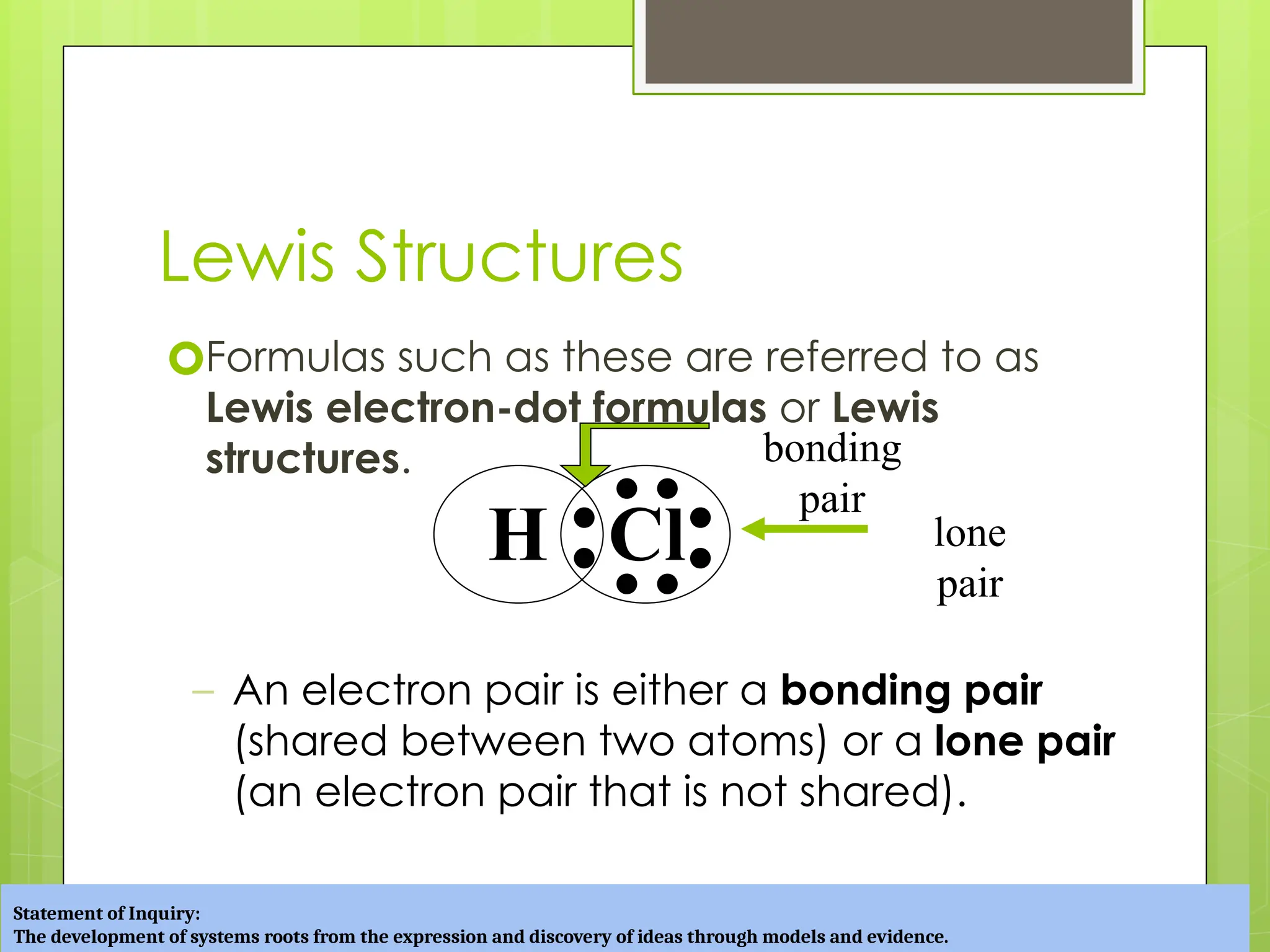
🞇Formulas such as these are referred to as
Lewis electron-dot formulas or Lewis
structures.
:
:
H Cl
:
:
– An electron pair is either a bonding pair
(shared between two atoms) or a lone pair
(an electron pair that is not shared).
bonding
pair
lone
pair
Statement of Inquiry:
The development of systems roots from the expression and discovery of ideas through models and evidence.
Inorganic examples
C
: : :
O
..
:
O
..
: : C :
O
..
O
..
:
: : :
N
:
C
:
H :
N
C
H
Carbon dioxide
Hydrogen cyanide
Statement of Inquiry:
The development of systems roots from the expression and discovery of ideas through models and evidence.
Organic examples
Ethylene
ethene
Acetylene
ethylene
: : :
C
:
C
:
H H C
C
H H
C
: :
C
..
H ::
..
H
H
H
C C
H H
H
H
Global Context: Personal and cultural
expressions
Key Concept: systems Related concept: Models and evidence
Statement of Inquiry:
The development of systems roots from the expression and discovery of ideas through models and evidence.
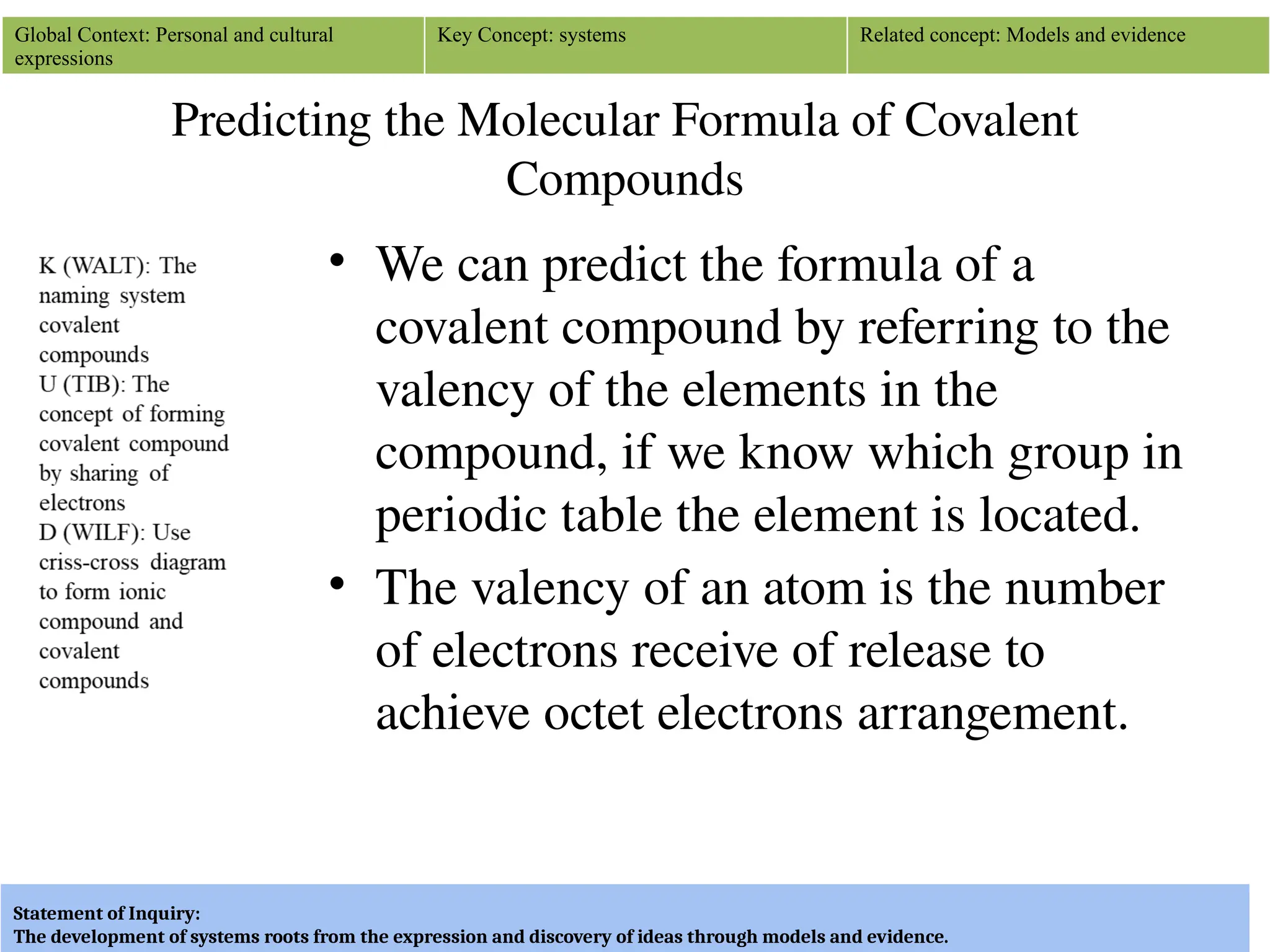
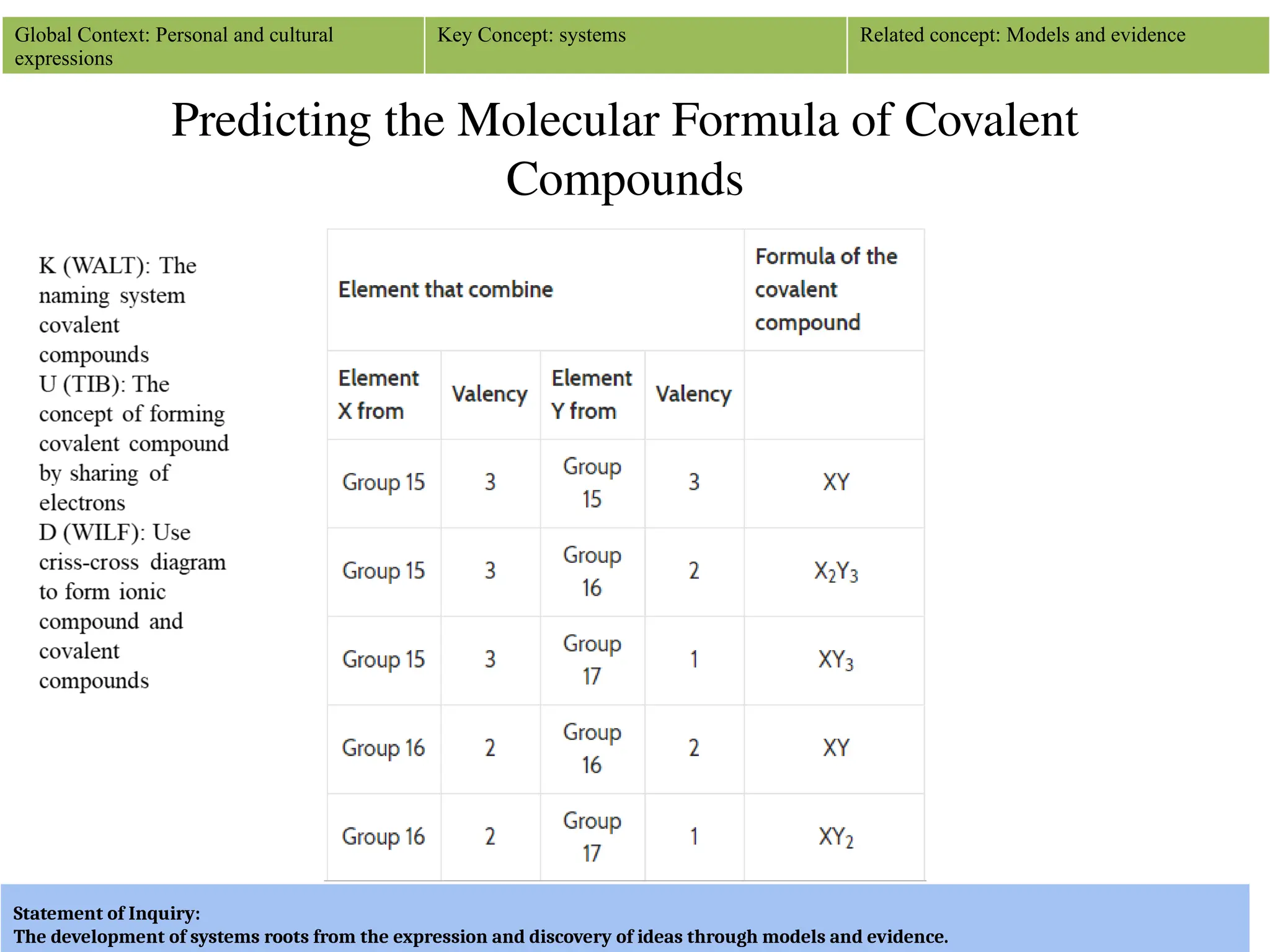
Predicting the Molecular Formula of Covalent
Compounds
• We can predict the formula of a
covalent compound by referring to the
valency of the elements in the
compound, if we know which group in
periodic table the element is located.
• The valency of an atom is the number
of electrons receive of release to
achieve octet electrons arrangement.
Global Context: Personal and cultural
expressions
Key Concept: systems Related concept: Models and evidence
Statement of Inquiry:
The development of systems roots from the expression and discovery of ideas through models and evidence.
Predicting the Molecular Formula of Covalent
Compounds
Global Context: Personal and cultural
expressions
Key Concept: systems Related concept: Models and evidence
Statement of Inquiry:
The development of systems roots from the expression and discovery of ideas through models and evidence.
Low melting/boiling point (Volatile)
Molecules held by weak intermolecular forces in
a simple molecular structure, requires little
energy to overcome.
1
Low density
Molecules held by weak intermolecular forces, hence
they are usually not packed.
2
Does not conduct electricity in any state
They do not have any free moving ions to carry electrical charges.
4
Properties of Covalent Compound
Usually insoluble in water
Soluble in organic compounds (eg oil)
3
Simple Molecular
Structure
Intermolecular
Forces (Weak)
Covalent
Bond
(Strong)
Tuning in Sorting Out Going Further Making Conclusion
Properties of covalent compounds
Global Context: Personal and cultural
expressions
Key Concept: systems Related concept: Models and evidence
Statement of Inquiry:
The development of systems roots from the expression and discovery of ideas through models and evidence.
• Most covalent compounds are made up of independent molecular units,
as shown in figure above.
• The attraction force between molecules is the weak Van der Waals’
force.
Statement of Inquiry:
The development of systems roots from the expression and discovery of ideas through models and evidence.
Properties of Simple Covalent Molecular
Substances – Small Molecules!
⮚ The intermolecular force between the simple
covalent molecules is very weak. Therefore,
covalent compounds have low melting and boiling
point.
⮚ They are also poor conductors of electricity
because there are no free electrons or ions in any
state to carry electric charge.
⮚ Most small molecules will dissolve in organic
solvent to form a solution.
⮚ Examples – CO2, CO, NH3
Activity 1
Draw dot and cross diagrams to illustrate the
bonding in the following covalent compounds. If
you wish you
need only draw the outer shell electrons;
1. Water, H2O
2. Carbon dioxide, CO2
3. Ethyne, C2H2
Post-Lesson Task
Group 1: Define giant molecules
How the structure of giant molecules are
different from simple covalent structures
Provide examples of giant molecules
List down the properties of simple molecules
and giant molecules.
Quiz 1
Quiz 2
Quiz 3
Quiz 4
Quiz 5
WEEK 5 LESSON 1
Molecules and covalent bonds
Hydrogen bond (Brief)*
Macromolecules (giant covalent)
Metallic bond formation
MYP Criteria:
Criterion: A
Strand(s):
apply scientific knowledge and understanding to solve problems set in familiar and
unfamiliar situations
In this session, students will learn
K: State the basis behind formation of ions
U: Describe how different group elements loses/gain electrons
D: Draw Dot and cross diagrams for various ionic
compounds
Covalent BONDing
1 Sharing of Electrons
Ionic bonding cannot be formed
when:
a) Atom has 4 valence electrons
b) Metals are absent (no
electron donor)
To obtain noble configuration, non-
metals will:
a) Share electrons with another atom
of the same element
b) Share electrons with another non-
metal
Tuning in Sorting Out Going Further Making Conclusion
F F O
C
O
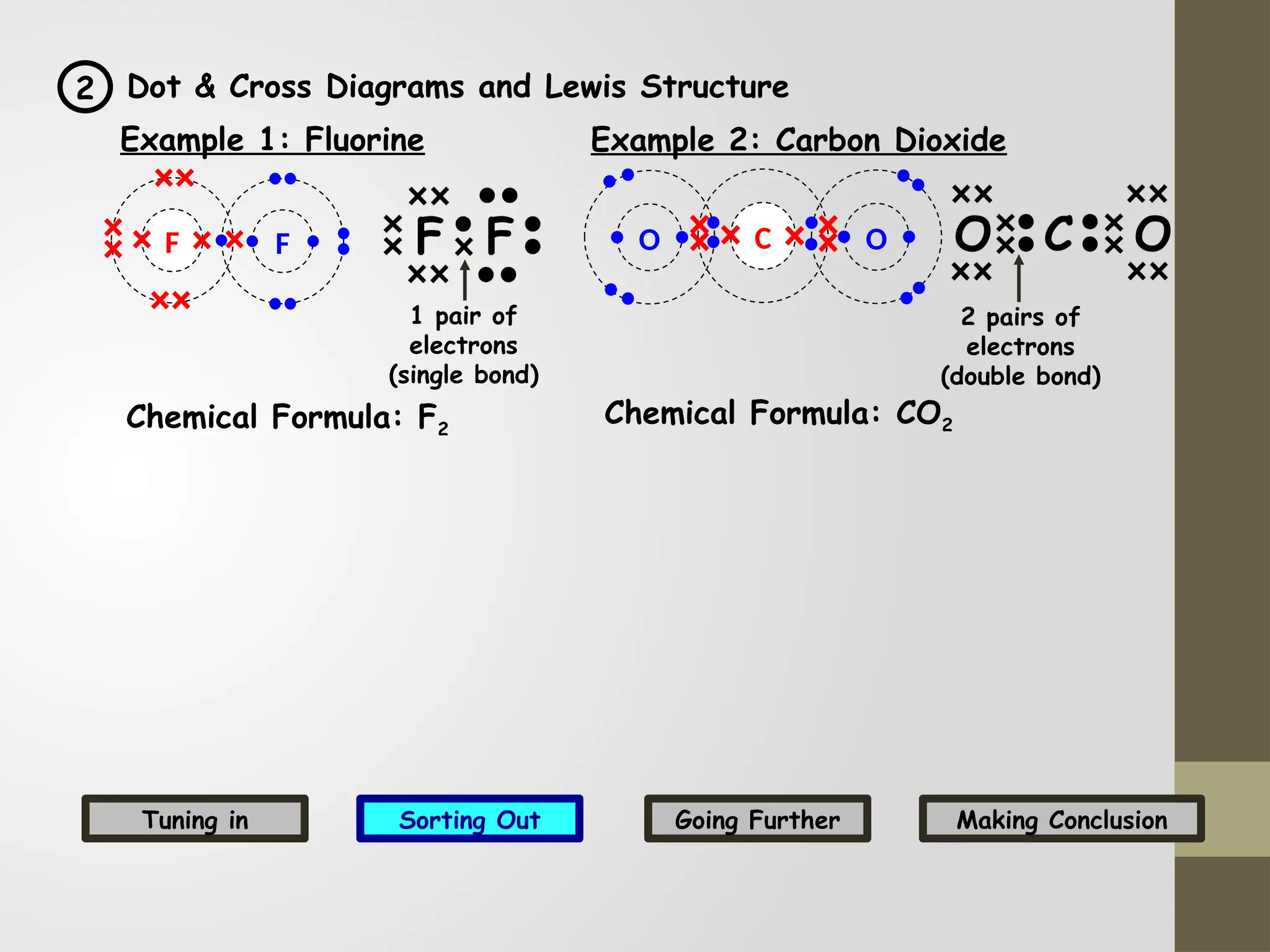
2 Dot & Cross Diagrams and Lewis Structure
Example 1: Fluorine Example 2: Carbon Dioxide
Chemical Formula: F2
Chemical Formula: CO2
2 pairs of
electrons
(double bond)
1 pair of
electrons
(single bond)
Tuning in Sorting Out Going Further Making Conclusion
Low melting/boiling point (Volatile)
Molecules held by weak intermolecular forces in
a simple molecular structure, requires little
energy to overcome.
1
Low density
Molecules held by weak intermolecular forces, hence
they are usually not packed.
2
Does not conduct electricity in any state
They do not have any free moving ions to carry electrical charges.
4
Properties of Covalent Compound
Usually insoluble in water
Soluble in organic compounds (eg oil)
3
Simple Molecular
Structure
Intermolecular
Forces (Weak)
Covalent
Bond
(Strong)
Tuning in Sorting Out Going Further Making Conclusion
Metallic bonding
1 Sea of delocalised electrons
Metals always lose electrons to form positive ions (cations)
When there is no available atoms to take in the electrons lost, the electrons will
stay ’floating’ around the positive ion.
In a bigger picture, many electrons will ‘float’ around their corresponding positive
ions, forming a sea of delocalised electrons
Tuning in Sorting Out Going Further Making Conclusion
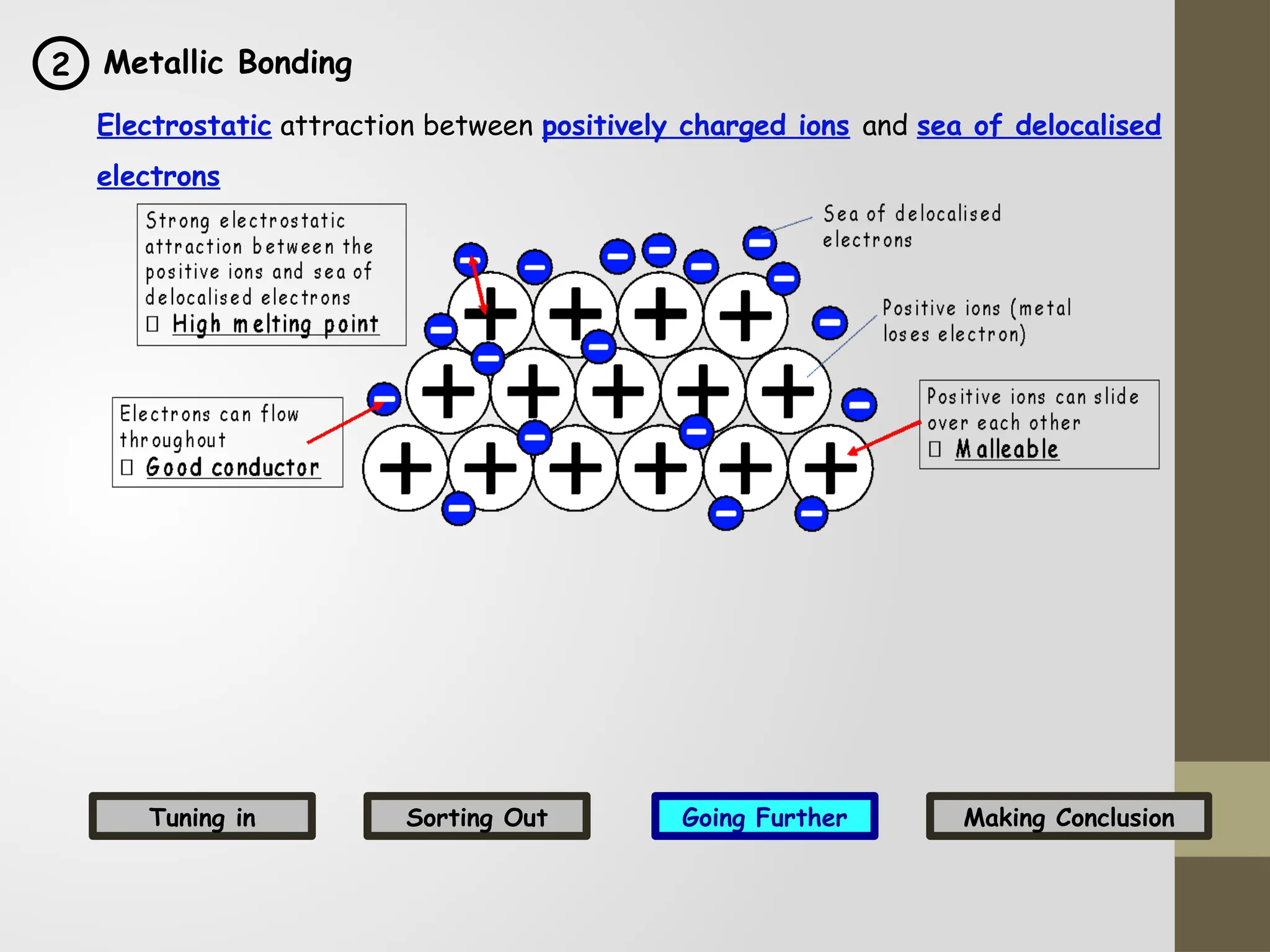
2 Metallic Bonding
Electrostatic attraction between positively charged ions and sea of delocalised
electrons
Tuning in Sorting Out Going Further Making Conclusion
Special covalent bonding
a) Diamond
What it is?
Diamond is made up of carbon elements
held together in a strong lattice.
It is an element.
1 What does it look like?
2
Each carbon is
bonded to 4
other carbons
What does it mean?
The giant covalent structure is extremely strong.
Therefore, diamond:
a) is the hardest substance
b) has a high m.p of 3550 o
C
3
All valence electrons of a carbon atom are used up to form bonding.
Therefore, diamond cannot conduct electricity.
Tuning in Sorting Out Going Further Making Conclusion
b) Graphite
What it is?
Graphite is made up of carbon
elements held together in layers. It is
an element.
1 What does it look like?
2
What does it mean?
The layers can slide over each other easily.
Therefore, graphite is soft and slippery.
3
Each carbon is
bonded to 3
other carbons
The layers are
held together by
weak forces
Only 3 electrons of a carbon atom are used to form bonding. The remaining electron
are free to move.
Therefore, graphite can conduct electricity.
Tuning in Sorting Out Going Further Making Conclusion
c) Silicon (IV) Oxide
What it is?
Silicon (IV) oxide is made up of silicon and
oxygen atoms held together in a strong
lattice. It is a compound.
1 What does it look like?
2
What does it mean?
The giant covalent structure is extremely strong.
Therefore, sand:
a) is a hard substance
b) has a high m.p of 1710 o
C
3
All valence electrons silicon and oxygen atoms are used up to form bonding.
Therefore, sand cannot conduct electricity.
Each silicon is
bonded to 4
oxygen atoms
Each oxygen is
bonded to 2 silicon
atoms
Tuning in Sorting Out Going Further Making Conclusion

covalent bonding IGCSE chemistry, topic 4

  • 1.
    Formation of ChemicalBondings K (WALT): The naming system covalent Compounds/ molecules U (TIB): The concept of forming covalent compound by sharing of electrons D (WILF): Use criss-cross diagram to form ionic compound and covalent compounds Properties, naming and Formation of covalent compound
  • 2.
    ⮚When atoms ofthe same or different types chemically joined together, it is known as chemical bonding. ⮚Atoms bond together in order to achieve stable electronic configuration of noble gases. ⮚According to octet rule atoms will lose, gain or share electrons to achieve full valence shell K (WALT): The naming system covalent compounds U (TIB): The concept of forming covalent compound by sharing of electrons D (WILF): Use criss-cross diagram to form ionic compound and covalent compounds Chemical Bonding
  • 3.
  • 4.
    K (WALT): The namingsystem covalent compounds U (TIB): The concept of forming covalent compound by sharing of electrons D (WILF): Use criss-cross diagram to form ionic compound and covalent compounds COVALENT BOND Bond formed by the sharing of electrons between non- metallic elements in group 14-17. Think about the word Covalent share Valence electron
  • 5.
    What are thetypes of covalent bonds? Single Triple Statement of Inquiry: The development of systems roots from the expression and discovery of ideas through models and evidence. Double
  • 6.
    What are thetypes of covalent bonds? Single Triple Statement of Inquiry: The development of systems roots from the expression and discovery of ideas through models and evidence. Double
  • 7.
    Formation of covalentcompound Positive end of a magnet attracted to negative end of another magnet. Same principle is applied in formation of covalent bond
  • 8.
    Formation of covalentcompound K (WALT): The naming system covalent compounds U (TIB): The concept of forming covalent compound by sharing of electrons D (WILF): Use criss-cross diagram to form ionic compound and covalent compounds
  • 9.
    The two chlorineshared electrons to form a covalent bond. The shared electrons are concentrated between two nucleus of chlorine atoms.
  • 10.
    The two chlorineshared electrons to form a covalent bond. The shared electrons are concentrated between two nucleus of chlorine atoms. Global Context: Personal and cultural expressions Key Concept: systems Related concept: Models and evidence
  • 11.
    M4 Bonding: CovalentBonding Single Covalent Bond • Other elements that share two electrons between themselves and form a diatomic molecule are: – The rest of the halogens (Chlorine, Bromine, and Iodine) – Oxygen – Nitrogen • Hydrogen and halogens (fluorine, chlorine, bromine and iodine) share only two electrons between the atoms bonded together. A covalent bond consisting of only two shared electrons it is referred to as a single bond. Oxygen and nitrogen however share 4 and 6 electrons respectively. Can you guess why? (Hint: How many electrons do oxygen and nitrogen atoms need to have a full valence shell?)
  • 12.
    M4 Bonding: CovalentBonding Multiple covalent bonds: Double Bond • Electronic configuration: 2, (6 + 2 = 8) 2, (6 + 2 = 8) outer shell full outer shell full energetically stable energetically stable Since the oxygen atoms share 2 pairs of electrons (4 electrons), a molecule of oxygen therefore has a double bond. Determine the bonding situation in nitrogen. (Hint: It has a triple bond.) Determine the bonding situation in diatomic molecules of chlorine, bromine and iodine as well. Additionally, draw structural formula for all the molecules considered thus far. O2
  • 13.
    M4 Bonding: CovalentBonding Multiple covalent bonds: Triple Bond • Nitrogen is another non-metal. A structure for nitrogen is given to the right. How many electrons does it need to have a completely filled outer shell and become energetically stable? If two nitrogen atoms are to combine and form a diatomic molecule, and become stable, how many electrons must they each contribute to the bond then? How many electrons must they share between them? 2, 5 5 3 6 3 What is the electronic configuration of nitrogen? How many electrons does its outer shell have?
  • 14.
    What is electronegativity?? Theatoms with higher tendency to gain electrons to attain full valence shell
  • 15.
    What is electronegativity?? Ifthe attraction is between more electronegative atoms and less electrogative atom, the electrons will not be shared evenly. Uneven charge distribution causes the formation of dipole
  • 16.
    What is DIPOLE?? •Separation of the charges between two covalently bonded atoms • The more electronegative atom attract electrons of bonded atom more strongly . • The resulting bonding is described as ‘polar’- unequal sharing of electrons gives it ‘direction’
  • 17.
    Simple concept behindpolar and non-polar covalent bond Non-polar
  • 18.
    Simple concept behindpolar and polar covalent bond Statement of Inquiry: The development of systems roots from the expression and discovery of ideas through models and evidence. Polar
  • 19.
    Probability representations ofthe electron sharing in HF. (a) What the probability map would look like if the two electrons in the H–F bond were shared equally. (b) The actual situation, where the shared pair spends more time close to the fluorine atom than to the hydrogen atom. Global Context: Personal and cultural expressions Key Concept: systems Related concept: Models and evidence
  • 20.
    Lewis Structures 🞇The formationof a bond between H and Cl to give an HCl molecule can be represented in a similar way. – Thus, hydrogen has two valence electrons about it (as in He) and Cl has eight valence electrons about it (as in Ar). : H : : : Cl H. . : : Cl: +
  • 21.
    Lewis Structures 🞇Formulas suchas these are referred to as Lewis electron-dot formulas or Lewis structures. : : H Cl : : – An electron pair is either a bonding pair (shared between two atoms) or a lone pair (an electron pair that is not shared). bonding pair lone pair Statement of Inquiry: The development of systems roots from the expression and discovery of ideas through models and evidence.
  • 22.
    Inorganic examples C : :: O .. : O .. : : C : O .. O .. : : : : N : C : H : N C H Carbon dioxide Hydrogen cyanide Statement of Inquiry: The development of systems roots from the expression and discovery of ideas through models and evidence.
  • 23.
    Organic examples Ethylene ethene Acetylene ethylene : :: C : C : H H C C H H C : : C .. H :: .. H H H C C H H H H Global Context: Personal and cultural expressions Key Concept: systems Related concept: Models and evidence Statement of Inquiry: The development of systems roots from the expression and discovery of ideas through models and evidence.
  • 24.
    Predicting the MolecularFormula of Covalent Compounds • We can predict the formula of a covalent compound by referring to the valency of the elements in the compound, if we know which group in periodic table the element is located. • The valency of an atom is the number of electrons receive of release to achieve octet electrons arrangement. Global Context: Personal and cultural expressions Key Concept: systems Related concept: Models and evidence Statement of Inquiry: The development of systems roots from the expression and discovery of ideas through models and evidence.
  • 25.
    Predicting the MolecularFormula of Covalent Compounds Global Context: Personal and cultural expressions Key Concept: systems Related concept: Models and evidence Statement of Inquiry: The development of systems roots from the expression and discovery of ideas through models and evidence.
  • 26.
    Low melting/boiling point(Volatile) Molecules held by weak intermolecular forces in a simple molecular structure, requires little energy to overcome. 1 Low density Molecules held by weak intermolecular forces, hence they are usually not packed. 2 Does not conduct electricity in any state They do not have any free moving ions to carry electrical charges. 4 Properties of Covalent Compound Usually insoluble in water Soluble in organic compounds (eg oil) 3 Simple Molecular Structure Intermolecular Forces (Weak) Covalent Bond (Strong) Tuning in Sorting Out Going Further Making Conclusion
  • 27.
    Properties of covalentcompounds Global Context: Personal and cultural expressions Key Concept: systems Related concept: Models and evidence Statement of Inquiry: The development of systems roots from the expression and discovery of ideas through models and evidence. • Most covalent compounds are made up of independent molecular units, as shown in figure above. • The attraction force between molecules is the weak Van der Waals’ force.
  • 28.
    Statement of Inquiry: Thedevelopment of systems roots from the expression and discovery of ideas through models and evidence. Properties of Simple Covalent Molecular Substances – Small Molecules! ⮚ The intermolecular force between the simple covalent molecules is very weak. Therefore, covalent compounds have low melting and boiling point. ⮚ They are also poor conductors of electricity because there are no free electrons or ions in any state to carry electric charge. ⮚ Most small molecules will dissolve in organic solvent to form a solution. ⮚ Examples – CO2, CO, NH3
  • 29.
    Activity 1 Draw dotand cross diagrams to illustrate the bonding in the following covalent compounds. If you wish you need only draw the outer shell electrons; 1. Water, H2O 2. Carbon dioxide, CO2 3. Ethyne, C2H2
  • 30.
    Post-Lesson Task Group 1:Define giant molecules How the structure of giant molecules are different from simple covalent structures Provide examples of giant molecules List down the properties of simple molecules and giant molecules.
  • 31.
  • 32.
  • 33.
  • 34.
  • 35.
  • 36.
    WEEK 5 LESSON1 Molecules and covalent bonds Hydrogen bond (Brief)* Macromolecules (giant covalent) Metallic bond formation MYP Criteria: Criterion: A Strand(s): apply scientific knowledge and understanding to solve problems set in familiar and unfamiliar situations In this session, students will learn K: State the basis behind formation of ions U: Describe how different group elements loses/gain electrons D: Draw Dot and cross diagrams for various ionic compounds
  • 37.
    Covalent BONDing 1 Sharingof Electrons Ionic bonding cannot be formed when: a) Atom has 4 valence electrons b) Metals are absent (no electron donor) To obtain noble configuration, non- metals will: a) Share electrons with another atom of the same element b) Share electrons with another non- metal Tuning in Sorting Out Going Further Making Conclusion
  • 38.
    F F O C O 2Dot & Cross Diagrams and Lewis Structure Example 1: Fluorine Example 2: Carbon Dioxide Chemical Formula: F2 Chemical Formula: CO2 2 pairs of electrons (double bond) 1 pair of electrons (single bond) Tuning in Sorting Out Going Further Making Conclusion
  • 39.
    Low melting/boiling point(Volatile) Molecules held by weak intermolecular forces in a simple molecular structure, requires little energy to overcome. 1 Low density Molecules held by weak intermolecular forces, hence they are usually not packed. 2 Does not conduct electricity in any state They do not have any free moving ions to carry electrical charges. 4 Properties of Covalent Compound Usually insoluble in water Soluble in organic compounds (eg oil) 3 Simple Molecular Structure Intermolecular Forces (Weak) Covalent Bond (Strong) Tuning in Sorting Out Going Further Making Conclusion
  • 40.
    Metallic bonding 1 Seaof delocalised electrons Metals always lose electrons to form positive ions (cations) When there is no available atoms to take in the electrons lost, the electrons will stay ’floating’ around the positive ion. In a bigger picture, many electrons will ‘float’ around their corresponding positive ions, forming a sea of delocalised electrons Tuning in Sorting Out Going Further Making Conclusion
  • 41.
    2 Metallic Bonding Electrostaticattraction between positively charged ions and sea of delocalised electrons Tuning in Sorting Out Going Further Making Conclusion
  • 42.
    Special covalent bonding a)Diamond What it is? Diamond is made up of carbon elements held together in a strong lattice. It is an element. 1 What does it look like? 2 Each carbon is bonded to 4 other carbons What does it mean? The giant covalent structure is extremely strong. Therefore, diamond: a) is the hardest substance b) has a high m.p of 3550 o C 3 All valence electrons of a carbon atom are used up to form bonding. Therefore, diamond cannot conduct electricity. Tuning in Sorting Out Going Further Making Conclusion
  • 43.
    b) Graphite What itis? Graphite is made up of carbon elements held together in layers. It is an element. 1 What does it look like? 2 What does it mean? The layers can slide over each other easily. Therefore, graphite is soft and slippery. 3 Each carbon is bonded to 3 other carbons The layers are held together by weak forces Only 3 electrons of a carbon atom are used to form bonding. The remaining electron are free to move. Therefore, graphite can conduct electricity. Tuning in Sorting Out Going Further Making Conclusion
  • 44.
    c) Silicon (IV)Oxide What it is? Silicon (IV) oxide is made up of silicon and oxygen atoms held together in a strong lattice. It is a compound. 1 What does it look like? 2 What does it mean? The giant covalent structure is extremely strong. Therefore, sand: a) is a hard substance b) has a high m.p of 1710 o C 3 All valence electrons silicon and oxygen atoms are used up to form bonding. Therefore, sand cannot conduct electricity. Each silicon is bonded to 4 oxygen atoms Each oxygen is bonded to 2 silicon atoms Tuning in Sorting Out Going Further Making Conclusion