Chapter 2 Slide 1 of 85
Chapter Two
Structures of Solids
Chapter 2 Slide 2 of 85
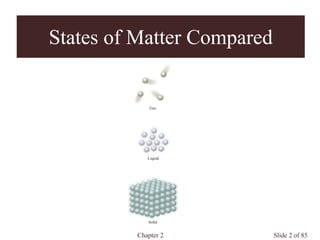
States of Matter Compared
Chapter 2 Slide 3 of 85
Chapter 2 Slide 4 of 85
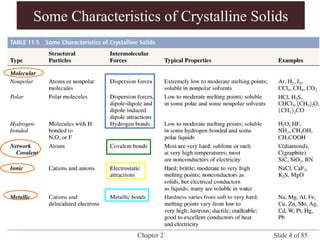
Some Characteristics of Crystalline Solids
Chapter 2 Slide 5 of 85
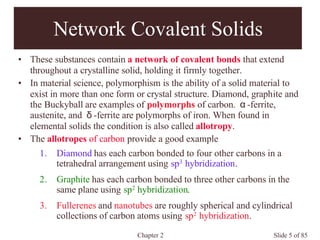
Network Covalent Solids
• These substances contain a network of covalent bonds that extend
throughout a crystalline solid, holding it firmly together.
• In material science, polymorphism is the ability of a solid material to
exist in more than one form or crystal structure. Diamond, graphite and
the Buckyball are examples of polymorphs of carbon. α-ferrite,
austenite, and δ-ferrite are polymorphs of iron. When found in
elemental solids the condition is also called allotropy.
• The allotropes of carbon provide a good example
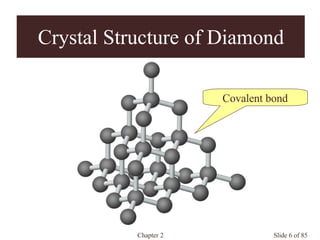
1. Diamond has each carbon bonded to four other carbons in a
tetrahedral arrangement using sp3 hybridization.
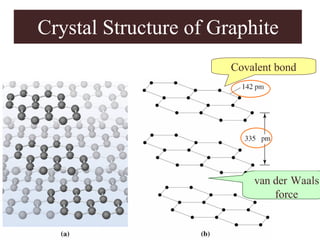
2. Graphite has each carbon bonded to three other carbons in the
same plane using sp2 hybridization.
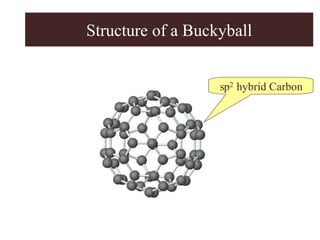
3. Fullerenes and nanotubes are roughly spherical and cylindrical
collections of carbon atoms using sp2 hybridization.
Chapter 2 Slide 6 of 85
Crystal Structure of Diamond
Covalent bond
Crystal Structure of Graphite
Covalent bond
van der Waals
force
Structure of a Buckyball
sp2 hybrid Carbon
Chapter 2 Slide 9 of 85
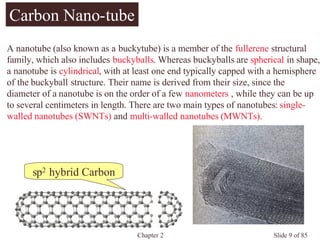
sp2 hybrid Carbon
Carbon Nano-tube
A nanotube (also known as a buckytube) is a member of the fullerene structural
family, which also includes buckyballs. Whereas buckyballs are spherical in shape,
a nanotube is cylindrical, with at least one end typically capped with a hemisphere
of the buckyball structure. Their name is derived from their size, since the
diameter of a nanotube is on the order of a few nanometers , while they can be up
to several centimeters in length. There are two main types of nanotubes: single-
walled nanotubes (SWNTs) and multi-walled nanotubes (MWNTs).
Chapter 2 Slide 10 of 85
Experimental Determination
of Crystal Structures
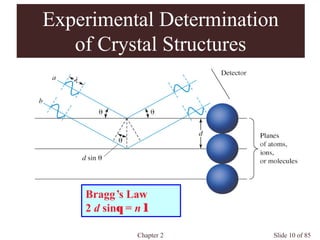
Bragg’s Law
2 d sinθ = n λ
Chapter 2 Slide 11 of 85
Chapter 2 Slide 12 of 85
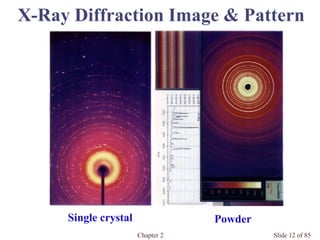
X-Ray Diffraction Image & Pattern
Single crystal Powder
Chapter 2 Slide 13 of 85
Crystal Lattices
• To describe crystals, three-dimensional views must be used.
• The repeating unit of the lattice is called the unit cell.
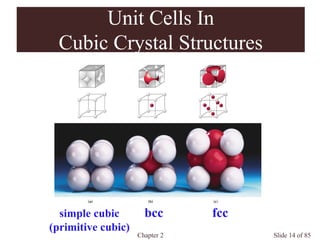
• The simple cubic cell (primitive cubic) is the simplest unit
cell and has structural particles centered only at its corners.
• The body-centered cubic (bcc) structure has an additional
structural particle at the center of the cube.
• The face-centered cubic (fcc) structure has an additional
structural particle at the center of each face.
Chapter 2 Slide 14 of 85
Unit Cells In
Cubic Crystal Structures
simple cubic
(primitive cubic)
bcc fcc
Chapter 2 Slide 15 of 85
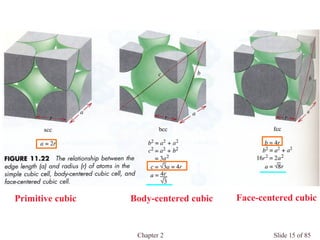
Face-centered cubicBody-centered cubicPrimitive cubic
Chapter 2 Slide 16 of 85
Occupancies per Unit Cells
Primitive cubic: a = 2r
1 atom/unit cell
occupancy = [4/3(πr3)]/a3 = [4/3(πr3)]/(2r)3
= 0.52 = 52%
Body-centered cubic: a = 4r/(3)1/2
2 atom/unit cell
occupancy = 2 x [4/3(πr3)]/a3 = 2 x [4/3(πr3)]/[4r/(3)1/2]3
= 0.68 = 68%
Face-centered cubic: a = (8)1/2 r
4 atom/unit cell
occupancy = 4 x [4/3(πr3)]/a3 = 4 x [4/3(πr3)]/[(8)1/2 r]3
= 0.74 = 74%
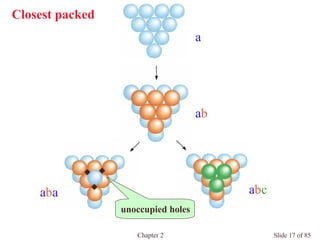
Closest packed
Chapter 2 Slide 17 of 85
a
ab
aba abc
unoccupied holes
Closest packed
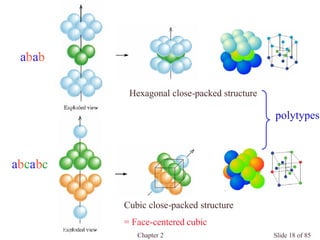
Chapter 2 Slide 18 of 85
abab
abcabc
Cubic close-packed structure
= Face-centered cubic
Hexagonal close-packed structure
polytypes
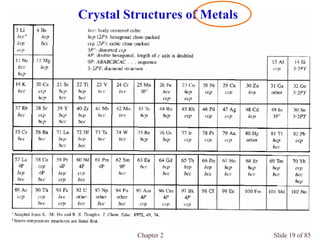
Chapter 2 Slide 19 of 85
Crystal Structures of Metals
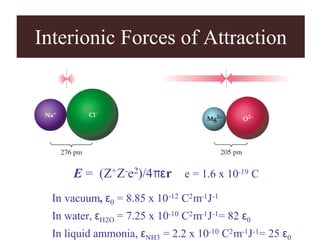
Interionic Forces of Attraction
E = (Z+Z-e2)/4πεr e = 1.6 x 10⁻¹⁹ C
In vacuum, ε0 = 8.85 x 10⁻¹² C2m-1J-1
In water, εH2O = 7.25 x 10⁻¹⁰ C2m-1J-1= 82 ε0
In liquid ammonia, εNH3 = 2.2 x 10⁻¹⁰ C2m-1J-1= 25 ε0
Chapter 2 Slide 21 of 85
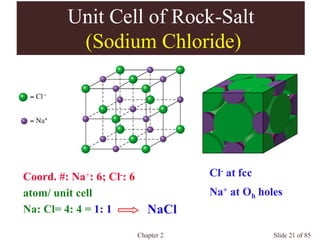
Unit Cell of Rock-Salt
(Sodium Chloride)
Cl- at fcc
Na+ at Oh holes
Coord. #: Na+: 6; Cl-: 6
atom/ unit cell
Na: Cl= 4: 4 = 1: 1 NaCl
Chapter 2 Slide 22 of 85
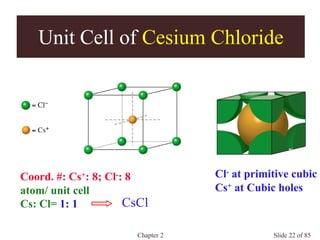
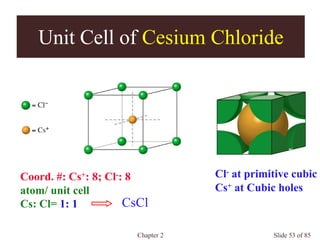
Unit Cell of Cesium Chloride
Cl- at primitive cubic
Cs+ at Cubic holes
Coord. #: Cs+: 8; Cl-: 8
atom/ unit cell
Cs: Cl= 1: 1 CsCl
Chapter 2 Slide 23 of 85
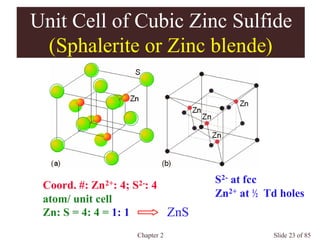
Unit Cell of Cubic Zinc Sulfide
(Sphalerite or Zinc blende)
Coord. #: Zn2+: 4; S2-: 4
atom/ unit cell
Zn: S = 4: 4 = 1: 1 ZnS
S2- at fcc
Zn2+ at ½ Td holes
Chapter 2 Slide 24 of 85
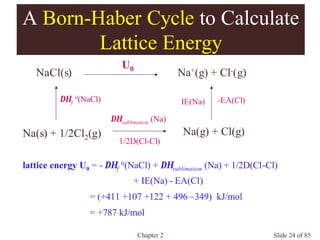
A Born-Haber Cycle to Calculate
Lattice Energy
1/2D(Cl-Cl)
∆Ηsublimation (Na)
IE(Na) -EA(Cl)
lattice energy U0 = - ∆Ηf
0(NaCl) + ∆Ηsublimation (Na) + 1/2D(Cl-Cl)
+ IE(Na) - EA(Cl)
= (+411 +107 +122 + 496 –349) kJ/mol
= +787 kJ/mol
∆Ηf
0(NaCl)
U0
NaCl(s) Na+(g) + Cl-(g)
Na(g) + Cl(g)Na(s) + 1/2Cl2(g)
Chapter 2 Slide 25 of 85
Lattice Energy & Madelung Constant
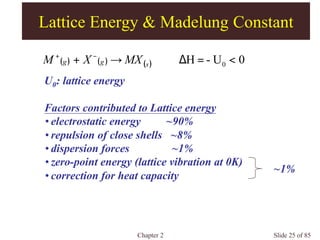
( ) ( ) ( ) 0U-H 0 <=∆→+ −+
sgg MXXM
U0: lattice energy
Factors contributed to Lattice energy
•electrostatic energy ~90%
•repulsion of close shells ~8%
•dispersion forces ~1%
•zero-point energy (lattice vibration at 0K)
•correction for heat capacity
~1%
Chapter 2 Slide 26 of 85
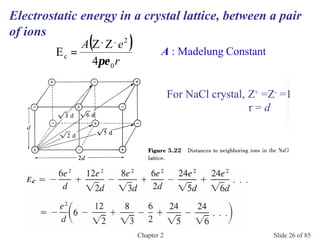
Electrostatic energy in a crystal lattice, between a pair
of ions
For NaCl crystal, Z+ =Z- =1
r = d
( )
r
eA
0
2
c
4
ZZ
E
πε
−+
= A : Madelung Constant
Chapter 2 Slide 27 of 85
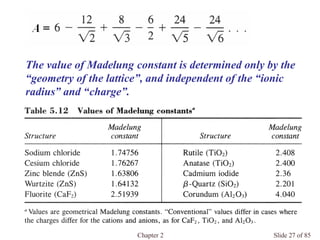
The value of Madelung constant is determined only by the
“geometry of the lattice”, and independent of the “ionic
radius” and “charge”.
Chapter 2 Slide 28 of 85
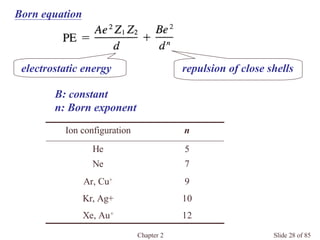
electrostatic energy repulsion of close shells
B: constant
n: Born exponent
Born equation
12Xe, Au+
10Kr, Ag+
9Ar, Cu+
7Ne
5He
nIon configuration
Chapter 2 Slide 29 of 85
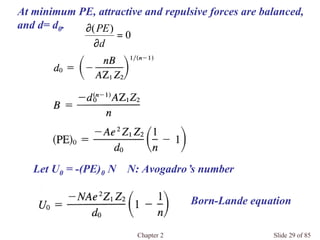
Let U0 = -(PE)0 N N: Avogadro’s number
Born-Lande equation
At minimum PE, attractive and repulsive forces are balanced,
and d= d0.
0
)(
=
∂
∂
d
PE
Chapter 2 Slide 30 of 85
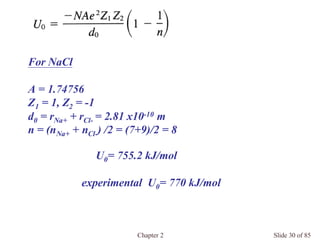
For NaCl
A = 1.74756
Z1 = 1, Z2 = -1
d0 = rNa+ + rCl- = 2.81 x10⁻¹⁰ m
n = (nNa+ + nCl-) /2 = (7+9)/2 = 8
⇒ U0= 755.2 kJ/mol
experimental U0= 770 kJ/mol
Chapter 2 Slide 31 of 85
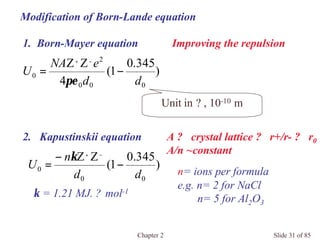
Modification of Born-Lande equation
)
345.0
1(
4
ZZ
000
2
0
dd
eNA
U −=
−+
πε
Unit in ? , 10-10 m
2. Kapustinskii equation
Improving the repulsion
)
345.0
1(
ZZ
00
0
dd
n
U −
−
=
−+
κ
κ = 1.21 MJ. ? mol-1
n= ions per formula
e.g. n= 2 for NaCl
n= 5 for Al2O3
A ? crystal lattice ? r+/r- ? r0
A/n ~constant
1. Born-Mayer equation
Chapter 2 Slide 32 of 85
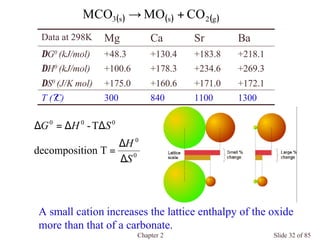
+218.1+183.8+130.4+48.3∆G0 (kJ/mol)
13001100840300T (?C)
+172.1+171.0+160.6+175.0∆S0 (J/K mol)
+269.3+234.6+178.3+100.6∆H0 (kJ/mol)
BaSrCaMgData at 298K
( ) ( ) ( )g2ss3 COMOMCO +→
A small cation increases the lattice enthalpy of the oxide
more than that of a carbonate.
0
0
000
Tiondecomposit
T-
S
H
SHG
∆
∆
=
∆∆=∆
Chapter 2 Slide 33 of 85
< 0 > 0
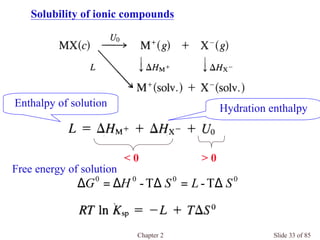
Solubility of ionic compounds
0000
T-T- SLSHG ∆=∆∆=∆
Enthalpy of solution Hydration enthalpy
Free energy of solution
Chapter 2 Slide 34 of 85
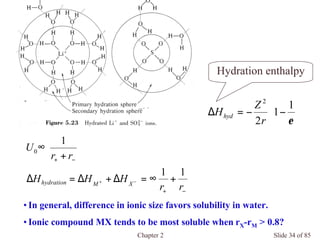
Hydration enthalpy
−+
−+
+∞=∆+∆=∆
+
∞
−+
rr
HHH
rr
U
XMhydration
11
1
0






−−=∆
ε
1
1
2
2
r
Z
Hhyd
•In general, difference in ionic size favors solubility in water.
•Ionic compound MX tends to be most soluble when rX-rM > 0.8?
Chapter 2 Slide 35 of 85
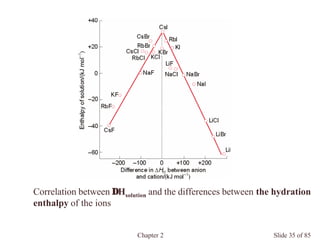
Correlation between ∆Hsolution and the differences between the hydration
enthalpy of the ions
Chapter 2 Slide 36 of 85
Fajan's rules
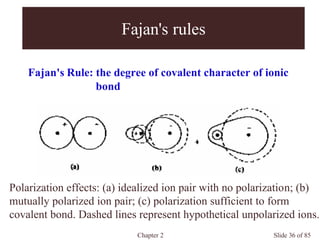
Fajan's Rule: the degree of covalent character of ionic
bond
Polarization effects: (a) idealized ion pair with no polarization; (b)
mutually polarized ion pair; (c) polarization sufficient to form
covalent bond. Dashed lines represent hypothetical unpolarized ions.
Chapter 2 Slide 37 of 85
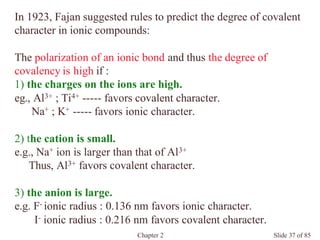
In 1923, Fajan suggested rules to predict the degree of covalent
character in ionic compounds:
The polarization of an ionic bond and thus the degree of
covalency is high if :
1) the charges on the ions are high.
eg., Al3+ ; Ti4+ ----- favors covalent character.
Na+ ; K+ ----- favors ionic character.
2) the cation is small.
e.g., Na+ ion is larger than that of Al3+
Thus, Al3+ favors covalent character.
3) the anion is large.
e.g. F- ionic radius : 0.136 nm favors ionic character.
I- ionic radius : 0.216 nm favors covalent character.
Chapter 2 Slide 38 of 85
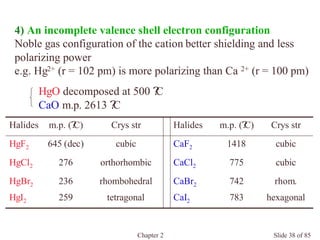
4) An incomplete valence shell electron configuration
Noble gas configuration of the cation better shielding and less
polarizing power
e.g. Hg2+ (r = 102 pm) is more polarizing than Ca 2+ (r = 100 pm)
HgO decomposed at 500 ?C
CaO m.p. 2613 ?C
783
742
775
1418
m.p. (?C)
hexagonal
rhom.
cubic
cubic
Crys str
259
236
276
645 (dec)
m.p. (?C)
tetragonal
rhombohedral
orthorhombic
cubic
Crys str
CaI2
CaBr2
CaCl2
CaF2
Halides
HgI2
HgBr2
HgCl2
HgF2
Halides
Chapter 2 Slide 39 of 85
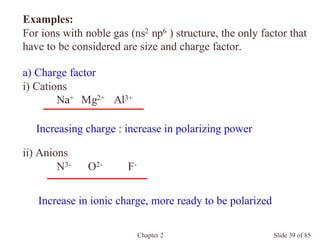
a) Charge factor
i) Cations
Na+ Mg2+ Al3+
Examples:
For ions with noble gas (ns2 np6 ) structure, the only factor that
have to be considered are size and charge factor.
ii) Anions
N3- O2- F-
Increasing charge : increase in polarizing power
Increase in ionic charge, more ready to be polarized
Chapter 2 Slide 40 of 85
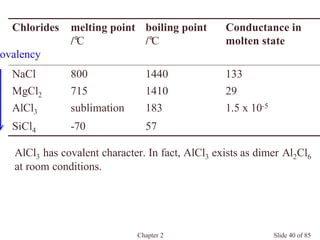
1.5 x 10-5183sublimationAlCl3
57-70SiCl4
1410
1440
boiling point
/°C
715
800
melting point
/°C
Conductance in
molten state
Chlorides
29MgCl2
133NaCl
AlCl3 has covalent character. In fact, AlCl3 exists as dimer Al2Cl6
at room conditions.
covalency
Chapter 2 Slide 41 of 85
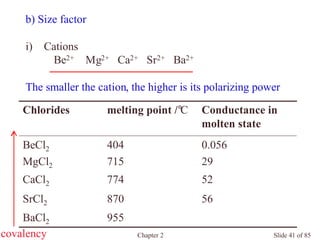
b) Size factor
i) Cations
Be2+ Mg2+ Ca2+ Sr2+ Ba2+
The smaller the cation, the higher is its polarizing power
52774CaCl2
56870SrCl2
Conductance in
molten state
melting point /°CChlorides
955BaCl2
29715MgCl2
0.056404BeCl2
covalency
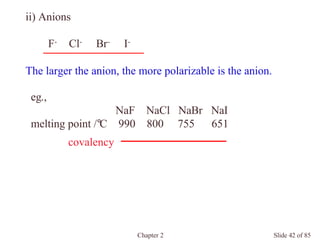
Chapter 2 Slide 42 of 85
ii) Anions
F- Cl- Br- I-
The larger the anion, the more polarizable is the anion.
eg.,
NaF NaCl NaBr NaI
melting point /°C 990 800 755 651
covalency
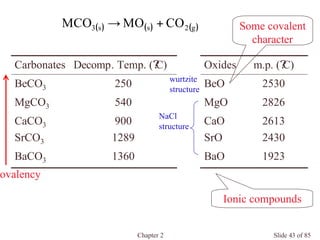
Chapter 2 Slide 43 of 85
( ) ( ) ( )g2ss3 COMOMCO +→
1360BaCO3
1289SrCO3
900CaCO3
540MgCO3
250BeCO3
Decomp. Temp. (?C)Carbonates
1923BaO
2430SrO
2613CaO
2826MgO
2530BeO
m.p. (?C)Oxides
Ionic compounds
covalency
wurtzite
structure
NaCl
structure
Some covalent
character
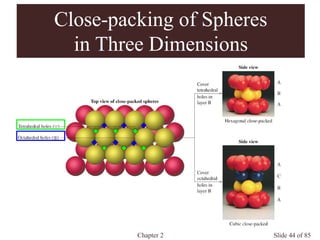
Chapter 2 Slide 44 of 85
Close-packing of Spheres
in Three Dimensions
Chapter 2 Slide 45 of 85
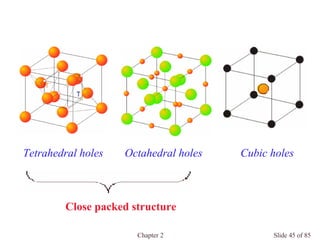
Octahedral holesTetrahedral holes Cubic holes
Close packed structure
Chapter 2 Slide 46 of 85
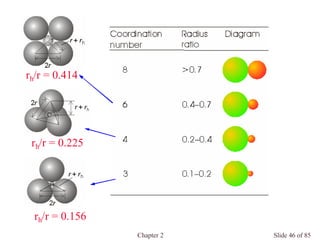
rh/r = 0.156
rh/r = 0.225
rh/r = 0.414
Chapter 2 Slide 47 of 85
Chapter 2 Slide 48 of 85
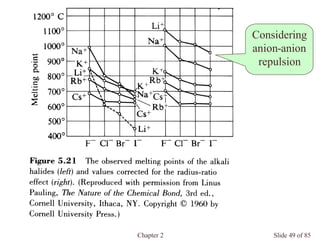
Chapter 2 Slide 49 of 85
Considering
anion-anion
repulsion
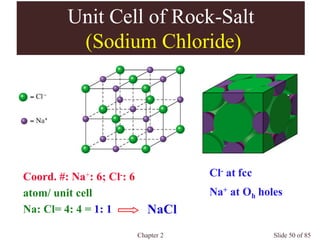
Chapter 2 Slide 50 of 85
Unit Cell of Rock-Salt
(Sodium Chloride)
Cl- at fcc
Na+ at Oh holes
Coord. #: Na+: 6; Cl-: 6
atom/ unit cell
Na: Cl= 4: 4 = 1: 1 NaCl
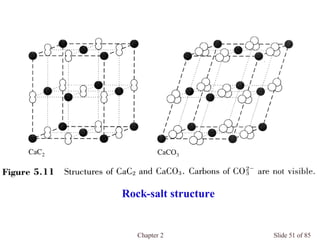
Chapter 2 Slide 51 of 85
Rock-salt structure
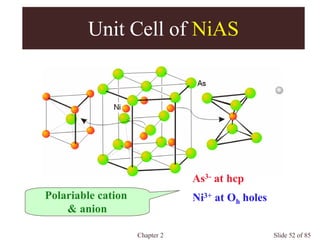
Chapter 2 Slide 52 of 85
Unit Cell of NiAS
As3- at hcp
Ni3+ at Oh holesPolariable cation
& anion
Chapter 2 Slide 53 of 85
Unit Cell of Cesium Chloride
Cl- at primitive cubic
Cs+ at Cubic holes
Coord. #: Cs+: 8; Cl-: 8
atom/ unit cell
Cs: Cl= 1: 1 CsCl
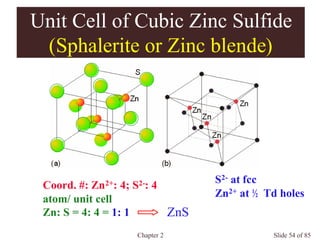
Chapter 2 Slide 54 of 85
Unit Cell of Cubic Zinc Sulfide
(Sphalerite or Zinc blende)
Coord. #: Zn2+: 4; S2-: 4
atom/ unit cell
Zn: S = 4: 4 = 1: 1 ZnS
S2- at fcc
Zn2+ at ½ Td holes
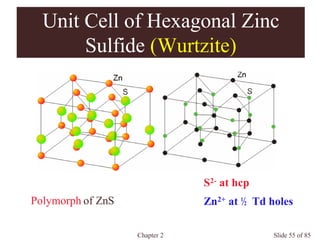
Chapter 2 Slide 55 of 85
Unit Cell of Hexagonal Zinc
Sulfide (Wurtzite)
S2- at hcp
Zn2+ at ½ Td holesPolymorph of ZnS
Chapter 2 Slide 56 of 85
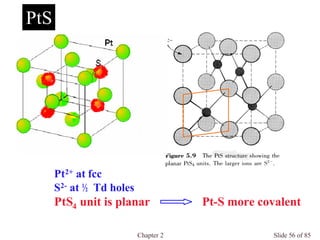
Pt2+ at fcc
S2- at ½ Td holes
PtS4 unit is planar Pt-S more covalent
PtS
Chapter 2 Slide 57 of 85
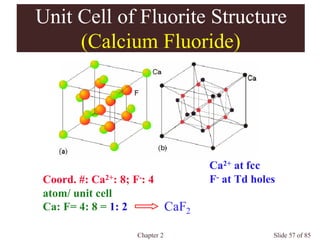
Unit Cell of Fluorite Structure
(Calcium Fluoride)
Ca2+ at fcc
F- at Td holesCoord. #: Ca2+: 8; F-: 4
atom/ unit cell
Ca: F= 4: 8 = 1: 2 CaF2
Chapter 2 Slide 58 of 85
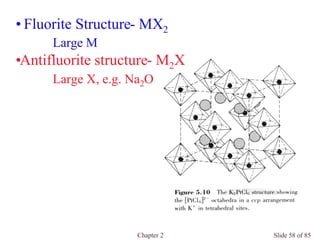
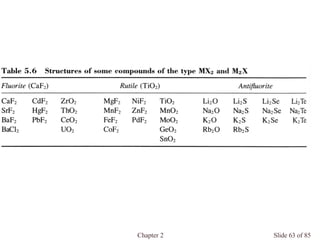
•Fluorite Structure- MX2
Large M
•Antifluorite structure- M2X
Large X, e.g. Na2O
Chapter 2 Slide 59 of 85
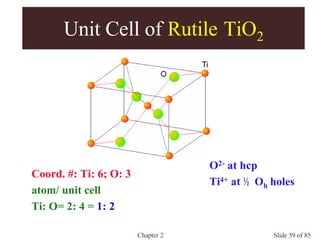
Unit Cell of Rutile TiO2
O2- at hcp
Ti4+ at ½ Oh holes
Coord. #: Ti: 6; O: 3
atom/ unit cell
Ti: O= 2: 4 = 1: 2
Chapter 2 Slide 60 of 85
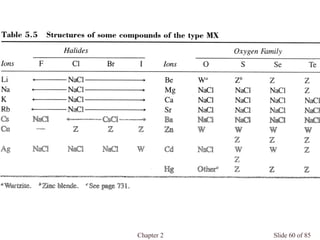
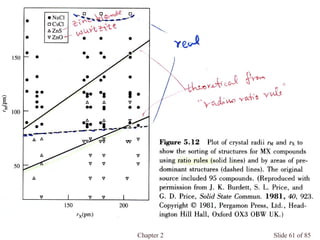
Chapter 2 Slide 61 of 85
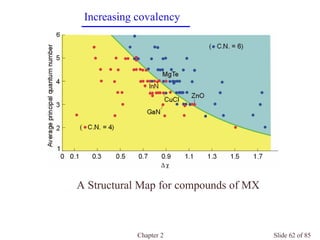
Chapter 2 Slide 62 of 85
A Structural Map for compounds of MX
Increasing covalency
Chapter 2 Slide 63 of 85
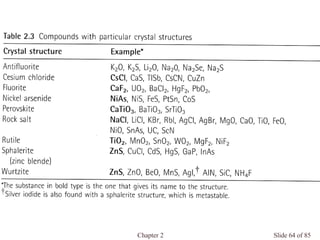
Chapter 2 Slide 64 of 85
Chapter 2 Slide 65 of 85
Chapter 2 Slide 66 of 85
Chapter 2 Slide 67 of 85
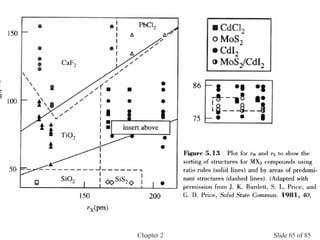
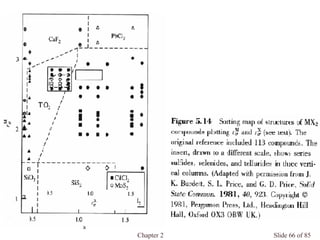
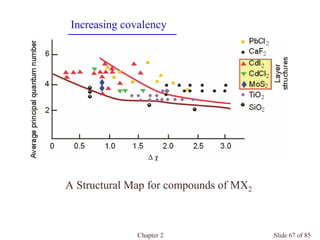
A Structural Map for compounds of MX2
Increasing covalency
Chapter 2 Slide 68 of 85
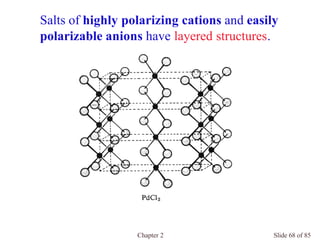
Salts of highly polarizing cations and easily
polarizable anions have layered structures.
Chapter 2 Slide 69 of 85
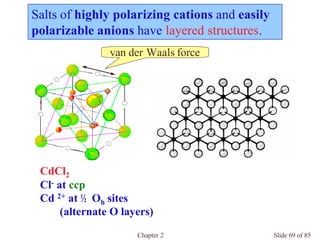
Salts of highly polarizing cations and easily
polarizable anions have layered structures.
CdCl2
Cl- at ccp
Cd 2+ at ½ Oh sites
(alternate O layers)
van der Waals force
Chapter 2 Slide 70 of 85
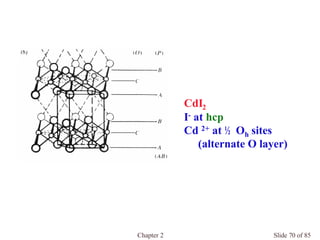
CdI2
I- at hcp
Cd 2+ at ½ Oh sites
(alternate O layer)
Chapter 2 Slide 71 of 85
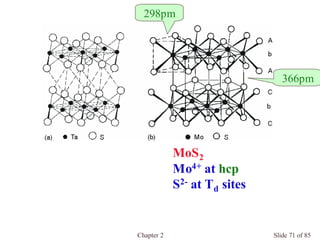
MoS2
Mo4+ at hcp
S2- at Td sites
298pm
366pm
Chapter 2 Slide 72 of 85
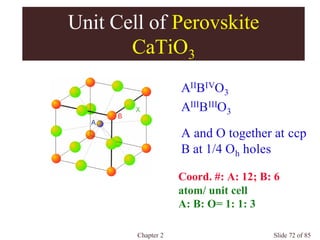
Unit Cell of Perovskite
CaTiO3
AIIBIVO3
AIIIBIIIO3
Coord. #: A: 12; B: 6
atom/ unit cell
A: B: O= 1: 1: 3
A and O together at ccp
B at 1/4 Oh holes
Chapter 2 Slide 73 of 85
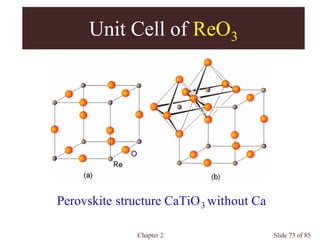
Unit Cell of ReO3
Perovskite structure CaTiO3 without Ca
Chapter 2 Slide 74 of 85
Unit Cell of Spinel
MgAl2O4
Normal Spinel
AII[BIII]2O4, AIV[BII]2O4 , AVI[BI]2O4
e.g. NiCr2O4, Co3O4 , Mn3O4
Inverse Spinel
B[AB]O4
e.g. Fe3O4
O 2- at fcc
A at 1/8 Td holes
B at 1/2 Oh holes
Chapter 2 Slide 75 of 85
Chapter 2 Slide 76 of 85
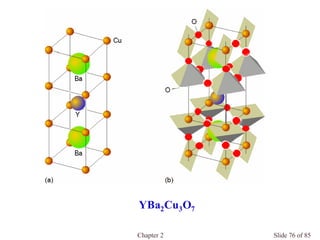
YBa2Cu3O7
Chapter 2 Slide 77 of 85
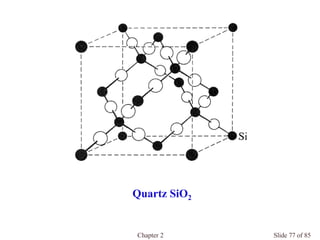
Quartz SiO2
Chapter 2 Slide 78 of 85
Chapter 2 Slide 79 of 85
Chapter 2 Slide 80 of 85
Chapter 2 Slide 81 of 85
Chapter 2 Slide 82 of 85
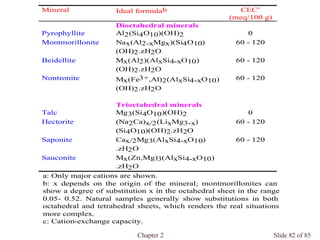
Mineral Ideal formulab CECc
(meq/100 g)
Dioctahedral minerals
Pyrophyllite Al2(Si4O10)(OH)2 0
Montmorillonite Nax(Al2-xMgx)(Si4O10)
(OH)2.zH2O
60 - 120
Beidellite Mx(Al2)(AlxSi4-xO10)
(OH)2.zH2O
60 - 120
Nontronite Mx(Fe3+,Al)2(AlxSi4-xO10)
(OH)2.zH2O
60 - 120
Trioctahedral minerals
Talc Mg3(Si4O10)(OH)2 0
Hectorite (Na2Ca)x/2(LixMg3-x)
(Si4O10)(OH)2.zH2O
60 - 120
Saponite Cax/2Mg3(AlxSi4-xO10)
.zH2O
60 - 120
Sauconite Mx(Zn,Mg)3(AlxSi4-xO10)
.zH2O
a: Only major cations are shown.
b: x depends on the origin of the mineral; montmorillonites can
show a degree of substitution x in the octahedral sheet in the range
0.05- 0.52. Natural samples generally show substitutions in both
octahedral and tetrahedral sheets, which renders the real situations
more complex.
c: Cation-exchange capacity.
Chapter 2 Slide 83 of 85
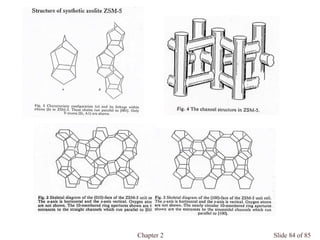
Chapter 2 Slide 84 of 85
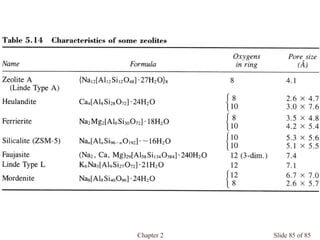
Chapter 2 Slide 85 of 85

Structures of solids

  • 1.
    Chapter 2 Slide1 of 85 Chapter Two Structures of Solids
  • 2.
    Chapter 2 Slide2 of 85 States of Matter Compared
  • 3.
  • 4.
    Chapter 2 Slide4 of 85 Some Characteristics of Crystalline Solids
  • 5.
    Chapter 2 Slide5 of 85 Network Covalent Solids • These substances contain a network of covalent bonds that extend throughout a crystalline solid, holding it firmly together. • In material science, polymorphism is the ability of a solid material to exist in more than one form or crystal structure. Diamond, graphite and the Buckyball are examples of polymorphs of carbon. α-ferrite, austenite, and δ-ferrite are polymorphs of iron. When found in elemental solids the condition is also called allotropy. • The allotropes of carbon provide a good example 1. Diamond has each carbon bonded to four other carbons in a tetrahedral arrangement using sp3 hybridization. 2. Graphite has each carbon bonded to three other carbons in the same plane using sp2 hybridization. 3. Fullerenes and nanotubes are roughly spherical and cylindrical collections of carbon atoms using sp2 hybridization.
  • 6.
    Chapter 2 Slide6 of 85 Crystal Structure of Diamond Covalent bond
  • 7.
    Crystal Structure ofGraphite Covalent bond van der Waals force
  • 8.
    Structure of aBuckyball sp2 hybrid Carbon
  • 9.
    Chapter 2 Slide9 of 85 sp2 hybrid Carbon Carbon Nano-tube A nanotube (also known as a buckytube) is a member of the fullerene structural family, which also includes buckyballs. Whereas buckyballs are spherical in shape, a nanotube is cylindrical, with at least one end typically capped with a hemisphere of the buckyball structure. Their name is derived from their size, since the diameter of a nanotube is on the order of a few nanometers , while they can be up to several centimeters in length. There are two main types of nanotubes: single- walled nanotubes (SWNTs) and multi-walled nanotubes (MWNTs).
  • 10.
    Chapter 2 Slide10 of 85 Experimental Determination of Crystal Structures Bragg’s Law 2 d sinθ = n λ
  • 11.
  • 12.
    Chapter 2 Slide12 of 85 X-Ray Diffraction Image & Pattern Single crystal Powder
  • 13.
    Chapter 2 Slide13 of 85 Crystal Lattices • To describe crystals, three-dimensional views must be used. • The repeating unit of the lattice is called the unit cell. • The simple cubic cell (primitive cubic) is the simplest unit cell and has structural particles centered only at its corners. • The body-centered cubic (bcc) structure has an additional structural particle at the center of the cube. • The face-centered cubic (fcc) structure has an additional structural particle at the center of each face.
  • 14.
    Chapter 2 Slide14 of 85 Unit Cells In Cubic Crystal Structures simple cubic (primitive cubic) bcc fcc
  • 15.
    Chapter 2 Slide15 of 85 Face-centered cubicBody-centered cubicPrimitive cubic
  • 16.
    Chapter 2 Slide16 of 85 Occupancies per Unit Cells Primitive cubic: a = 2r 1 atom/unit cell occupancy = [4/3(πr3)]/a3 = [4/3(πr3)]/(2r)3 = 0.52 = 52% Body-centered cubic: a = 4r/(3)1/2 2 atom/unit cell occupancy = 2 x [4/3(πr3)]/a3 = 2 x [4/3(πr3)]/[4r/(3)1/2]3 = 0.68 = 68% Face-centered cubic: a = (8)1/2 r 4 atom/unit cell occupancy = 4 x [4/3(πr3)]/a3 = 4 x [4/3(πr3)]/[(8)1/2 r]3 = 0.74 = 74% Closest packed
  • 17.
    Chapter 2 Slide17 of 85 a ab aba abc unoccupied holes Closest packed
  • 18.
    Chapter 2 Slide18 of 85 abab abcabc Cubic close-packed structure = Face-centered cubic Hexagonal close-packed structure polytypes
  • 19.
    Chapter 2 Slide19 of 85 Crystal Structures of Metals
  • 20.
    Interionic Forces ofAttraction E = (Z+Z-e2)/4πεr e = 1.6 x 10⁻¹⁹ C In vacuum, ε0 = 8.85 x 10⁻¹² C2m-1J-1 In water, εH2O = 7.25 x 10⁻¹⁰ C2m-1J-1= 82 ε0 In liquid ammonia, εNH3 = 2.2 x 10⁻¹⁰ C2m-1J-1= 25 ε0
  • 21.
    Chapter 2 Slide21 of 85 Unit Cell of Rock-Salt (Sodium Chloride) Cl- at fcc Na+ at Oh holes Coord. #: Na+: 6; Cl-: 6 atom/ unit cell Na: Cl= 4: 4 = 1: 1 NaCl
  • 22.
    Chapter 2 Slide22 of 85 Unit Cell of Cesium Chloride Cl- at primitive cubic Cs+ at Cubic holes Coord. #: Cs+: 8; Cl-: 8 atom/ unit cell Cs: Cl= 1: 1 CsCl
  • 23.
    Chapter 2 Slide23 of 85 Unit Cell of Cubic Zinc Sulfide (Sphalerite or Zinc blende) Coord. #: Zn2+: 4; S2-: 4 atom/ unit cell Zn: S = 4: 4 = 1: 1 ZnS S2- at fcc Zn2+ at ½ Td holes
  • 24.
    Chapter 2 Slide24 of 85 A Born-Haber Cycle to Calculate Lattice Energy 1/2D(Cl-Cl) ∆Ηsublimation (Na) IE(Na) -EA(Cl) lattice energy U0 = - ∆Ηf 0(NaCl) + ∆Ηsublimation (Na) + 1/2D(Cl-Cl) + IE(Na) - EA(Cl) = (+411 +107 +122 + 496 –349) kJ/mol = +787 kJ/mol ∆Ηf 0(NaCl) U0 NaCl(s) Na+(g) + Cl-(g) Na(g) + Cl(g)Na(s) + 1/2Cl2(g)
  • 25.
    Chapter 2 Slide25 of 85 Lattice Energy & Madelung Constant ( ) ( ) ( ) 0U-H 0 <=∆→+ −+ sgg MXXM U0: lattice energy Factors contributed to Lattice energy •electrostatic energy ~90% •repulsion of close shells ~8% •dispersion forces ~1% •zero-point energy (lattice vibration at 0K) •correction for heat capacity ~1%
  • 26.
    Chapter 2 Slide26 of 85 Electrostatic energy in a crystal lattice, between a pair of ions For NaCl crystal, Z+ =Z- =1 r = d ( ) r eA 0 2 c 4 ZZ E πε −+ = A : Madelung Constant
  • 27.
    Chapter 2 Slide27 of 85 The value of Madelung constant is determined only by the “geometry of the lattice”, and independent of the “ionic radius” and “charge”.
  • 28.
    Chapter 2 Slide28 of 85 electrostatic energy repulsion of close shells B: constant n: Born exponent Born equation 12Xe, Au+ 10Kr, Ag+ 9Ar, Cu+ 7Ne 5He nIon configuration
  • 29.
    Chapter 2 Slide29 of 85 Let U0 = -(PE)0 N N: Avogadro’s number Born-Lande equation At minimum PE, attractive and repulsive forces are balanced, and d= d0. 0 )( = ∂ ∂ d PE
  • 30.
    Chapter 2 Slide30 of 85 For NaCl A = 1.74756 Z1 = 1, Z2 = -1 d0 = rNa+ + rCl- = 2.81 x10⁻¹⁰ m n = (nNa+ + nCl-) /2 = (7+9)/2 = 8 ⇒ U0= 755.2 kJ/mol experimental U0= 770 kJ/mol
  • 31.
    Chapter 2 Slide31 of 85 Modification of Born-Lande equation ) 345.0 1( 4 ZZ 000 2 0 dd eNA U −= −+ πε Unit in ? , 10-10 m 2. Kapustinskii equation Improving the repulsion ) 345.0 1( ZZ 00 0 dd n U − − = −+ κ κ = 1.21 MJ. ? mol-1 n= ions per formula e.g. n= 2 for NaCl n= 5 for Al2O3 A ? crystal lattice ? r+/r- ? r0 A/n ~constant 1. Born-Mayer equation
  • 32.
    Chapter 2 Slide32 of 85 +218.1+183.8+130.4+48.3∆G0 (kJ/mol) 13001100840300T (?C) +172.1+171.0+160.6+175.0∆S0 (J/K mol) +269.3+234.6+178.3+100.6∆H0 (kJ/mol) BaSrCaMgData at 298K ( ) ( ) ( )g2ss3 COMOMCO +→ A small cation increases the lattice enthalpy of the oxide more than that of a carbonate. 0 0 000 Tiondecomposit T- S H SHG ∆ ∆ = ∆∆=∆
  • 33.
    Chapter 2 Slide33 of 85 < 0 > 0 Solubility of ionic compounds 0000 T-T- SLSHG ∆=∆∆=∆ Enthalpy of solution Hydration enthalpy Free energy of solution
  • 34.
    Chapter 2 Slide34 of 85 Hydration enthalpy −+ −+ +∞=∆+∆=∆ + ∞ −+ rr HHH rr U XMhydration 11 1 0       −−=∆ ε 1 1 2 2 r Z Hhyd •In general, difference in ionic size favors solubility in water. •Ionic compound MX tends to be most soluble when rX-rM > 0.8?
  • 35.
    Chapter 2 Slide35 of 85 Correlation between ∆Hsolution and the differences between the hydration enthalpy of the ions
  • 36.
    Chapter 2 Slide36 of 85 Fajan's rules Fajan's Rule: the degree of covalent character of ionic bond Polarization effects: (a) idealized ion pair with no polarization; (b) mutually polarized ion pair; (c) polarization sufficient to form covalent bond. Dashed lines represent hypothetical unpolarized ions.
  • 37.
    Chapter 2 Slide37 of 85 In 1923, Fajan suggested rules to predict the degree of covalent character in ionic compounds: The polarization of an ionic bond and thus the degree of covalency is high if : 1) the charges on the ions are high. eg., Al3+ ; Ti4+ ----- favors covalent character. Na+ ; K+ ----- favors ionic character. 2) the cation is small. e.g., Na+ ion is larger than that of Al3+ Thus, Al3+ favors covalent character. 3) the anion is large. e.g. F- ionic radius : 0.136 nm favors ionic character. I- ionic radius : 0.216 nm favors covalent character.
  • 38.
    Chapter 2 Slide38 of 85 4) An incomplete valence shell electron configuration Noble gas configuration of the cation better shielding and less polarizing power e.g. Hg2+ (r = 102 pm) is more polarizing than Ca 2+ (r = 100 pm) HgO decomposed at 500 ?C CaO m.p. 2613 ?C 783 742 775 1418 m.p. (?C) hexagonal rhom. cubic cubic Crys str 259 236 276 645 (dec) m.p. (?C) tetragonal rhombohedral orthorhombic cubic Crys str CaI2 CaBr2 CaCl2 CaF2 Halides HgI2 HgBr2 HgCl2 HgF2 Halides
  • 39.
    Chapter 2 Slide39 of 85 a) Charge factor i) Cations Na+ Mg2+ Al3+ Examples: For ions with noble gas (ns2 np6 ) structure, the only factor that have to be considered are size and charge factor. ii) Anions N3- O2- F- Increasing charge : increase in polarizing power Increase in ionic charge, more ready to be polarized
  • 40.
    Chapter 2 Slide40 of 85 1.5 x 10-5183sublimationAlCl3 57-70SiCl4 1410 1440 boiling point /°C 715 800 melting point /°C Conductance in molten state Chlorides 29MgCl2 133NaCl AlCl3 has covalent character. In fact, AlCl3 exists as dimer Al2Cl6 at room conditions. covalency
  • 41.
    Chapter 2 Slide41 of 85 b) Size factor i) Cations Be2+ Mg2+ Ca2+ Sr2+ Ba2+ The smaller the cation, the higher is its polarizing power 52774CaCl2 56870SrCl2 Conductance in molten state melting point /°CChlorides 955BaCl2 29715MgCl2 0.056404BeCl2 covalency
  • 42.
    Chapter 2 Slide42 of 85 ii) Anions F- Cl- Br- I- The larger the anion, the more polarizable is the anion. eg., NaF NaCl NaBr NaI melting point /°C 990 800 755 651 covalency
  • 43.
    Chapter 2 Slide43 of 85 ( ) ( ) ( )g2ss3 COMOMCO +→ 1360BaCO3 1289SrCO3 900CaCO3 540MgCO3 250BeCO3 Decomp. Temp. (?C)Carbonates 1923BaO 2430SrO 2613CaO 2826MgO 2530BeO m.p. (?C)Oxides Ionic compounds covalency wurtzite structure NaCl structure Some covalent character
  • 44.
    Chapter 2 Slide44 of 85 Close-packing of Spheres in Three Dimensions
  • 45.
    Chapter 2 Slide45 of 85 Octahedral holesTetrahedral holes Cubic holes Close packed structure
  • 46.
    Chapter 2 Slide46 of 85 rh/r = 0.156 rh/r = 0.225 rh/r = 0.414
  • 47.
  • 48.
  • 49.
    Chapter 2 Slide49 of 85 Considering anion-anion repulsion
  • 50.
    Chapter 2 Slide50 of 85 Unit Cell of Rock-Salt (Sodium Chloride) Cl- at fcc Na+ at Oh holes Coord. #: Na+: 6; Cl-: 6 atom/ unit cell Na: Cl= 4: 4 = 1: 1 NaCl
  • 51.
    Chapter 2 Slide51 of 85 Rock-salt structure
  • 52.
    Chapter 2 Slide52 of 85 Unit Cell of NiAS As3- at hcp Ni3+ at Oh holesPolariable cation & anion
  • 53.
    Chapter 2 Slide53 of 85 Unit Cell of Cesium Chloride Cl- at primitive cubic Cs+ at Cubic holes Coord. #: Cs+: 8; Cl-: 8 atom/ unit cell Cs: Cl= 1: 1 CsCl
  • 54.
    Chapter 2 Slide54 of 85 Unit Cell of Cubic Zinc Sulfide (Sphalerite or Zinc blende) Coord. #: Zn2+: 4; S2-: 4 atom/ unit cell Zn: S = 4: 4 = 1: 1 ZnS S2- at fcc Zn2+ at ½ Td holes
  • 55.
    Chapter 2 Slide55 of 85 Unit Cell of Hexagonal Zinc Sulfide (Wurtzite) S2- at hcp Zn2+ at ½ Td holesPolymorph of ZnS
  • 56.
    Chapter 2 Slide56 of 85 Pt2+ at fcc S2- at ½ Td holes PtS4 unit is planar Pt-S more covalent PtS
  • 57.
    Chapter 2 Slide57 of 85 Unit Cell of Fluorite Structure (Calcium Fluoride) Ca2+ at fcc F- at Td holesCoord. #: Ca2+: 8; F-: 4 atom/ unit cell Ca: F= 4: 8 = 1: 2 CaF2
  • 58.
    Chapter 2 Slide58 of 85 •Fluorite Structure- MX2 Large M •Antifluorite structure- M2X Large X, e.g. Na2O
  • 59.
    Chapter 2 Slide59 of 85 Unit Cell of Rutile TiO2 O2- at hcp Ti4+ at ½ Oh holes Coord. #: Ti: 6; O: 3 atom/ unit cell Ti: O= 2: 4 = 1: 2
  • 60.
  • 61.
  • 62.
    Chapter 2 Slide62 of 85 A Structural Map for compounds of MX Increasing covalency
  • 63.
  • 64.
  • 65.
  • 66.
  • 67.
    Chapter 2 Slide67 of 85 A Structural Map for compounds of MX2 Increasing covalency
  • 68.
    Chapter 2 Slide68 of 85 Salts of highly polarizing cations and easily polarizable anions have layered structures.
  • 69.
    Chapter 2 Slide69 of 85 Salts of highly polarizing cations and easily polarizable anions have layered structures. CdCl2 Cl- at ccp Cd 2+ at ½ Oh sites (alternate O layers) van der Waals force
  • 70.
    Chapter 2 Slide70 of 85 CdI2 I- at hcp Cd 2+ at ½ Oh sites (alternate O layer)
  • 71.
    Chapter 2 Slide71 of 85 MoS2 Mo4+ at hcp S2- at Td sites 298pm 366pm
  • 72.
    Chapter 2 Slide72 of 85 Unit Cell of Perovskite CaTiO3 AIIBIVO3 AIIIBIIIO3 Coord. #: A: 12; B: 6 atom/ unit cell A: B: O= 1: 1: 3 A and O together at ccp B at 1/4 Oh holes
  • 73.
    Chapter 2 Slide73 of 85 Unit Cell of ReO3 Perovskite structure CaTiO3 without Ca
  • 74.
    Chapter 2 Slide74 of 85 Unit Cell of Spinel MgAl2O4 Normal Spinel AII[BIII]2O4, AIV[BII]2O4 , AVI[BI]2O4 e.g. NiCr2O4, Co3O4 , Mn3O4 Inverse Spinel B[AB]O4 e.g. Fe3O4 O 2- at fcc A at 1/8 Td holes B at 1/2 Oh holes
  • 75.
  • 76.
    Chapter 2 Slide76 of 85 YBa2Cu3O7
  • 77.
    Chapter 2 Slide77 of 85 Quartz SiO2
  • 78.
  • 79.
  • 80.
  • 81.
  • 82.
    Chapter 2 Slide82 of 85 Mineral Ideal formulab CECc (meq/100 g) Dioctahedral minerals Pyrophyllite Al2(Si4O10)(OH)2 0 Montmorillonite Nax(Al2-xMgx)(Si4O10) (OH)2.zH2O 60 - 120 Beidellite Mx(Al2)(AlxSi4-xO10) (OH)2.zH2O 60 - 120 Nontronite Mx(Fe3+,Al)2(AlxSi4-xO10) (OH)2.zH2O 60 - 120 Trioctahedral minerals Talc Mg3(Si4O10)(OH)2 0 Hectorite (Na2Ca)x/2(LixMg3-x) (Si4O10)(OH)2.zH2O 60 - 120 Saponite Cax/2Mg3(AlxSi4-xO10) .zH2O 60 - 120 Sauconite Mx(Zn,Mg)3(AlxSi4-xO10) .zH2O a: Only major cations are shown. b: x depends on the origin of the mineral; montmorillonites can show a degree of substitution x in the octahedral sheet in the range 0.05- 0.52. Natural samples generally show substitutions in both octahedral and tetrahedral sheets, which renders the real situations more complex. c: Cation-exchange capacity.
  • 83.
  • 84.
  • 85.