The document discusses Read Only Memory (ROM) and its characteristics. It defines ROM as memory that permanently stores binary information. ROM is programmed during manufacturing and does not allow writing. It is used to store fixed information like instructions or lookup tables. The document also provides examples to illustrate how to determine the number of address lines and input/output lines for different ROM configurations. It describes the internal structure of ROM including decoders and programmable connections to store binary data at each address.

ROM
• In ROMBinary information is stored permanently.
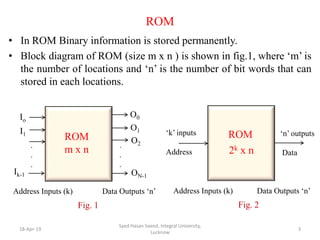
• Block diagram of ROM (size m x n ) is shown in fig.1, where ‘m’ is
the number of locations and ‘n’ is the number of bit words that can
stored in each locations.
18-Apr-19
Syed Hasan Saeed, Integral University,
Lucknow
3
2k x n
ROM
m x n
Data Outputs ‘n’Address Inputs (k) Data Outputs ‘n’Address Inputs (k)
Fig. 1 Fig. 2
Io
I1
Ik-1
.
.
.
.
.
.
ROM
O0
O1
O2
ON-1
‘k’ inputs
Address
‘n’ outputs
Data
4.
ROM
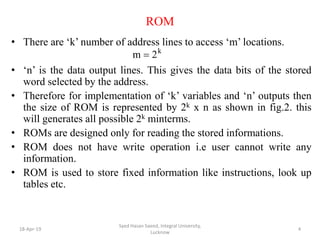
• There are‘k’ number of address lines to access ‘m’ locations.
• ‘n’ is the data output lines. This gives the data bits of the stored
word selected by the address.
• Therefore for implementation of ‘k’ variables and ‘n’ outputs then
the size of ROM is represented by 2k x n as shown in fig.2. this
will generates all possible 2k minterms.
• ROMs are designed only for reading the stored informations.
• ROM does not have write operation i.e user cannot write any
information.
• ROM is used to store fixed information like instructions, look up
tables etc.
18-Apr-19
Syed Hasan Saeed, Integral University,
Lucknow
4
k
2m
5.
ROM
• ROMs areprogrammed at the time of manufacturing.
• ROMs are costly.
• ROMs can be used for the implementation of combinational
circuits
18-Apr-19
Syed Hasan Saeed, Integral University,
Lucknow
5
6.
EXAMPLE 1
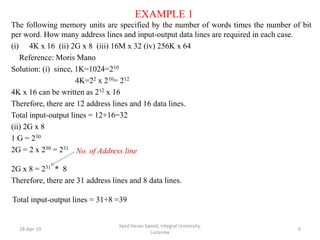
The followingmemory units are specified by the number of words times the number of bit
per word. How many address lines and input-output data lines are required in each case.
(i) 4K x 16 (ii) 2G x 8 (iii) 16M x 32 (iv) 256K x 64
Reference: Moris Mano
Solution: (i) since, 1K=1024=210
4K=22 x 210= 212
4K x 16 can be written as 212 x 16
Therefore, there are 12 address lines and 16 data lines.
Total input-output lines = 12+16=32
(ii) 2G x 8
1 G = 230
2G = 2 x 230 = 231
2G x 8 = 231 * 8
Therefore, there are 31 address lines and 8 data lines.
Total input-output lines = 31+8 =39
18-Apr-19
Syed Hasan Saeed, Integral University,
Lucknow
6
No. of Address line
7.
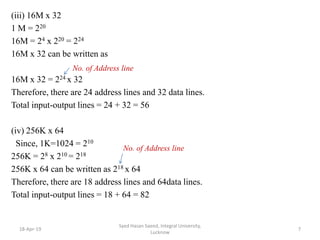
(iii) 16M x32
1 M = 220
16M = 24 x 220 = 224
16M x 32 can be written as
16M x 32 = 224 x 32
Therefore, there are 24 address lines and 32 data lines.
Total input-output lines = 24 + 32 = 56
(iv) 256K x 64
Since, 1K=1024 = 210
256K = 28 x 210 = 218
256K x 64 can be written as 218 x 64
Therefore, there are 18 address lines and 64data lines.
Total input-output lines = 18 + 64 = 82
18-Apr-19
Syed Hasan Saeed, Integral University,
Lucknow
7
No. of Address line
No. of Address line
8.
EXAMPLE 2: Givethe number of bytes stored in the memories listed in example 1.
SOLUTION:
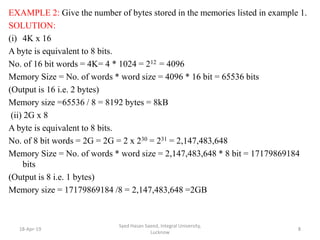
(i) 4K x 16
A byte is equivalent to 8 bits.
No. of 16 bit words = 4K= 4 * 1024 = 212 = 4096
Memory Size = No. of words * word size = 4096 * 16 bit = 65536 bits
(Output is 16 i.e. 2 bytes)
Memory size =65536 / 8 = 8192 bytes = 8kB
(ii) 2G x 8
A byte is equivalent to 8 bits.
No. of 8 bit words = 2G = 2G = 2 x 230 = 231 = 2,147,483,648
Memory Size = No. of words * word size = 2,147,483,648 * 8 bit = 17179869184
bits
(Output is 8 i.e. 1 bytes)
Memory size = 17179869184 /8 = 2,147,483,648 =2GB
18-Apr-19
Syed Hasan Saeed, Integral University,
Lucknow
8
9.
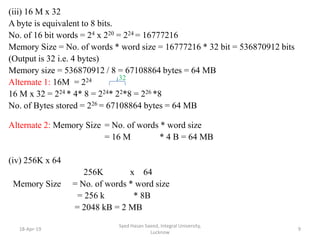
(iii) 16 Mx 32
A byte is equivalent to 8 bits.
No. of 16 bit words = 24 x 220 = 224 = 16777216
Memory Size = No. of words * word size = 16777216 * 32 bit = 536870912 bits
(Output is 32 i.e. 4 bytes)
Memory size = 536870912 / 8 = 67108864 bytes = 64 MB
Alternate 1: 16M = 224
16 M x 32 = 224 * 4* 8 = 224* 22*8 = 226 *8
No. of Bytes stored = 226 = 67108864 bytes = 64 MB
Alternate 2: Memory Size = No. of words * word size
= 16 M * 4 B = 64 MB
(iv) 256K x 64
256K x 64
Memory Size = No. of words * word size
= 256 k * 8B
= 2048 kB = 2 MB
18-Apr-19
Syed Hasan Saeed, Integral University,
Lucknow
9
32
10.
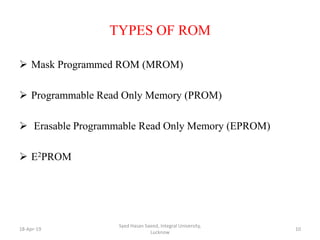
TYPES OF ROM
Mask Programmed ROM (MROM)
Programmable Read Only Memory (PROM)
Erasable Programmable Read Only Memory (EPROM)
E2PROM
18-Apr-19
Syed Hasan Saeed, Integral University,
Lucknow
10
11.
ADVANTAGES OF ROM
•Low Cost
• High Speed
• Flexibility in system designed
• ROM is non-volatile memory.
18-Apr-19
Syed Hasan Saeed, Integral University,
Lucknow
11
12.
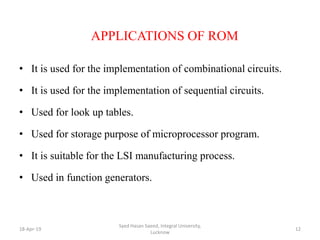
APPLICATIONS OF ROM
•It is used for the implementation of combinational circuits.
• It is used for the implementation of sequential circuits.
• Used for look up tables.
• Used for storage purpose of microprocessor program.
• It is suitable for the LSI manufacturing process.
• Used in function generators.
18-Apr-19
Syed Hasan Saeed, Integral University,
Lucknow
12
13.
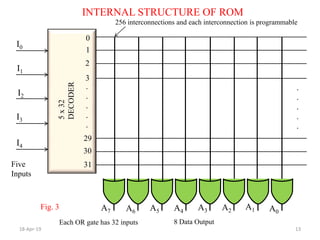
INTERNAL STRUCTURE OFROM
18-Apr-19 13
.
.
.
.
.
5x32
DECODER
A7 A0
A1A2A6 A5 A4 A3
I0
I4
I3
I2
I1
1
2
3
31
30
29
0
8 Data Output
.
.
.
.
.
Each OR gate has 32 inputs
Five
Inputs
256 interconnections and each interconnection is programmable
Fig. 3
14.
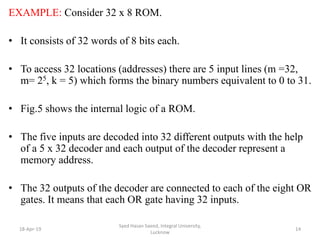
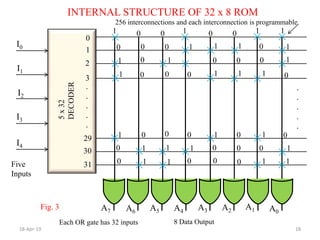
EXAMPLE: Consider 32x 8 ROM.
• It consists of 32 words of 8 bits each.
• To access 32 locations (addresses) there are 5 input lines (m =32,
m= 25, k = 5) which forms the binary numbers equivalent to 0 to 31.
• Fig.5 shows the internal logic of a ROM.
• The five inputs are decoded into 32 different outputs with the help
of a 5 x 32 decoder and each output of the decoder represent a
memory address.
• The 32 outputs of the decoder are connected to each of the eight OR
gates. It means that each OR gate having 32 inputs.
18-Apr-19
Syed Hasan Saeed, Integral University,
Lucknow
14
15.
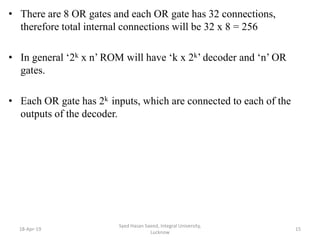
• There are8 OR gates and each OR gate has 32 connections,
therefore total internal connections will be 32 x 8 = 256
• In general ‘2k x n’ ROM will have ‘k x 2k’ decoder and ‘n’ OR
gates.
• Each OR gate has 2k inputs, which are connected to each of the
outputs of the decoder.
18-Apr-19
Syed Hasan Saeed, Integral University,
Lucknow
15
16.
• All 256intersections are programmable.
• A programmable connection between two lines is equivalent to a
switch which is either turned ON or OFF. ON means two lines are
connected with each other and OFF means two lines are not
connected.
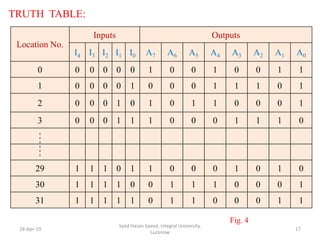
• ROM truth table is shown in fig.4
• Truth table shows that there are 5 inputs and 8 outputs.
• There are 32 locations (addresses) and each location stored 8 bits
word.
• ‘0’ in truth table indicates there is no connection and ‘1’ indicates a
connection.
18-Apr-19
Syed Hasan Saeed, Integral University,
Lucknow
16