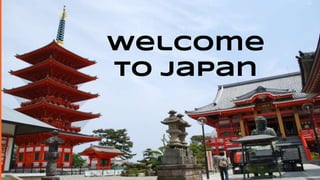
Welcome
to Japan
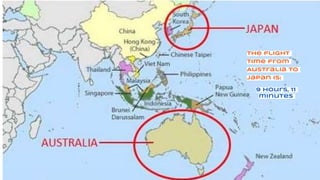
The flight
time from
Australia to
Japan is:
9 hours, 11
minutes
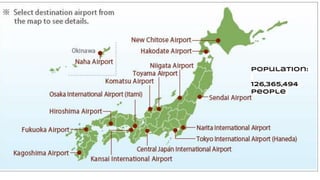
Population:
126,365,494
people
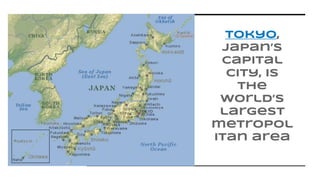
Tokyo,
Japan’s
capital
city, is
the
world’s
largest
metropol
itan area
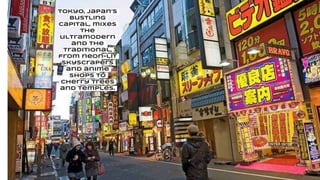
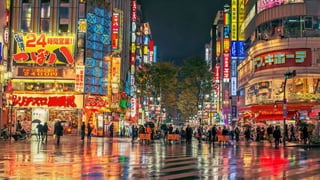
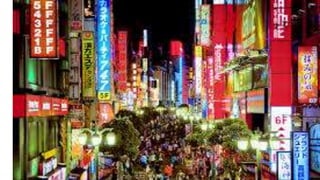
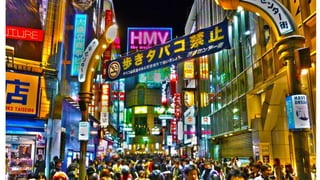
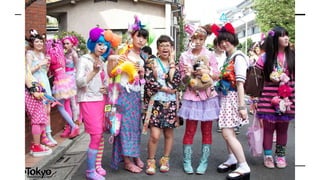
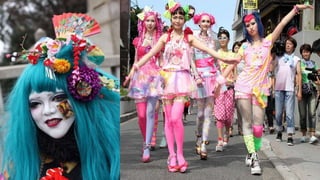
Tokyo, Japan’s
bustling
capital, mixes
the
ultramodern
and the
traditional,
from neon-lit
skyscrapers
and anime
shops to
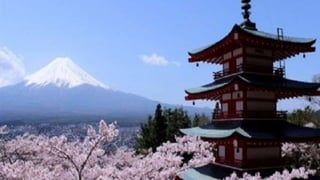
cherry trees
and temples.
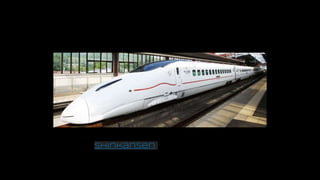
Shinkansen
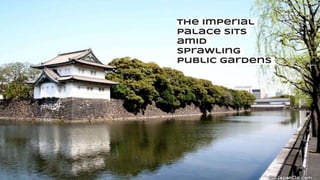
The Imperial
Palace sits
amid
sprawling
public gardens
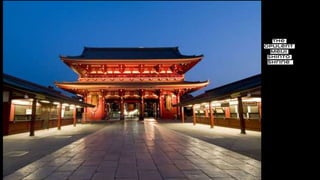
The
opulent
Meiji
Shinto
Shrine
Itinerary for the week
Day 1: Japanese Culture Crash Course
Day 2: Hiroshima Peace Memorial
Museum
Day 3: Haiku amongst the Cherry
Blossoms/ sakura
Day 4: Tea Ceremony and Karaoke
basic language and
customs
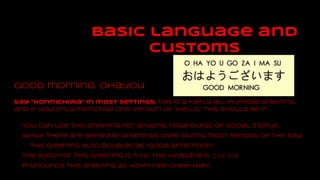
Good morning: ohayou
Say "konnichiwa" in most settings. This is a fairly all-purpose greeting,
and if you only memorise one version of “hello,” this should be it.
You can use this greeting for anyone, regardless of social status.
While there are separate greetings used during most periods of the day,
this greeting also doubles as “good afternoon.”
The kanji for this greeting is 今日は. The hiragana is こんにちは.
Pronounce this greeting as kohn-nee-chee-wah
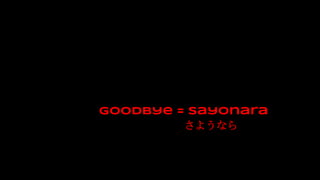
goodbye = sayonara
さようなら
brief history
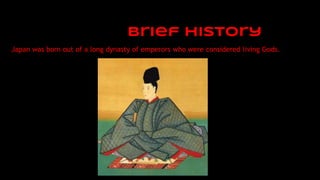
Japan was born out of a long dynasty of emperors who were considered living Gods.
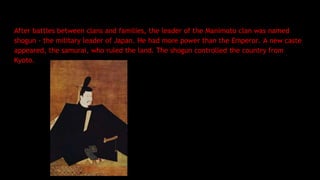
After battles between clans and families, the leader of the Manimoto clan was named
shogun - the military leader of Japan. He had more power than the Emperor. A new caste
appeared, the samurai, who ruled the land. The shogun controlled the country from
Kyoto.
The Tokugawa family ruled Japan during the Edo period - when
modern-day Tokyo became the capital.They were extremely
conservative to the point of barring any contact with the outside
world. Japanese people couldn’t leave and foreigners were
prohibited from entering. This went on until 1868, FOR MORE
THAN TWO CENTURIES.
Imagine what kind of effect this might have had on Japanese
culture!
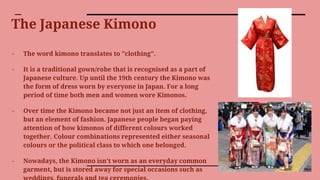
The Japanese Kimono
- The word kimono translates to "clothing".
- It is a traditional gown/robe that is recognised as a part of
Japanese culture. Up until the 19th century the Kimono was
the form of dress worn by everyone in Japan. For a long
period of time both men and women wore Kimonos.
- Over time the Kimono became not just an item of clothing,
but an element of fashion. Japanese people began paying
attention of how kimonos of different colours worked
together. Colour combinations represented either seasonal
colours or the political class to which one belonged.
- Nowadays, the Kimono isn't worn as an everyday common
garment, but is stored away for special occasions such as
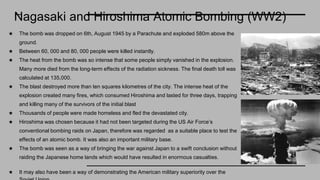
Nagasaki and Hiroshima Atomic Bombing (WW2)
★ The bomb was dropped on 6th, August 1945 by a Parachute and exploded 580m above the
ground.
★ Between 60, 000 and 80, 000 people were killed instantly.
★ The heat from the bomb was so intense that some people simply vanished in the explosion.
Many more died from the long-term effects of the radiation sickness. The final death toll was
calculated at 135,000.
★ The blast destroyed more than ten squares kilometres of the city. The intense heat of the
explosion created many fires, which consumed Hiroshima and lasted for three days, trapping
and killing many of the survivors of the initial blast
★ Thousands of people were made homeless and fled the devastated city.
★ Hiroshima was chosen because it had not been targeted during the US Air Force’s
conventional bombing raids on Japan, therefore was regarded as a suitable place to test the
effects of an atomic bomb. It was also an important military base.
★ The bomb was seen as a way of bringing the war against Japan to a swift conclusion without
raiding the Japanese home lands which would have resulted in enormous casualties.
★ It may also have been a way of demonstrating the American military superiority over the
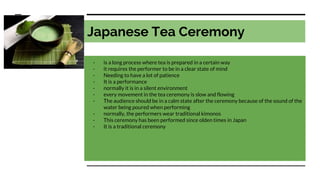
Japanese Tea Ceremony
- is a long process where tea is prepared in a certain way
- it requires the performer to be in a clear state of mind
- Needing to have a lot of patience
- It is a performance
- normally it is in a silent environment
- every movement in the tea ceremony is slow and flowing
- The audience should be in a calm state after the ceremony because of the sound of the
water being poured when performing
- normally, the performers wear traditional kimonos
- This ceremony has been performed since olden times in Japan
- It is a traditional ceremony
Japanese Cuisine
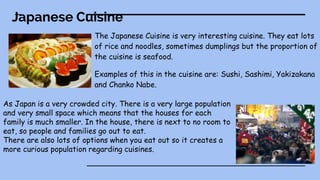
The Japanese Cuisine is very interesting cuisine. They eat lots
of rice and noodles, sometimes dumplings but the proportion of
the cuisine is seafood.
Examples of this in the cuisine are: Sushi, Sashimi, Yakizakana
and Chanko Nabe.
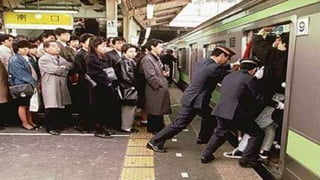
As Japan is a very crowded city. There is a very large population
and very small space which means that the houses for each
family is much smaller. In the house, there is next to no room to
eat, so people and families go out to eat.
There are also lots of options when you eat out so it creates a
more curious population regarding cuisines.
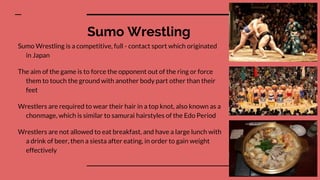
Sumo Wrestling
Sumo Wrestling is a competitive, full - contact sport which originated
in Japan
The aim of the game is to force the opponent out of the ring or force
them to touch the ground with another body part other than their
feet
Wrestlers are required to wear their hair in a top knot, also known as a
chonmage, which is similar to samurai hairstyles of the Edo Period
Wrestlers are not allowed to eat breakfast, and have a large lunch with
a drink of beer, then a siesta after eating, in order to gain weight
effectively
The Bombings of Hiroshima and Nagasaki
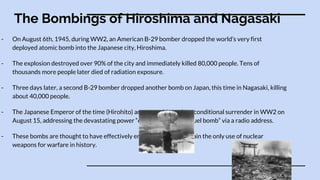
- On August 6th, 1945, during WW2, an American B-29 bomber dropped the world’s very first
deployed atomic bomb into the Japanese city, Hiroshima.
- The explosion destroyed over 90% of the city and immediately killed 80,000 people. Tens of
thousands more people later died of radiation exposure.
- Three days later, a second B-29 bomber dropped another bomb on Japan, this time in Nagasaki, killing
about 40,000 people.
- The Japanese Emperor of the time (Hirohito) announced Japan’s unconditional surrender in WW2 on
August 15, addressing the devastating power “of a new and most cruel bomb” via a radio address.
- These bombs are thought to have effectively ended WW2, and remain the only use of nuclear
weapons for warfare in history.
Hiroshi
ma
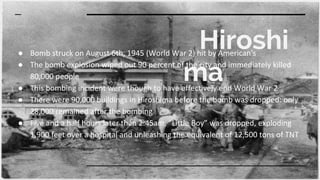
● Bomb struck on August 6th, 1945 (World War 2) hit by American's
● The bomb explosion wiped out 90 percent of the city and immediately killed
80,000 people
● This bombing incident were though to have effectively end World War 2
● There were 90,000 buildings in Hiroshima before the bomb was dropped: only
28,000 remained after the bombing
● Five and a half hours later than 2:45am, “Little Boy” was dropped, exploding
1,900 feet over a hospital and unleashing the equivalent of 12,500 tons of TNT
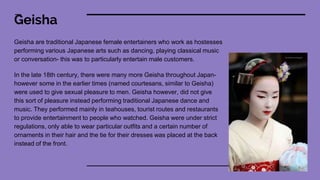
Geisha
Geisha are traditional Japanese female entertainers who work as hostesses
performing various Japanese arts such as dancing, playing classical music
or conversation- this was to particularly entertain male customers.
In the late 18th century, there were many more Geisha throughout Japan-
however some in the earlier times (named courtesans, similar to Geisha)
were used to give sexual pleasure to men. Geisha however, did not give
this sort of pleasure instead performing traditional Japanese dance and
music. They performed mainly in teahouses, tourist routes and restaurants
to provide entertainment to people who watched. Geisha were under strict
regulations, only able to wear particular outfits and a certain number of
ornaments in their hair and the tie for their dresses was placed at the back
instead of the front.
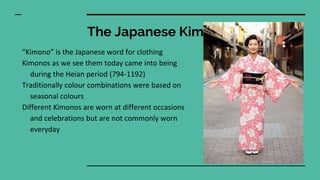
The Japanese Kimono
“Kimono” is the Japanese word for clothing
Kimonos as we see them today came into being
during the Heian period (794-1192)
Traditionally colour combinations were based on
seasonal colours
Different Kimonos are worn at different occasions
and celebrations but are not commonly worn
everyday
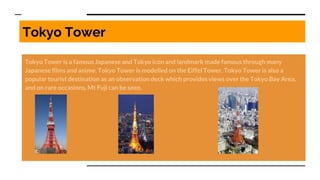
Tokyo Tower
Tokyo Tower is a famous Japanese and Tokyo icon and landmark made famous through many
Japanese films and anime. Tokyo Tower is modelled on the Eiffel Tower. Tokyo Tower is also a
popular tourist destination as an observation deck which provides views over the Tokyo Bay Area,
and on rare occasions, Mt Fuji can be seen.
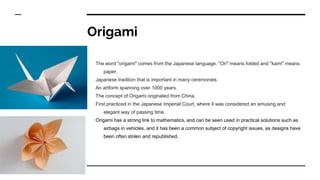
Origami
The word "origami" comes from the Japanese language. "Ori" means folded and "kami" means
paper.
Japanese tradition that is important in many ceremonies.
An artform spanning over 1000 years.
The concept of Origami originated from China.
First practiced in the Japanese Imperial Court, where it was considered an amusing and
elegant way of passing time.
Origami has a strong link to mathematics, and can be seen used in practical solutions such as
airbags in vehicles, and it has been a common subject of copyright issues, as designs have
been often stolen and republished.
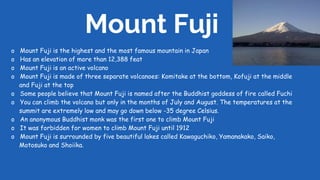
Mount Fuji
o Mount Fuji is the highest and the most famous mountain in Japan
o Has an elevation of more than 12,388 feat
o Mount Fuji is an active volcano
o Mount Fuji is made of three separate volcanoes: Komitake at the bottom, Kofuji at the middle
and Fuji at the top
o Some people believe that Mount Fuji is named after the Buddhist goddess of fire called Fuchi
o You can climb the volcano but only in the months of July and August. The temperatures at the
summit are extremely low and may go down below -35 degree Celsius.
o An anonymous Buddhist monk was the first one to climb Mount Fuji
o It was forbidden for women to climb Mount Fuji until 1912
o Mount Fuji is surrounded by five beautiful lakes called Kawaguchiko, Yamanakako, Saiko,
Motosuko and Shoiika.
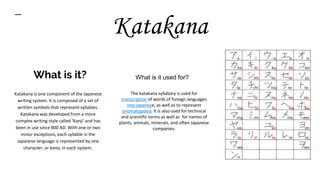
What is it?
Katakana is one component of the Japanese
writing system. It is composed of a set of
written symbols that represent syllables.
Katakana was developed from a more
complex writing style called ‘Kanji’ and has
been in use since 800 AD. With one or two
minor exceptions, each syllable in the
Japanese language is represented by one
character, or kana, in each system.
The katakana syllabary is used for
transcription of words of foreign languages
into Japanese, as well as to represent
onomatopoeia. It is also used for technical
and scientific terms as well as for names of
plants, animals, minerals, and often Japanese
companies.
Katakana
What is it used for?
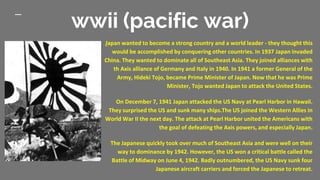
Japan wanted to become a strong country and a world leader - they thought this
would be accomplished by conquering other countries. In 1937 Japan invaded
China. They wanted to dominate all of Southeast Asia. They joined alliances with
th Axis alliance of Germany and Italy in 1940. In 1941 a former General of the
Army, Hideki Tojo, became Prime Minister of Japan. Now that he was Prime
Minister, Tojo wanted Japan to attack the United States.
On December 7, 1941 Japan attacked the US Navy at Pearl Harbor in Hawaii.
They surprised the US and sunk many ships.The US joined the Western Allies in
World War II the next day. The attack at Pearl Harbor united the Americans with
the goal of defeating the Axis powers, and especially Japan.
The Japanese quickly took over much of Southeast Asia and were well on their
way to dominance by 1942. However, the US won a critical battle called the
Battle of Midway on June 4, 1942. Badly outnumbered, the US Navy sunk four
Japanese aircraft carriers and forced the Japanese to retreat.
wwii (pacific war)
Samurai
After battles between clans and families, the leader of the
Minamoto clan was named shogun- the military leader of Japan.
He had more power than the Emperor. A new caste appeared,
the samurai, who ruled the land. The shogun controlled the
country from Kyoto.
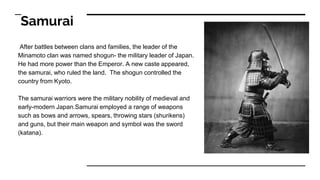
The samurai warriors were the military nobility of medieval and
early-modern Japan.Samurai employed a range of weapons
such as bows and arrows, spears, throwing stars (shurikens)
and guns, but their main weapon and symbol was the sword
(katana).
Japan presentation

Japan presentation

  • 1.
  • 2.
    The flight time from Australiato Japan is: 9 hours, 11 minutes
  • 3.
  • 4.
  • 5.
    Tokyo, Japan’s bustling capital, mixes the ultramodern andthe traditional, from neon-lit skyscrapers and anime shops to cherry trees and temples.
  • 11.
  • 13.
  • 15.
  • 16.
    Itinerary for theweek Day 1: Japanese Culture Crash Course Day 2: Hiroshima Peace Memorial Museum Day 3: Haiku amongst the Cherry Blossoms/ sakura Day 4: Tea Ceremony and Karaoke
  • 17.
    basic language and customs Goodmorning: ohayou Say "konnichiwa" in most settings. This is a fairly all-purpose greeting, and if you only memorise one version of “hello,” this should be it. You can use this greeting for anyone, regardless of social status. While there are separate greetings used during most periods of the day, this greeting also doubles as “good afternoon.” The kanji for this greeting is 今日は. The hiragana is こんにちは. Pronounce this greeting as kohn-nee-chee-wah
  • 18.
  • 19.
    brief history Japan wasborn out of a long dynasty of emperors who were considered living Gods.
  • 20.
    After battles betweenclans and families, the leader of the Manimoto clan was named shogun - the military leader of Japan. He had more power than the Emperor. A new caste appeared, the samurai, who ruled the land. The shogun controlled the country from Kyoto.
  • 21.
    The Tokugawa familyruled Japan during the Edo period - when modern-day Tokyo became the capital.They were extremely conservative to the point of barring any contact with the outside world. Japanese people couldn’t leave and foreigners were prohibited from entering. This went on until 1868, FOR MORE THAN TWO CENTURIES. Imagine what kind of effect this might have had on Japanese culture!
  • 22.
    The Japanese Kimono -The word kimono translates to "clothing". - It is a traditional gown/robe that is recognised as a part of Japanese culture. Up until the 19th century the Kimono was the form of dress worn by everyone in Japan. For a long period of time both men and women wore Kimonos. - Over time the Kimono became not just an item of clothing, but an element of fashion. Japanese people began paying attention of how kimonos of different colours worked together. Colour combinations represented either seasonal colours or the political class to which one belonged. - Nowadays, the Kimono isn't worn as an everyday common garment, but is stored away for special occasions such as
  • 23.
    Nagasaki and HiroshimaAtomic Bombing (WW2) ★ The bomb was dropped on 6th, August 1945 by a Parachute and exploded 580m above the ground. ★ Between 60, 000 and 80, 000 people were killed instantly. ★ The heat from the bomb was so intense that some people simply vanished in the explosion. Many more died from the long-term effects of the radiation sickness. The final death toll was calculated at 135,000. ★ The blast destroyed more than ten squares kilometres of the city. The intense heat of the explosion created many fires, which consumed Hiroshima and lasted for three days, trapping and killing many of the survivors of the initial blast ★ Thousands of people were made homeless and fled the devastated city. ★ Hiroshima was chosen because it had not been targeted during the US Air Force’s conventional bombing raids on Japan, therefore was regarded as a suitable place to test the effects of an atomic bomb. It was also an important military base. ★ The bomb was seen as a way of bringing the war against Japan to a swift conclusion without raiding the Japanese home lands which would have resulted in enormous casualties. ★ It may also have been a way of demonstrating the American military superiority over the
  • 24.
    Japanese Tea Ceremony -is a long process where tea is prepared in a certain way - it requires the performer to be in a clear state of mind - Needing to have a lot of patience - It is a performance - normally it is in a silent environment - every movement in the tea ceremony is slow and flowing - The audience should be in a calm state after the ceremony because of the sound of the water being poured when performing - normally, the performers wear traditional kimonos - This ceremony has been performed since olden times in Japan - It is a traditional ceremony
  • 25.
    Japanese Cuisine The JapaneseCuisine is very interesting cuisine. They eat lots of rice and noodles, sometimes dumplings but the proportion of the cuisine is seafood. Examples of this in the cuisine are: Sushi, Sashimi, Yakizakana and Chanko Nabe. As Japan is a very crowded city. There is a very large population and very small space which means that the houses for each family is much smaller. In the house, there is next to no room to eat, so people and families go out to eat. There are also lots of options when you eat out so it creates a more curious population regarding cuisines.
  • 26.
    Sumo Wrestling Sumo Wrestlingis a competitive, full - contact sport which originated in Japan The aim of the game is to force the opponent out of the ring or force them to touch the ground with another body part other than their feet Wrestlers are required to wear their hair in a top knot, also known as a chonmage, which is similar to samurai hairstyles of the Edo Period Wrestlers are not allowed to eat breakfast, and have a large lunch with a drink of beer, then a siesta after eating, in order to gain weight effectively
  • 27.
    The Bombings ofHiroshima and Nagasaki - On August 6th, 1945, during WW2, an American B-29 bomber dropped the world’s very first deployed atomic bomb into the Japanese city, Hiroshima. - The explosion destroyed over 90% of the city and immediately killed 80,000 people. Tens of thousands more people later died of radiation exposure. - Three days later, a second B-29 bomber dropped another bomb on Japan, this time in Nagasaki, killing about 40,000 people. - The Japanese Emperor of the time (Hirohito) announced Japan’s unconditional surrender in WW2 on August 15, addressing the devastating power “of a new and most cruel bomb” via a radio address. - These bombs are thought to have effectively ended WW2, and remain the only use of nuclear weapons for warfare in history.
  • 28.
    Hiroshi ma ● Bomb struckon August 6th, 1945 (World War 2) hit by American's ● The bomb explosion wiped out 90 percent of the city and immediately killed 80,000 people ● This bombing incident were though to have effectively end World War 2 ● There were 90,000 buildings in Hiroshima before the bomb was dropped: only 28,000 remained after the bombing ● Five and a half hours later than 2:45am, “Little Boy” was dropped, exploding 1,900 feet over a hospital and unleashing the equivalent of 12,500 tons of TNT
  • 29.
    Geisha Geisha are traditionalJapanese female entertainers who work as hostesses performing various Japanese arts such as dancing, playing classical music or conversation- this was to particularly entertain male customers. In the late 18th century, there were many more Geisha throughout Japan- however some in the earlier times (named courtesans, similar to Geisha) were used to give sexual pleasure to men. Geisha however, did not give this sort of pleasure instead performing traditional Japanese dance and music. They performed mainly in teahouses, tourist routes and restaurants to provide entertainment to people who watched. Geisha were under strict regulations, only able to wear particular outfits and a certain number of ornaments in their hair and the tie for their dresses was placed at the back instead of the front.
  • 30.
    The Japanese Kimono “Kimono”is the Japanese word for clothing Kimonos as we see them today came into being during the Heian period (794-1192) Traditionally colour combinations were based on seasonal colours Different Kimonos are worn at different occasions and celebrations but are not commonly worn everyday
  • 31.
    Tokyo Tower Tokyo Toweris a famous Japanese and Tokyo icon and landmark made famous through many Japanese films and anime. Tokyo Tower is modelled on the Eiffel Tower. Tokyo Tower is also a popular tourist destination as an observation deck which provides views over the Tokyo Bay Area, and on rare occasions, Mt Fuji can be seen.
  • 32.
    Origami The word "origami"comes from the Japanese language. "Ori" means folded and "kami" means paper. Japanese tradition that is important in many ceremonies. An artform spanning over 1000 years. The concept of Origami originated from China. First practiced in the Japanese Imperial Court, where it was considered an amusing and elegant way of passing time. Origami has a strong link to mathematics, and can be seen used in practical solutions such as airbags in vehicles, and it has been a common subject of copyright issues, as designs have been often stolen and republished.
  • 33.
    Mount Fuji o MountFuji is the highest and the most famous mountain in Japan o Has an elevation of more than 12,388 feat o Mount Fuji is an active volcano o Mount Fuji is made of three separate volcanoes: Komitake at the bottom, Kofuji at the middle and Fuji at the top o Some people believe that Mount Fuji is named after the Buddhist goddess of fire called Fuchi o You can climb the volcano but only in the months of July and August. The temperatures at the summit are extremely low and may go down below -35 degree Celsius. o An anonymous Buddhist monk was the first one to climb Mount Fuji o It was forbidden for women to climb Mount Fuji until 1912 o Mount Fuji is surrounded by five beautiful lakes called Kawaguchiko, Yamanakako, Saiko, Motosuko and Shoiika.
  • 34.
    What is it? Katakanais one component of the Japanese writing system. It is composed of a set of written symbols that represent syllables. Katakana was developed from a more complex writing style called ‘Kanji’ and has been in use since 800 AD. With one or two minor exceptions, each syllable in the Japanese language is represented by one character, or kana, in each system. The katakana syllabary is used for transcription of words of foreign languages into Japanese, as well as to represent onomatopoeia. It is also used for technical and scientific terms as well as for names of plants, animals, minerals, and often Japanese companies. Katakana What is it used for?
  • 35.
    Japan wanted tobecome a strong country and a world leader - they thought this would be accomplished by conquering other countries. In 1937 Japan invaded China. They wanted to dominate all of Southeast Asia. They joined alliances with th Axis alliance of Germany and Italy in 1940. In 1941 a former General of the Army, Hideki Tojo, became Prime Minister of Japan. Now that he was Prime Minister, Tojo wanted Japan to attack the United States. On December 7, 1941 Japan attacked the US Navy at Pearl Harbor in Hawaii. They surprised the US and sunk many ships.The US joined the Western Allies in World War II the next day. The attack at Pearl Harbor united the Americans with the goal of defeating the Axis powers, and especially Japan. The Japanese quickly took over much of Southeast Asia and were well on their way to dominance by 1942. However, the US won a critical battle called the Battle of Midway on June 4, 1942. Badly outnumbered, the US Navy sunk four Japanese aircraft carriers and forced the Japanese to retreat. wwii (pacific war)
  • 36.
    Samurai After battles betweenclans and families, the leader of the Minamoto clan was named shogun- the military leader of Japan. He had more power than the Emperor. A new caste appeared, the samurai, who ruled the land. The shogun controlled the country from Kyoto. The samurai warriors were the military nobility of medieval and early-modern Japan.Samurai employed a range of weapons such as bows and arrows, spears, throwing stars (shurikens) and guns, but their main weapon and symbol was the sword (katana).