Course: Renewable EnergyTechnology
Course Code: EEE 4389
Name: Md.Tareq Hasan;Ambarish Biswas; Mahaz
Sarkar; Md. Neamot Ullah
ID: EEE233; EEE188;EEE192; EEE114
Welcome
TIDAL ENERGY CONVERSION
Topic
Describe different method of Tidal
power generating.
 Brief idea of Renewability;
Security & Efficiency of Tidal power
generating.
 Brief idea about Perspective of
tidal power generation according to
Bangladesh.
Tidal Turbines
Tidal power generating methods
Tidal stream generator
Tidal barrage
Dynamic tidal power
Tidal lagoon
Renewability
Security & Efficiency
Perspective of Tidal power generation according to
Bangladesh
Review
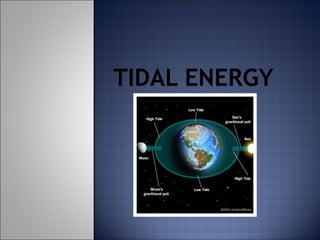
TIDAL ENERGY
Tidal Turbines
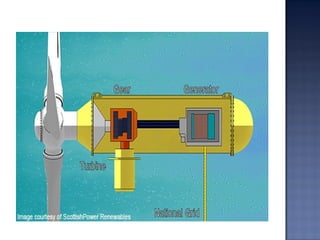
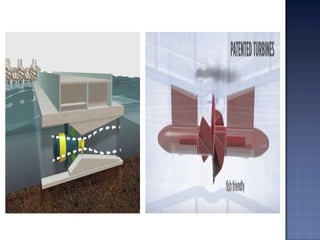
Tidal turbines use similar technology to wind turbines,
although their blades are much shorter and stronger. So a
good way to think of them is as underwater windmills.
Basically the water currents turn the turbines, which in turn
activate a generator that produces electricity. These systems
work best where there are very strong tidal zones (Norwegian
and British coastlines.) and although it is still in it’s infancy it
does show great promise.
The upfront cost of these tidal stream systems is very high
and also installation and maintenance is difficult. But it’s still
cheaper and has less environmental impact than another
tidal system which uses barrages.
Tidal power generating methods
Tidal power can be classified into four
generating methods:
Tidal stream generator
Tidal barrage
Dynamic tidal power
Tidal lagoon
Tidal stream generator
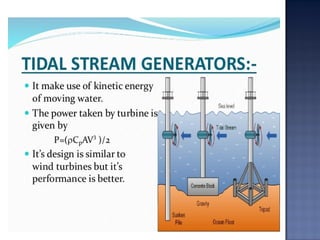
Tidal stream generators (or TSGs) make use
of the kinetic energy of moving water to
power turbines, in a similar way to
wind turbines that use wind to power
turbines. Some tidal generators can be built
into the structures of existing bridges,
involving virtually no aesthetic problems.
Land constrictions such as straits or inlets
can create high velocities at specific sites,
which can be captured with the use of
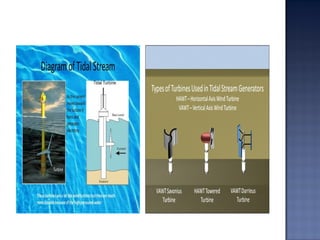
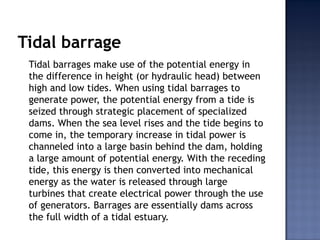
turbines. These turbines can be horizontal,
vertical, open, or ducted and are typically
placed near the bottom of the water column.
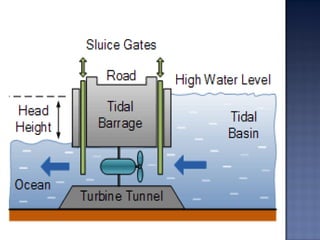
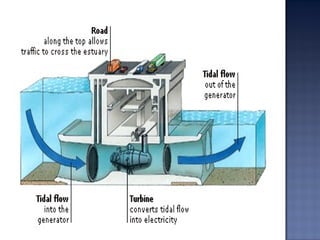
Tidal barrage
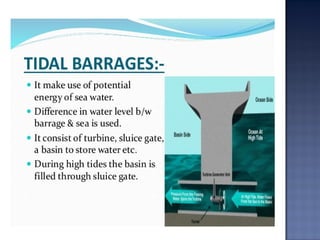
Tidal barrages make use of the potential energy in
the difference in height (or hydraulic head) between
high and low tides. When using tidal barrages to
generate power, the potential energy from a tide is
seized through strategic placement of specialized
dams. When the sea level rises and the tide begins to
come in, the temporary increase in tidal power is
channeled into a large basin behind the dam, holding
a large amount of potential energy. With the receding
tide, this energy is then converted into mechanical
energy as the water is released through large
turbines that create electrical power through the use
of generators. Barrages are essentially dams across
the full width of a tidal estuary.
Dynamic tidal power
Dynamic tidal power (or DTP) is an untried
but promising technology that would exploit
an interaction between potential and kinetic
energies in tidal flows. It proposes that very
long dams (for example: 30–50 km length) be
built from coasts straight out into the sea or
ocean, without enclosing an area. Tidal
phase differences are introduced across the
dam, leading to a significant water-level
differential in shallow coastal seas –
featuring strong coast-parallel oscillating
tidal currents such as found in the UK, China,
and Korea.
Tidal lagoon
A newer tidal energy design option is to construct circular
retaining walls embedded with turbines that can capture
the potential energy of tides. The created reservoirs are
similar to those of tidal barrages, except that the location
is artificial and does not contain a preexisting ecosystem.
The lagoons can also be in double (or triple) format
without pumping or with pumping that will flatten out the
power output. The pumping power could be provided by
excess to grid demand renewable energy from for example
wind turbines or solar photovoltaic arrays. Excess
renewable energy rather than being curtailed could be
used and stored for a later period of time. Geographically
dispersed tidal lagoons with a time delay between peak
production would also flatten out peak production
providing near base load production though at a higher
cost than some other alternatives such as district heating
renewable energy storage. The proposed Tidal Lagoon
Swansea Bay in Wales, United Kingdom would be the first
tidal power station of this type once built.
Renewability
In an energy-hungry world people is seeking
for energy to meet up for the future crisis.
But oil, gas, coal and other re-courses will be
finished within 40 years. So renewable
energy is the only solution for meet up the
future crisis. Solar, wind, wave, tidal, fuel
cell, geothermal etc are the renewable
energy sources. Tidal power/energy is more
predictable than solar or wind and other
energies. Rise and fall of tides is more cyclic
than random weather patterns.
Security & Efficiency
Tidal barrages or small dam can secure a city. It can
protect the city from dangerous tide during storm.
Tidal power is highly efficient. Its efficiency is about
80%.It means Tidal turbines are up to 80% efficient in
converting tid-al energy to usable electricity. It is
also said that bigger the power generating
equipment, the higher the efficiency. As because
tidal generators not use fuel they are more efficient
and long lusting (30-50years) compared to other
generators. The efficiency of tidal power is much
higher than solar or wind energy generators.
AN OVERVIEW OF TIDAL POWER IN COSTAL AREA
(SANDWIP)
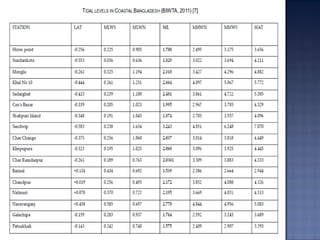
Bangladesh has a long coastal area (710 km) with 2~8 m tidal
height/head rise and fall [8]. It also has some large tidal
sites and many channels of low tidal range in a large
number of deltaic islands, where barrages and sluice gates
already exist.
Therefore, the potential for tidal power to be harnessed is
significant, because the barrages necessary for creating
controlled flow through turbines (to tap tidal power) are
also needed for flood control.
This avoids the problem of high capital cost as the
engineering is either already there or is needed for
cyclone protection .
 The island of Sandwip is located in the Bay of Bengal,
adjacent to Chittagong and is a mere 15 km from the
mainland. The entire island is 50 kilometers long and 5-15
kilometers wide The population is around 472179(as of
2009) on an area of 357 km2. The entire island is a mudflat
created from the Ganges delta.
 The 5 m tides experienced at Sandwip results in poor
accessibility, with the island constantly surrounded by mud
flats, except during high tides.
 A flood control barrage exists around the entire island and
contains 28 sluice gates. A short electricity grid is also
available linking the main commercial areas on the island.
Two diesel generators of 200 KW run for a few hours late
after-noon/early evening supplying electricity, mainly for
commercial use. Some households have batteries and some
diesel generators are used for powering rice threshers.
 A photo voltaic (PV) system is used to
maintain a refrigerator for vaccines in the
health centre. 100 kWp solar power
generation plant in Sandwip island is largest
in Bangladesh. Purobi Green Energy Limited
started operation on September 29, 2010.
The mud flats are composed of extremely
rich soil.
 According to the scoping visit and expert
analysis of different tidal range, Bangladesh
may harness energy from coastal tidal
resources by applying two technologies: 1.
Low head tidal movements (2~5 m head);
and 2. Medium head tidal movements (> 5 m
head).
 Therefore, the infrastructure needed for barrages and sluice
gates has already been present in this region. These barrages
and sluice gates may be used for electricity generation by
applying simple technology that can have widespread
application. Therefore the potential for tidal power to be
applied is significant, because the barrages necessary for
creating controlled flow through turbines (to tap tidal power)
are also needed for flood control.
 This therefore avoids the problem of high capital cost as the
engineering is either already there or is needed for cyclone
protection. In this application, three elements are needed:
firstly, the use of an under-shot paddlewheel with simple civil
construction enabling the placement of the wheel at
appropriate locations in the levees/barrages. The existing
technology of undershot paddlewheels is historical, and
generally uses a greater head as the energy source.
 Paddlewheels are generally not as efficient
at harnessing the energy from moving water
as are turbines or revolving blades using the
lift principle; however the proposed
application is seen as appropriate.
 The second element is the use of recently
developed, variable speed, electricity
generation equipment. This is attached
either directly to the wheel or via a simple
gearing-up mechanism. The third element is
the use of existing electronic controllers,
appropriate for small-scale machines, to
regulate the power output from variable
water flow.
 Perspective and Prospect of Tidal Energy in Bangladesh by Tausif
Ali, Muhammad Omar Faruk, Sabuj Das Gupta, Kamrul
Hasan(International Journal of Scientific and Research
Publications, Volume 3)
 Tidal Power: An Option for Alternative Sustainable Power
Generation in Bangladesh by Tausif Ali*, Muhammad Omar
Faruk**, Sabuj Das Gupata* (International Journal of Scientific
and Research Publications, Volume 2)
 https://en.wikipedia.org/wiki/Tidal_power
 http://oilprice.com/Alternative-Energy/Tidal-Energy/How-Does-
Tidal-Energy-Work.html
Tidal energy
Tidal energy

Tidal energy

  • 1.
    Course: Renewable EnergyTechnology CourseCode: EEE 4389 Name: Md.Tareq Hasan;Ambarish Biswas; Mahaz Sarkar; Md. Neamot Ullah ID: EEE233; EEE188;EEE192; EEE114 Welcome
  • 2.
  • 3.
    Describe different methodof Tidal power generating.  Brief idea of Renewability; Security & Efficiency of Tidal power generating.  Brief idea about Perspective of tidal power generation according to Bangladesh.
  • 4.
    Tidal Turbines Tidal powergenerating methods Tidal stream generator Tidal barrage Dynamic tidal power Tidal lagoon Renewability Security & Efficiency Perspective of Tidal power generation according to Bangladesh Review
  • 5.
  • 6.
    Tidal Turbines Tidal turbinesuse similar technology to wind turbines, although their blades are much shorter and stronger. So a good way to think of them is as underwater windmills. Basically the water currents turn the turbines, which in turn activate a generator that produces electricity. These systems work best where there are very strong tidal zones (Norwegian and British coastlines.) and although it is still in it’s infancy it does show great promise. The upfront cost of these tidal stream systems is very high and also installation and maintenance is difficult. But it’s still cheaper and has less environmental impact than another tidal system which uses barrages.
  • 8.
    Tidal power generatingmethods Tidal power can be classified into four generating methods: Tidal stream generator Tidal barrage Dynamic tidal power Tidal lagoon
  • 9.
    Tidal stream generator Tidalstream generators (or TSGs) make use of the kinetic energy of moving water to power turbines, in a similar way to wind turbines that use wind to power turbines. Some tidal generators can be built into the structures of existing bridges, involving virtually no aesthetic problems. Land constrictions such as straits or inlets can create high velocities at specific sites, which can be captured with the use of turbines. These turbines can be horizontal, vertical, open, or ducted and are typically placed near the bottom of the water column.
  • 12.
    Tidal barrage Tidal barragesmake use of the potential energy in the difference in height (or hydraulic head) between high and low tides. When using tidal barrages to generate power, the potential energy from a tide is seized through strategic placement of specialized dams. When the sea level rises and the tide begins to come in, the temporary increase in tidal power is channeled into a large basin behind the dam, holding a large amount of potential energy. With the receding tide, this energy is then converted into mechanical energy as the water is released through large turbines that create electrical power through the use of generators. Barrages are essentially dams across the full width of a tidal estuary.
  • 15.
    Dynamic tidal power Dynamictidal power (or DTP) is an untried but promising technology that would exploit an interaction between potential and kinetic energies in tidal flows. It proposes that very long dams (for example: 30–50 km length) be built from coasts straight out into the sea or ocean, without enclosing an area. Tidal phase differences are introduced across the dam, leading to a significant water-level differential in shallow coastal seas – featuring strong coast-parallel oscillating tidal currents such as found in the UK, China, and Korea.
  • 17.
    Tidal lagoon A newertidal energy design option is to construct circular retaining walls embedded with turbines that can capture the potential energy of tides. The created reservoirs are similar to those of tidal barrages, except that the location is artificial and does not contain a preexisting ecosystem. The lagoons can also be in double (or triple) format without pumping or with pumping that will flatten out the power output. The pumping power could be provided by excess to grid demand renewable energy from for example wind turbines or solar photovoltaic arrays. Excess renewable energy rather than being curtailed could be used and stored for a later period of time. Geographically dispersed tidal lagoons with a time delay between peak production would also flatten out peak production providing near base load production though at a higher cost than some other alternatives such as district heating renewable energy storage. The proposed Tidal Lagoon Swansea Bay in Wales, United Kingdom would be the first tidal power station of this type once built.
  • 19.
    Renewability In an energy-hungryworld people is seeking for energy to meet up for the future crisis. But oil, gas, coal and other re-courses will be finished within 40 years. So renewable energy is the only solution for meet up the future crisis. Solar, wind, wave, tidal, fuel cell, geothermal etc are the renewable energy sources. Tidal power/energy is more predictable than solar or wind and other energies. Rise and fall of tides is more cyclic than random weather patterns.
  • 20.
    Security & Efficiency Tidalbarrages or small dam can secure a city. It can protect the city from dangerous tide during storm. Tidal power is highly efficient. Its efficiency is about 80%.It means Tidal turbines are up to 80% efficient in converting tid-al energy to usable electricity. It is also said that bigger the power generating equipment, the higher the efficiency. As because tidal generators not use fuel they are more efficient and long lusting (30-50years) compared to other generators. The efficiency of tidal power is much higher than solar or wind energy generators.
  • 21.
    AN OVERVIEW OFTIDAL POWER IN COSTAL AREA (SANDWIP) Bangladesh has a long coastal area (710 km) with 2~8 m tidal height/head rise and fall [8]. It also has some large tidal sites and many channels of low tidal range in a large number of deltaic islands, where barrages and sluice gates already exist. Therefore, the potential for tidal power to be harnessed is significant, because the barrages necessary for creating controlled flow through turbines (to tap tidal power) are also needed for flood control. This avoids the problem of high capital cost as the engineering is either already there or is needed for cyclone protection .
  • 22.
     The islandof Sandwip is located in the Bay of Bengal, adjacent to Chittagong and is a mere 15 km from the mainland. The entire island is 50 kilometers long and 5-15 kilometers wide The population is around 472179(as of 2009) on an area of 357 km2. The entire island is a mudflat created from the Ganges delta.  The 5 m tides experienced at Sandwip results in poor accessibility, with the island constantly surrounded by mud flats, except during high tides.  A flood control barrage exists around the entire island and contains 28 sluice gates. A short electricity grid is also available linking the main commercial areas on the island. Two diesel generators of 200 KW run for a few hours late after-noon/early evening supplying electricity, mainly for commercial use. Some households have batteries and some diesel generators are used for powering rice threshers.
  • 23.
     A photovoltaic (PV) system is used to maintain a refrigerator for vaccines in the health centre. 100 kWp solar power generation plant in Sandwip island is largest in Bangladesh. Purobi Green Energy Limited started operation on September 29, 2010. The mud flats are composed of extremely rich soil.  According to the scoping visit and expert analysis of different tidal range, Bangladesh may harness energy from coastal tidal resources by applying two technologies: 1. Low head tidal movements (2~5 m head); and 2. Medium head tidal movements (> 5 m head).
  • 24.
     Therefore, theinfrastructure needed for barrages and sluice gates has already been present in this region. These barrages and sluice gates may be used for electricity generation by applying simple technology that can have widespread application. Therefore the potential for tidal power to be applied is significant, because the barrages necessary for creating controlled flow through turbines (to tap tidal power) are also needed for flood control.  This therefore avoids the problem of high capital cost as the engineering is either already there or is needed for cyclone protection. In this application, three elements are needed: firstly, the use of an under-shot paddlewheel with simple civil construction enabling the placement of the wheel at appropriate locations in the levees/barrages. The existing technology of undershot paddlewheels is historical, and generally uses a greater head as the energy source.
  • 25.
     Paddlewheels aregenerally not as efficient at harnessing the energy from moving water as are turbines or revolving blades using the lift principle; however the proposed application is seen as appropriate.  The second element is the use of recently developed, variable speed, electricity generation equipment. This is attached either directly to the wheel or via a simple gearing-up mechanism. The third element is the use of existing electronic controllers, appropriate for small-scale machines, to regulate the power output from variable water flow.
  • 28.
     Perspective andProspect of Tidal Energy in Bangladesh by Tausif Ali, Muhammad Omar Faruk, Sabuj Das Gupta, Kamrul Hasan(International Journal of Scientific and Research Publications, Volume 3)  Tidal Power: An Option for Alternative Sustainable Power Generation in Bangladesh by Tausif Ali*, Muhammad Omar Faruk**, Sabuj Das Gupata* (International Journal of Scientific and Research Publications, Volume 2)  https://en.wikipedia.org/wiki/Tidal_power  http://oilprice.com/Alternative-Energy/Tidal-Energy/How-Does- Tidal-Energy-Work.html