TIDAL ENERGY
Sources of Energy
• Non-Renewable Sources of Energy
Those sources of energy which have accumulated in nature over a
very, very long time and cannot be quickly replaced when exhausted
are called non-renewable sources of energy.
• Renewable Sources of Energy
Those sources of energy which are being produced continuously in
nature and are inexhaustible, are called renewable sources of
energy.
Energy from the sea
The energy from the sea can be obtained mainly in three
forms:
1. Tidal energy
2. Wave energy, and
3. Ocean thermal energy
Tidal Energy
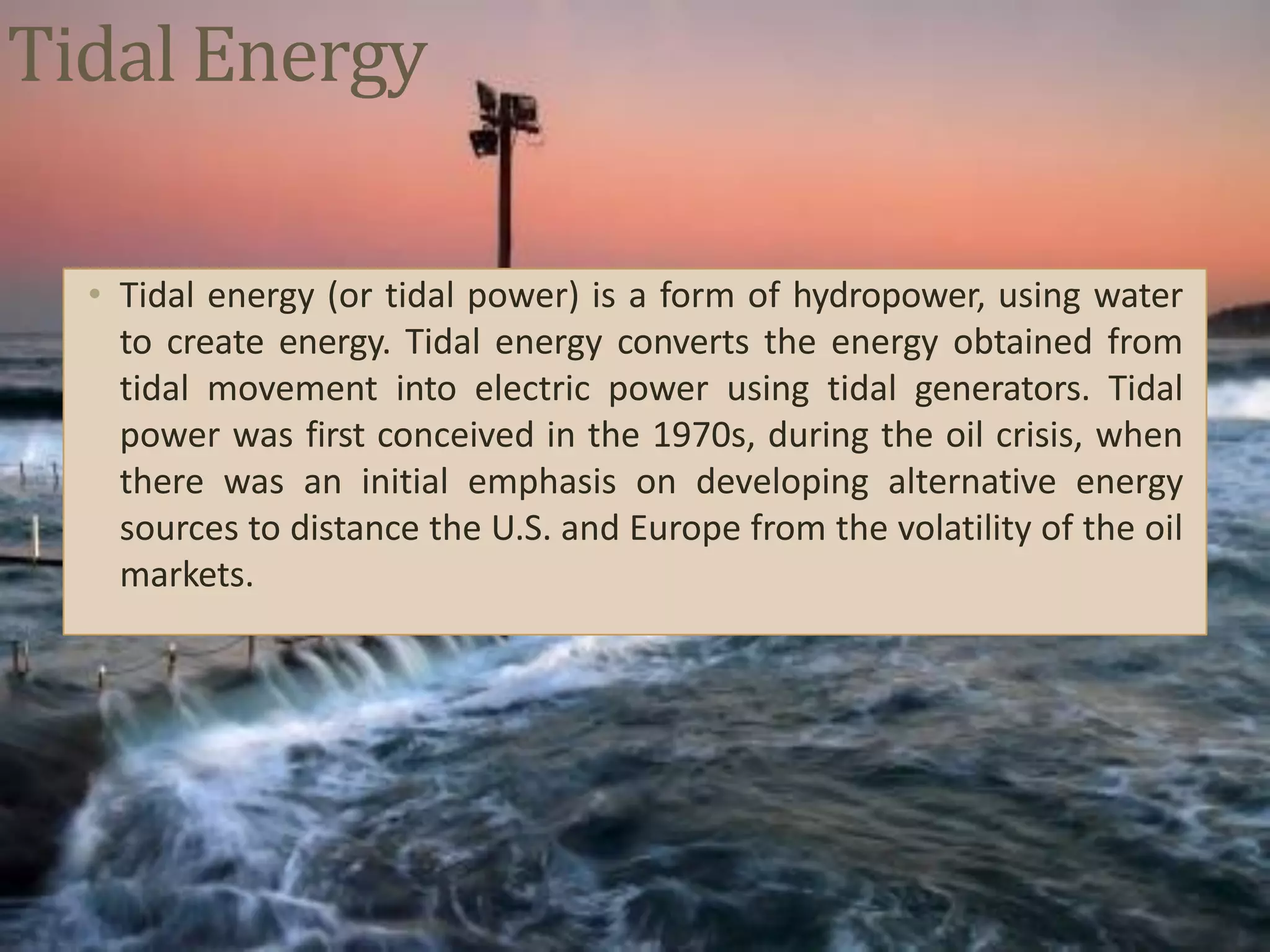
• Tidal energy (or tidal power) is a form of hydropower, using water
to create energy. Tidal energy converts the energy obtained from
tidal movement into electric power using tidal generators. Tidal
power was first conceived in the 1970s, during the oil crisis, when
there was an initial emphasis on developing alternative energy
sources to distance the U.S. and Europe from the volatility of the oil
markets.
Site Selection
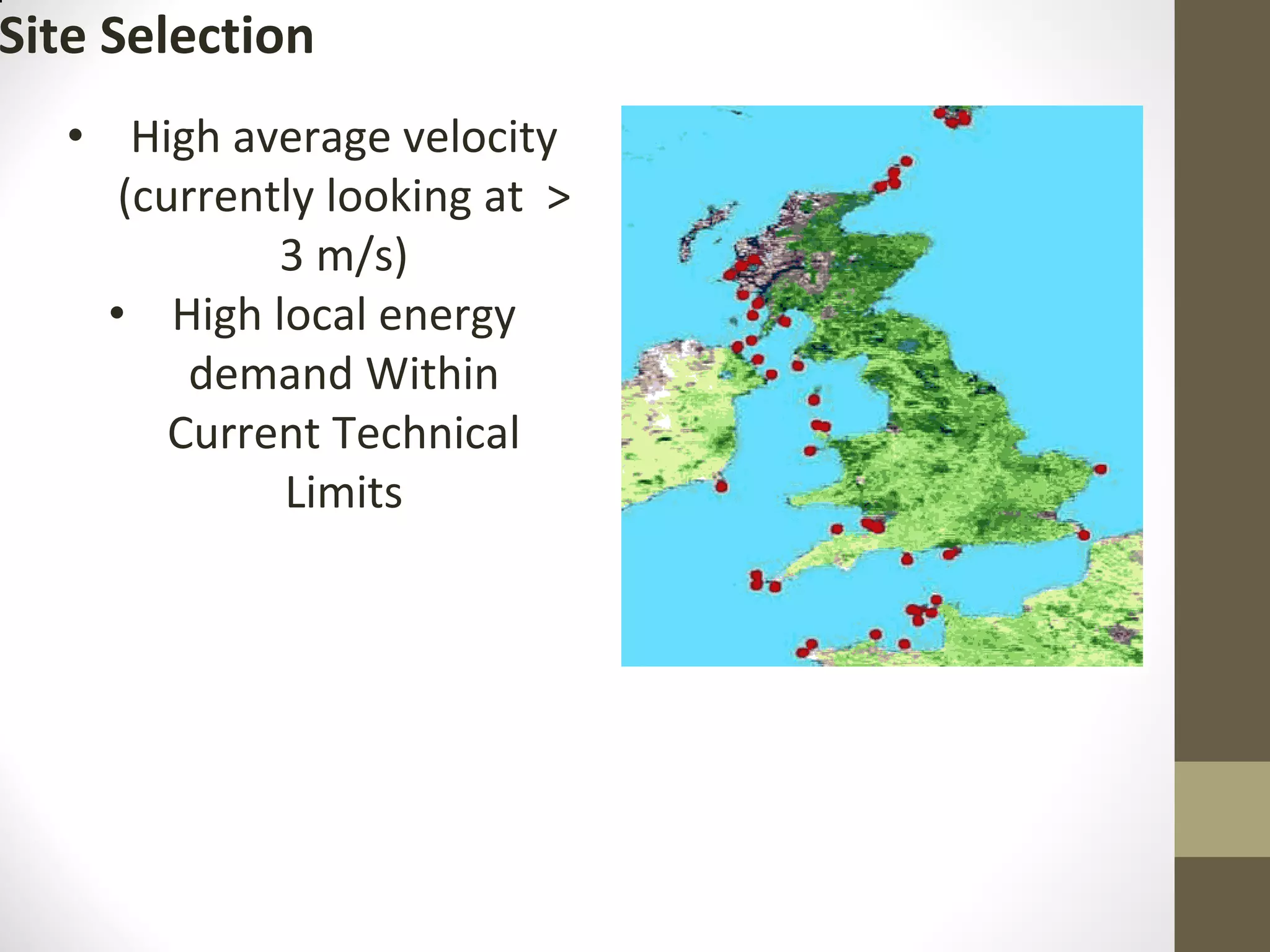
• High average velocity
(currently looking at >
3 m/s)
• High local energy
demand Within
Current Technical
Limits
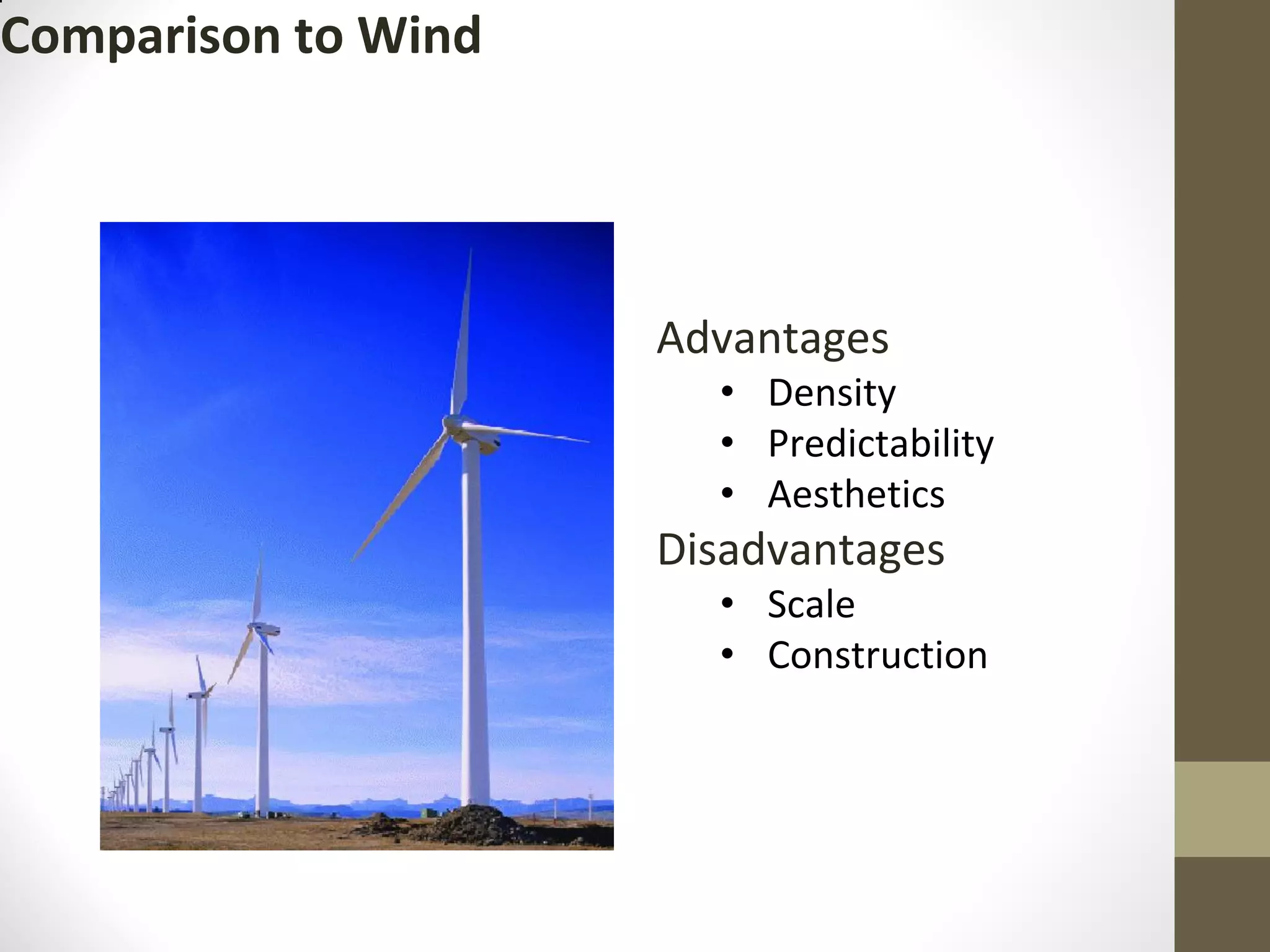
Comparison to Wind
Advantages
• Density
• Predictability
• Aesthetics
Disadvantages
• Scale
• Construction
Current Projects
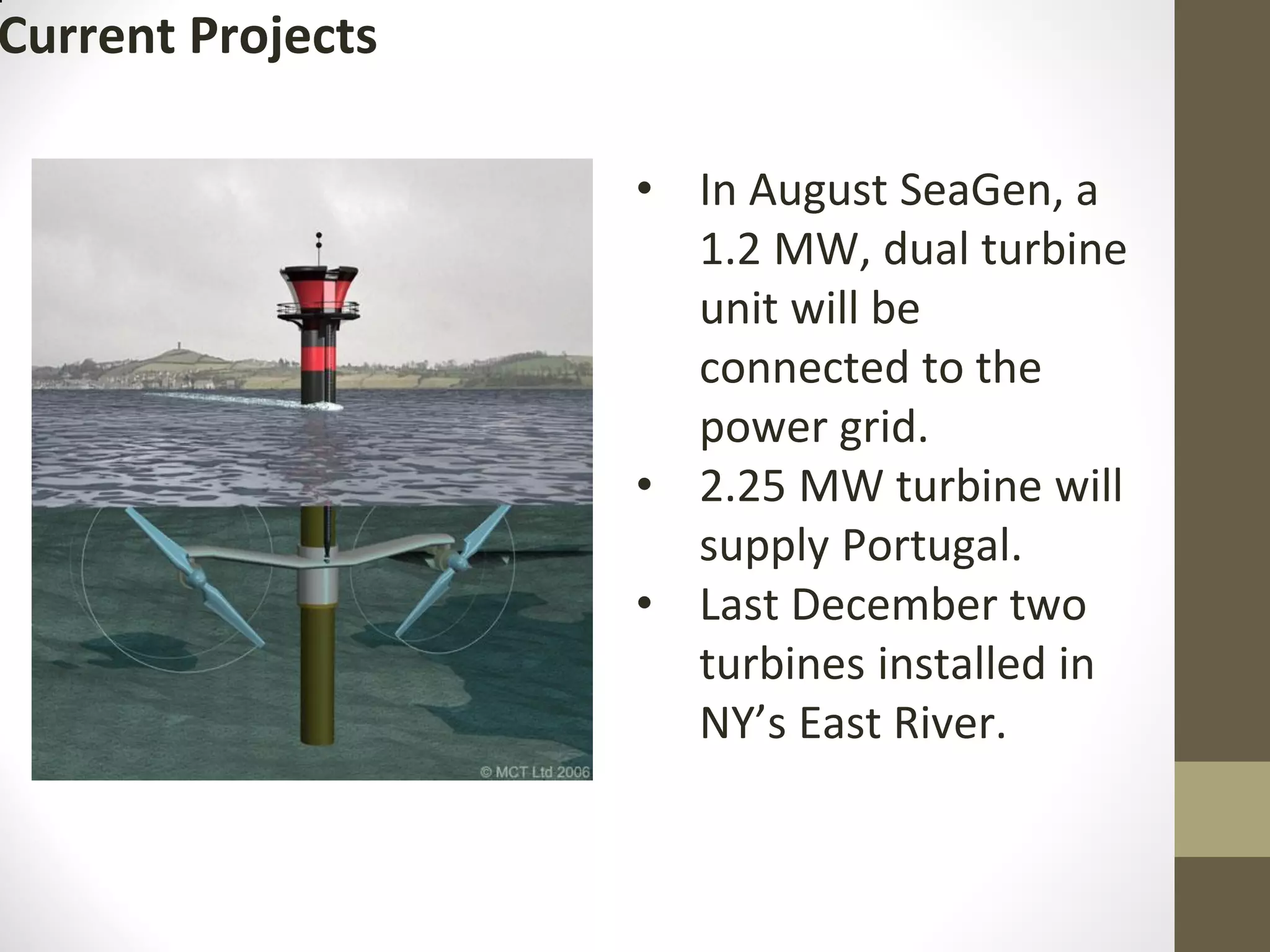
• In August SeaGen, a
1.2 MW, dual turbine
unit will be
connected to the
power grid.
• 2.25 MW turbine will
supply Portugal.
• Last December two
turbines installed in
NY’s East River.
Wave Energy
• Wave power is the capture of energy of wind waves to do
useful work – for example, electricity generation, water
desalination, or pumping water. A machine that exploits wave
power is a wave energy converter.
• Wave power is distinct from tidal power, which captures the
energy of the current caused by the gravitational pull of the
Sun and Moon.
• Waves and tides are also distinct from ocean currents which
are caused by other forces including breaking waves, wind and
differences in temperature and salinity.
Ocean Thermal Energy
• Ocean thermal energy conversion uses the temperature
difference between cooler deep and warmer shallow or
surface seawaters to run a heat engine and produce useful
work, usually in the form of electricity.
• OTEC can operate with a very high capacity factor and so can
operate in base load mode.
OTEC Working Principle
• This plant works on the principle of a closed Rankine This plant works
on the principle of a closed Rankine Cycle.
• Warm Water is used to evaporate working fluid like Warm Water is
used to evaporate working fluid like Ammonia or halocarbon
Refrigerant. Ammonia or halocarbon Refrigerant.
• Evaporated Fluid expands in a low pressure turbine, which
Evaporated Fluid expands in a low pressure turbine, which is coupled
with a turbo alternator to produce electricity.is coupled with a turbo
alternator to produce electricity.
OTEC Systems
There are three types of electricity conversion:
I. The Closed or Anderson, OTEC Cycle Power Plant
II. The Open or Claude OTEC Cycle Power
III. Hybrid Cycle OTEC Power Plant
Closed-loop OTEC
Closed cycle system use fluid with a low boiling point, such Closed
cycle system use fluid with a low boiling point, such as ammonia
to power a turbine to generate electricity.
Open-loop OTEC
Georges Claude Constructed first OTEC plant in 1929 in Cuba. The
Claude Plant used an open cycle in which seawater itself plays the
multiple role of heat source, working fluid, coolant, & heat sink.
Hybrid OTEC
A Hybrid cycle combines the features of both the closed & Open
Cycle System Cycle System.
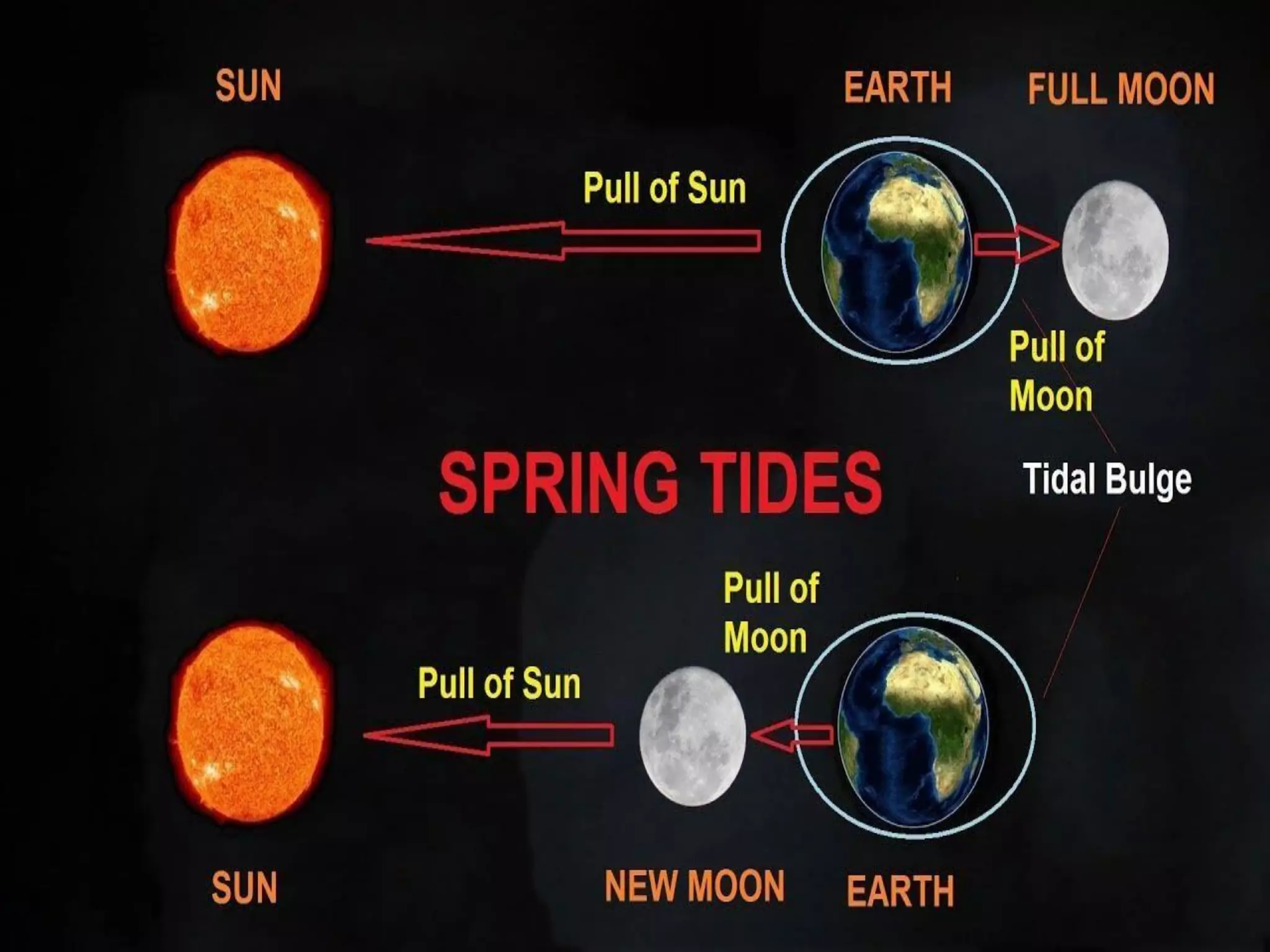
The Cause of Tides
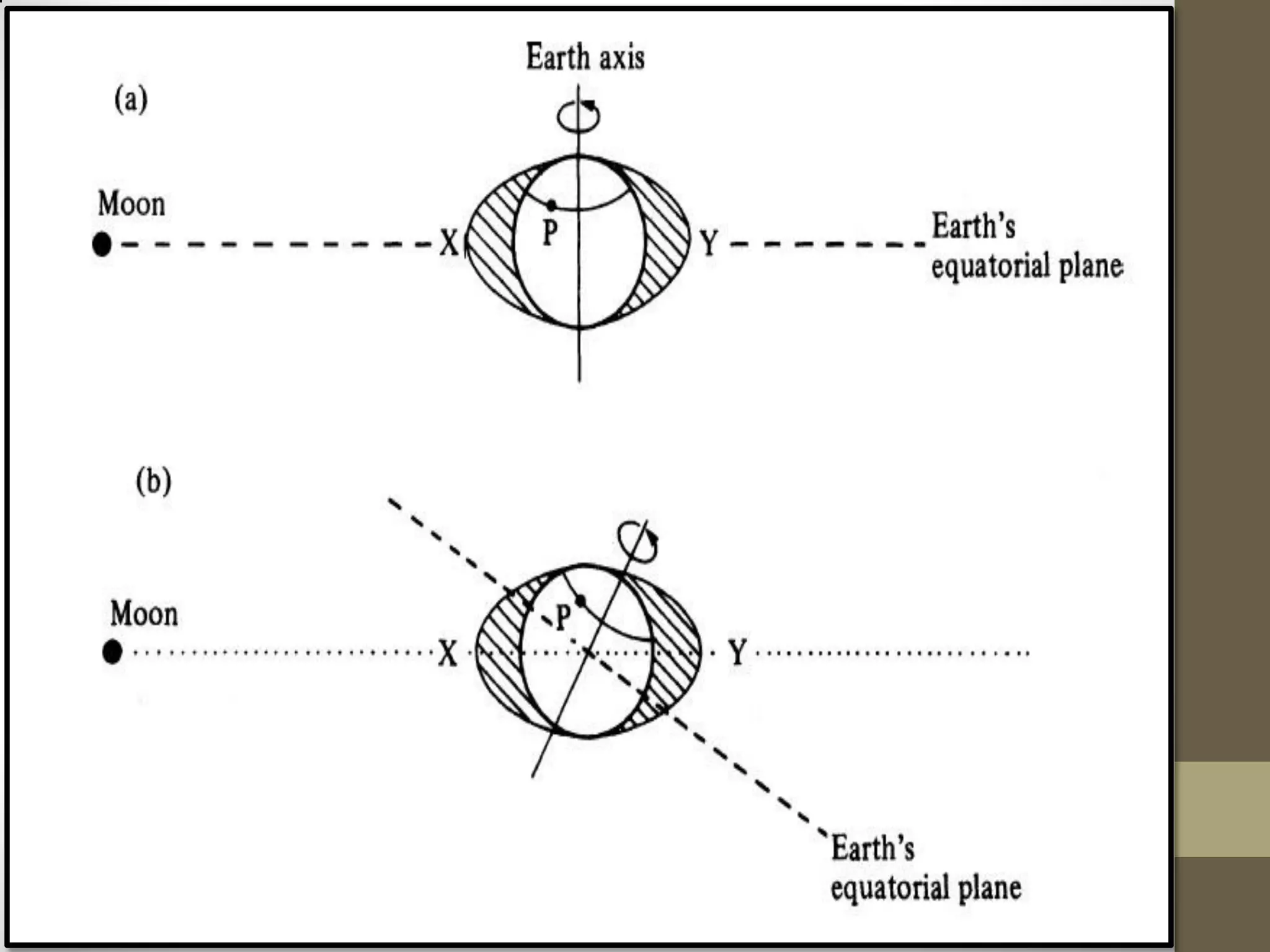
• Tides refer to the rise and fall of our oceans’ surfaces. It is
caused by the attractive forces of the Moon and Sun’s
gravitational fields as well as the centrifugal force due to the
Earth’s spin.
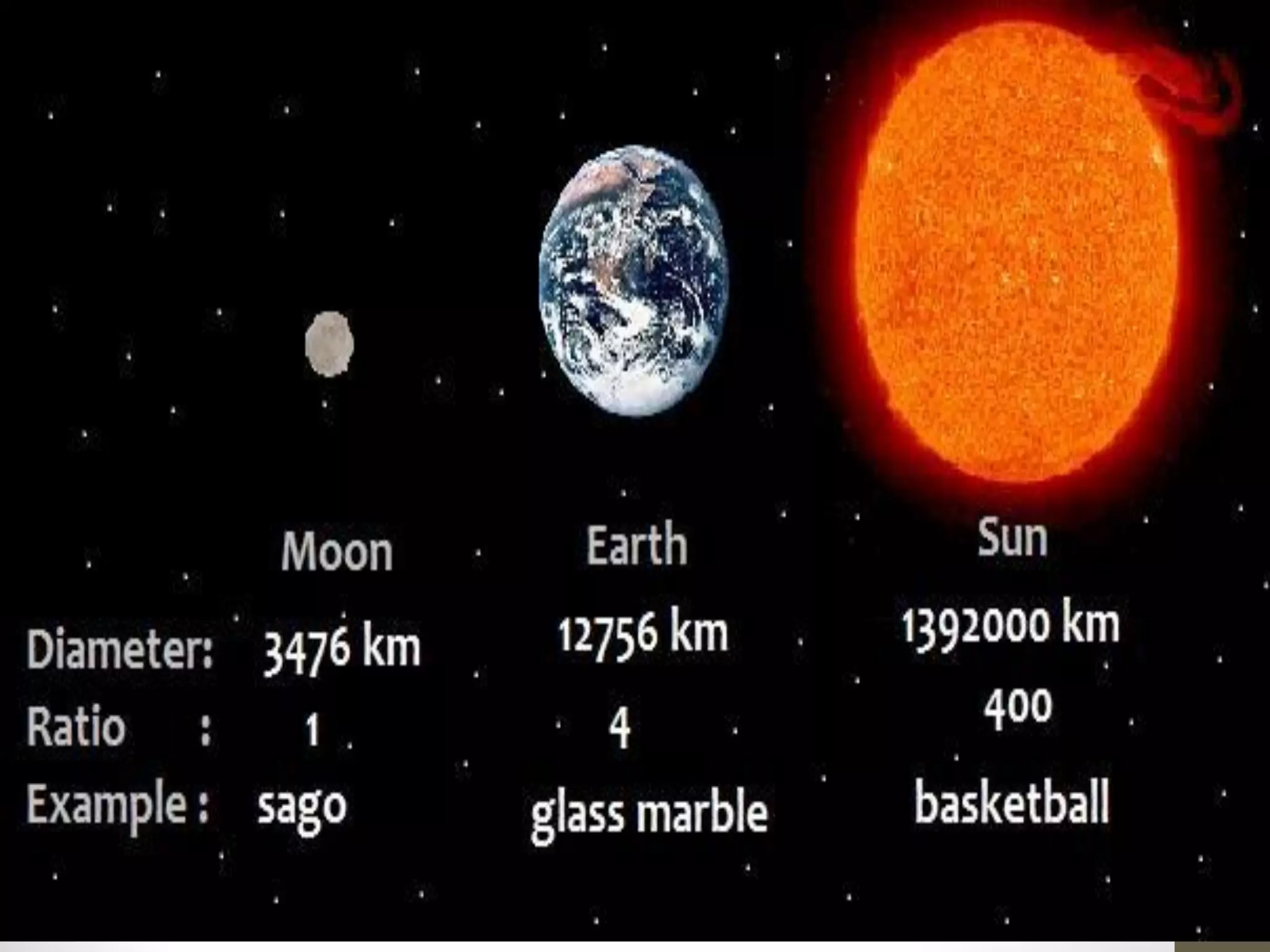
• The Moon, although much smaller than the Sun, is much
closer. Now, gravitational forces decrease rapidly as the
distance between two masses widen. Thus, the Moon’s gravity
has a larger effect on tides than the Sun. In fact, the Sun’s
effect is only about half that of the Moon’s.
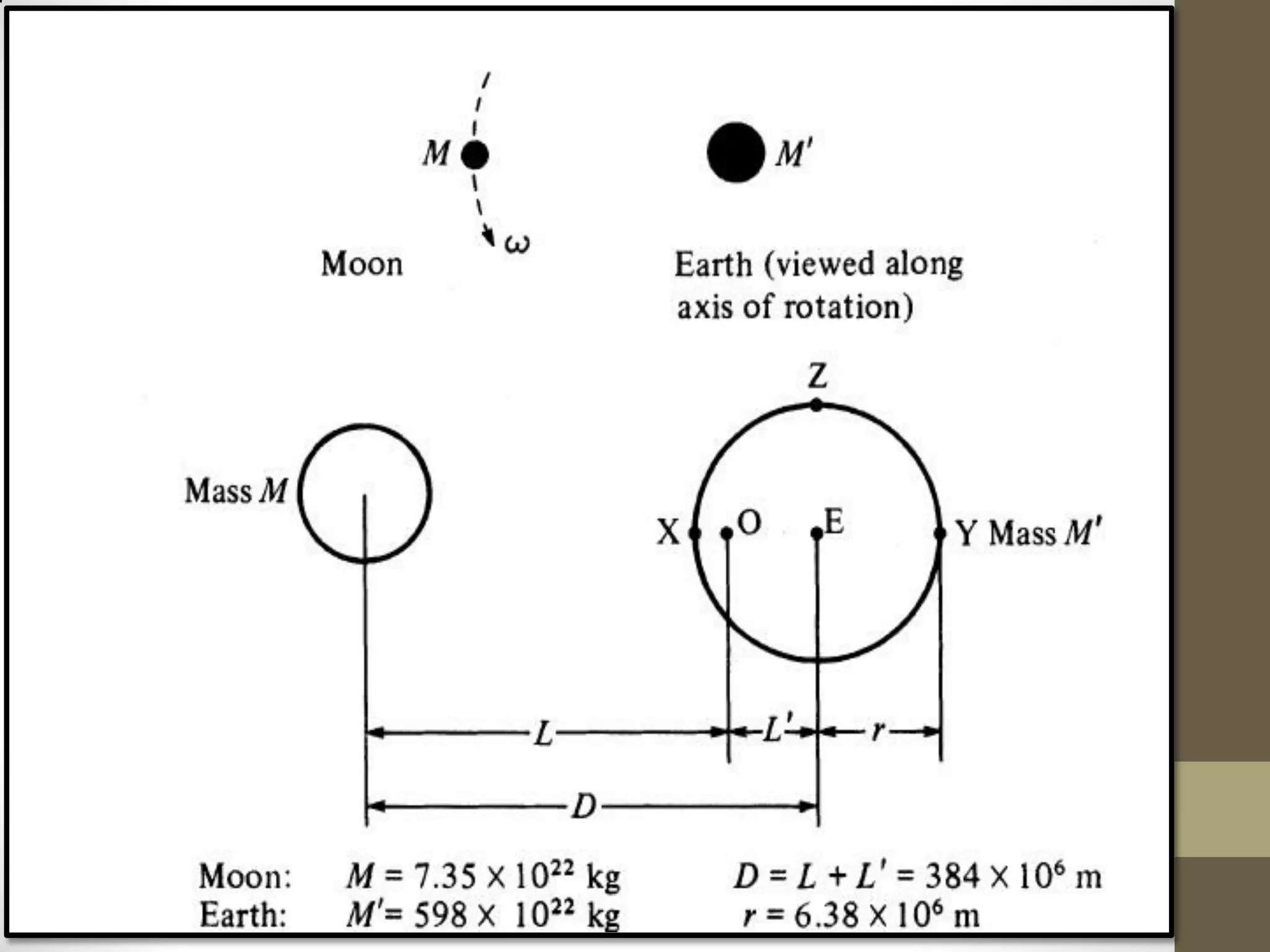
The lunar induced tide
• The Moon and Earth revolve about each other in space
but since the mass of the Earth is nearly hundred times
greater than the Moon’s mass, the Moon’s motion is
more apparent. The centre of revolution is at O, such
that
• ML =M’L’
• L’ = MD/M ‘+M
• L’ = 4670km
Generation of Tidal energy
• Tidal power is taken from the Earth's oceanic tides. Tidal forces are
periodic variations in gravitational attraction exerted by celestial
bodies.
• Due to the strong attraction to the oceans, a bulge in the water
level is created, causing a temporary increase in sea level.
Tidal stream Generator
• Tidal stream generators make use of the kinetic energy of moving
water to power turbines, in a similar way to wind turbines that use
wind to power turbines.
• Some tidal generators can be built into the structures of existing
bridges or are entirely submersed, thus avoiding concerns over
impact on the natural landscape.
Tidal barrage
• Tidal barrages make use of the potential energy in the difference in
height (or hydraulic head) between high and low tides.
• When using tidal barrages to generate power, the potential energy
from a tide is seized through strategic placement of specialized
dams.
• When the sea level rises and the tide begins to come in, the
temporary increase in tidal power is channeled into a large basin
behind the dam, holding a large amount of potential energy.
Dynamic Tidal power
• Dynamic tidal power (or DTP) is an untried but promising
technology that would exploit an interaction between
potential and kinetic energies in tidal flows.
• Tidal phase differences are introduced across the dam, leading
to a significant water-level differential in shallow coastal seas
– featuring strong coast-parallel oscillating tidal currents such
as found in the UK, China, and Korea.
Tidal lagoon
• A new tidal energy design option is to construct circular
retaining walls embedded with turbines that can capture the
potential energy of tides.
• The created reservoirs are similar to those of tidal barrages,
except that the location is artificial and does not contain a pre-
existing ecosystem.
• The lagoons can also be in double (or triple) format without
pumping or with pumping that will flatten out the power
output.
Corrosion
• Salt water causes corrosion in metal parts. It can be difficult to
maintain tidal stream generators due to their size and depth in
the water.
• The use of corrosion-resistant materials such as stainless
steels, high-nickel alloys, copper-nickel alloys, nickel-copper
alloys and titanium can greatly reduce, or eliminate, corrosion
damage.
Cost
• Tidal Energy has an expensive initial cost which may be one of the
reasons tidal energy is not a popular source of renewable energy.
• It is projected that tidal power will be commercially profitable
within 2020 with better technology and larger scales.
• Tidal Energy is however still very early in the research process and
the ability to reduce the price of tidal energy can be an option.
The cost effectiveness depends on each site tidal generators are
being placed.
Environmental Impacts of Tidal Energy
• The main environmental concerns with tidal energy are from
the turbine blades striking or entangling marine organisms, as
higher speed flowing water increases the risk of organisms
being pulled near or through these devices.
• As with all offshore renewable energies , there is also a
concern about how the creation of electromagnetic fields and
acoustic outputs may affect marine organisms.
Advantages
• It is an inexhaustible source of energy.
• Tidal energy is environment friendly energy and doesn’t produce
greenhouse gases.
• As 71% of Earth’s surface is covered by water, there is scope to
generate this energy on large scale.
• We can predict the rise and fall of tides as they follow cyclic fashion.
• Efficiency of tidal power is far greater as compared to coal, solar or
wind energy. Its efficiency is around 80%.
• Although cost of construction of tidal power is high but
maintenance costs are relatively low.
Disadvantages
• Cost of construction of tidal power plants is high.
• There are very few ideal locations for construction of plant and
they too are localized to coastal regions only.
• Intensity of sea waves is unpredictable and there can be damage
to power generation units.
• Influences aquatic life adversely and can disrupt migration of fish.
• The actual generation is for a short period of time. The tides
only happen twice a day so electricity can be produced only
for that time.
• Frozen sea, low or weak tides, straight shorelines, low tidal rise or
fall are some of the obstructions.
Uses
• Tidal Electricity- Like other forms of Energy, the main usage of Tidal
Energy is in the generation of Electricity. Tidal Energy is being used in
France to generate 240MW of Tidal Electricity at very low costs.
• Grain Mills- Tidal Energy has been used for hundreds of years. Just like
Wind Mills, Tidal Energy was used for the mechanical crushing of grains
in Grains Mills.
• Energy Storage- Tidal Energy can also be used as a store of Energy.
Like many of the hydroelectric dams which can be used a large
Energy Storage, so Tidal Barrages with their reservoirs can be
modified to store energy.
• Energy Storage- Tidal Energy can also be used as a store of Energy. Like
many of the hydroelectric dams which can be used a large Energy
Storage, so Tidal Barrages with their reservoirs can be modified to store
energy.
• Provide Protection to Coast in High Storms- Tidal Barrages can prevent
Damage to the Coast during High Storms and also provide an easy
transport method between the 2 arms of a Bay or an Estuary on which
it is built.
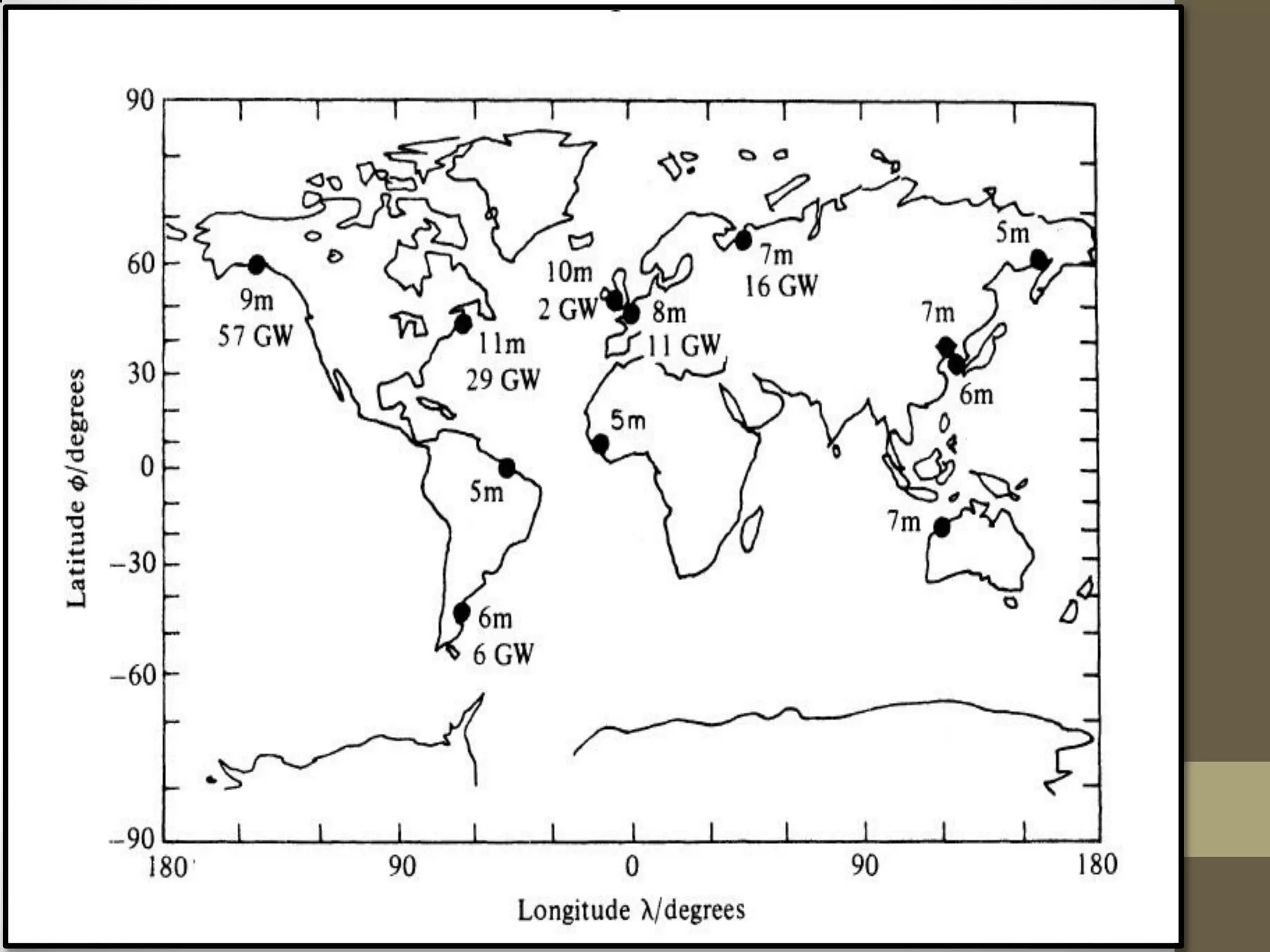
World Range Power Sites
• The total dissipation of energy by water tides in the Earth is
estimated to be 3000GW, including no more than about 1000GW
dissipated in shallow sea areas accessible for large civil engineering
works.
• They have a combined total potential of about 120GW.
• This is about 12% of near-shoreline potential and 10% of the total
world hydropower (river) potential.
Tidal Energy in India
• According to the estimates of the Indian government, the
country has a potential of 8,000 MW of tidal energy.
• This includes about 7,000 MW in the Gulf of Cambay in
Gujarat, 1,200 MW in the Gulf of Kutch and 100 MW in
the Gangetic delta in the Sunderbans region of West
Bengal.
THANK YOU

Unit 2_Tidal Energy.pdf

  • 1.
  • 2.
    Sources of Energy •Non-Renewable Sources of Energy Those sources of energy which have accumulated in nature over a very, very long time and cannot be quickly replaced when exhausted are called non-renewable sources of energy. • Renewable Sources of Energy Those sources of energy which are being produced continuously in nature and are inexhaustible, are called renewable sources of energy.
  • 3.
    Energy from thesea The energy from the sea can be obtained mainly in three forms: 1. Tidal energy 2. Wave energy, and 3. Ocean thermal energy
  • 4.
    Tidal Energy • Tidalenergy (or tidal power) is a form of hydropower, using water to create energy. Tidal energy converts the energy obtained from tidal movement into electric power using tidal generators. Tidal power was first conceived in the 1970s, during the oil crisis, when there was an initial emphasis on developing alternative energy sources to distance the U.S. and Europe from the volatility of the oil markets.
  • 5.
    Site Selection • Highaverage velocity (currently looking at > 3 m/s) • High local energy demand Within Current Technical Limits
  • 6.
    Comparison to Wind Advantages •Density • Predictability • Aesthetics Disadvantages • Scale • Construction
  • 7.
    Current Projects • InAugust SeaGen, a 1.2 MW, dual turbine unit will be connected to the power grid. • 2.25 MW turbine will supply Portugal. • Last December two turbines installed in NY’s East River.
  • 8.
    Wave Energy • Wavepower is the capture of energy of wind waves to do useful work – for example, electricity generation, water desalination, or pumping water. A machine that exploits wave power is a wave energy converter. • Wave power is distinct from tidal power, which captures the energy of the current caused by the gravitational pull of the Sun and Moon. • Waves and tides are also distinct from ocean currents which are caused by other forces including breaking waves, wind and differences in temperature and salinity.
  • 9.
    Ocean Thermal Energy •Ocean thermal energy conversion uses the temperature difference between cooler deep and warmer shallow or surface seawaters to run a heat engine and produce useful work, usually in the form of electricity. • OTEC can operate with a very high capacity factor and so can operate in base load mode.
  • 10.
    OTEC Working Principle •This plant works on the principle of a closed Rankine This plant works on the principle of a closed Rankine Cycle. • Warm Water is used to evaporate working fluid like Warm Water is used to evaporate working fluid like Ammonia or halocarbon Refrigerant. Ammonia or halocarbon Refrigerant. • Evaporated Fluid expands in a low pressure turbine, which Evaporated Fluid expands in a low pressure turbine, which is coupled with a turbo alternator to produce electricity.is coupled with a turbo alternator to produce electricity. OTEC Systems There are three types of electricity conversion: I. The Closed or Anderson, OTEC Cycle Power Plant II. The Open or Claude OTEC Cycle Power III. Hybrid Cycle OTEC Power Plant
  • 11.
    Closed-loop OTEC Closed cyclesystem use fluid with a low boiling point, such Closed cycle system use fluid with a low boiling point, such as ammonia to power a turbine to generate electricity. Open-loop OTEC Georges Claude Constructed first OTEC plant in 1929 in Cuba. The Claude Plant used an open cycle in which seawater itself plays the multiple role of heat source, working fluid, coolant, & heat sink. Hybrid OTEC A Hybrid cycle combines the features of both the closed & Open Cycle System Cycle System.
  • 12.
    The Cause ofTides • Tides refer to the rise and fall of our oceans’ surfaces. It is caused by the attractive forces of the Moon and Sun’s gravitational fields as well as the centrifugal force due to the Earth’s spin. • The Moon, although much smaller than the Sun, is much closer. Now, gravitational forces decrease rapidly as the distance between two masses widen. Thus, the Moon’s gravity has a larger effect on tides than the Sun. In fact, the Sun’s effect is only about half that of the Moon’s.
  • 15.
    The lunar inducedtide • The Moon and Earth revolve about each other in space but since the mass of the Earth is nearly hundred times greater than the Moon’s mass, the Moon’s motion is more apparent. The centre of revolution is at O, such that • ML =M’L’ • L’ = MD/M ‘+M • L’ = 4670km
  • 18.
    Generation of Tidalenergy • Tidal power is taken from the Earth's oceanic tides. Tidal forces are periodic variations in gravitational attraction exerted by celestial bodies. • Due to the strong attraction to the oceans, a bulge in the water level is created, causing a temporary increase in sea level.
  • 19.
    Tidal stream Generator •Tidal stream generators make use of the kinetic energy of moving water to power turbines, in a similar way to wind turbines that use wind to power turbines. • Some tidal generators can be built into the structures of existing bridges or are entirely submersed, thus avoiding concerns over impact on the natural landscape.
  • 20.
    Tidal barrage • Tidalbarrages make use of the potential energy in the difference in height (or hydraulic head) between high and low tides. • When using tidal barrages to generate power, the potential energy from a tide is seized through strategic placement of specialized dams. • When the sea level rises and the tide begins to come in, the temporary increase in tidal power is channeled into a large basin behind the dam, holding a large amount of potential energy.
  • 21.
    Dynamic Tidal power •Dynamic tidal power (or DTP) is an untried but promising technology that would exploit an interaction between potential and kinetic energies in tidal flows. • Tidal phase differences are introduced across the dam, leading to a significant water-level differential in shallow coastal seas – featuring strong coast-parallel oscillating tidal currents such as found in the UK, China, and Korea.
  • 22.
    Tidal lagoon • Anew tidal energy design option is to construct circular retaining walls embedded with turbines that can capture the potential energy of tides. • The created reservoirs are similar to those of tidal barrages, except that the location is artificial and does not contain a pre- existing ecosystem. • The lagoons can also be in double (or triple) format without pumping or with pumping that will flatten out the power output.
  • 23.
    Corrosion • Salt watercauses corrosion in metal parts. It can be difficult to maintain tidal stream generators due to their size and depth in the water. • The use of corrosion-resistant materials such as stainless steels, high-nickel alloys, copper-nickel alloys, nickel-copper alloys and titanium can greatly reduce, or eliminate, corrosion damage.
  • 24.
    Cost • Tidal Energyhas an expensive initial cost which may be one of the reasons tidal energy is not a popular source of renewable energy. • It is projected that tidal power will be commercially profitable within 2020 with better technology and larger scales. • Tidal Energy is however still very early in the research process and the ability to reduce the price of tidal energy can be an option. The cost effectiveness depends on each site tidal generators are being placed.
  • 25.
    Environmental Impacts ofTidal Energy • The main environmental concerns with tidal energy are from the turbine blades striking or entangling marine organisms, as higher speed flowing water increases the risk of organisms being pulled near or through these devices. • As with all offshore renewable energies , there is also a concern about how the creation of electromagnetic fields and acoustic outputs may affect marine organisms.
  • 26.
    Advantages • It isan inexhaustible source of energy. • Tidal energy is environment friendly energy and doesn’t produce greenhouse gases. • As 71% of Earth’s surface is covered by water, there is scope to generate this energy on large scale. • We can predict the rise and fall of tides as they follow cyclic fashion. • Efficiency of tidal power is far greater as compared to coal, solar or wind energy. Its efficiency is around 80%. • Although cost of construction of tidal power is high but maintenance costs are relatively low.
  • 27.
    Disadvantages • Cost ofconstruction of tidal power plants is high. • There are very few ideal locations for construction of plant and they too are localized to coastal regions only. • Intensity of sea waves is unpredictable and there can be damage to power generation units. • Influences aquatic life adversely and can disrupt migration of fish. • The actual generation is for a short period of time. The tides only happen twice a day so electricity can be produced only for that time. • Frozen sea, low or weak tides, straight shorelines, low tidal rise or fall are some of the obstructions.
  • 28.
    Uses • Tidal Electricity-Like other forms of Energy, the main usage of Tidal Energy is in the generation of Electricity. Tidal Energy is being used in France to generate 240MW of Tidal Electricity at very low costs. • Grain Mills- Tidal Energy has been used for hundreds of years. Just like Wind Mills, Tidal Energy was used for the mechanical crushing of grains in Grains Mills. • Energy Storage- Tidal Energy can also be used as a store of Energy. Like many of the hydroelectric dams which can be used a large Energy Storage, so Tidal Barrages with their reservoirs can be modified to store energy. • Energy Storage- Tidal Energy can also be used as a store of Energy. Like many of the hydroelectric dams which can be used a large Energy Storage, so Tidal Barrages with their reservoirs can be modified to store energy. • Provide Protection to Coast in High Storms- Tidal Barrages can prevent Damage to the Coast during High Storms and also provide an easy transport method between the 2 arms of a Bay or an Estuary on which it is built.
  • 29.
    World Range PowerSites • The total dissipation of energy by water tides in the Earth is estimated to be 3000GW, including no more than about 1000GW dissipated in shallow sea areas accessible for large civil engineering works. • They have a combined total potential of about 120GW. • This is about 12% of near-shoreline potential and 10% of the total world hydropower (river) potential.
  • 31.
    Tidal Energy inIndia • According to the estimates of the Indian government, the country has a potential of 8,000 MW of tidal energy. • This includes about 7,000 MW in the Gulf of Cambay in Gujarat, 1,200 MW in the Gulf of Kutch and 100 MW in the Gangetic delta in the Sunderbans region of West Bengal.
  • 32.