CAREER POINT UNIVERSITY
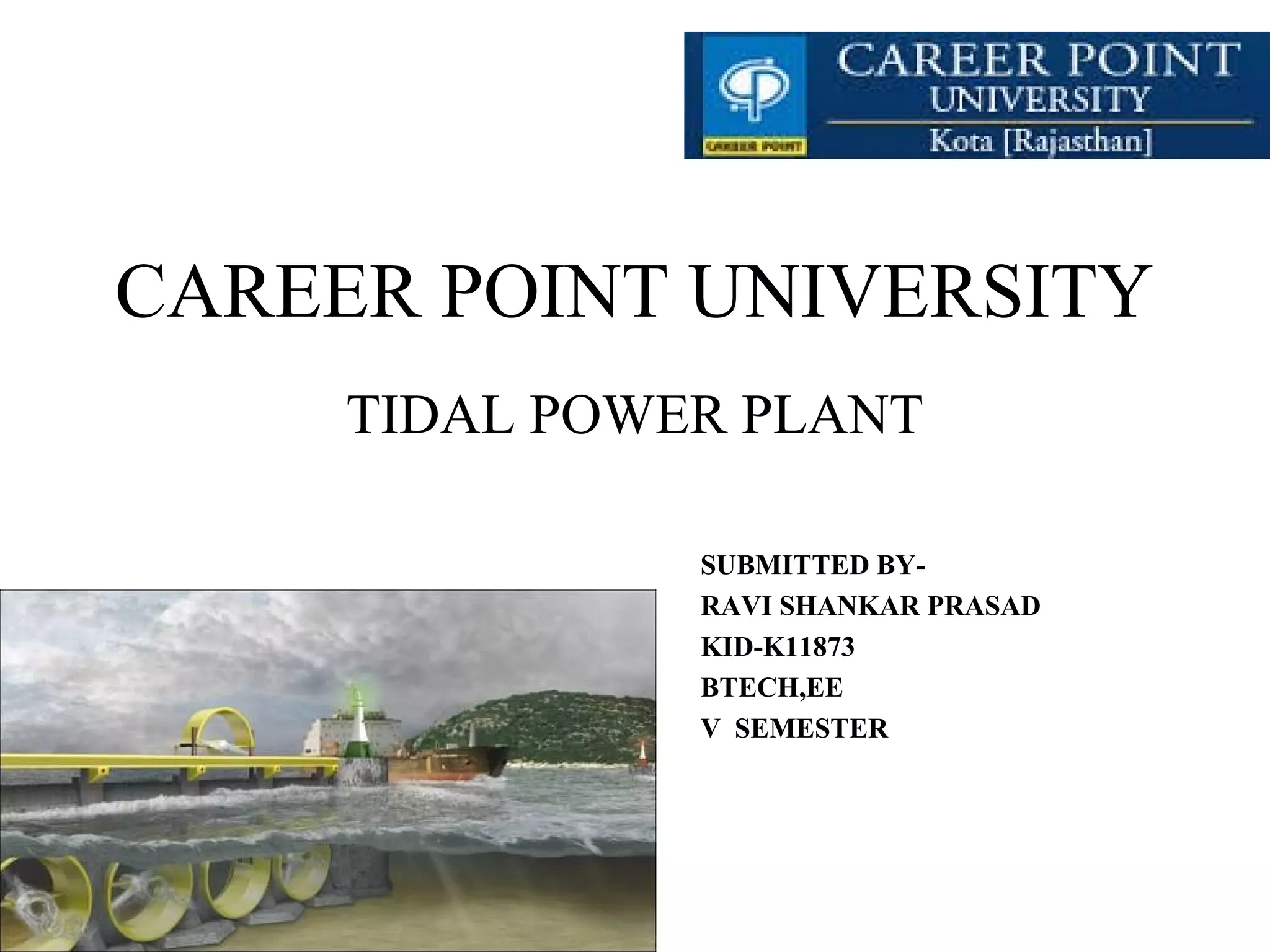
TIDAL POWER PLANT
SUBMITTED BY-
RAVI SHANKAR PRASAD
KID-K11873
BTECH,EE
V SEMESTER
Introduction
• Tide is a periodic rise and fall of the water level of sea which are carried by
the action of the sun and moon on the water of the earth.
• Here, the large scale up and down movement of sea water represents an
unlimited source of energy.
• The main feature of the tidal cycle is the difference in water surface
elevation at the high tide and at the low tide.
• If this differential head could be utilized in operating a hydraulic turbine, the
tidal energy could be converted into electrical energy by means of an attached
generator.
TIDE
• Tides are produced mainly by the gravitational attraction of the Moon and the
Sun.
• Earth is able to hold onto everything except the water.
• Since the water is always moving, the Earth cannot hold onto it, and the
moon is able to pull at it.
• About 70% of the tide producing force is due to the moon and 30% to the
sun.
• The moon is the major factor in the tide formation.
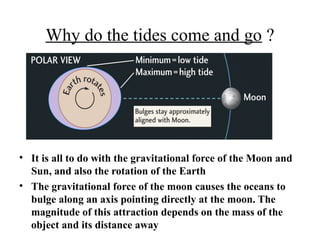
Why do the tides come and go ?
• It is all to do with the gravitational force of the Moon and
Sun, and also the rotation of the Earth
• The gravitational force of the moon causes the oceans to
bulge along an axis pointing directly at the moon. The
magnitude of this attraction depends on the mass of the
object and its distance away
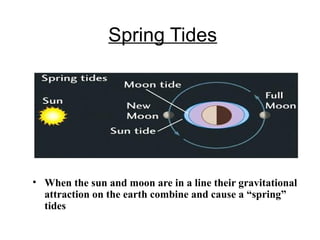
Spring Tides
• When the sun and moon are in a line their gravitational
attraction on the earth combine and cause a “spring”
tides
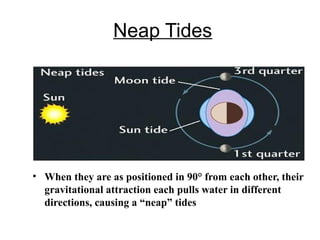
Neap Tides
• When they are as positioned in 90° from each other, their
gravitational attraction each pulls water in different
directions, causing a “neap” tides
Components of Tidal Power Plants
There are three main components of a tidal power plant i.e.
• The power house.
• The dam or barrage.
• Sluice-ways.
• The turbines, electric generators and other equipments are the main
equipments of power house.
• The function of dam is to form a barrier between the sea and the basin or
between one basin and the other in case of multiple basin.
• The sluice ways are used either to fill the basin during the high tide or
empty the basin during the low tide. These are gate controlled devices.
Classification of Tidal power systems
• Single basin arrangement
Single ebb cycle system
Single tide cycle system
Double cycle system
• Double basin arrangement
Single ebb cycle system
• When the flood tide comes in, the sluice gates are opened to permit sea-
water to enter the basin or reservoir, while the turbine sets are shut.
• The reservoir thus starts filling while its level rises, till the maximum tide
level is reached.
• At the beginning of the ebb tide the sluice gates are closed.
• Then the generation of power takes place when the sea is ebbing and the
water from the basin flow over the turbine into lower level sea water.
Single tide cycle system
• In single tide cycle systems, the generation is affected when the sea is at
flood tide.
• The water is admitted into the basin over the turbines.
• As the flood tide period is over and the sea level starts falling again, the
generation is stopped.
• The basin is drained into the sea through the sluice ways.
• Flood operation scheme need larger size plant, operating for shorter period
and hence less efficient as compared to ebb tide operation.
• The ebb operation plant will be of smaller size, but will operate over a
large period.
• The main disadvantage in both the ebb-cycle as well as the tide cycle
systems is the intermittent nature in their operation.
• A system can be geared to generate power, both during the ebb and the
flood tides with the help of single basin only.
• This system is known as the double cycle system.
Double cycle system
The power generation is affected during the ebb as well as in flood tides.
The direction of flow through the turbines during the ebb and flood tides
alternates, but the machine acts as a turbine for either direction of flow.
In this method, the generation of power is accomplished both during
emptying and filling cycles.
Both filling and emptying process take place during short periods of time,
the filling when the ocean is at high tide while the water in the basin is at
low tide level, the emptying when the ocean is at low tide and the basin at
high-tide level.
The flow of water in both directions is used to drive a number of reversible
water turbines, each driving an electrical generator.
• Though the double cycle system has only short duration interruptions in
the turbine operation, yet a continuous generation of power is still not
possible.
• These problems are solved to some extant in the two-basin scheme.
Double Basin Arrangement
• It requires two separate but adjacent basins.
• In one basin called ‘upper basin’, the water level is maintained above that
in the other, the ‘lower basin’.
• Because there is always a head between upper and lower basins, electricity
can be generated continuously.
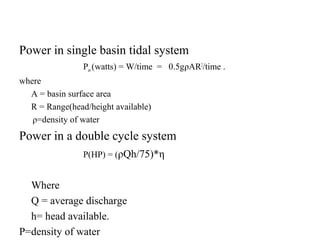
Power in single basin tidal system
Pav(watts) = W/time = 0.5gρAR2
/time .
where
A = basin surface area
R = Range(head/height available)
ρ=density of water
Power in a double cycle system
P(HP) = (ρQh/75)*η
Where
Q = average discharge
h= head available.
Ρ=density of water
Electricity Generation
Different Types of Generating
System
Bulb Turbine System
Rim Turbine System
Oscillating water column System
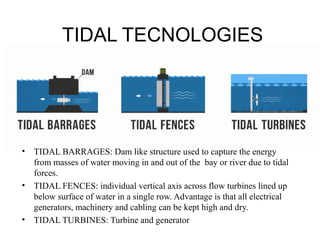
TIDAL TECNOLOGIES
• TIDAL BARRAGES: Dam like structure used to capture the energy
from masses of water moving in and out of the bay or river due to tidal
forces.
• TIDAL FENCES: individual vertical axis across flow turbines lined up
below surface of water in a single row. Advantage is that all electrical
generators, machinery and cabling can be kept high and dry.
• TIDAL TURBINES: Turbine and generator
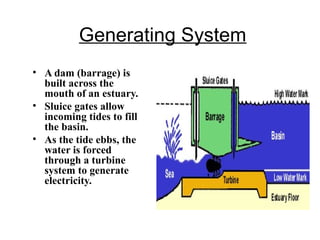
Generating System
• A dam (barrage) is
built across the
mouth of an estuary.
• Sluice gates allow
incoming tides to fill
the basin.
• As the tide ebbs, the
water is forced
through a turbine
system to generate
electricity.
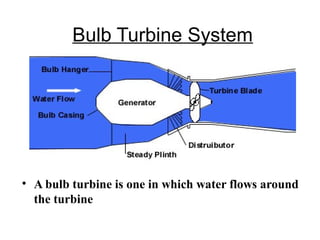
Bulb Turbine System
• A bulb turbine is one in which water flows around
the turbine
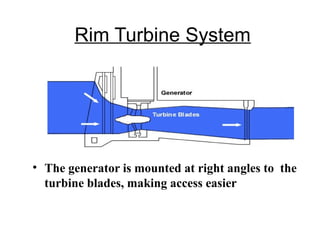
Rim Turbine System
• The generator is mounted at right angles to the
turbine blades, making access easier
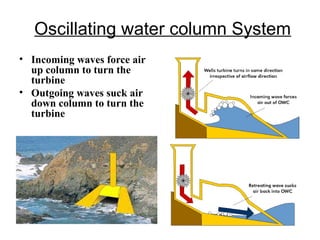
Oscillating water column System
• Incoming waves force air
up column to turn the
turbine
• Outgoing waves suck air
down column to turn the
turbine
Pumping
• The turbines in the barrage can be used to pump extra water
into the basin at periods of low demand, generally at night
when demand is low, extra water is pumped in and then power
is generated at times of high demand
Advantages
• The biggest advantage of the tidal power is inexhaustible.
• It is completely independent of the rain or continuous dry of any number
of years.
• Tidal power generation is free from pollution, as it does not use any fuel
and also does not produce any unhealthy waste like gases, ash, atomic
residue.
• These power plants do not demand large area of valuable land because
they are on the sea shore.
• Once you've built it, tidal power is free it produces no green-house gases or
other waste.
• Not expensive to maintain and provides a non-polluting and inexhaustible
supply of energy.
Limitations
• The variability in output caused by the variations in the tidal range.
• The tidal ranges is highly variable and thus the turbine have to work on a
wide range of head variations. This affects the efficiency of the plant.
• Sea water is corrosive.
• Construction in sea or near too sea is found difficult.
• Cost is not favorable compared to the other sources of energy.
Indian Scenario
• India is surrounded by sea on three sides.
• The most attractive locations are the Gulf of Cambay and the Culf of
Kachchh on the west coast where the maximum tidal range is 11 m and 8
m with average tidal range of 6.77 m and 5.23 m respectively.
• The Ganges Delta in the Sunderbans in West Bengal also has good
locations for small scale tidal power development. The maximum tidal
range in Sunderbans is approximately 5 m with an average tidal range of
2.97 m.
• The identified economic tidal power potential in India is of the order of
8000-9000 MW with about 7000 MW in the Gulf of Cambay(10.8m) about
1200 MW in the Gulf of Kachchh (7m) and less than 100 MW in
Sundarbans.(4m)
• In, 1970, the CEA had identified this tidal project in the Gulf of Kachchh in
Gujarat.
• The investigations were formally launched in 1982.
• More than twelve specialized organizations of Govt. of India and Govt. of
Gujarat were involved in the field of investigations.
• The techno-economic feasibility study has been completed in a very scientific
and systematic manner and the feasibility report completed in 1988.
• The proposed tidal power scheme was an installation of 900 MW project
biggest in the world, located in the Hansthal Creek, 25 Kms. from Kandla
Port in Dist Kachchh of Gujarat State.
• The Durgaduani Creek of Sundarbans site is selected for tidal energy
project because there the difference between the high tide and the low tide
is 4 meters and this is considered to be good for tidal energy projects.
• The 3.75 mw capacity Durgaduani Creek tidal energy project is a
technology demonstration project.
• The cost of the project is Rs 48 crore, the project is to be completed in
36months, Work on the project started in September.
REFERENCE
Books
• DP khothari and IJ Nagarath ,Modern power system
Websites
• http://fundyforce.ca/renewable-and-predictable/tidal-energy-generation/
• The indic view (alternate energy and the indian infrastructure and energy
sense) indicview.blogspot.com
THANK
YOU…

Power engineering assign

  • 1.
    CAREER POINT UNIVERSITY TIDALPOWER PLANT SUBMITTED BY- RAVI SHANKAR PRASAD KID-K11873 BTECH,EE V SEMESTER
  • 2.
    Introduction • Tide isa periodic rise and fall of the water level of sea which are carried by the action of the sun and moon on the water of the earth. • Here, the large scale up and down movement of sea water represents an unlimited source of energy. • The main feature of the tidal cycle is the difference in water surface elevation at the high tide and at the low tide. • If this differential head could be utilized in operating a hydraulic turbine, the tidal energy could be converted into electrical energy by means of an attached generator.
  • 3.
    TIDE • Tides areproduced mainly by the gravitational attraction of the Moon and the Sun. • Earth is able to hold onto everything except the water. • Since the water is always moving, the Earth cannot hold onto it, and the moon is able to pull at it. • About 70% of the tide producing force is due to the moon and 30% to the sun. • The moon is the major factor in the tide formation.
  • 4.
    Why do thetides come and go ? • It is all to do with the gravitational force of the Moon and Sun, and also the rotation of the Earth • The gravitational force of the moon causes the oceans to bulge along an axis pointing directly at the moon. The magnitude of this attraction depends on the mass of the object and its distance away
  • 5.
    Spring Tides • Whenthe sun and moon are in a line their gravitational attraction on the earth combine and cause a “spring” tides
  • 6.
    Neap Tides • Whenthey are as positioned in 90° from each other, their gravitational attraction each pulls water in different directions, causing a “neap” tides
  • 7.
    Components of TidalPower Plants There are three main components of a tidal power plant i.e. • The power house. • The dam or barrage. • Sluice-ways. • The turbines, electric generators and other equipments are the main equipments of power house. • The function of dam is to form a barrier between the sea and the basin or between one basin and the other in case of multiple basin. • The sluice ways are used either to fill the basin during the high tide or empty the basin during the low tide. These are gate controlled devices.
  • 8.
    Classification of Tidalpower systems • Single basin arrangement Single ebb cycle system Single tide cycle system Double cycle system • Double basin arrangement
  • 9.
    Single ebb cyclesystem • When the flood tide comes in, the sluice gates are opened to permit sea- water to enter the basin or reservoir, while the turbine sets are shut. • The reservoir thus starts filling while its level rises, till the maximum tide level is reached. • At the beginning of the ebb tide the sluice gates are closed. • Then the generation of power takes place when the sea is ebbing and the water from the basin flow over the turbine into lower level sea water.
  • 10.
    Single tide cyclesystem • In single tide cycle systems, the generation is affected when the sea is at flood tide. • The water is admitted into the basin over the turbines. • As the flood tide period is over and the sea level starts falling again, the generation is stopped. • The basin is drained into the sea through the sluice ways.
  • 11.
    • Flood operationscheme need larger size plant, operating for shorter period and hence less efficient as compared to ebb tide operation. • The ebb operation plant will be of smaller size, but will operate over a large period. • The main disadvantage in both the ebb-cycle as well as the tide cycle systems is the intermittent nature in their operation. • A system can be geared to generate power, both during the ebb and the flood tides with the help of single basin only. • This system is known as the double cycle system.
  • 12.
    Double cycle system Thepower generation is affected during the ebb as well as in flood tides. The direction of flow through the turbines during the ebb and flood tides alternates, but the machine acts as a turbine for either direction of flow. In this method, the generation of power is accomplished both during emptying and filling cycles. Both filling and emptying process take place during short periods of time, the filling when the ocean is at high tide while the water in the basin is at low tide level, the emptying when the ocean is at low tide and the basin at high-tide level. The flow of water in both directions is used to drive a number of reversible water turbines, each driving an electrical generator.
  • 13.
    • Though thedouble cycle system has only short duration interruptions in the turbine operation, yet a continuous generation of power is still not possible. • These problems are solved to some extant in the two-basin scheme. Double Basin Arrangement • It requires two separate but adjacent basins. • In one basin called ‘upper basin’, the water level is maintained above that in the other, the ‘lower basin’. • Because there is always a head between upper and lower basins, electricity can be generated continuously.
  • 14.
    Power in singlebasin tidal system Pav(watts) = W/time = 0.5gρAR2 /time . where A = basin surface area R = Range(head/height available) ρ=density of water Power in a double cycle system P(HP) = (ρQh/75)*η Where Q = average discharge h= head available. Ρ=density of water
  • 15.
  • 16.
    Different Types ofGenerating System Bulb Turbine System Rim Turbine System Oscillating water column System
  • 17.
    TIDAL TECNOLOGIES • TIDALBARRAGES: Dam like structure used to capture the energy from masses of water moving in and out of the bay or river due to tidal forces. • TIDAL FENCES: individual vertical axis across flow turbines lined up below surface of water in a single row. Advantage is that all electrical generators, machinery and cabling can be kept high and dry. • TIDAL TURBINES: Turbine and generator
  • 18.
    Generating System • Adam (barrage) is built across the mouth of an estuary. • Sluice gates allow incoming tides to fill the basin. • As the tide ebbs, the water is forced through a turbine system to generate electricity.
  • 19.
    Bulb Turbine System •A bulb turbine is one in which water flows around the turbine
  • 20.
    Rim Turbine System •The generator is mounted at right angles to the turbine blades, making access easier
  • 21.
    Oscillating water columnSystem • Incoming waves force air up column to turn the turbine • Outgoing waves suck air down column to turn the turbine
  • 22.
    Pumping • The turbinesin the barrage can be used to pump extra water into the basin at periods of low demand, generally at night when demand is low, extra water is pumped in and then power is generated at times of high demand
  • 23.
    Advantages • The biggestadvantage of the tidal power is inexhaustible. • It is completely independent of the rain or continuous dry of any number of years. • Tidal power generation is free from pollution, as it does not use any fuel and also does not produce any unhealthy waste like gases, ash, atomic residue. • These power plants do not demand large area of valuable land because they are on the sea shore. • Once you've built it, tidal power is free it produces no green-house gases or other waste. • Not expensive to maintain and provides a non-polluting and inexhaustible supply of energy.
  • 24.
    Limitations • The variabilityin output caused by the variations in the tidal range. • The tidal ranges is highly variable and thus the turbine have to work on a wide range of head variations. This affects the efficiency of the plant. • Sea water is corrosive. • Construction in sea or near too sea is found difficult. • Cost is not favorable compared to the other sources of energy.
  • 25.
    Indian Scenario • Indiais surrounded by sea on three sides. • The most attractive locations are the Gulf of Cambay and the Culf of Kachchh on the west coast where the maximum tidal range is 11 m and 8 m with average tidal range of 6.77 m and 5.23 m respectively. • The Ganges Delta in the Sunderbans in West Bengal also has good locations for small scale tidal power development. The maximum tidal range in Sunderbans is approximately 5 m with an average tidal range of 2.97 m. • The identified economic tidal power potential in India is of the order of 8000-9000 MW with about 7000 MW in the Gulf of Cambay(10.8m) about 1200 MW in the Gulf of Kachchh (7m) and less than 100 MW in Sundarbans.(4m)
  • 26.
    • In, 1970,the CEA had identified this tidal project in the Gulf of Kachchh in Gujarat. • The investigations were formally launched in 1982. • More than twelve specialized organizations of Govt. of India and Govt. of Gujarat were involved in the field of investigations. • The techno-economic feasibility study has been completed in a very scientific and systematic manner and the feasibility report completed in 1988. • The proposed tidal power scheme was an installation of 900 MW project biggest in the world, located in the Hansthal Creek, 25 Kms. from Kandla Port in Dist Kachchh of Gujarat State.
  • 27.
    • The DurgaduaniCreek of Sundarbans site is selected for tidal energy project because there the difference between the high tide and the low tide is 4 meters and this is considered to be good for tidal energy projects. • The 3.75 mw capacity Durgaduani Creek tidal energy project is a technology demonstration project. • The cost of the project is Rs 48 crore, the project is to be completed in 36months, Work on the project started in September.
  • 28.
    REFERENCE Books • DP khothariand IJ Nagarath ,Modern power system Websites • http://fundyforce.ca/renewable-and-predictable/tidal-energy-generation/ • The indic view (alternate energy and the indian infrastructure and energy sense) indicview.blogspot.com
  • 29.