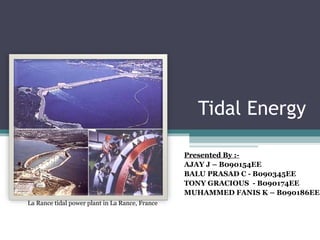
Tidal Energy Presented By :- AJAY J – B090154EE BALU PRASAD C - B090345EE TONY GRACIOUS  - B090174EE MUHAMMED FANIS K – B090186EE  La Rance tidal power plant in La Rance, France
INDEX Introduction Tides History Types of tidal power plants Major kinds of generators used Pros and Cons Facts
Tidal power, also called tidal energy, is a form of hydropower that converts the energy of tides into useful forms of power - mainly electricity.   This is the only form of energy whose source is the moon.
Basic physics of tides There are two high tides and two low tides during each period of rotation of the earth. Spring and Neap tides  depend on the orientation of the sun, moon, and the earth. High spring tides  occur when the sun and moon line up with the earth. This occurs whether they are either on same or opposite side. Low neap tides  occur when the sun and moon line up at 90  ͦ  to each other. Flood Currents : currents moving in the direction of the coast. Ebb Currents : the current receding from the coast Gravitational pull of the sun and moon and the pull of the centrifugal force of rotation of the earth-moon system.  When a landmass lines up with the earth-moon system, the water around it is at  high tide .  When a landmass is at 90   ͦ  to the earth-moon system, the water around it is at  low tide .
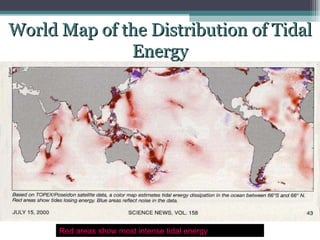
World Map of the Distribution of Tidal Energy Red areas show most intense tidal energy
Developing Nations that could receive significant benefits from Tidal   Energy ________________________________________ Indian Ocean:  Comoros, Madagascar, Maldives, Seychelles.  Asia:  China, India, Indonesia, Korea, Philippines, Vietnam. Pacific Ocean:  Fiji, Kiribati, Micronesia, Palau, Papua New    Guinea, Samoa, Solomon Islands, Timor, Tuvalu, Vanuatu.  Central and South America:  Argentina, Brazil, Ecuador,    Guyana, Panama, Surinam. Atlantic Ocean:  Cape Verde. All coastal nations  with tidal passes between coral reefs    or offshore islands.
History The first tidal power station was the Rance tidal power plant built over a period of 6 years from 1960 to 1966 at La Rance, France. It has 240 MW installed capacity. also the world's second biggest tidal power station.
With a peak rating of 240 Megawatts, generated by its 24 turbines, it supplies 0.012% of the power demand of France. With a capacity factor of approximately 40%, it supplies an average 96 Megawatts, giving an annual output of approximately 600GWh. The barrage is 750 m (2,461 ft) long, from Brebis point in the west to Briantais point in the east. The power plant portion of the dam is 332.5 m (1,091 ft) long. The tidal basin measures 22.5 km 2  (9 sq mi).
Two types of tidal plant facilities. Tidal barrages Tidal current turbines Dynamic tidal power plants
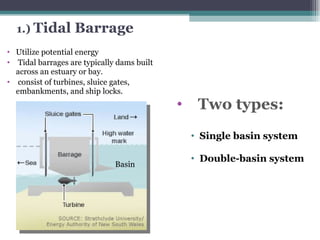
1.)  Tidal Barrage Two types: Single basin system Double-basin system Utilize potential energy Tidal barrages are typically dams built across an estuary or bay.  consist of turbines, sluice gates, embankments, and ship locks. Basin
 
Single basin system- Ebb generation : During flood tide basin is filled and sluice gates are closed , trapping water. Gates are kept closed until the tide has ebbed sufficiently and thus turbines start spinning and generating electricity. Flood generation:  The basin is filled through the turbine which generate at flood tide. Two way generation:   Sluice gates and turbines are closed until near the end of the flood tide when water is allowed to flow through the turbines into the basin creating electricity. At the point where the hydrostatic head is insufficient for power generation the sluice gates are opened and kept open until high tide when they are closed. When the tide outside the barrage has dropped sufficiently water is allowed to flow out of the basin through the turbines again creating electricity.
Double-basin system There are two basins, but it operates similar to en ebb generation, single-basin system. The only difference is  a proportion of the electricity is used to pump water into the second basin allowing storage.
Current sites of tidal barrages La Rance , Brittany, France The first and 2 nd   largest tidal barrage power plant Constructed between 1961 and 1967.  Situated on the Rance River. Contains 24 reversible 10 MW bulb turbines generating a capacity of 240 MW and a net power output of 480 GWh per year. Two- way generation system and pumped storage.
Annapolis Tidal Generation Facility   on the  Bay of Fundy , Canada Constructed between 1981 and 1984. Generating capacity of 20 MW and a net output of 30 GW h per year. Further development is being considered in the Bay of Fundy.
2.)Tidal current turbines Make use of the kinetic energy of moving water to power turbines, in a similar way to wind turbines that use wind to power turbines. Operate during flood and ebb tides. Consists of a rotor, gearbox, and a generator. These three parts are mounted onto a support structure. There are three main types: Gravity structure Piled structure Floating structure
Gravity Structures  are massive steel or concrete structures attached to the base of the units to achieve stability by their own inertia. Piled Structures  are pinned to the seabed by one or more steel or concrete piles. The piles are fixed to the seabed by hammering if the ground conditions are sufficiently soft or by pre-drilling, positioning and grouting if the rock is harder. Floating Structures  provide a potentially more convincing solution for deep water locations.
 
 
3)DYNAMIC TIDAL POWER PLANT Dynamic tidal power  or  DTP  is a new and untested method of tidal power generation. It would involve creating large dam-like structure extending from the coast straight to the ocean, with a perpendicular barrier at the far end, forming a large 'T' shape. A single dam can accommodate over 8 GW (8000 MW) of installed capacity.
A DTP dam is a long dam of 30 to 60 km which is built perpendicular to the coast, running straight out into the ocean, without enclosing an area. Other concerns include: shipping routes, marine ecology, sediments, and storm surges.
Prof. Alexander Gorlov  of Northeastern University  with the helical turbine.  He invented and perfected it. Tidal Energy can be captured efficiently and  inexpensively  using the helical  turbine
Features of the Helical Turbine: Basic Concept designed for hydroelectric applications    in free-flowing water  operates in ocean, tidal, and river    currents  does not require expensive dams    that can harm the environment
Features of the Helical Turbine   Operation self-starting with flow as low as 0.6 m/s  smooth-running rotates in same direction  regardless    of the direction of flow, making it ideal    for tidal applications
Types of tidal stream generators Since tidal stream generators are an immature technology, no standard technology has yet emerged as the clear winner.   but a large variety of designs are being experimented with, some very close to large scale deployment.
Major 2 Types of tidal stream generators Axial turbines Vertical and horizontal axis cross flow turbines
Axial turbines These are close in concept to traditional windmills operating under the sea.
Vertical and horizontal axis cross flow turbines   These turbines that can be deployed either vertically or horizontally.
Significant benefits  from using Tidal Energy include : Electrification of isolated communities Generation for the grid Regrowth of coral reefs using    mineral accretion technology  Substitution of imported petroleum    used to generate electricity
Multiple Benefits from Tidal Energy. Practical Examples : Electrification of isolated    communities. Regrowth of  coral reefs using   mineral accretion technology.
Pros  and  cons of both tidal power facilities
Tidal Barrages Mature technology that has been around for nearly 50 years. Reliable energy source. BUT High costs of construction Environmental impacts on marine life Low power output in comparison to other energy source like coal and nuclear power plants .
Tidal Current Turbines Able to utilize both  ebb and flood tides. Tidal current turbines are not large massive dam structure. BUT Tidal current turbine technology is young in its development. Installation and maintenance challenges. Environmental impacts are still being tested
ENVIRONMENTAL FRIENDLINESS Tidal energy use involving dams creates many of the same environmental concerns as damming rivers. Tidal dams restrict fish migration and cause silt build up which affects tidal basin ecosystems in negative ways. Systems that take advantage of natural narrow channels with high tidal flow rates have less negative environmental impact than dammed systems. But they are not without environmental problems.
Both systems use turbines that can cause fish kills. But these are being replaced by new, more fish friendly turbines. The art and science of environmentally friendly hydro engineering is well advanced and will certainly be applied to any tidal energy project. But even with dams, the environmental impact of tidal energy projects may prove to be smaller than our use of any other energy resource. Economics will severely limit the number of tidal energy projects. 
Major Tidal plants in World
Tidal plants in India West Bengal Renewable Energy Development Agency  in sunderbans. The Indian state of Gujarat is planning to host South Asia's first commercial-scale tidal power station. The company Atlantis Resources is to install a 50MW tidal farm in the Gulf of Kutch on India's west coast, with construction starting early in 2012. later on it is decided to increase the capacity up to 250MW plants.
Tidal plants in Kerala   Situated near the breakwaters of Vizhinjam Port which is about 20 km from Thiruvananthapuram city. The station started its commercial operation in 1991. This oscillating water column (OWC) produces about 150 kw of power.
Economics Tidal energy is not cost competitive because it is generally not commercially available. When selecting a spot to set up a tidal energy station it is important to make sure that it will be economically feasible. To set up a tidal facility with an average annual output of 1050 MW would cost about 1.2 billion dollars, not including maintenance and running costs. This is far more expensive than coal and oil.
FUTURE? In a society with increasing energy needs, it is becoming more and more important to have alternative sources of power to keep up with the ever growing energy demand. The capacity of tidal energy exceeds that of coal and oil and is renewable. The Department of Energy has shown great enthusiasm in regards to tidal power as the perfect energy source for the future.
References Tidal energy update 2009  Applied Energy , Volume 87, Issue 2 , February 2010, Pages 398-409  Fergal O Rourke, Fergal Boyle, Anthony Reynolds http://www.emec.org.uk/ Wikipedia www.answers.com energybusinessdaily.com

Tidal power plants

  • 1.
    Tidal Energy PresentedBy :- AJAY J – B090154EE BALU PRASAD C - B090345EE TONY GRACIOUS - B090174EE MUHAMMED FANIS K – B090186EE La Rance tidal power plant in La Rance, France
  • 2.
    INDEX Introduction TidesHistory Types of tidal power plants Major kinds of generators used Pros and Cons Facts
  • 3.
    Tidal power, alsocalled tidal energy, is a form of hydropower that converts the energy of tides into useful forms of power - mainly electricity. This is the only form of energy whose source is the moon.
  • 4.
    Basic physics oftides There are two high tides and two low tides during each period of rotation of the earth. Spring and Neap tides depend on the orientation of the sun, moon, and the earth. High spring tides occur when the sun and moon line up with the earth. This occurs whether they are either on same or opposite side. Low neap tides occur when the sun and moon line up at 90 ͦ to each other. Flood Currents : currents moving in the direction of the coast. Ebb Currents : the current receding from the coast Gravitational pull of the sun and moon and the pull of the centrifugal force of rotation of the earth-moon system. When a landmass lines up with the earth-moon system, the water around it is at high tide . When a landmass is at 90 ͦ to the earth-moon system, the water around it is at low tide .
  • 5.
    World Map ofthe Distribution of Tidal Energy Red areas show most intense tidal energy
  • 6.
    Developing Nations thatcould receive significant benefits from Tidal Energy ________________________________________ Indian Ocean: Comoros, Madagascar, Maldives, Seychelles. Asia: China, India, Indonesia, Korea, Philippines, Vietnam. Pacific Ocean: Fiji, Kiribati, Micronesia, Palau, Papua New Guinea, Samoa, Solomon Islands, Timor, Tuvalu, Vanuatu. Central and South America: Argentina, Brazil, Ecuador, Guyana, Panama, Surinam. Atlantic Ocean: Cape Verde. All coastal nations with tidal passes between coral reefs or offshore islands.
  • 7.
    History The firsttidal power station was the Rance tidal power plant built over a period of 6 years from 1960 to 1966 at La Rance, France. It has 240 MW installed capacity. also the world's second biggest tidal power station.
  • 8.
    With a peakrating of 240 Megawatts, generated by its 24 turbines, it supplies 0.012% of the power demand of France. With a capacity factor of approximately 40%, it supplies an average 96 Megawatts, giving an annual output of approximately 600GWh. The barrage is 750 m (2,461 ft) long, from Brebis point in the west to Briantais point in the east. The power plant portion of the dam is 332.5 m (1,091 ft) long. The tidal basin measures 22.5 km 2  (9 sq mi).
  • 9.
    Two types oftidal plant facilities. Tidal barrages Tidal current turbines Dynamic tidal power plants
  • 10.
    1.) TidalBarrage Two types: Single basin system Double-basin system Utilize potential energy Tidal barrages are typically dams built across an estuary or bay. consist of turbines, sluice gates, embankments, and ship locks. Basin
  • 11.
  • 12.
    Single basin system-Ebb generation : During flood tide basin is filled and sluice gates are closed , trapping water. Gates are kept closed until the tide has ebbed sufficiently and thus turbines start spinning and generating electricity. Flood generation: The basin is filled through the turbine which generate at flood tide. Two way generation: Sluice gates and turbines are closed until near the end of the flood tide when water is allowed to flow through the turbines into the basin creating electricity. At the point where the hydrostatic head is insufficient for power generation the sluice gates are opened and kept open until high tide when they are closed. When the tide outside the barrage has dropped sufficiently water is allowed to flow out of the basin through the turbines again creating electricity.
  • 13.
    Double-basin system Thereare two basins, but it operates similar to en ebb generation, single-basin system. The only difference is a proportion of the electricity is used to pump water into the second basin allowing storage.
  • 14.
    Current sites oftidal barrages La Rance , Brittany, France The first and 2 nd largest tidal barrage power plant Constructed between 1961 and 1967. Situated on the Rance River. Contains 24 reversible 10 MW bulb turbines generating a capacity of 240 MW and a net power output of 480 GWh per year. Two- way generation system and pumped storage.
  • 15.
    Annapolis Tidal GenerationFacility on the Bay of Fundy , Canada Constructed between 1981 and 1984. Generating capacity of 20 MW and a net output of 30 GW h per year. Further development is being considered in the Bay of Fundy.
  • 16.
    2.)Tidal current turbinesMake use of the kinetic energy of moving water to power turbines, in a similar way to wind turbines that use wind to power turbines. Operate during flood and ebb tides. Consists of a rotor, gearbox, and a generator. These three parts are mounted onto a support structure. There are three main types: Gravity structure Piled structure Floating structure
  • 17.
    Gravity Structures are massive steel or concrete structures attached to the base of the units to achieve stability by their own inertia. Piled Structures are pinned to the seabed by one or more steel or concrete piles. The piles are fixed to the seabed by hammering if the ground conditions are sufficiently soft or by pre-drilling, positioning and grouting if the rock is harder. Floating Structures provide a potentially more convincing solution for deep water locations.
  • 18.
  • 19.
  • 20.
    3)DYNAMIC TIDAL POWERPLANT Dynamic tidal power or DTP is a new and untested method of tidal power generation. It would involve creating large dam-like structure extending from the coast straight to the ocean, with a perpendicular barrier at the far end, forming a large 'T' shape. A single dam can accommodate over 8 GW (8000 MW) of installed capacity.
  • 21.
    A DTP damis a long dam of 30 to 60 km which is built perpendicular to the coast, running straight out into the ocean, without enclosing an area. Other concerns include: shipping routes, marine ecology, sediments, and storm surges.
  • 22.
    Prof. Alexander Gorlov of Northeastern University with the helical turbine. He invented and perfected it. Tidal Energy can be captured efficiently and inexpensively using the helical turbine
  • 23.
    Features of theHelical Turbine: Basic Concept designed for hydroelectric applications in free-flowing water operates in ocean, tidal, and river currents does not require expensive dams that can harm the environment
  • 24.
    Features of theHelical Turbine Operation self-starting with flow as low as 0.6 m/s smooth-running rotates in same direction regardless of the direction of flow, making it ideal for tidal applications
  • 25.
    Types of tidalstream generators Since tidal stream generators are an immature technology, no standard technology has yet emerged as the clear winner.   but a large variety of designs are being experimented with, some very close to large scale deployment.
  • 26.
    Major 2 Typesof tidal stream generators Axial turbines Vertical and horizontal axis cross flow turbines
  • 27.
    Axial turbines Theseare close in concept to traditional windmills operating under the sea.
  • 28.
    Vertical and horizontalaxis cross flow turbines   These turbines that can be deployed either vertically or horizontally.
  • 29.
    Significant benefits from using Tidal Energy include : Electrification of isolated communities Generation for the grid Regrowth of coral reefs using mineral accretion technology Substitution of imported petroleum used to generate electricity
  • 30.
    Multiple Benefits fromTidal Energy. Practical Examples : Electrification of isolated communities. Regrowth of coral reefs using mineral accretion technology.
  • 31.
    Pros and cons of both tidal power facilities
  • 32.
    Tidal Barrages Maturetechnology that has been around for nearly 50 years. Reliable energy source. BUT High costs of construction Environmental impacts on marine life Low power output in comparison to other energy source like coal and nuclear power plants .
  • 33.
    Tidal Current TurbinesAble to utilize both ebb and flood tides. Tidal current turbines are not large massive dam structure. BUT Tidal current turbine technology is young in its development. Installation and maintenance challenges. Environmental impacts are still being tested
  • 34.
    ENVIRONMENTAL FRIENDLINESS Tidalenergy use involving dams creates many of the same environmental concerns as damming rivers. Tidal dams restrict fish migration and cause silt build up which affects tidal basin ecosystems in negative ways. Systems that take advantage of natural narrow channels with high tidal flow rates have less negative environmental impact than dammed systems. But they are not without environmental problems.
  • 35.
    Both systems useturbines that can cause fish kills. But these are being replaced by new, more fish friendly turbines. The art and science of environmentally friendly hydro engineering is well advanced and will certainly be applied to any tidal energy project. But even with dams, the environmental impact of tidal energy projects may prove to be smaller than our use of any other energy resource. Economics will severely limit the number of tidal energy projects. 
  • 36.
  • 37.
    Tidal plants inIndia West Bengal Renewable Energy Development Agency in sunderbans. The Indian state of Gujarat is planning to host South Asia's first commercial-scale tidal power station. The company Atlantis Resources is to install a 50MW tidal farm in the Gulf of Kutch on India's west coast, with construction starting early in 2012. later on it is decided to increase the capacity up to 250MW plants.
  • 38.
    Tidal plants inKerala   Situated near the breakwaters of Vizhinjam Port which is about 20 km from Thiruvananthapuram city. The station started its commercial operation in 1991. This oscillating water column (OWC) produces about 150 kw of power.
  • 39.
    Economics Tidal energyis not cost competitive because it is generally not commercially available. When selecting a spot to set up a tidal energy station it is important to make sure that it will be economically feasible. To set up a tidal facility with an average annual output of 1050 MW would cost about 1.2 billion dollars, not including maintenance and running costs. This is far more expensive than coal and oil.
  • 40.
    FUTURE? In asociety with increasing energy needs, it is becoming more and more important to have alternative sources of power to keep up with the ever growing energy demand. The capacity of tidal energy exceeds that of coal and oil and is renewable. The Department of Energy has shown great enthusiasm in regards to tidal power as the perfect energy source for the future.
  • 41.
    References Tidal energyupdate 2009 Applied Energy , Volume 87, Issue 2 , February 2010, Pages 398-409 Fergal O Rourke, Fergal Boyle, Anthony Reynolds http://www.emec.org.uk/ Wikipedia www.answers.com energybusinessdaily.com