GRID INTERFACED TIDAL POWER
           PLANTS
                 By
        Trisha Gopalakrishna
          Zoish Hormusjee
          Shashank Pathak
Introduction


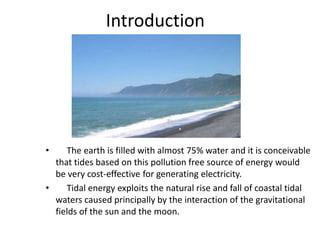
•    The earth is filled with almost 75% water and it is conceivable
  that tides based on this pollution free source of energy would
  be very cost-effective for generating electricity.
•    Tidal energy exploits the natural rise and fall of coastal tidal
  waters caused principally by the interaction of the gravitational
  fields of the sun and the moon.
History
• Tidal mills were in use on the coasts of Spain, France, UK and
  China during the medieval period, around 1100 AD.
• They remained in common use for many centuries, but were
  gradually replaced by more convenient and cheaper sources
  made available due to the industrial revolution.
• The principle used for harnessing this energy consisted of a
  pond filled through sluice (rapid controlled gates) when tides
  are high and emptying it during low tides via an undershot
  waterwheel, producing mechanical power.
Advantages
• The energy produced is clean and non polluting.
• There is no carbon dioxide or any other by-products
  released. It produces no greenhouse gases or other.
• There are two tides every day and they can be relied on.. So
  the electricity supply is constant and efficient.
• Tides are definitely predictable.
• A plant is expected to be in production for 75 to 100 years.
• Uses an abundant, inexpensive fuel source (water) to
  generate power
• May protect coastline against damage from high storm
  tides and provide a ready-made road bridge
Disadvantages
• Economic recovery of energy from tides is feasible only at
  those sites where energy is concentrated in the form of
  tidal range of about 5m or more and the geography
  provides a favorable site for economic construction of a
  tidal plant. Thus, it is site specific.
• Changing tidal range in two week periods produces
  changing power.
• The turbines are required to operate at variable head.
• Requirement of large water volume flow at low head
  necessitates parallel operation of many turbines.
• Tidal power plants disrupt marine life at the location and
  can cause potential harm to ecology.
Formation of tides
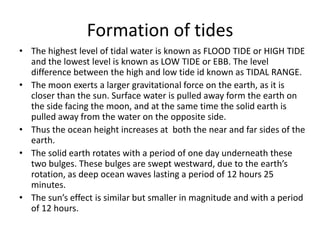
• The highest level of tidal water is known as FLOOD TIDE or HIGH TIDE
  and the lowest level is known as LOW TIDE or EBB. The level
  difference between the high and low tide id known as TIDAL RANGE.
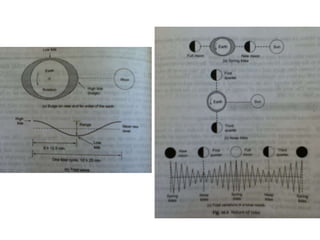
• The moon exerts a larger gravitational force on the earth, as it is
  closer than the sun. Surface water is pulled away form the earth on
  the side facing the moon, and at the same time the solid earth is
  pulled away from the water on the opposite side.
• Thus the ocean height increases at both the near and far sides of the
  earth.
• The solid earth rotates with a period of one day underneath these
  two bulges. These bulges are swept westward, due to the earth’s
  rotation, as deep ocean waves lasting a period of 12 hours 25
  minutes.
• The sun’s effect is similar but smaller in magnitude and with a period
  of 12 hours.
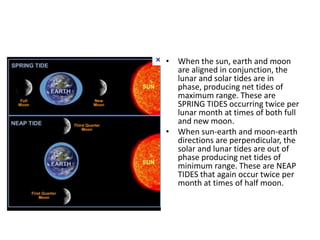
• When the sun, earth and moon
  are aligned in conjunction, the
  lunar and solar tides are in
  phase, producing net tides of
  maximum range. These are
  SPRING TIDES occurring twice per
  lunar month at times of both full
  and new moon.
• When sun-earth and moon-earth
  directions are perpendicular, the
  solar and lunar tides are out of
  phase producing net tides of
  minimum range. These are NEAP
  TIDES that again occur twice per
  month at times of half moon.
• The generation of electricity from tidal power can be achieved
  using
  (i) tidal barrages
  (ii) tidal impoundments or lagoons
  (iii) tidal stream turbines
• Usually tidal barrage type of plants are set up and hence
  discussed further.
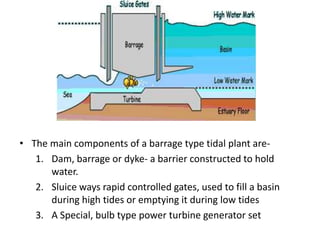
• The main components of a barrage type tidal plant are-
   1. Dam, barrage or dyke- a barrier constructed to hold
      water.
   2. Sluice ways rapid controlled gates, used to fill a basin
      during high tides or emptying it during low tides
   3. A Special, bulb type power turbine generator set
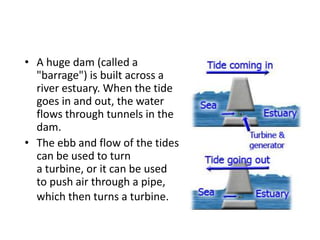
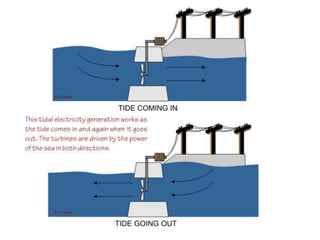
• A huge dam (called a
  "barrage") is built across a
  river estuary. When the tide
  goes in and out, the water
  flows through tunnels in the
  dam.
• The ebb and flow of the tides
  can be used to turn
  a turbine, or it can be used
  to push air through a pipe,
  which then turns a turbine.
Grid Interfacing
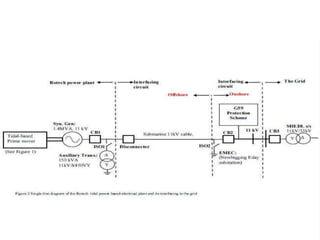
The energy harnessed in the form of
mechanical energy , it is converted to
electrical energy with the help of auxiliary
equipment such as submarine cables, a
protection system designed accordingly and
the electrical networks including various
connections and earthing.
Videos
THANK YOU

Grid interfaced tidal power plants

  • 1.
    GRID INTERFACED TIDALPOWER PLANTS By Trisha Gopalakrishna Zoish Hormusjee Shashank Pathak
  • 2.
    Introduction • The earth is filled with almost 75% water and it is conceivable that tides based on this pollution free source of energy would be very cost-effective for generating electricity. • Tidal energy exploits the natural rise and fall of coastal tidal waters caused principally by the interaction of the gravitational fields of the sun and the moon.
  • 3.
    History • Tidal millswere in use on the coasts of Spain, France, UK and China during the medieval period, around 1100 AD. • They remained in common use for many centuries, but were gradually replaced by more convenient and cheaper sources made available due to the industrial revolution. • The principle used for harnessing this energy consisted of a pond filled through sluice (rapid controlled gates) when tides are high and emptying it during low tides via an undershot waterwheel, producing mechanical power.
  • 4.
    Advantages • The energyproduced is clean and non polluting. • There is no carbon dioxide or any other by-products released. It produces no greenhouse gases or other. • There are two tides every day and they can be relied on.. So the electricity supply is constant and efficient. • Tides are definitely predictable. • A plant is expected to be in production for 75 to 100 years. • Uses an abundant, inexpensive fuel source (water) to generate power • May protect coastline against damage from high storm tides and provide a ready-made road bridge
  • 5.
    Disadvantages • Economic recoveryof energy from tides is feasible only at those sites where energy is concentrated in the form of tidal range of about 5m or more and the geography provides a favorable site for economic construction of a tidal plant. Thus, it is site specific. • Changing tidal range in two week periods produces changing power. • The turbines are required to operate at variable head. • Requirement of large water volume flow at low head necessitates parallel operation of many turbines. • Tidal power plants disrupt marine life at the location and can cause potential harm to ecology.
  • 6.
    Formation of tides •The highest level of tidal water is known as FLOOD TIDE or HIGH TIDE and the lowest level is known as LOW TIDE or EBB. The level difference between the high and low tide id known as TIDAL RANGE. • The moon exerts a larger gravitational force on the earth, as it is closer than the sun. Surface water is pulled away form the earth on the side facing the moon, and at the same time the solid earth is pulled away from the water on the opposite side. • Thus the ocean height increases at both the near and far sides of the earth. • The solid earth rotates with a period of one day underneath these two bulges. These bulges are swept westward, due to the earth’s rotation, as deep ocean waves lasting a period of 12 hours 25 minutes. • The sun’s effect is similar but smaller in magnitude and with a period of 12 hours.
  • 8.
    • When thesun, earth and moon are aligned in conjunction, the lunar and solar tides are in phase, producing net tides of maximum range. These are SPRING TIDES occurring twice per lunar month at times of both full and new moon. • When sun-earth and moon-earth directions are perpendicular, the solar and lunar tides are out of phase producing net tides of minimum range. These are NEAP TIDES that again occur twice per month at times of half moon.
  • 9.
    • The generationof electricity from tidal power can be achieved using (i) tidal barrages (ii) tidal impoundments or lagoons (iii) tidal stream turbines • Usually tidal barrage type of plants are set up and hence discussed further.
  • 10.
    • The maincomponents of a barrage type tidal plant are- 1. Dam, barrage or dyke- a barrier constructed to hold water. 2. Sluice ways rapid controlled gates, used to fill a basin during high tides or emptying it during low tides 3. A Special, bulb type power turbine generator set
  • 11.
    • A hugedam (called a "barrage") is built across a river estuary. When the tide goes in and out, the water flows through tunnels in the dam. • The ebb and flow of the tides can be used to turn a turbine, or it can be used to push air through a pipe, which then turns a turbine.
  • 12.
    Grid Interfacing The energyharnessed in the form of mechanical energy , it is converted to electrical energy with the help of auxiliary equipment such as submarine cables, a protection system designed accordingly and the electrical networks including various connections and earthing.
  • 14.
  • 16.