Tidal Energy
Presented By :-
ROHIL KUMAR
17M713La Rance tidal power plant in La Rance, France
Abstract
• Tidal energy has the potential to play a valuable part in a
sustainable energy future, extremely predictable energy
source, depending only on the gravitational pull of the moon
and the sun and the centrifugal forces created by the rotation
of the earth–moon system.
• Tidal energy has been exploited on a significant scale since
the construction of the La Rance tidal barrage in France in
1967. A tidal barrage utilises the potential energy of the tide
and has proven to be very successful.
• Kinetic energy can also be harnessed from tidal currents to
generate electricity and involves the use of a tidal current
turbine but still it is in an early stage of development.
INDEX
• Introduction
• History
• Tides
• Types of tidal power plants
• Tidal turbines
• Helical turbine
• Major tidal plants in World and India
- current
- under construction
- future schemes
• Pros and cons
• References
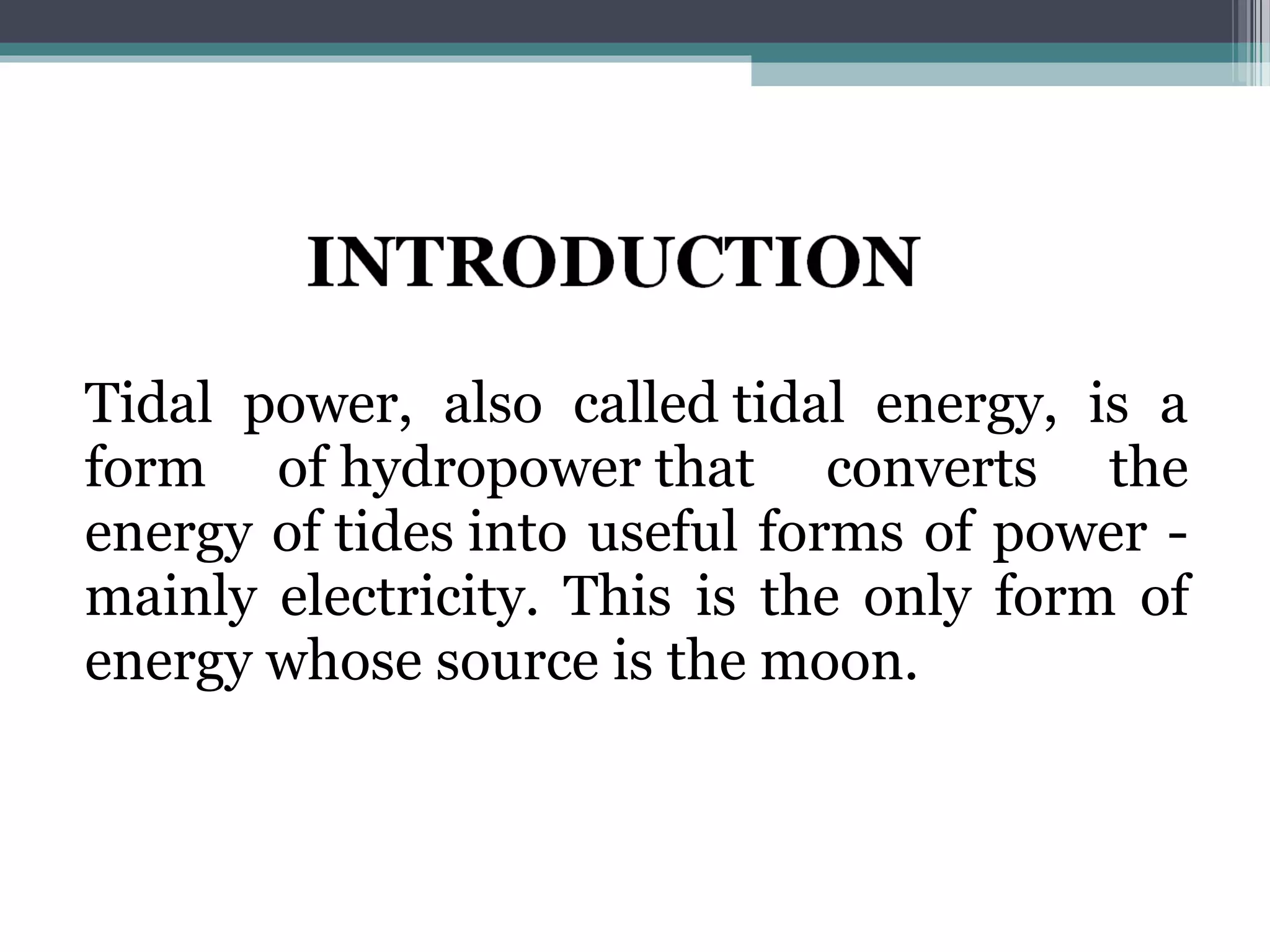
Tidal power, also called tidal energy, is a
form of hydropower that converts the
energy of tides into useful forms of power -
mainly electricity. This is the only form of
energy whose source is the moon.
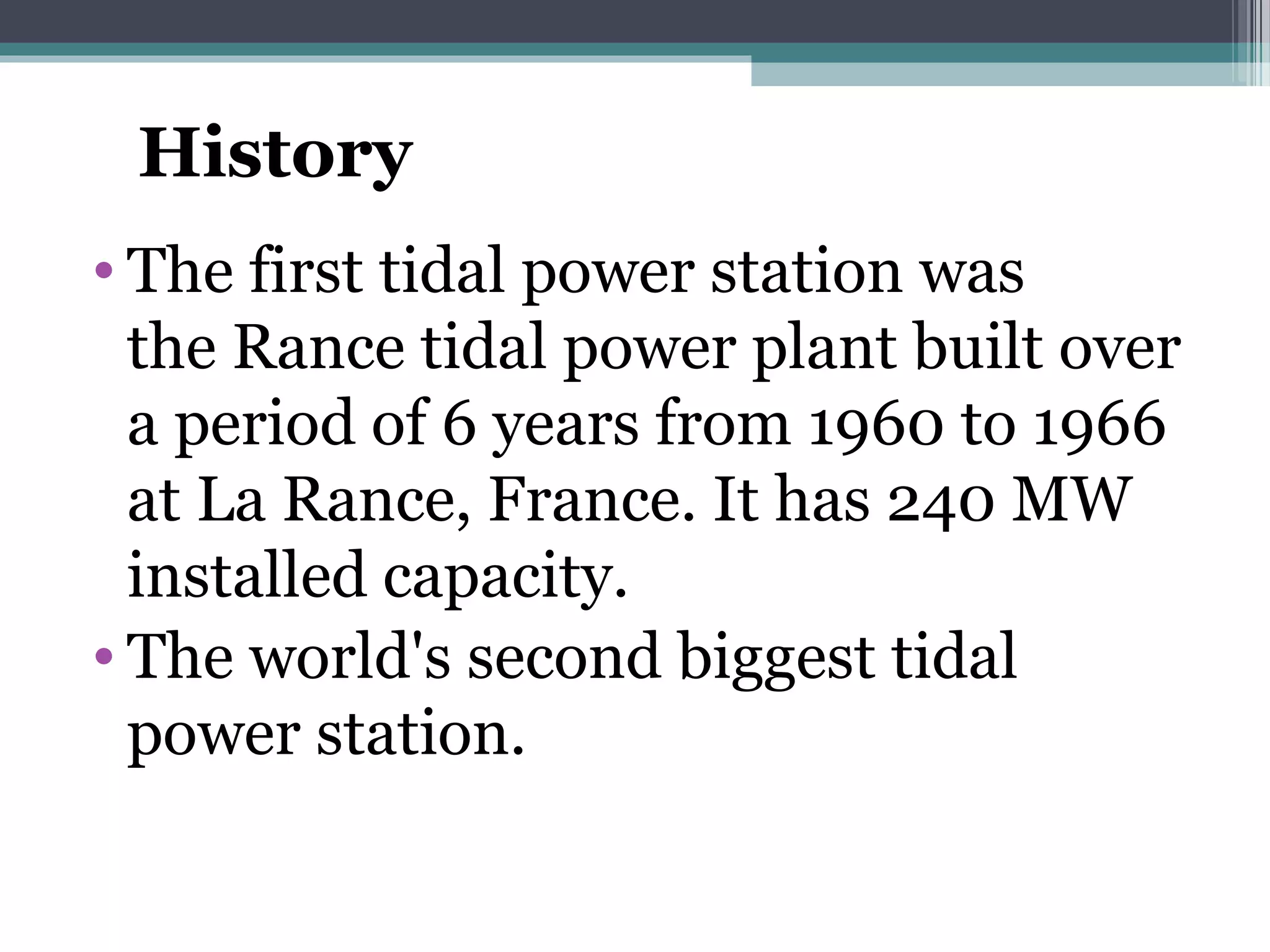
History
• The first tidal power station was
the Rance tidal power plant built over
a period of 6 years from 1960 to 1966
at La Rance, France. It has 240 MW
installed capacity.
• The world's second biggest tidal
power station.
Developing Nations
that could receive
significant benefits
from Tidal Energy
Indian Ocean: Comoros, Madagascar, Maldives, Seychelles.
Asia: China, India, Indonesia, Korea, Philippines, Vietnam.
Pacific Ocean: Fiji, Kiribati, Micronesia, Palau, Papua New
Guinea, Samoa, Solomon Islands, Timor, Tuvalu, Vanuatu.
Central and South America: Argentina, Brazil, Ecuador,
Guyana, Panama, Surinam.
Atlantic Ocean: Cape Verde.
All coastal nations with tidal passes between coral reefs
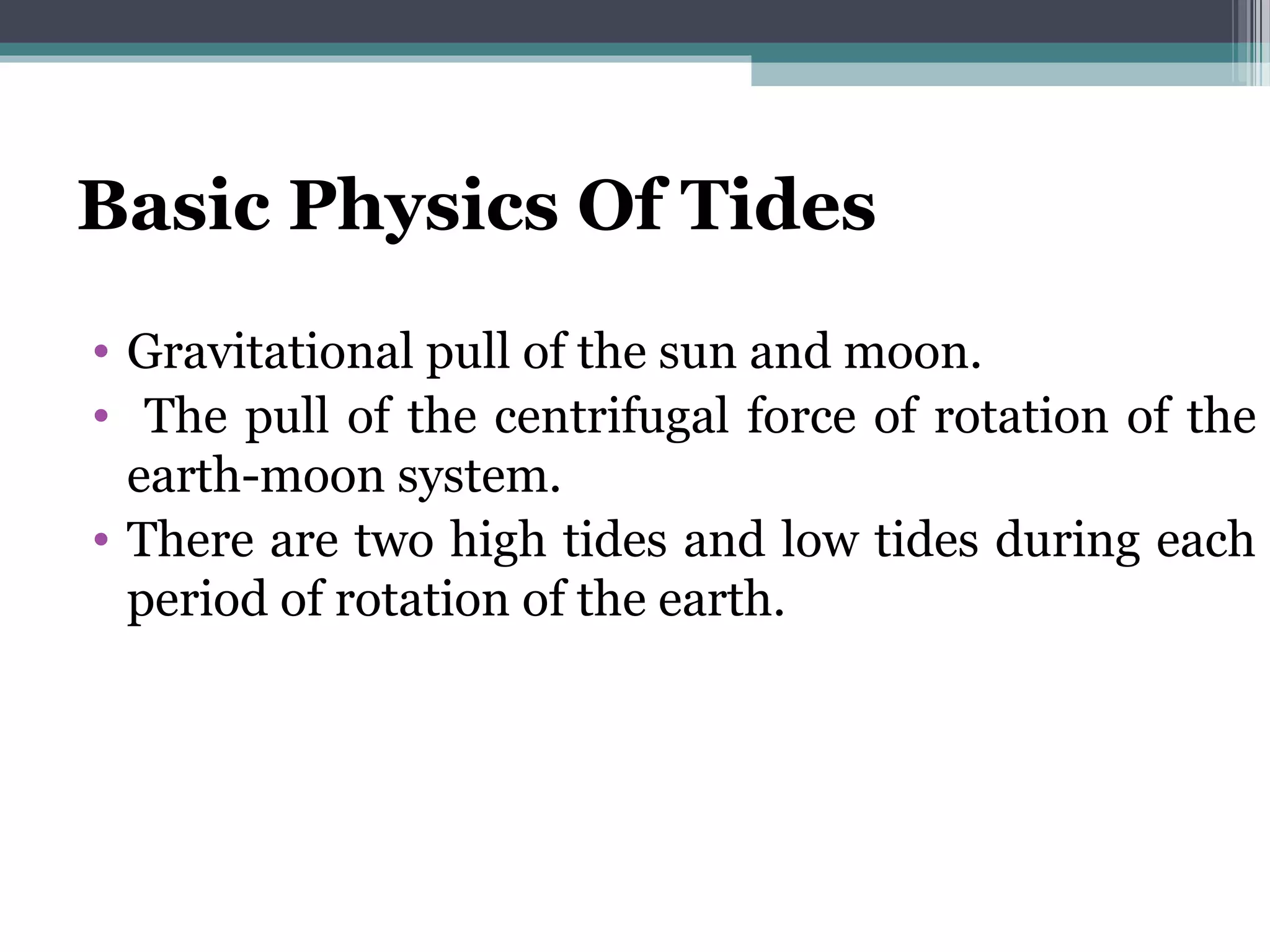
Basic Physics Of Tides
• Gravitational pull of the sun and moon.
• The pull of the centrifugal force of rotation of the
earth-moon system.
• There are two high tides and low tides during each
period of rotation of the earth.
HOW the tides come and go ?
• The gravitational force of the moon causes the oceans
to bulge along an axis pointing directly at the moon.
The magnitude of this attraction depends on the mass
of the object and its distance away .
Spring Tides
• When the sun and moon are in a line their gravitational
attraction on the earth combine and cause a “spring”
tides.
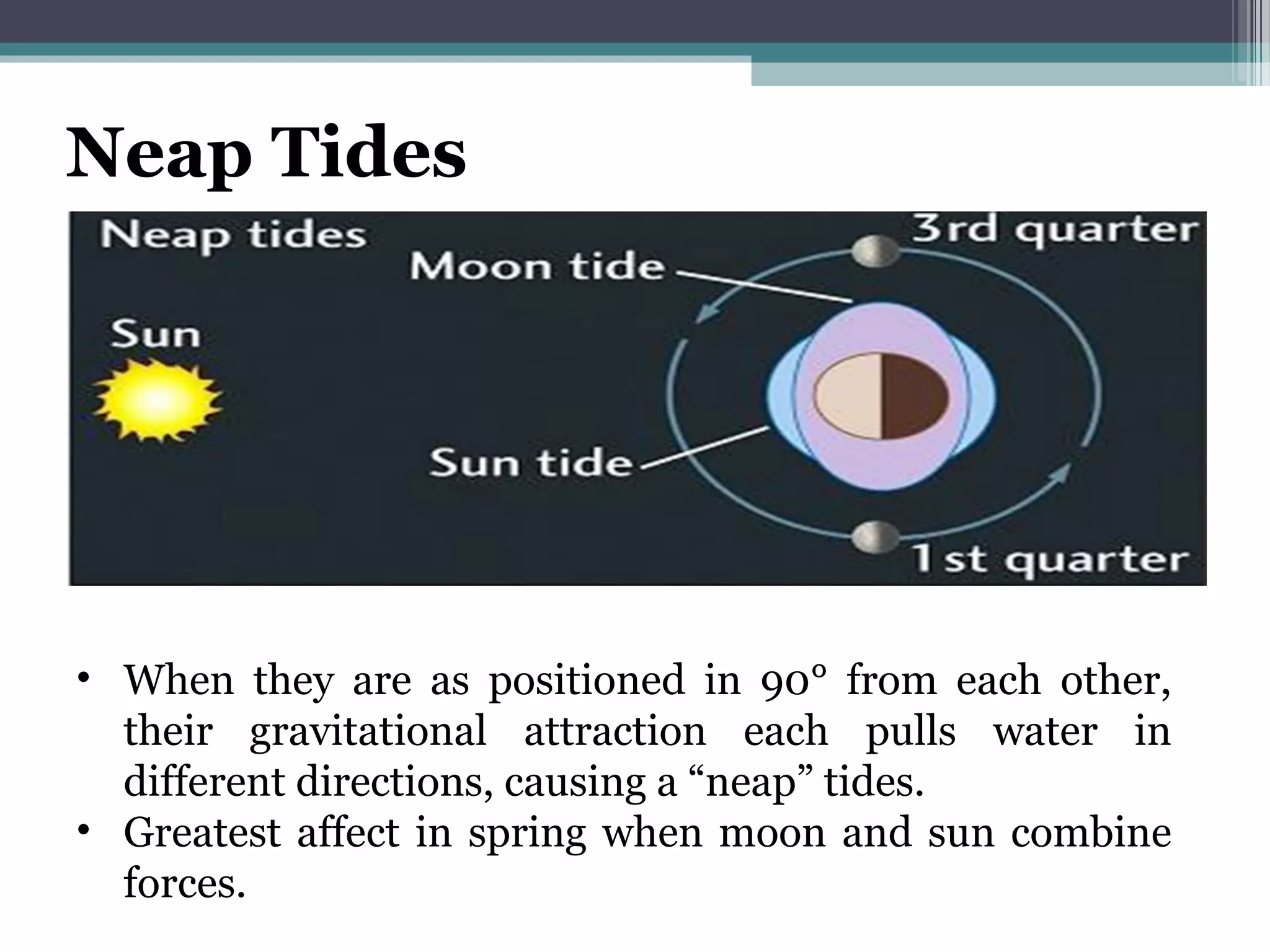
Neap Tides
• When they are as positioned in 90° from each other,
their gravitational attraction each pulls water in
different directions, causing a “neap” tides.
• Greatest affect in spring when moon and sun combine
forces.
Three types of tidal plant
facilities.
• Tidal barrages
• Tidal current turbines
• Dynamic tidal power plants
1.) Tidal Barrage
Two types:
• Single basin system
• Double-basin system
• Utilize potential energy
• Tidal barrages are typically dams
built across an estuary or bay.
• Consist of turbines, sluice gates,
embankments, and ship locks.
Basin
Single Basin System
• Ebb generation: During flood tide basin is filled and sluice
gates are closed , trapping water. Gates are kept closed until
the tide has ebbed sufficiently and thus turbines start
spinning and generating electricity.
• Flood generation: The basin is filled through the turbine
which generate at flood tide.
• Two way generation: Sluice gates and turbines are closed
until near the end of the flood tide when water is allowed to
flow through the turbines into the basin creating electricity.
At the point where the hydrostatic head is insufficient for
power generation the sluice gates are opened and kept open
until high tide when they are closed. When the tide outside
the barrage has dropped sufficiently water is allowed to flow
out of the basin through the turbines again creating
electricity.
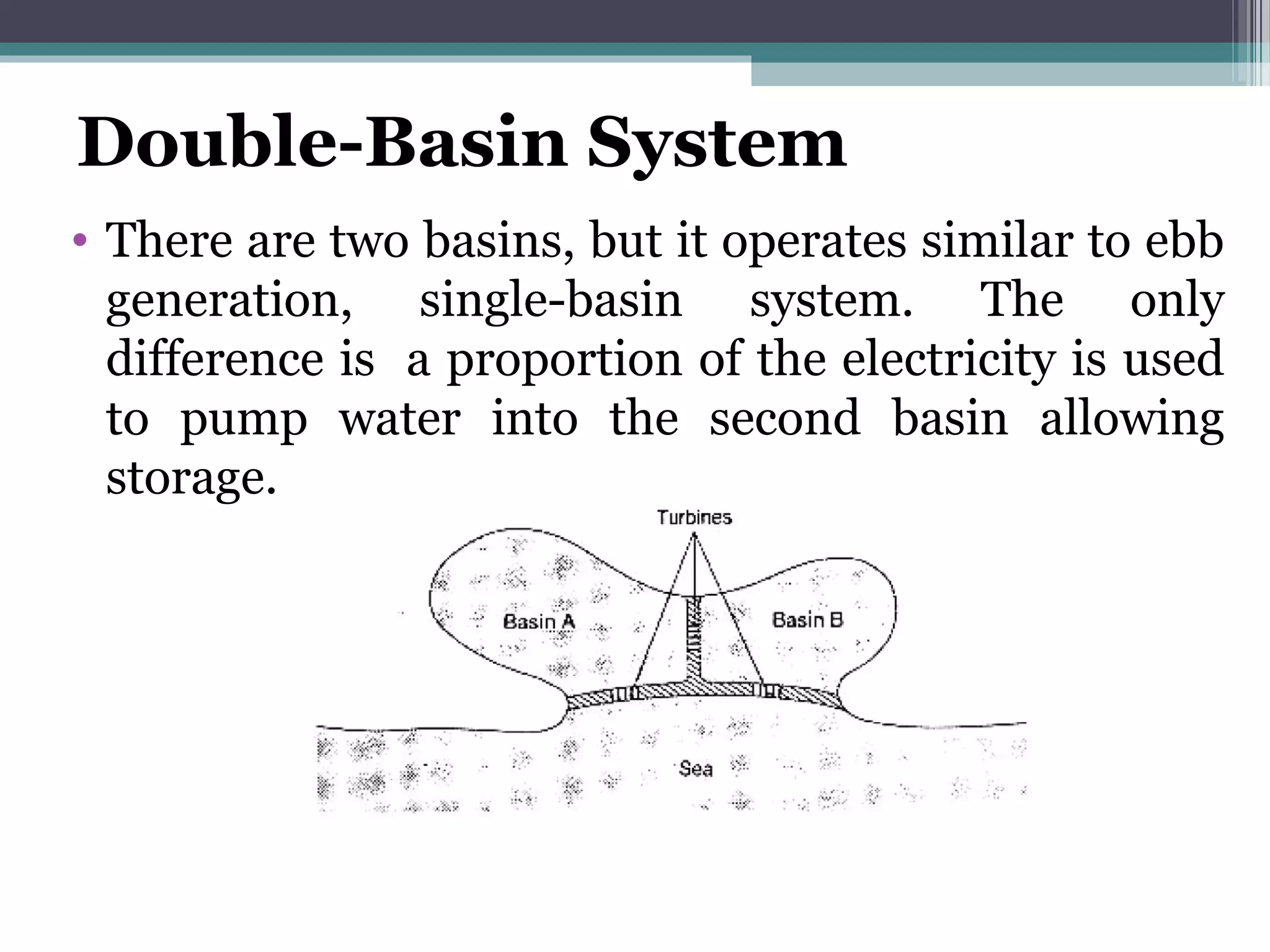
Double-Basin System
• There are two basins, but it operates similar to ebb
generation, single-basin system. The only
difference is a proportion of the electricity is used
to pump water into the second basin allowing
storage.
2.)Tidal Current
Turbines
• Make use of the kinetic energy of
moving water to power turbines,
in a similar way to wind
turbines that use wind to power
turbines.
• Operate during flood and ebb
tides.
• Consists of a rotor, gearbox, and
a generator. These three parts are
mounted onto a support
structure. There are three main
types:
▫ Gravity structure
▫ Piled structure
▫ Floating structure
• Gravity Structures are massive steel or
concrete structures attached to the base of the
units to achieve stability by their own inertia.
• Piled Structures are pinned to the seabed by
one or more steel or concrete piles. The piles are
fixed to the seabed by hammering if the ground
conditions are sufficiently soft or by pre-drilling,
positioning and grouting if the rock is harder.
• Floating Structures provide a potentially
more convincing solution for deep water
locations.
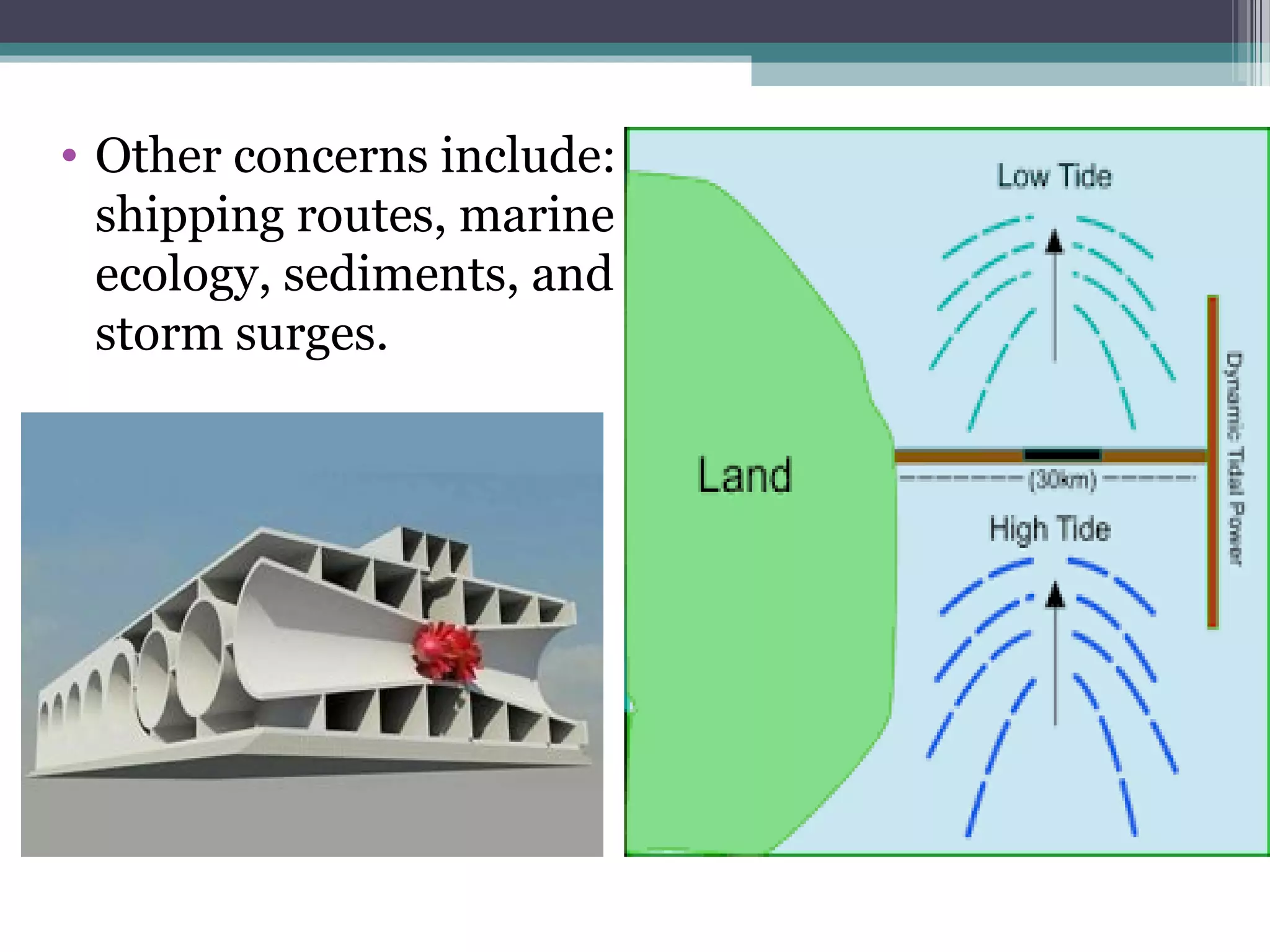
3) Dynamic Tidal Power Plant
•Dynamic tidal power or DTP is a new and
untested method of tidal power generation. It
would involve creating large dam-like structure
extending from the coast straight to the ocean, with
a perpendicular barrier at the far end, forming a
large 'T' shape.
•A single dam can accommodate over 8 GW (8000
MW) of installed capacity.
•A DTP dam is a long dam of 30 to 60 km which is
built perpendicular to the coast, running straight
out into the ocean, without enclosing an area.
• Other concerns include:
shipping routes, marine
ecology, sediments, and
storm surges.
Tidal turbine
Types:
• Bulb turbine
• Rim turbine
• Tubular turbine
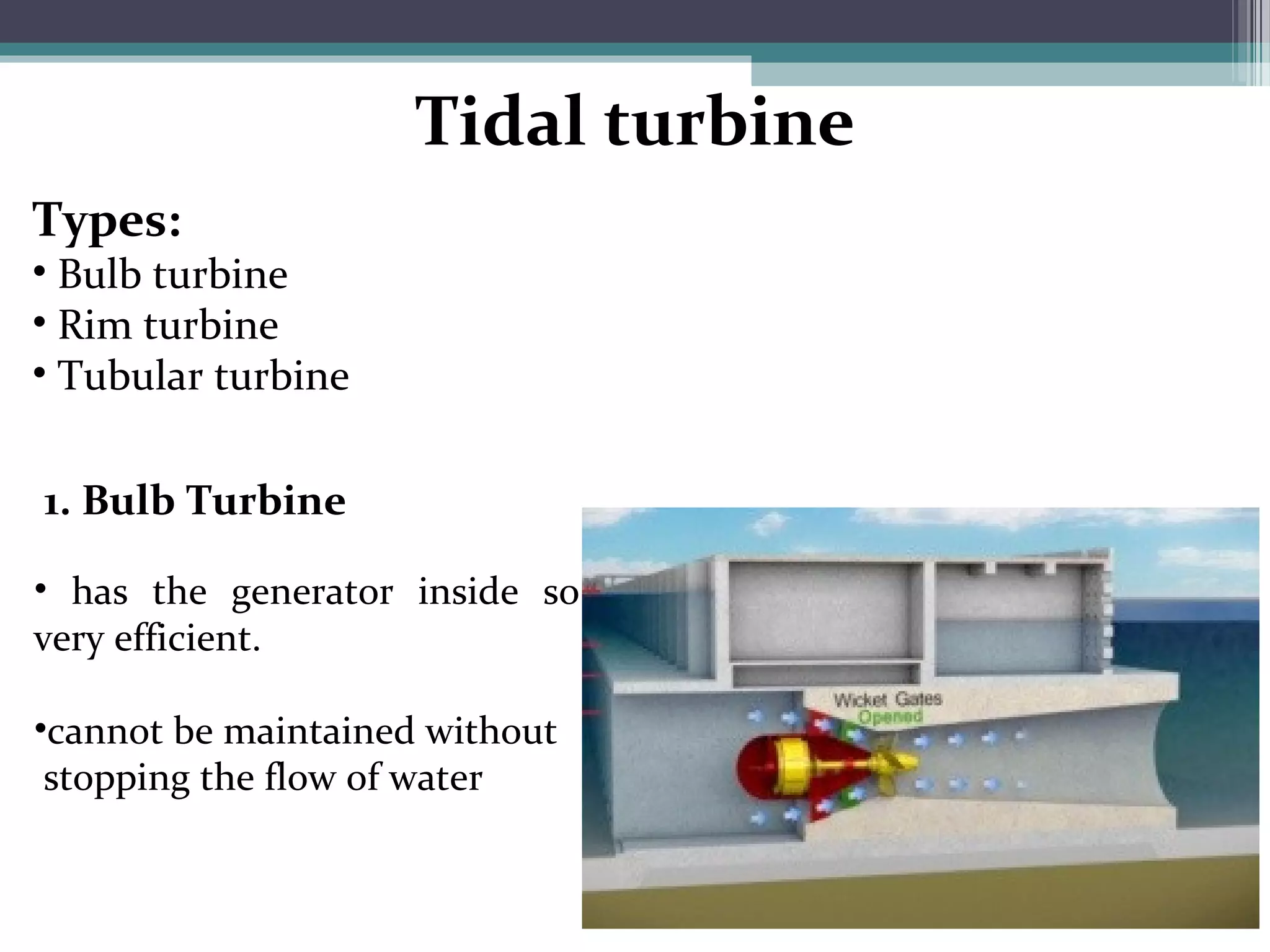
1. Bulb Turbine
• has the generator inside so
very efficient.
•cannot be maintained without
stopping the flow of water
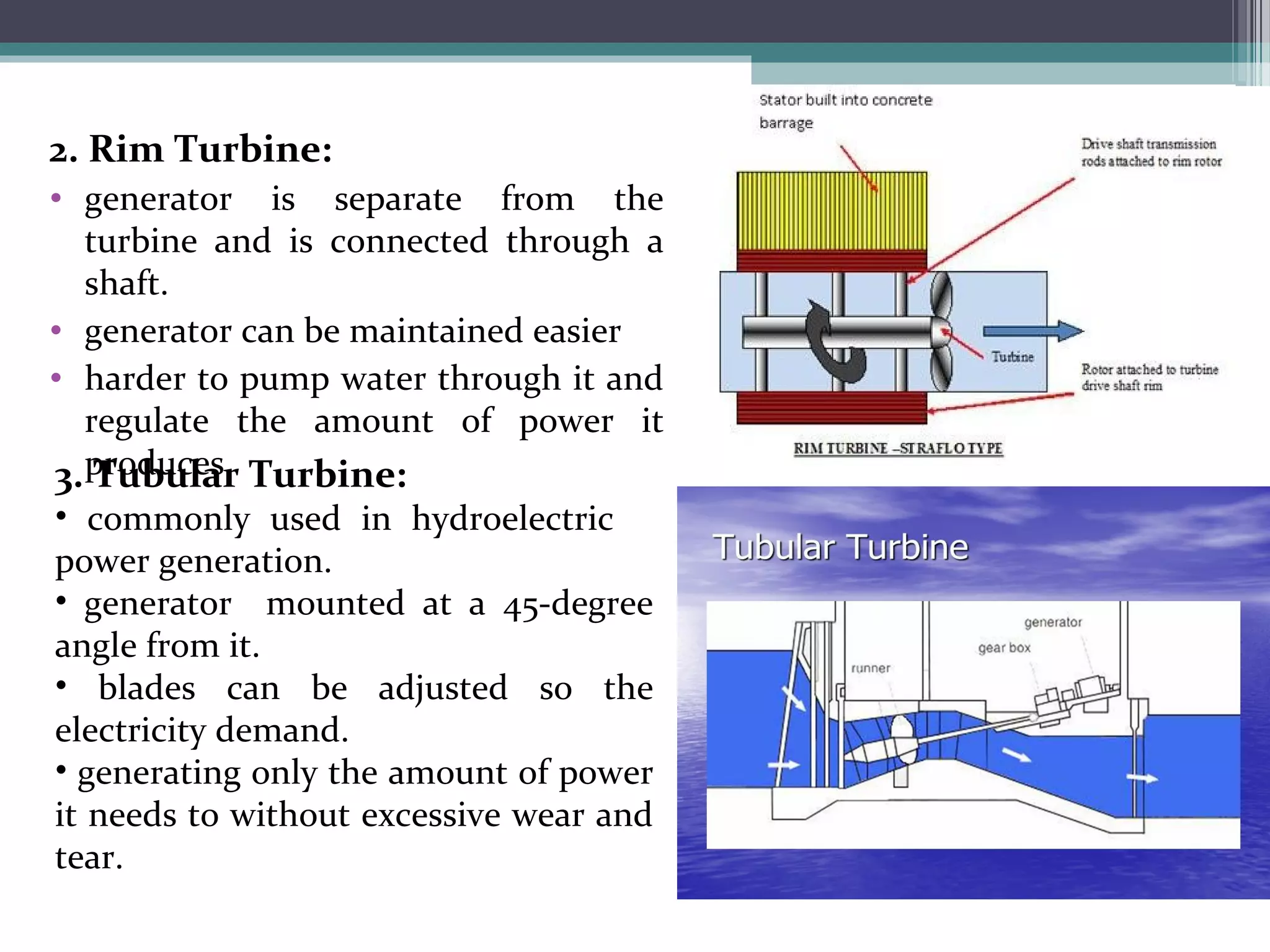
2. Rim Turbine:
• generator is separate from the
turbine and is connected through a
shaft.
• generator can be maintained easier
• harder to pump water through it and
regulate the amount of power it
produces.3. Tubular Turbine:
• commonly used in hydroelectric
power generation.
• generator mounted at a 45-degree
angle from it.
• blades can be adjusted so the
electricity demand.
• generating only the amount of power
it needs to without excessive wear and
tear.
Helical turbine
•Tidal Energy can be captured efficiently and
inexpensively using the helical turbine.
•designed for hydroelectric applications in
free-flowing water.
•operates in ocean, tidal, and river currents.
•does not require expensive dams that can harm
the environment.
Chain of Horizontal Gorlov turbines being
installed in South Korea
Prof. Alexander Gorlov
Operation
• self-starting with flow as low as 0.6 m/s
• smooth-running
• rotates in same direction regardless
of the direction of flow, making it ideal
for tidal applications.
How It Works
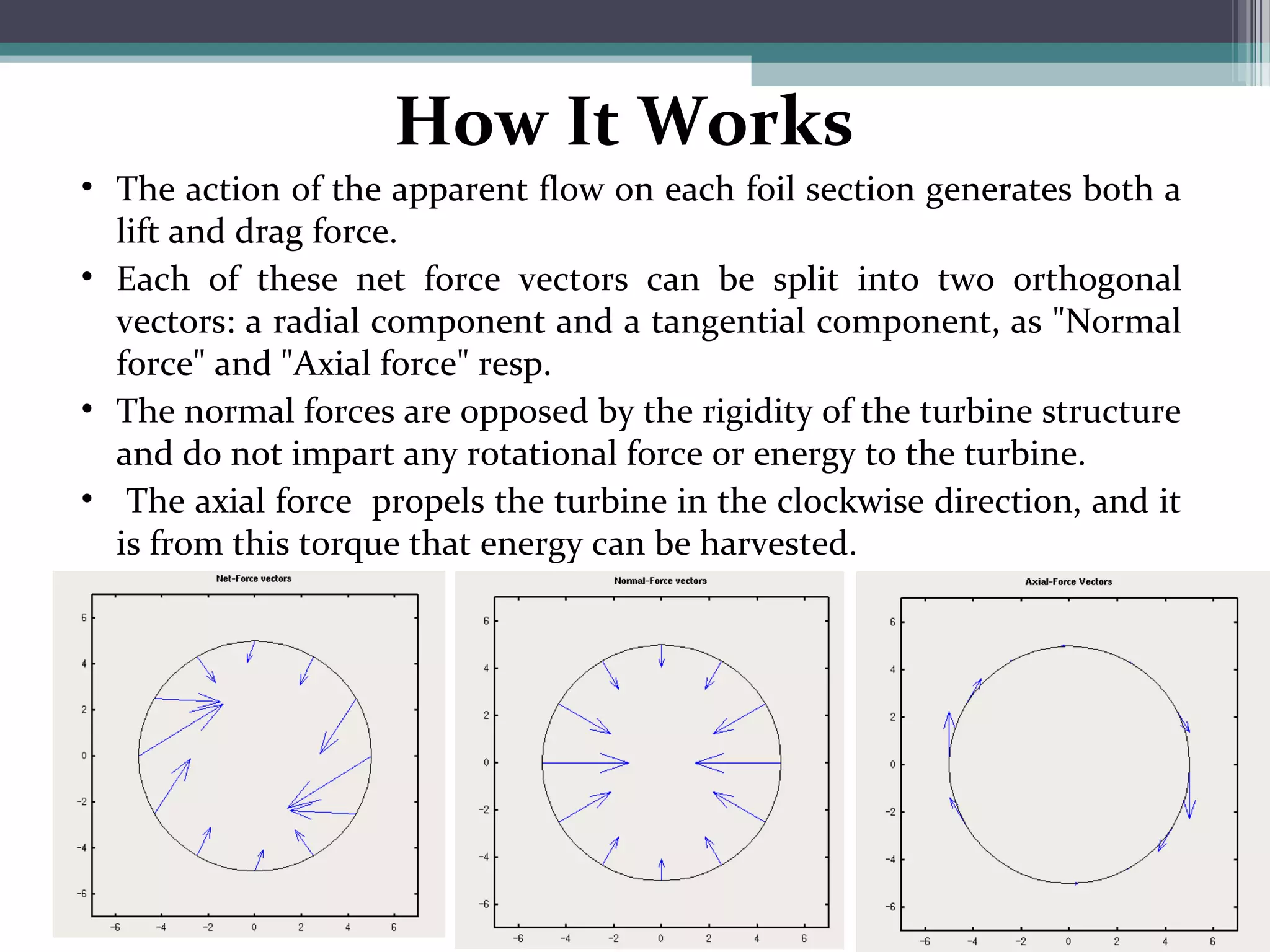
• The action of the apparent flow on each foil section generates both a
lift and drag force.
• Each of these net force vectors can be split into two orthogonal
vectors: a radial component and a tangential component, as "Normal
force" and "Axial force" resp.
• The normal forces are opposed by the rigidity of the turbine structure
and do not impart any rotational force or energy to the turbine.
• The axial force propels the turbine in the clockwise direction, and it
is from this torque that energy can be harvested.
Major Tidal plants in World
# https://en.wikipedia.org/wiki/List_of_tidal_power_stations
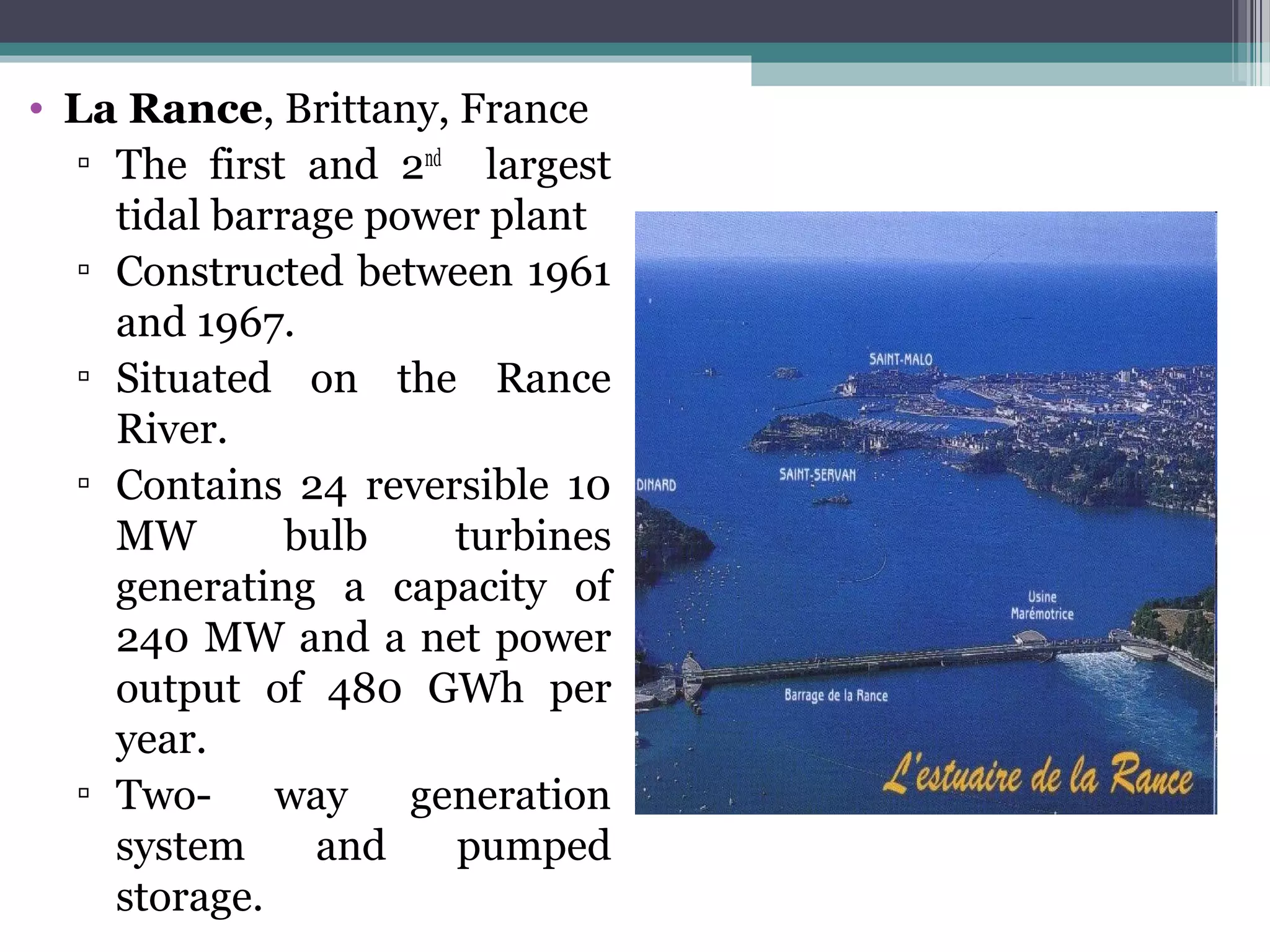
• La Rance, Brittany, France
▫ The first and 2nd
largest
tidal barrage power plant
▫ Constructed between 1961
and 1967.
▫ Situated on the Rance
River.
▫ Contains 24 reversible 10
MW bulb turbines
generating a capacity of
240 MW and a net power
output of 480 GWh per
year.
▫ Two- way generation
system and pumped
storage.
Annapolis Tidal Generation Facility on the
Bay of Fundy, Canada
• Constructed between
1981 and 1984.
• Generating capacity of
20 MW and a net
output of 30 GW h per
year.
• Further development is
being considered in the
Bay of Fundy.
Station
Capacity (
MW)
Country Location Start Ref
Bluemull Sound
Tidal Stream
Array
0.5 United Kingdom
60°41′01″N
00°59′12″W
2016 [7]
Meygen Tidal
Project
398 United Kingdom
58°39′26.1504″
N 3°7′1.5456″W
2015 [8]
Tidal Power Stations Under
Construction
# https://en.wikipedia.org/wiki/List_of_tidal_power_stations
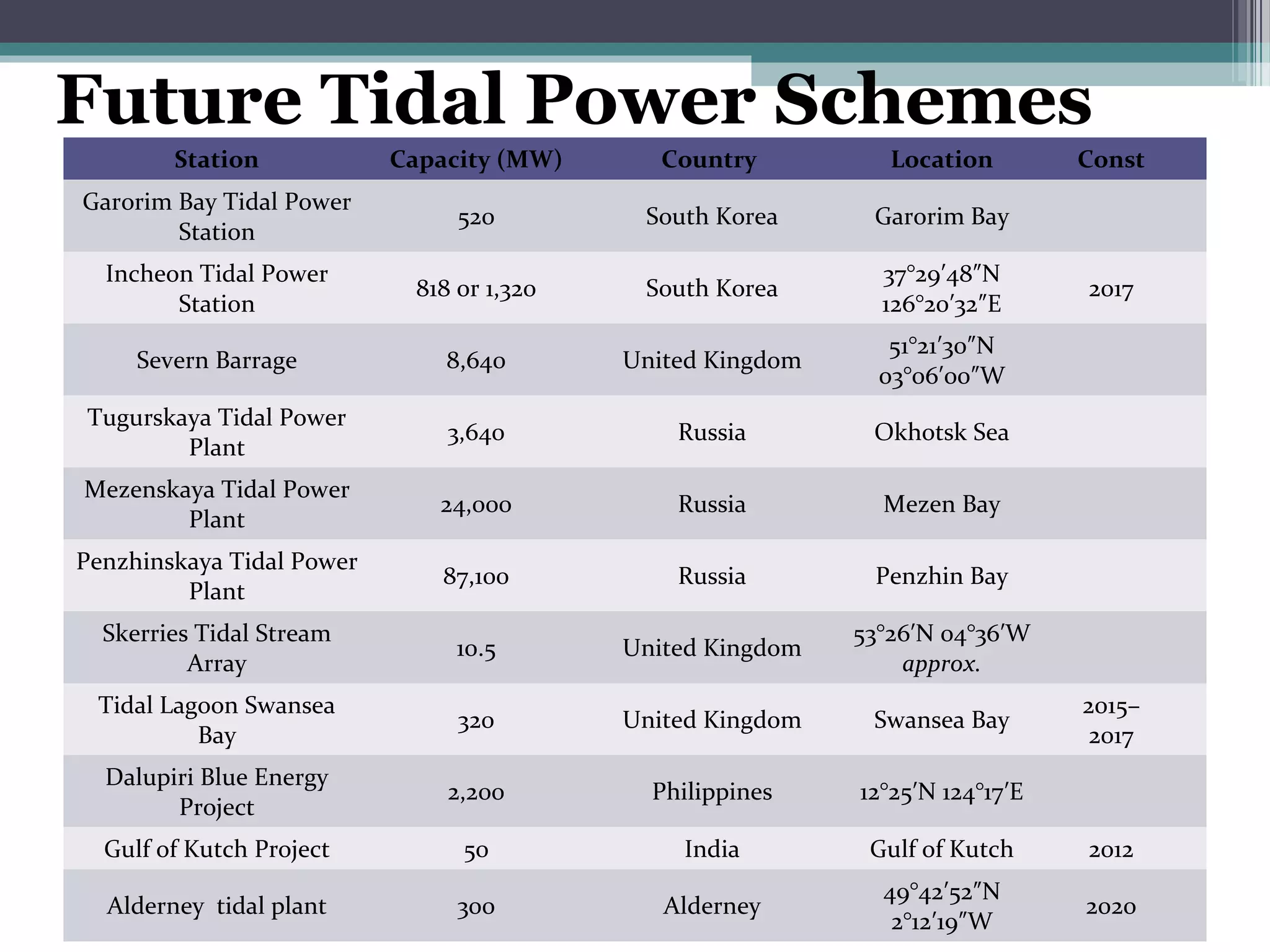
Station Capacity (MW) Country Location Const
Garorim Bay Tidal Power
Station
520 South Korea Garorim Bay
Incheon Tidal Power
Station
818 or 1,320 South Korea
37°29 48 N′ ″
126°20 32 E′ ″
2017
Severn Barrage 8,640 United Kingdom
51°21 30 N′ ″
03°06 00 W′ ″
Tugurskaya Tidal Power
Plant
3,640 Russia Okhotsk Sea
Mezenskaya Tidal Power
Plant
24,000 Russia Mezen Bay
Penzhinskaya Tidal Power
Plant
87,100 Russia Penzhin Bay
Skerries Tidal Stream
Array
10.5 United Kingdom
53°26 N 04°36 W′ ′
approx.
Tidal Lagoon Swansea
Bay
320 United Kingdom Swansea Bay
2015–
2017
Dalupiri Blue Energy
Project
2,200 Philippines 12°25 N 124°17 E′ ′
Gulf of Kutch Project 50 India Gulf of Kutch 2012
Alderney tidal plant 300 Alderney
49°42 52 N′ ″
2°12 19 W′ ″
2020
Future Tidal Power Schemes
Tidal plants in India
• In 2011, there was an announcement that a tidal
power plant was under consideration in the Gulf
of Kutch in Gujarat. With an initial capacity of 50
MW, it was to be expanded to 200 MW
eventually. In 2016, there was news that the
Government would tie up with an Israeli firm to
set up tidal power plants in Goa.
• According to the estimates of the Indian govt, the
country has a potential of 8,000 MW of tidal
energy. This includes about 7,000 MW in the
Gulf of Cambay in Gujarat, 1,200 MW in the
Gulf of Kutch and 100 MW in the Gangetic delta
in the Sunderbans region of West Bengal.
ADVANTAGES DISADVATAGES
• Renewable
• Green
• Predictable
• Effective at Low Speeds
• Long Life spans
• Environmental Effects
• Close to Land
• Expensive
References
• Tidal energy update 2009
Applied Energy , Volume 87, Issue 2 , February 2010, Pages 398-409
Fergal O Rourke, Fergal Boyle, Anthony Reynolds
• http://www.emec.org.uk/
• Wikipedia
• www.answers.com
• energybusinessdaily.com
• https://en.wikipedia.org/wiki/List_of_tidal_power_stations
• https://en.wikipedia.org/wiki/Gorlov_helical_turbine
• https://sputniknews.com/asia/201609221045601301-india-tidal-waves-
power/

Tidal energy

  • 1.
    Tidal Energy Presented By:- ROHIL KUMAR 17M713La Rance tidal power plant in La Rance, France
  • 2.
    Abstract • Tidal energyhas the potential to play a valuable part in a sustainable energy future, extremely predictable energy source, depending only on the gravitational pull of the moon and the sun and the centrifugal forces created by the rotation of the earth–moon system. • Tidal energy has been exploited on a significant scale since the construction of the La Rance tidal barrage in France in 1967. A tidal barrage utilises the potential energy of the tide and has proven to be very successful. • Kinetic energy can also be harnessed from tidal currents to generate electricity and involves the use of a tidal current turbine but still it is in an early stage of development.
  • 3.
    INDEX • Introduction • History •Tides • Types of tidal power plants • Tidal turbines • Helical turbine • Major tidal plants in World and India - current - under construction - future schemes • Pros and cons • References
  • 4.
    Tidal power, alsocalled tidal energy, is a form of hydropower that converts the energy of tides into useful forms of power - mainly electricity. This is the only form of energy whose source is the moon.
  • 5.
    History • The firsttidal power station was the Rance tidal power plant built over a period of 6 years from 1960 to 1966 at La Rance, France. It has 240 MW installed capacity. • The world's second biggest tidal power station.
  • 6.
    Developing Nations that couldreceive significant benefits from Tidal Energy Indian Ocean: Comoros, Madagascar, Maldives, Seychelles. Asia: China, India, Indonesia, Korea, Philippines, Vietnam. Pacific Ocean: Fiji, Kiribati, Micronesia, Palau, Papua New Guinea, Samoa, Solomon Islands, Timor, Tuvalu, Vanuatu. Central and South America: Argentina, Brazil, Ecuador, Guyana, Panama, Surinam. Atlantic Ocean: Cape Verde. All coastal nations with tidal passes between coral reefs
  • 7.
    Basic Physics OfTides • Gravitational pull of the sun and moon. • The pull of the centrifugal force of rotation of the earth-moon system. • There are two high tides and low tides during each period of rotation of the earth.
  • 8.
    HOW the tidescome and go ? • The gravitational force of the moon causes the oceans to bulge along an axis pointing directly at the moon. The magnitude of this attraction depends on the mass of the object and its distance away .
  • 9.
    Spring Tides • Whenthe sun and moon are in a line their gravitational attraction on the earth combine and cause a “spring” tides.
  • 10.
    Neap Tides • Whenthey are as positioned in 90° from each other, their gravitational attraction each pulls water in different directions, causing a “neap” tides. • Greatest affect in spring when moon and sun combine forces.
  • 11.
    Three types oftidal plant facilities. • Tidal barrages • Tidal current turbines • Dynamic tidal power plants
  • 12.
    1.) Tidal Barrage Twotypes: • Single basin system • Double-basin system • Utilize potential energy • Tidal barrages are typically dams built across an estuary or bay. • Consist of turbines, sluice gates, embankments, and ship locks. Basin
  • 13.
    Single Basin System •Ebb generation: During flood tide basin is filled and sluice gates are closed , trapping water. Gates are kept closed until the tide has ebbed sufficiently and thus turbines start spinning and generating electricity. • Flood generation: The basin is filled through the turbine which generate at flood tide. • Two way generation: Sluice gates and turbines are closed until near the end of the flood tide when water is allowed to flow through the turbines into the basin creating electricity. At the point where the hydrostatic head is insufficient for power generation the sluice gates are opened and kept open until high tide when they are closed. When the tide outside the barrage has dropped sufficiently water is allowed to flow out of the basin through the turbines again creating electricity.
  • 15.
    Double-Basin System • Thereare two basins, but it operates similar to ebb generation, single-basin system. The only difference is a proportion of the electricity is used to pump water into the second basin allowing storage.
  • 16.
    2.)Tidal Current Turbines • Makeuse of the kinetic energy of moving water to power turbines, in a similar way to wind turbines that use wind to power turbines. • Operate during flood and ebb tides. • Consists of a rotor, gearbox, and a generator. These three parts are mounted onto a support structure. There are three main types: ▫ Gravity structure ▫ Piled structure ▫ Floating structure
  • 17.
    • Gravity Structuresare massive steel or concrete structures attached to the base of the units to achieve stability by their own inertia. • Piled Structures are pinned to the seabed by one or more steel or concrete piles. The piles are fixed to the seabed by hammering if the ground conditions are sufficiently soft or by pre-drilling, positioning and grouting if the rock is harder. • Floating Structures provide a potentially more convincing solution for deep water locations.
  • 19.
    3) Dynamic TidalPower Plant •Dynamic tidal power or DTP is a new and untested method of tidal power generation. It would involve creating large dam-like structure extending from the coast straight to the ocean, with a perpendicular barrier at the far end, forming a large 'T' shape. •A single dam can accommodate over 8 GW (8000 MW) of installed capacity. •A DTP dam is a long dam of 30 to 60 km which is built perpendicular to the coast, running straight out into the ocean, without enclosing an area.
  • 20.
    • Other concernsinclude: shipping routes, marine ecology, sediments, and storm surges.
  • 21.
    Tidal turbine Types: • Bulbturbine • Rim turbine • Tubular turbine 1. Bulb Turbine • has the generator inside so very efficient. •cannot be maintained without stopping the flow of water
  • 22.
    2. Rim Turbine: •generator is separate from the turbine and is connected through a shaft. • generator can be maintained easier • harder to pump water through it and regulate the amount of power it produces.3. Tubular Turbine: • commonly used in hydroelectric power generation. • generator mounted at a 45-degree angle from it. • blades can be adjusted so the electricity demand. • generating only the amount of power it needs to without excessive wear and tear.
  • 23.
    Helical turbine •Tidal Energycan be captured efficiently and inexpensively using the helical turbine. •designed for hydroelectric applications in free-flowing water. •operates in ocean, tidal, and river currents. •does not require expensive dams that can harm the environment.
  • 24.
    Chain of HorizontalGorlov turbines being installed in South Korea Prof. Alexander Gorlov
  • 25.
    Operation • self-starting withflow as low as 0.6 m/s • smooth-running • rotates in same direction regardless of the direction of flow, making it ideal for tidal applications.
  • 26.
    How It Works •The action of the apparent flow on each foil section generates both a lift and drag force. • Each of these net force vectors can be split into two orthogonal vectors: a radial component and a tangential component, as "Normal force" and "Axial force" resp. • The normal forces are opposed by the rigidity of the turbine structure and do not impart any rotational force or energy to the turbine. • The axial force propels the turbine in the clockwise direction, and it is from this torque that energy can be harvested.
  • 27.
    Major Tidal plantsin World # https://en.wikipedia.org/wiki/List_of_tidal_power_stations
  • 28.
    • La Rance,Brittany, France ▫ The first and 2nd largest tidal barrage power plant ▫ Constructed between 1961 and 1967. ▫ Situated on the Rance River. ▫ Contains 24 reversible 10 MW bulb turbines generating a capacity of 240 MW and a net power output of 480 GWh per year. ▫ Two- way generation system and pumped storage.
  • 29.
    Annapolis Tidal GenerationFacility on the Bay of Fundy, Canada • Constructed between 1981 and 1984. • Generating capacity of 20 MW and a net output of 30 GW h per year. • Further development is being considered in the Bay of Fundy.
  • 30.
    Station Capacity ( MW) Country LocationStart Ref Bluemull Sound Tidal Stream Array 0.5 United Kingdom 60°41′01″N 00°59′12″W 2016 [7] Meygen Tidal Project 398 United Kingdom 58°39′26.1504″ N 3°7′1.5456″W 2015 [8] Tidal Power Stations Under Construction # https://en.wikipedia.org/wiki/List_of_tidal_power_stations
  • 31.
    Station Capacity (MW)Country Location Const Garorim Bay Tidal Power Station 520 South Korea Garorim Bay Incheon Tidal Power Station 818 or 1,320 South Korea 37°29 48 N′ ″ 126°20 32 E′ ″ 2017 Severn Barrage 8,640 United Kingdom 51°21 30 N′ ″ 03°06 00 W′ ″ Tugurskaya Tidal Power Plant 3,640 Russia Okhotsk Sea Mezenskaya Tidal Power Plant 24,000 Russia Mezen Bay Penzhinskaya Tidal Power Plant 87,100 Russia Penzhin Bay Skerries Tidal Stream Array 10.5 United Kingdom 53°26 N 04°36 W′ ′ approx. Tidal Lagoon Swansea Bay 320 United Kingdom Swansea Bay 2015– 2017 Dalupiri Blue Energy Project 2,200 Philippines 12°25 N 124°17 E′ ′ Gulf of Kutch Project 50 India Gulf of Kutch 2012 Alderney tidal plant 300 Alderney 49°42 52 N′ ″ 2°12 19 W′ ″ 2020 Future Tidal Power Schemes
  • 32.
    Tidal plants inIndia • In 2011, there was an announcement that a tidal power plant was under consideration in the Gulf of Kutch in Gujarat. With an initial capacity of 50 MW, it was to be expanded to 200 MW eventually. In 2016, there was news that the Government would tie up with an Israeli firm to set up tidal power plants in Goa. • According to the estimates of the Indian govt, the country has a potential of 8,000 MW of tidal energy. This includes about 7,000 MW in the Gulf of Cambay in Gujarat, 1,200 MW in the Gulf of Kutch and 100 MW in the Gangetic delta in the Sunderbans region of West Bengal.
  • 33.
    ADVANTAGES DISADVATAGES • Renewable •Green • Predictable • Effective at Low Speeds • Long Life spans • Environmental Effects • Close to Land • Expensive
  • 34.
    References • Tidal energyupdate 2009 Applied Energy , Volume 87, Issue 2 , February 2010, Pages 398-409 Fergal O Rourke, Fergal Boyle, Anthony Reynolds • http://www.emec.org.uk/ • Wikipedia • www.answers.com • energybusinessdaily.com • https://en.wikipedia.org/wiki/List_of_tidal_power_stations • https://en.wikipedia.org/wiki/Gorlov_helical_turbine • https://sputniknews.com/asia/201609221045601301-india-tidal-waves- power/