Explained By 
Kavan Oza (IU1241060031) 
Maharshi Pandya(IU1241060034) 
Ashir Sheth(IU1241060053)
Outlines 
 How Tides Occurs? 
 Introduction of Tidal Energy 
 How to Generate Tidal Energy 
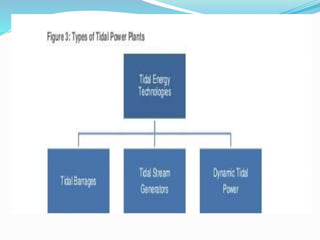
 Types of Tidal Power Plant 
 Tidal Scenario In India 
 Advantages – Dis advantages
Tidal power, also called tidal energy, is a form 
of hydropower that converts the energy of tides into 
useful forms of power, mainly electricity.
 Tidal forces are periodic variations in gravitational 
attraction exerted by moon. 
 These forces create corresponding motions or 
currents in the world's oceans. 
 Due to the strong attraction to the oceans, a bulge in 
the water level is created, causing a temporary 
increase in sea level. 
 When the sea level is raised, water from the middle 
of the ocean is forced to move toward the shorelines, 
creating a tide. 
 This occurrence takes place in an unfailing manner, 
due to the consistent pattern of the moon’s orbit 
around the earth.
How To Generate Tidal Energy?? 
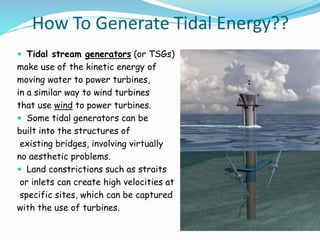
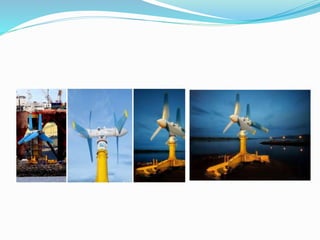
 Tidal stream generators (or TSGs) 
make use of the kinetic energy of 
moving water to power turbines, 
in a similar way to wind turbines 
that use wind to power turbines. 
 Some tidal generators can be 
built into the structures of 
existing bridges, involving virtually 
no aesthetic problems. 
 Land constrictions such as straits 
or inlets can create high velocities at 
specific sites, which can be captured 
with the use of turbines.
 This form of generation has many 
advantages over its other tidal 
energy rivals. 
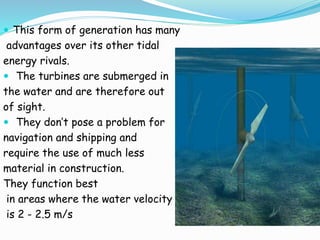
 The turbines are submerged in 
the water and are therefore out 
of sight. 
 They don’t pose a problem for 
navigation and shipping and 
require the use of much less 
material in construction. 
They function best 
in areas where the water velocity 
is 2 - 2.5 m/s
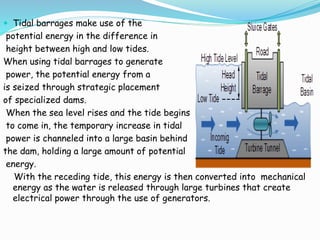
 Tidal barrages make use of the 
potential energy in the difference in 
height between high and low tides. 
When using tidal barrages to generate 
power, the potential energy from a 
is seized through strategic placement 
of specialized dams. 
When the sea level rises and the tide begins 
to come in, the temporary increase in tidal 
power is channeled into a large basin behind 
the dam, holding a large amount of potential 
energy. 
With the receding tide, this energy is then converted into mechanical 
energy as the water is released through large turbines that create 
electrical power through the use of generators.
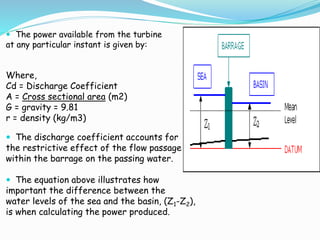
 The power available from the turbine 
at any particular instant is given by: 
Where, 
Cd = Discharge Coefficient 
A = Cross sectional area (m2) 
G = gravity = 9.81 
r = density (kg/m3) 
 The discharge coefficient accounts for 
the restrictive effect of the flow passage 
within the barrage on the passing water. 
 The equation above illustrates how 
important the difference between the 
water levels of the sea and the basin, (Z1-Z2), 
is when calculating the power produced.
 Tidal range may vary over a wide range (4.5-12.4 m) from site to site. A 
tidal range of at least 7 m is required for economical operation and for 
sufficient head of water for the turbines. 
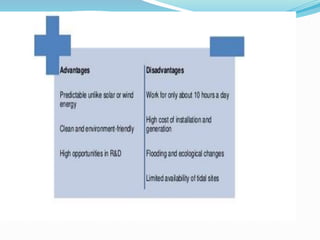
 A major drawback of tidal power stations is that they can only generate 
when the tide is flowing in or out - in other words, only for 10 hours each 
day. 
 However, tides are totally predictable, so we can plan to have other 
power stations generating at those times when the tidal station is out of 
action.
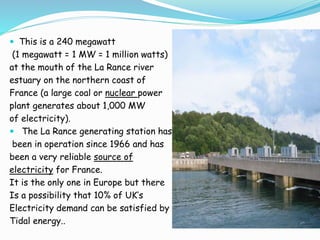
 This is a 240 megawatt 
(1 megawatt = 1 MW = 1 million watts) 
at the mouth of the La Rance river 
estuary on the northern coast of 
France (a large coal or nuclear power 
plant generates about 1,000 MW 
of electricity). 
 The La Rance generating station has 
been in operation since 1966 and has 
been a very reliable source of 
electricity for France. 
It is the only one in Europe but there 
Is a possibility that 10% of UK’s 
Electricity demand can be satisfied by 
Tidal energy..
 The technology required for tidal power is well developed, and the main 
barrier to increased use of the tides is that of construction costs. 
 There is a high capital cost for a tidal energy project, with possibly a 10- 
year construction period. 
 Therefore, the electricity cost is very sensitive to the discount rate. 
 The major factors in determining the cost effectiveness of a tidal power 
site are the size (length and height) of the barrage required, and the 
difference in height between high and low tide. 
 These factors can be expressed in what is called a site’s “Gibrat” ratio. 
The Gibrat ratio is the ratio of the length of the barrage in metres to 
the annual energy production in kilowatt hours (1 kilowatt hour = 1 KWH = 
1000 watts used for 1 hour). 
 The smaller the Gibrat site ratio, the more desireable the site.
Indian Tidal Energy Scenario 
 Tidal Energy is one of the new and emerging 
technologies, which is commercially not viable and 
still in Research & Development (R&D) stage. India 
has a long coastline with the estuaries and gulfs where 
tides are strong enough to move turbines for electrical 
power generation.
Tidal Energy Potential 
 As per the studies, the Gulf of Kutch and Gulf of Cambay in Gujarat and 
Sunderbans area in West Bengal are the only potential sites in India for the 
development of Tidal Energy Projects. 
 Central Electricity Authority (CEA) undertook a study for the assessment of 
tidal energy potential in India. According to the study, the identified 
economic power potential is of the order of 8000 MW
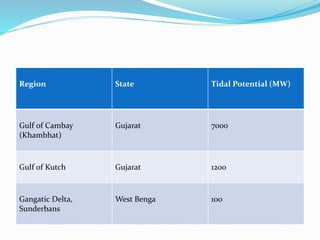
Region State Tidal Potential (MW) 
Gulf of Cambay 
(Khambhat) 
Gujarat 7000 
Gulf of Kutch Gujarat 1200 
Gangatic Delta, 
Sunderbans 
West Benga 100
 In February 2008, under the Tidal Energy Programme, the Ministry 
of New & Renewable Energy (MNRE) sanctioned a demonstration 
project for setting up a 3.75 MW tidal power plant at Durgaduani 
Creek in Sunderbans, West Bengal. 
 The NHPC Limited was given responsibility to execute the project. 
The total estimated project cost was INR 48 crores, out of which 
90% (INR 43.20 crores) was to be shared by the MNRE and the 
remaining 10% (INR 4.80 crores) by the Government of West 
Bengal. 
 However, the project has been discontinued due to very high tender 
cost amounting to INR 238 crores against originally estimated cost 
of INR 48 crores.
Tidal Power Projects in Gulf of Kutch, 
 A committee was constituted under the Central 
Electricity Authority (CEA) on the 900 MW Kutch 
Tidal Power Project for estimating the cost of the 
project. A techno-economic feasibility study was 
carried out by the CEA in 1988 for a 900 MW Tidal 
Power Project. A revised estimate of INR 6184 crores 
was worked out for the execution of this project in 
1993.
Mandavi Tidal Power Project (250 MW) in 
Kutch 
 In January 2011, Government of Gujarat signed a 
Memorandum of Understanding (MoU) for establishing a 
250 MW tidal power project in Gulf of Kutch with Gujarat 
Power Corporation Ltd. (GPCL) Vadodara, Atlantis 
Resource Corporation, United Kingdom and Perfect 
Mining Energy Solutions (PMES), Singapore. 
 A Special Purpose Vehicle was incorporated in May, 2011 
and GPCL has taken up a 50 MW tidal power project at 
Mandavi in district Kutch in the first phase.
 As part of the agreed upon terms of the MoU for a total 
of 250MW of future tidal power development, the 
initial 50MW project could be scaled up to more than 
200MW of installed capacity. The project is expected 
to cost around Rs 750 crore
Thank you

Tidal Energy

  • 1.
    Explained By KavanOza (IU1241060031) Maharshi Pandya(IU1241060034) Ashir Sheth(IU1241060053)
  • 2.
    Outlines  HowTides Occurs?  Introduction of Tidal Energy  How to Generate Tidal Energy  Types of Tidal Power Plant  Tidal Scenario In India  Advantages – Dis advantages
  • 3.
    Tidal power, alsocalled tidal energy, is a form of hydropower that converts the energy of tides into useful forms of power, mainly electricity.
  • 4.
     Tidal forcesare periodic variations in gravitational attraction exerted by moon.  These forces create corresponding motions or currents in the world's oceans.  Due to the strong attraction to the oceans, a bulge in the water level is created, causing a temporary increase in sea level.  When the sea level is raised, water from the middle of the ocean is forced to move toward the shorelines, creating a tide.  This occurrence takes place in an unfailing manner, due to the consistent pattern of the moon’s orbit around the earth.
  • 6.
    How To GenerateTidal Energy??  Tidal stream generators (or TSGs) make use of the kinetic energy of moving water to power turbines, in a similar way to wind turbines that use wind to power turbines.  Some tidal generators can be built into the structures of existing bridges, involving virtually no aesthetic problems.  Land constrictions such as straits or inlets can create high velocities at specific sites, which can be captured with the use of turbines.
  • 7.
     This formof generation has many advantages over its other tidal energy rivals.  The turbines are submerged in the water and are therefore out of sight.  They don’t pose a problem for navigation and shipping and require the use of much less material in construction. They function best in areas where the water velocity is 2 - 2.5 m/s
  • 8.
     Tidal barragesmake use of the potential energy in the difference in height between high and low tides. When using tidal barrages to generate power, the potential energy from a is seized through strategic placement of specialized dams. When the sea level rises and the tide begins to come in, the temporary increase in tidal power is channeled into a large basin behind the dam, holding a large amount of potential energy. With the receding tide, this energy is then converted into mechanical energy as the water is released through large turbines that create electrical power through the use of generators.
  • 9.
     The poweravailable from the turbine at any particular instant is given by: Where, Cd = Discharge Coefficient A = Cross sectional area (m2) G = gravity = 9.81 r = density (kg/m3)  The discharge coefficient accounts for the restrictive effect of the flow passage within the barrage on the passing water.  The equation above illustrates how important the difference between the water levels of the sea and the basin, (Z1-Z2), is when calculating the power produced.
  • 10.
     Tidal rangemay vary over a wide range (4.5-12.4 m) from site to site. A tidal range of at least 7 m is required for economical operation and for sufficient head of water for the turbines.  A major drawback of tidal power stations is that they can only generate when the tide is flowing in or out - in other words, only for 10 hours each day.  However, tides are totally predictable, so we can plan to have other power stations generating at those times when the tidal station is out of action.
  • 11.
     This isa 240 megawatt (1 megawatt = 1 MW = 1 million watts) at the mouth of the La Rance river estuary on the northern coast of France (a large coal or nuclear power plant generates about 1,000 MW of electricity).  The La Rance generating station has been in operation since 1966 and has been a very reliable source of electricity for France. It is the only one in Europe but there Is a possibility that 10% of UK’s Electricity demand can be satisfied by Tidal energy..
  • 12.
     The technologyrequired for tidal power is well developed, and the main barrier to increased use of the tides is that of construction costs.  There is a high capital cost for a tidal energy project, with possibly a 10- year construction period.  Therefore, the electricity cost is very sensitive to the discount rate.  The major factors in determining the cost effectiveness of a tidal power site are the size (length and height) of the barrage required, and the difference in height between high and low tide.  These factors can be expressed in what is called a site’s “Gibrat” ratio. The Gibrat ratio is the ratio of the length of the barrage in metres to the annual energy production in kilowatt hours (1 kilowatt hour = 1 KWH = 1000 watts used for 1 hour).  The smaller the Gibrat site ratio, the more desireable the site.
  • 13.
    Indian Tidal EnergyScenario  Tidal Energy is one of the new and emerging technologies, which is commercially not viable and still in Research & Development (R&D) stage. India has a long coastline with the estuaries and gulfs where tides are strong enough to move turbines for electrical power generation.
  • 14.
    Tidal Energy Potential  As per the studies, the Gulf of Kutch and Gulf of Cambay in Gujarat and Sunderbans area in West Bengal are the only potential sites in India for the development of Tidal Energy Projects.  Central Electricity Authority (CEA) undertook a study for the assessment of tidal energy potential in India. According to the study, the identified economic power potential is of the order of 8000 MW
  • 15.
    Region State TidalPotential (MW) Gulf of Cambay (Khambhat) Gujarat 7000 Gulf of Kutch Gujarat 1200 Gangatic Delta, Sunderbans West Benga 100
  • 16.
     In February2008, under the Tidal Energy Programme, the Ministry of New & Renewable Energy (MNRE) sanctioned a demonstration project for setting up a 3.75 MW tidal power plant at Durgaduani Creek in Sunderbans, West Bengal.  The NHPC Limited was given responsibility to execute the project. The total estimated project cost was INR 48 crores, out of which 90% (INR 43.20 crores) was to be shared by the MNRE and the remaining 10% (INR 4.80 crores) by the Government of West Bengal.  However, the project has been discontinued due to very high tender cost amounting to INR 238 crores against originally estimated cost of INR 48 crores.
  • 17.
    Tidal Power Projectsin Gulf of Kutch,  A committee was constituted under the Central Electricity Authority (CEA) on the 900 MW Kutch Tidal Power Project for estimating the cost of the project. A techno-economic feasibility study was carried out by the CEA in 1988 for a 900 MW Tidal Power Project. A revised estimate of INR 6184 crores was worked out for the execution of this project in 1993.
  • 18.
    Mandavi Tidal PowerProject (250 MW) in Kutch  In January 2011, Government of Gujarat signed a Memorandum of Understanding (MoU) for establishing a 250 MW tidal power project in Gulf of Kutch with Gujarat Power Corporation Ltd. (GPCL) Vadodara, Atlantis Resource Corporation, United Kingdom and Perfect Mining Energy Solutions (PMES), Singapore.  A Special Purpose Vehicle was incorporated in May, 2011 and GPCL has taken up a 50 MW tidal power project at Mandavi in district Kutch in the first phase.
  • 19.
     As partof the agreed upon terms of the MoU for a total of 250MW of future tidal power development, the initial 50MW project could be scaled up to more than 200MW of installed capacity. The project is expected to cost around Rs 750 crore
  • 22.