TIDAL POWER 
Created by:- 
Yash 
Kathiriya 
Chetan 
Chauhan 
Jaydeep 
Patel
CONTENT 
 Tide 
 Tidal Force 
 Tidal Power 
 Principal of Tidal Power 
 Components of Tidal Power plant 
 Operation Method 
 Advantages & Disadvantages 
 Global Environment Impact
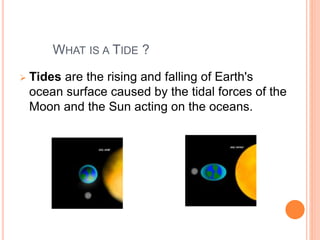
WHAT IS A TIDE ? 
 Tides are the rising and falling of Earth's 
ocean surface caused by the tidal forces of the 
Moon and the Sun acting on the oceans.
WHAT IS THE TIDAL FORCE ? 
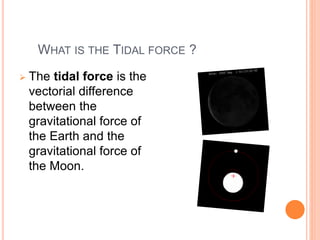
 The tidal force is the 
vectorial difference 
between the 
gravitational force of 
the Earth and the 
gravitational force of 
the Moon.
ABOUT TIDAL POWER 
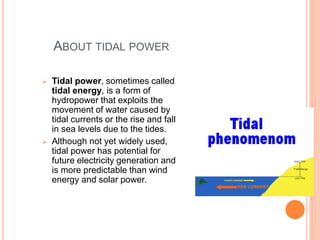
 Tidal power, sometimes called 
tidal energy, is a form of 
hydropower that exploits the 
movement of water caused by 
tidal currents or the rise and fall 
in sea levels due to the tides. 
 Although not yet widely used, 
tidal power has potential for 
future electricity generation and 
is more predictable than wind 
energy and solar power.
PRINCIPLE OF TIDAL POWER STATIONS 
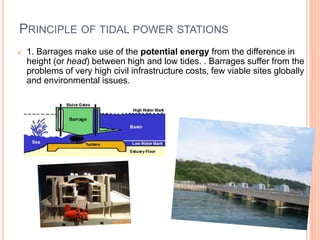
 1. Barrages make use of the potential energy from the difference in 
height (or head) between high and low tides. . Barrages suffer from the 
problems of very high civil infrastructure costs, few viable sites globally 
and environmental issues.
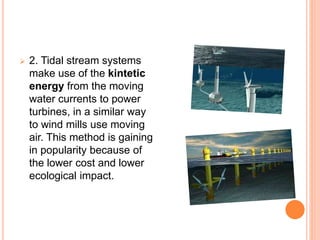
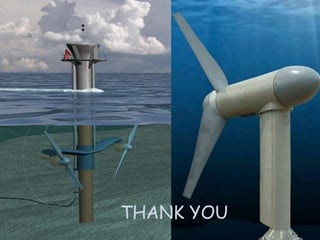
 2. Tidal stream systems 
make use of the kintetic 
energy from the moving 
water currents to power 
turbines, in a similar way 
to wind mills use moving 
air. This method is gaining 
in popularity because of 
the lower cost and lower 
ecological impact.
 Gates & Locks:- 
Tidal power basins have to be filled and emptied gates are open 
regularly and frequently, but heads are vary in highest and on the 
sides where they occurs which is not the case with the conventional 
river projects.The gates must be opened and closed rapidly and this 
operation should use a power. 
 Power House:- 
Because small heads only available large size turbine are 
hence power house is also large structure. Both the French and 
soviet operating use the bulb type of turbine the propeller type with 
the reversible blades. 
CONT…… 
COMPONENTS OF 
TIDAL POWER PLANT
 The Bulb Group:- 
A bulb type turbine is example of flow turbine. The bulb set 
resembling in appearance a small submarine is made up of an ague 
shape steel contains a horizontal duct in which alternator and a 
Kaplan turbine is placed and entirely surrounding by water. 
 Rim Type Turbine:- 
Different types of turbine are under study usually mention are 
include shaft turbine rim type turbine or straight flow turbine where 
the gear is attached on the turbine blade arrangement that couples 
two turbine of conventional type to one generator and a hydraulic 
system in which six turbine are to hydrostatic pumps. The main 
problems in rim type turbine in which the rotor surrounded the turbine 
the runner and rim.
OPERATION METHOD OF 
UTILIZATION OF TIDAL ENERGY 
 Electricity generation requires certain 
heads difference of water flow. The concept 
have been advised for operation hydraulic 
turbine. 
I. Single basin system 
II. Double basin system
I. SINGLE BASIN SYSTEM 
 In this system there is only one interaction with the 
sequence. The two are separated by dam and flow 
between through sluice valves. The generation of 
power is by…….. 
Single ebb cycle system 
Single tide cycle system 
Double cycle system
SINGLE EBB CYCLE SYSTEM:- 
When the flood tide comes in the sluice gates are open to 
permit sea water to enter the basin or reservoir, while turbine 
seas are shut. At the start of ebb tide and the sluice gates are 
closed. The generation of power takes place when the sea is 
ebbing and the water from basin flows over there sufficient 
difference between reservoir and falling tide. 
SINGLE TIDE SYSTEM 
Here generation is affected when sea is at flood tide. The 
water of sea is admitted into the basin over turbine. As the 
flood period is over and the sea level is slopping, the basin is 
drained into the sea through side ways. The main 
disadvantage is in the both the ebb and tide cycle system is 
intermittent occurs at regular interval. There is possibility of 
connection another system such possibility can regulate 
operation of the system for both ebb and flood tides with 
single basin.. 
cont……
DOUBLE CYCLE SYSTEM:- 
The power generation is affected when sea is at flood 
tide. The direction through turbine during the ebb and the 
flood tides alternate but the machine acts as a turbine for 
either direction of flow. 
In this system the power is accomplished during both 
emptying process takes place during short period of time. The 
filling of ocean is high while at low tide emptying occurs. The 
flow of water in both directions is used to drive a no of water 
turbine each driving an electric generator. Electric power is 
generated once in every six hours 12.5 min.
II. DOUBLE BASIN SYSTEM 
 Here the turbine is located two adjacent basin, while the 
sluice gates are usual embodied in the dam across the 
month of two estuaries. At the beginning of the flood tide the 
turbine are shut down. Basin A fills and B remains empty. As 
soon as the head difference of A and B is large enough the 
water is flow from A to B and turbine starts. 
 The separation can be control to make to continuous 
operation from upper to lower basin. However since water 
head between basin varies during each tidal cycle. As well 
as day so also power generation to improve situation in use 
off peak power from tidal generator or from alternate system 
to pump water from low to high basin, and increased head is 
available from tidal power at peak times.
ADVANTAGES OF USING TIDAL POWER: 
 Predictable source of “green" energy during 
lifetime of barrage 
 It produces no greenhouse gases or other waste; it 
needs no fuel. 
 Not expensive to maintain. 
 Tidal energy has an efficiency of 80% in converting 
the potential energy of the water into electricity 
 Vertical-axis tidal generators may be joined 
together in series to create a ‘tidal fence’ capable of 
generating electricity on a scale comparable to the 
largest existing fossil fuel based, hydroelectric and 
nuclear energy generation facilities
DISADVANTAGES OF USING TIDAL 
POWER: 
 A barrage across an estuary is very 
expensive to build, and affects a very wide 
area - the environment is changed for many 
miles upstream and downstream 
 it provides power for around 10 hours each 
day, when the tide is actually moving in or 
out, which is not very much 
 Existing ecosystems would be heavily 
altered, with new species moving in and 
perhaps dominating old species 
 Tidal power schemes have a high capital 
cost
GLOBAL ENVIROMENTAL IMPACT 
 A tidal power scheme is a long-term source of 
electricity. A proposal for the Severn Barrage, if 
built, has been projected to save 18 million 
tonnes of coal per year of operation. This 
decreases the output of greenhouse gases into 
the atmosphere. 
 If fossil fuel resource is likely to decline during 
the 21st century, as predicted by Hubbert peak 
theory, tidal power is one of the alternative 
source of energy that will need to be developed 
to satisfy the human demand for energy.
PRESENT IN INDIA 
 Gulf of Kutch Project 50 MW(Capacity) India Gulf 
of Kutch in 2012 
 Asia’s first tidal power plant
THANK YOU

Tidal Power

  • 1.
    TIDAL POWER Createdby:- Yash Kathiriya Chetan Chauhan Jaydeep Patel
  • 2.
    CONTENT  Tide  Tidal Force  Tidal Power  Principal of Tidal Power  Components of Tidal Power plant  Operation Method  Advantages & Disadvantages  Global Environment Impact
  • 3.
    WHAT IS ATIDE ?  Tides are the rising and falling of Earth's ocean surface caused by the tidal forces of the Moon and the Sun acting on the oceans.
  • 4.
    WHAT IS THETIDAL FORCE ?  The tidal force is the vectorial difference between the gravitational force of the Earth and the gravitational force of the Moon.
  • 5.
    ABOUT TIDAL POWER  Tidal power, sometimes called tidal energy, is a form of hydropower that exploits the movement of water caused by tidal currents or the rise and fall in sea levels due to the tides.  Although not yet widely used, tidal power has potential for future electricity generation and is more predictable than wind energy and solar power.
  • 6.
    PRINCIPLE OF TIDALPOWER STATIONS  1. Barrages make use of the potential energy from the difference in height (or head) between high and low tides. . Barrages suffer from the problems of very high civil infrastructure costs, few viable sites globally and environmental issues.
  • 7.
     2. Tidalstream systems make use of the kintetic energy from the moving water currents to power turbines, in a similar way to wind mills use moving air. This method is gaining in popularity because of the lower cost and lower ecological impact.
  • 8.
     Gates &Locks:- Tidal power basins have to be filled and emptied gates are open regularly and frequently, but heads are vary in highest and on the sides where they occurs which is not the case with the conventional river projects.The gates must be opened and closed rapidly and this operation should use a power.  Power House:- Because small heads only available large size turbine are hence power house is also large structure. Both the French and soviet operating use the bulb type of turbine the propeller type with the reversible blades. CONT…… COMPONENTS OF TIDAL POWER PLANT
  • 9.
     The BulbGroup:- A bulb type turbine is example of flow turbine. The bulb set resembling in appearance a small submarine is made up of an ague shape steel contains a horizontal duct in which alternator and a Kaplan turbine is placed and entirely surrounding by water.  Rim Type Turbine:- Different types of turbine are under study usually mention are include shaft turbine rim type turbine or straight flow turbine where the gear is attached on the turbine blade arrangement that couples two turbine of conventional type to one generator and a hydraulic system in which six turbine are to hydrostatic pumps. The main problems in rim type turbine in which the rotor surrounded the turbine the runner and rim.
  • 10.
    OPERATION METHOD OF UTILIZATION OF TIDAL ENERGY  Electricity generation requires certain heads difference of water flow. The concept have been advised for operation hydraulic turbine. I. Single basin system II. Double basin system
  • 11.
    I. SINGLE BASINSYSTEM  In this system there is only one interaction with the sequence. The two are separated by dam and flow between through sluice valves. The generation of power is by…….. Single ebb cycle system Single tide cycle system Double cycle system
  • 12.
    SINGLE EBB CYCLESYSTEM:- When the flood tide comes in the sluice gates are open to permit sea water to enter the basin or reservoir, while turbine seas are shut. At the start of ebb tide and the sluice gates are closed. The generation of power takes place when the sea is ebbing and the water from basin flows over there sufficient difference between reservoir and falling tide. SINGLE TIDE SYSTEM Here generation is affected when sea is at flood tide. The water of sea is admitted into the basin over turbine. As the flood period is over and the sea level is slopping, the basin is drained into the sea through side ways. The main disadvantage is in the both the ebb and tide cycle system is intermittent occurs at regular interval. There is possibility of connection another system such possibility can regulate operation of the system for both ebb and flood tides with single basin.. cont……
  • 13.
    DOUBLE CYCLE SYSTEM:- The power generation is affected when sea is at flood tide. The direction through turbine during the ebb and the flood tides alternate but the machine acts as a turbine for either direction of flow. In this system the power is accomplished during both emptying process takes place during short period of time. The filling of ocean is high while at low tide emptying occurs. The flow of water in both directions is used to drive a no of water turbine each driving an electric generator. Electric power is generated once in every six hours 12.5 min.
  • 14.
    II. DOUBLE BASINSYSTEM  Here the turbine is located two adjacent basin, while the sluice gates are usual embodied in the dam across the month of two estuaries. At the beginning of the flood tide the turbine are shut down. Basin A fills and B remains empty. As soon as the head difference of A and B is large enough the water is flow from A to B and turbine starts.  The separation can be control to make to continuous operation from upper to lower basin. However since water head between basin varies during each tidal cycle. As well as day so also power generation to improve situation in use off peak power from tidal generator or from alternate system to pump water from low to high basin, and increased head is available from tidal power at peak times.
  • 15.
    ADVANTAGES OF USINGTIDAL POWER:  Predictable source of “green" energy during lifetime of barrage  It produces no greenhouse gases or other waste; it needs no fuel.  Not expensive to maintain.  Tidal energy has an efficiency of 80% in converting the potential energy of the water into electricity  Vertical-axis tidal generators may be joined together in series to create a ‘tidal fence’ capable of generating electricity on a scale comparable to the largest existing fossil fuel based, hydroelectric and nuclear energy generation facilities
  • 16.
    DISADVANTAGES OF USINGTIDAL POWER:  A barrage across an estuary is very expensive to build, and affects a very wide area - the environment is changed for many miles upstream and downstream  it provides power for around 10 hours each day, when the tide is actually moving in or out, which is not very much  Existing ecosystems would be heavily altered, with new species moving in and perhaps dominating old species  Tidal power schemes have a high capital cost
  • 17.
    GLOBAL ENVIROMENTAL IMPACT  A tidal power scheme is a long-term source of electricity. A proposal for the Severn Barrage, if built, has been projected to save 18 million tonnes of coal per year of operation. This decreases the output of greenhouse gases into the atmosphere.  If fossil fuel resource is likely to decline during the 21st century, as predicted by Hubbert peak theory, tidal power is one of the alternative source of energy that will need to be developed to satisfy the human demand for energy.
  • 18.
    PRESENT IN INDIA  Gulf of Kutch Project 50 MW(Capacity) India Gulf of Kutch in 2012  Asia’s first tidal power plant
  • 19.