A Seminar Presentation on
Tidal Energy
A Renewable Energy Resources
Presented By: Presented To:
PUSHPENDRA PAL MR. DEEPAK PANDEY
1616421044 MR. ANKIT SRIVASTAVA
Contents
 RELEVANCE OF THE TOPIC
 INTRODUCTION
 TIDES & TIDAL POWER
 CLASSIFICATION
 TYPES OF TURBINE
 COMPARISION
 GLOBALAND INDIAN TIDAL ENERGY SCENARIO
 IMPROVEMENTS POSSIBLE
 PROS AND CONS
 FACTS
2
WHY TIDAL ENERGY CAME INTO EXISTANCE ?
 RENEWABLE ENERGY SOURCE
 IMPROVED ENERGY SECURITY
 MOST EFFICIENT ENERGY RESOURCE
 NO GREENHOUSE GAS EMMISION
3
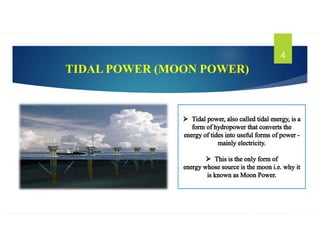
TIDAL POWER (MOON POWER)
4
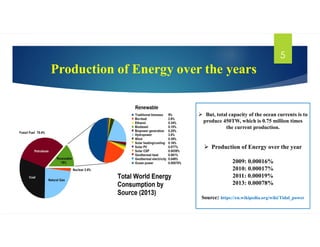
Production of Energy over the years
5
 But, total capacity of the ocean currents is to
produce 450TW, which is 0.75 million times
the current production.
 Production of Energy over the year
2009: 0.00016%
2010: 0.00017%
2011: 0.00019%
2013: 0.00078%
Source: https://en.wikipedia.org/wiki/Tidal_power
INTRODUCTION TO TIDAL ENERGY
 Tidal energy is one of many forms of hydropower generation.
 It comes from the gravitational forces of the Sun and the Moon
on the Earth’s bodies of water.
 It is creating periodic shifts in these bodies of water. These
shifts are called tides. The tide moves a huge amount of water
twice each day.
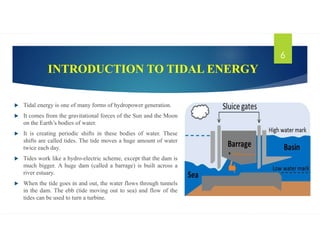
 Tides work like a hydro-electric scheme, except that the dam is
much bigger. A huge dam (called a barrage) is built across a
river estuary.
 When the tide goes in and out, the water flows through tunnels
in the dam. The ebb (tide moving out to sea) and flow of the
tides can be used to turn a turbine.
6
A TIDE
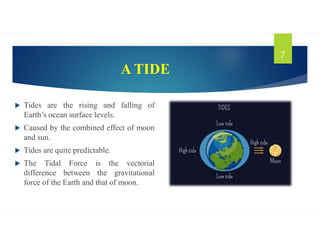
 Tides are the rising and falling of
Earth’s ocean surface levels.
 Caused by the combined effect of moon
and sun.
 Tides are quite predictable.
 The Tidal Force is the vectorial
difference between the gravitational
force of the Earth and that of moon.
7
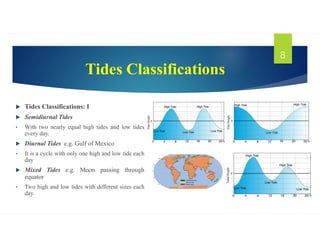
Tides Classifications
 Tides Classifications: I
 Semidiurnal Tides
• With two nearly equal high tides and low tides
every day.
 Diurnal Tides e.g. Gulf of Mexico
• It is a cycle with only one high and low tide each
day
 Mixed Tides e.g. Moon passing through
equator
• Two high and low tides with different sizes each
day.
8
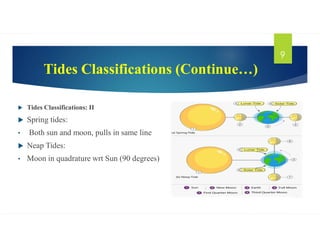
Tides Classifications (Continue…)
 Tides Classifications: II
 Spring tides:
• Both sun and moon, pulls in same line
 Neap Tides:
• Moon in quadrature wrt Sun (90 degrees)
9
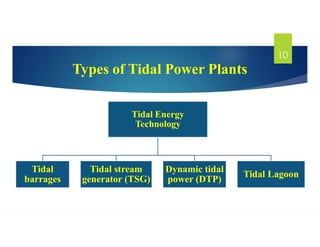
Types of Tidal Power Plants
10
Tidal Energy
Technology
Tidal
barrages
Tidal stream
generator (TSG)
Dynamic tidal
power (DTP)
Tidal Lagoon
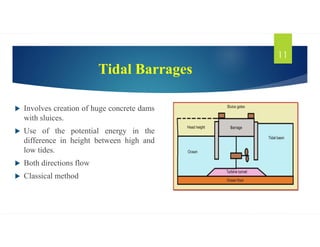
Tidal Barrages
 Involves creation of huge concrete dams
with sluices.
 Use of the potential energy in the
difference in height between high and
low tides.
 Both directions flow
 Classical method
11
Continue.…
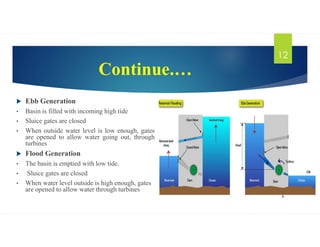
 Ebb Generation
• Basin is filled with incoming high tide
• Sluice gates are closed
• When outside water level is low enough, gates
are opened to allow water going out, through
turbines
 Flood Generation
• The basin is emptied with low tide.
• Sluice gates are closed
• When water level outside is high enough, gates
are opened to allow water through turbines
12
Tidal Stream Generators (TSG)
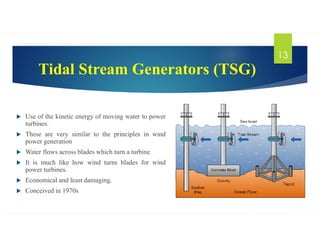
 Use of the kinetic energy of moving water to power
turbines.
 These are very similar to the principles in wind
power generation
 Water flows across blades which turn a turbine
 It is much like how wind turns blades for wind
power turbines.
 Economical and least damaging.
 Conceived in 1970s
13
Tidal Stream Turbine
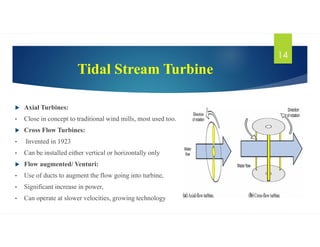
 Axial Turbines:
• Close in concept to traditional wind mills, most used too.
 Cross Flow Turbines:
• Invented in 1923
• Can be installed either vertical or horizontally only
 Flow augmented/ Venturi:
• Use of ducts to augment the flow going into turbine,
• Significant increase in power,
• Can operate at slower velocities, growing technology
14
Dynamic Tidal Power (DTP)
Latest Advancement
 This technology is not currently commercial viable.
 UK, Korea, and China have invested heavily in its
research.
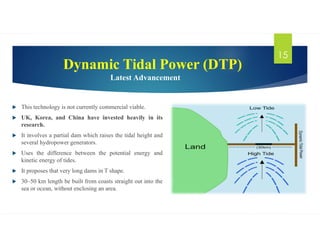
 It involves a partial dam which raises the tidal height and
several hydropower generators.
 Uses the difference between the potential energy and
kinetic energy of tides.
 It proposes that very long dams in T shape.
 30–50 km length be built from coasts straight out into the
sea or ocean, without enclosing an area.
15
Tidal Lagoon
Latest Advancement
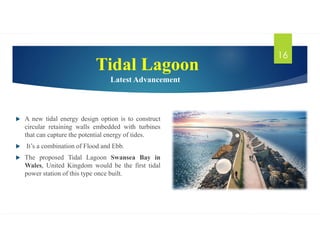
 A new tidal energy design option is to construct
circular retaining walls embedded with turbines
that can capture the potential energy of tides.
 It’s a combination of Flood and Ebb.
 The proposed Tidal Lagoon Swansea Bay in
Wales, United Kingdom would be the first tidal
power station of this type once built.
16
Types of Turbines used:
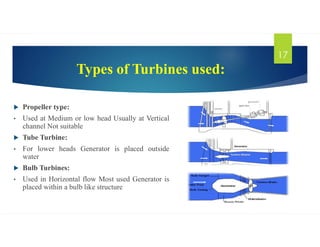
 Propeller type:
• Used at Medium or low head Usually at Vertical
channel Not suitable
 Tube Turbine:
• For lower heads Generator is placed outside
water
 Bulb Turbines:
• Used in Horizontal flow Most used Generator is
placed within a bulb like structure
17
Global Tidal Energy Scenario
 Tidal power is not yet widely used around the
world, though it has potential for future
electricity generation.
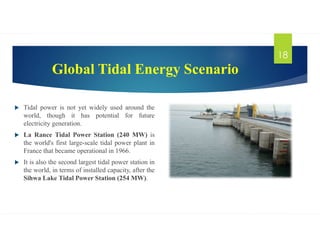
 La Rance Tidal Power Station (240 MW) is
the world's first large-scale tidal power plant in
France that became operational in 1966.
 It is also the second largest tidal power station in
the world, in terms of installed capacity, after the
Sihwa Lake Tidal Power Station (254 MW).
18
Tidal Power Stations in World
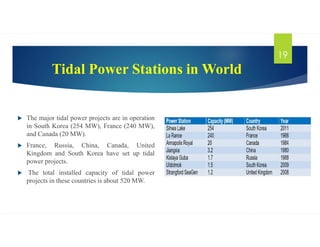
 The major tidal power projects are in operation
in South Korea (254 MW), France (240 MW),
and Canada (20 MW).
 France, Russia, China, Canada, United
Kingdom and South Korea have set up tidal
power projects.
 The total installed capacity of tidal power
projects in these countries is about 520 MW.
19
Indian Tidal Energy Scenario
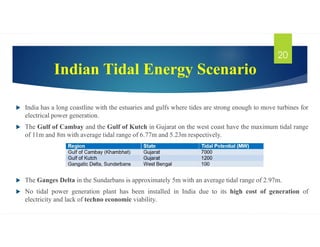
 India has a long coastline with the estuaries and gulfs where tides are strong enough to move turbines for
electrical power generation.
 The Gulf of Cambay and the Gulf of Kutch in Gujarat on the west coast have the maximum tidal range
of 11m and 8m with average tidal range of 6.77m and 5.23m respectively.
 The Ganges Delta in the Sundarbans is approximately 5m with an average tidal range of 2.97m.
 No tidal power generation plant has been installed in India due to its high cost of generation of
electricity and lack of techno economic viability.
20
Pros & Cons of Tidal Power
Advantages
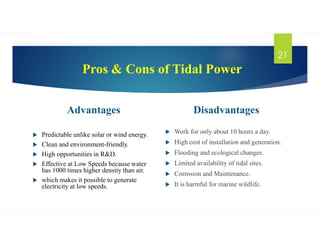
 Predictable unlike solar or wind energy.
 Clean and environment-friendly.
 High opportunities in R&D.
 Effective at Low Speeds because water
has 1000 times higher density than air.
 which makes it possible to generate
electricity at low speeds.
Disadvantages
 Work for only about 10 hours a day.
 High cost of installation and generation.
 Flooding and ecological changes.
 Limited availability of tidal sites.
 Corrosion and Maintenance.
 It is harmful for marine wildlife.
21
Economics
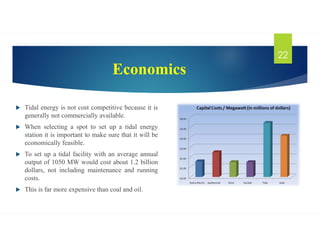
 Tidal energy is not cost competitive because it is
generally not commercially available.
 When selecting a spot to set up a tidal energy
station it is important to make sure that it will be
economically feasible.
 To set up a tidal facility with an average annual
output of 1050 MW would cost about 1.2 billion
dollars, not including maintenance and running
costs.
 This is far more expensive than coal and oil.
22
Improvements Possible &
Conclusions
 Optimizing existing schemes.
 Studies to minimize the environmental impact.
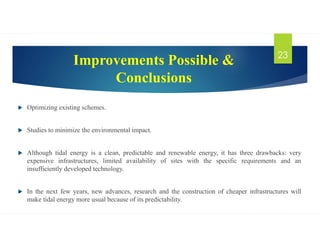
 Although tidal energy is a clean, predictable and renewable energy, it has three drawbacks: very
expensive infrastructures, limited availability of sites with the specific requirements and an
insufficiently developed technology.
 In the next few years, new advances, research and the construction of cheaper infrastructures will
make tidal energy more usual because of its predictability.
23
FUTURE ?
 In a society with increasing energy needs, it is becoming more and more important to
have alternative sources of power to keep up with the ever growing energy demand.
 The capacity of tidal energy exceeds that of coal and oil and is renewable.
 The Department of Energy has shown great enthusiasm in regards to tidal power as the
perfect energy source for the future.
24
SCOPE
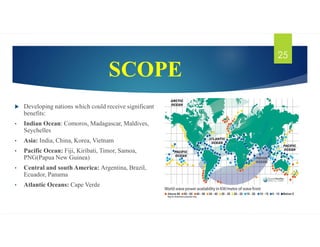
 Developing nations which could receive significant
benefits:
• Indian Ocean: Comoros, Madagascar, Maldives,
Seychelles
• Asia: India, China, Korea, Vietnam
• Pacific Ocean: Fiji, Kiribati, Timor, Samoa,
PNG(Papua New Guinea)
• Central and south America: Argentina, Brazil,
Ecuador, Panama
• Atlantic Oceans: Cape Verde
25
References
 http://en.wikipedia.org/wiki/Tidal_power
 http://en.wikipedia.org/wiki/Tide
 http://www.energybusinessdaily.com/
 http://www.answers.com/
 Tidal-power-report-141203005504-conversion-gate02.pdf
 GD Rai, a textbook of Non- conventional Energy Sources.
26
THANK
YOU
 “Take risks in your life, If you
win, you can lead! If you loose,
you can guide! - Swami Vivekananda
27

Tidal energy- A Renewable Energy Resources

  • 1.
    A Seminar Presentationon Tidal Energy A Renewable Energy Resources Presented By: Presented To: PUSHPENDRA PAL MR. DEEPAK PANDEY 1616421044 MR. ANKIT SRIVASTAVA
  • 2.
    Contents  RELEVANCE OFTHE TOPIC  INTRODUCTION  TIDES & TIDAL POWER  CLASSIFICATION  TYPES OF TURBINE  COMPARISION  GLOBALAND INDIAN TIDAL ENERGY SCENARIO  IMPROVEMENTS POSSIBLE  PROS AND CONS  FACTS 2
  • 3.
    WHY TIDAL ENERGYCAME INTO EXISTANCE ?  RENEWABLE ENERGY SOURCE  IMPROVED ENERGY SECURITY  MOST EFFICIENT ENERGY RESOURCE  NO GREENHOUSE GAS EMMISION 3
  • 4.
  • 5.
    Production of Energyover the years 5  But, total capacity of the ocean currents is to produce 450TW, which is 0.75 million times the current production.  Production of Energy over the year 2009: 0.00016% 2010: 0.00017% 2011: 0.00019% 2013: 0.00078% Source: https://en.wikipedia.org/wiki/Tidal_power
  • 6.
    INTRODUCTION TO TIDALENERGY  Tidal energy is one of many forms of hydropower generation.  It comes from the gravitational forces of the Sun and the Moon on the Earth’s bodies of water.  It is creating periodic shifts in these bodies of water. These shifts are called tides. The tide moves a huge amount of water twice each day.  Tides work like a hydro-electric scheme, except that the dam is much bigger. A huge dam (called a barrage) is built across a river estuary.  When the tide goes in and out, the water flows through tunnels in the dam. The ebb (tide moving out to sea) and flow of the tides can be used to turn a turbine. 6
  • 7.
    A TIDE  Tidesare the rising and falling of Earth’s ocean surface levels.  Caused by the combined effect of moon and sun.  Tides are quite predictable.  The Tidal Force is the vectorial difference between the gravitational force of the Earth and that of moon. 7
  • 8.
    Tides Classifications  TidesClassifications: I  Semidiurnal Tides • With two nearly equal high tides and low tides every day.  Diurnal Tides e.g. Gulf of Mexico • It is a cycle with only one high and low tide each day  Mixed Tides e.g. Moon passing through equator • Two high and low tides with different sizes each day. 8
  • 9.
    Tides Classifications (Continue…) Tides Classifications: II  Spring tides: • Both sun and moon, pulls in same line  Neap Tides: • Moon in quadrature wrt Sun (90 degrees) 9
  • 10.
    Types of TidalPower Plants 10 Tidal Energy Technology Tidal barrages Tidal stream generator (TSG) Dynamic tidal power (DTP) Tidal Lagoon
  • 11.
    Tidal Barrages  Involvescreation of huge concrete dams with sluices.  Use of the potential energy in the difference in height between high and low tides.  Both directions flow  Classical method 11
  • 12.
    Continue.…  Ebb Generation •Basin is filled with incoming high tide • Sluice gates are closed • When outside water level is low enough, gates are opened to allow water going out, through turbines  Flood Generation • The basin is emptied with low tide. • Sluice gates are closed • When water level outside is high enough, gates are opened to allow water through turbines 12
  • 13.
    Tidal Stream Generators(TSG)  Use of the kinetic energy of moving water to power turbines.  These are very similar to the principles in wind power generation  Water flows across blades which turn a turbine  It is much like how wind turns blades for wind power turbines.  Economical and least damaging.  Conceived in 1970s 13
  • 14.
    Tidal Stream Turbine Axial Turbines: • Close in concept to traditional wind mills, most used too.  Cross Flow Turbines: • Invented in 1923 • Can be installed either vertical or horizontally only  Flow augmented/ Venturi: • Use of ducts to augment the flow going into turbine, • Significant increase in power, • Can operate at slower velocities, growing technology 14
  • 15.
    Dynamic Tidal Power(DTP) Latest Advancement  This technology is not currently commercial viable.  UK, Korea, and China have invested heavily in its research.  It involves a partial dam which raises the tidal height and several hydropower generators.  Uses the difference between the potential energy and kinetic energy of tides.  It proposes that very long dams in T shape.  30–50 km length be built from coasts straight out into the sea or ocean, without enclosing an area. 15
  • 16.
    Tidal Lagoon Latest Advancement A new tidal energy design option is to construct circular retaining walls embedded with turbines that can capture the potential energy of tides.  It’s a combination of Flood and Ebb.  The proposed Tidal Lagoon Swansea Bay in Wales, United Kingdom would be the first tidal power station of this type once built. 16
  • 17.
    Types of Turbinesused:  Propeller type: • Used at Medium or low head Usually at Vertical channel Not suitable  Tube Turbine: • For lower heads Generator is placed outside water  Bulb Turbines: • Used in Horizontal flow Most used Generator is placed within a bulb like structure 17
  • 18.
    Global Tidal EnergyScenario  Tidal power is not yet widely used around the world, though it has potential for future electricity generation.  La Rance Tidal Power Station (240 MW) is the world's first large-scale tidal power plant in France that became operational in 1966.  It is also the second largest tidal power station in the world, in terms of installed capacity, after the Sihwa Lake Tidal Power Station (254 MW). 18
  • 19.
    Tidal Power Stationsin World  The major tidal power projects are in operation in South Korea (254 MW), France (240 MW), and Canada (20 MW).  France, Russia, China, Canada, United Kingdom and South Korea have set up tidal power projects.  The total installed capacity of tidal power projects in these countries is about 520 MW. 19
  • 20.
    Indian Tidal EnergyScenario  India has a long coastline with the estuaries and gulfs where tides are strong enough to move turbines for electrical power generation.  The Gulf of Cambay and the Gulf of Kutch in Gujarat on the west coast have the maximum tidal range of 11m and 8m with average tidal range of 6.77m and 5.23m respectively.  The Ganges Delta in the Sundarbans is approximately 5m with an average tidal range of 2.97m.  No tidal power generation plant has been installed in India due to its high cost of generation of electricity and lack of techno economic viability. 20
  • 21.
    Pros & Consof Tidal Power Advantages  Predictable unlike solar or wind energy.  Clean and environment-friendly.  High opportunities in R&D.  Effective at Low Speeds because water has 1000 times higher density than air.  which makes it possible to generate electricity at low speeds. Disadvantages  Work for only about 10 hours a day.  High cost of installation and generation.  Flooding and ecological changes.  Limited availability of tidal sites.  Corrosion and Maintenance.  It is harmful for marine wildlife. 21
  • 22.
    Economics  Tidal energyis not cost competitive because it is generally not commercially available.  When selecting a spot to set up a tidal energy station it is important to make sure that it will be economically feasible.  To set up a tidal facility with an average annual output of 1050 MW would cost about 1.2 billion dollars, not including maintenance and running costs.  This is far more expensive than coal and oil. 22
  • 23.
    Improvements Possible & Conclusions Optimizing existing schemes.  Studies to minimize the environmental impact.  Although tidal energy is a clean, predictable and renewable energy, it has three drawbacks: very expensive infrastructures, limited availability of sites with the specific requirements and an insufficiently developed technology.  In the next few years, new advances, research and the construction of cheaper infrastructures will make tidal energy more usual because of its predictability. 23
  • 24.
    FUTURE ?  Ina society with increasing energy needs, it is becoming more and more important to have alternative sources of power to keep up with the ever growing energy demand.  The capacity of tidal energy exceeds that of coal and oil and is renewable.  The Department of Energy has shown great enthusiasm in regards to tidal power as the perfect energy source for the future. 24
  • 25.
    SCOPE  Developing nationswhich could receive significant benefits: • Indian Ocean: Comoros, Madagascar, Maldives, Seychelles • Asia: India, China, Korea, Vietnam • Pacific Ocean: Fiji, Kiribati, Timor, Samoa, PNG(Papua New Guinea) • Central and south America: Argentina, Brazil, Ecuador, Panama • Atlantic Oceans: Cape Verde 25
  • 26.
    References  http://en.wikipedia.org/wiki/Tidal_power  http://en.wikipedia.org/wiki/Tide http://www.energybusinessdaily.com/  http://www.answers.com/  Tidal-power-report-141203005504-conversion-gate02.pdf  GD Rai, a textbook of Non- conventional Energy Sources. 26
  • 27.
    THANK YOU  “Take risksin your life, If you win, you can lead! If you loose, you can guide! - Swami Vivekananda 27