System Approach and
Contingency Approach
Presented by,
Ambarish Biswas (EEE120200188)
Md. Aktaruzzaman (EEE120100169)
Farhad Hossain (EEE120100180)
Salman Bin Muzib (CSE 100200619)
System
• A system is a set of interrelated but
separate parts working towards a common
purpose.
• The arrangement must be orderly and
there must be proper communication
facilitating interaction between the
elements and finally this interaction should
lead to achieve a common goal.
System Approach
• System approach to management views
the organization as a unified, purposeful
system composed of interrelated parts.
• This approach also gives the manager to
see the organization as a whole and as a
part of the larger external environment.
Contd…
• System oriented manager would make
decisions only after they have identified
impact of these decisions on all other
departments and the entire organization.
• They must intertwine their department with
the total organization and communicate
with all other departments, employees and
with each other.
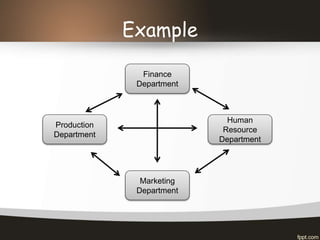
Example
Production
Department
Marketing
Department
Human
Resource
Department
Finance
Department
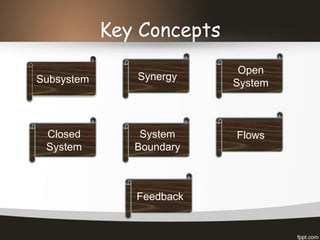
Key Concepts
Subsystem
Feedback
FlowsSystem
Boundary
Closed
System
Synergy
Open
System
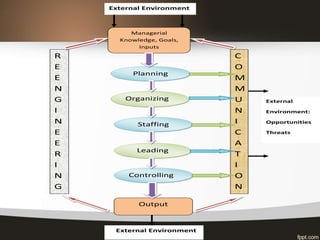
Managerial
Knowledge, Goals,
Inputs
Planning
Organizing
Staffing
Leading
Controlling
Output
R
E
E
N
G
I
N
E
E
R
I
N
G
C
O
M
M
U
N
I
C
A
T
I
O
N
External Environment
External
Environment:
Opportunities
Threats
Characteristics
• Systems have structure, defined by parts and their
composition;
• Systems have behavior, which involves inputs,
processing and outputs of material, energy or
information;
• Systems have interconnectivity : the various parts of
a system have functional as well as structural
relationships between each other.
• System(s) have by itself function(s) or group
of functions .
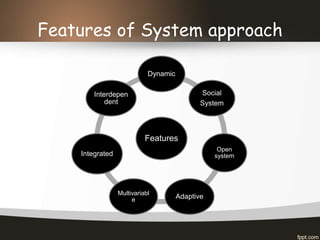
Features of System approach
Features
Dynamic
Social
System
Open
system
AdaptiveMultivariabl
e
Integrated
Interdepen
dent
Advantages
• It aims at meaningful analysis of
organizations and their management.
• It facilitates the interaction between
organization and its environment.
• It guide manager to avoid analyzing
problems in isolation and to develop an
integrated approach.
Disadvantages
• The approach does not recognize the
differences in systems.
• Over-conceptual
• Systems philosophy does not specify the
nature of interactions and
interdependencies.
• Unpractical: It cannot be easily and directly
applied to practical problems.
• Lack of Universality
• Complex System
CONTINGENCY APPRAOACH
Contingency approach states that there is “no
one best way” to manage an organisation.
It is also known as situational approach.
• In 1970s, it is recognized as a key to effective
management.
• CONTRIBUTORS:
 L.W. Lorsch
 Joan Woodward
 Burns
 George Stalker
 Paul R.Lawrence
What you do “depends” on the
“situation”.
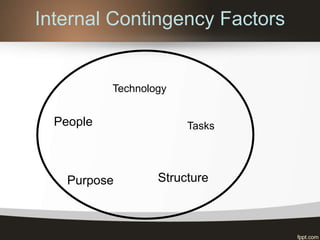
-internal contingency factors
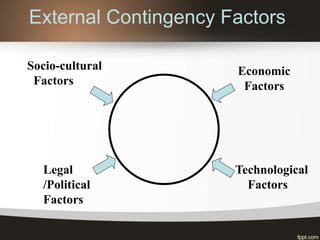
-external contingency factors
Internal Contingency Factors
Tasks
Technology
People
Purpose Structure
External Contingency Factors
Socio-cultural
Factors
Economic
Factors
Technological
Factors
Legal
/Political
Factors
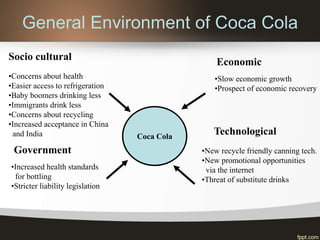
General Environment of Coca Cola
Socio cultural
•Concerns about health
•Easier access to refrigeration
•Baby boomers drinking less
•Immigrants drink less
•Concerns about recycling
•Increased acceptance in China
and India
Government
•Increased health standards
for bottling
•Stricter liability legislation
Economic
•Slow economic growth
•Prospect of economic recovery
Technological
•New recycle friendly canning tech.
•New promotional opportunities
via the internet
•Threat of substitute drinks
Coca Cola
Instead of propagating universally applicable
organisation-management principles, this
theory tries to demonstrate that different
circumstances require different organisational
structures
What works for one organisation may not work
for the other.
Managers need to understand the key
contingencies that effect the management
practice for a given situation.
 Difficulty in determining all relevant
contingency factors and showing relationship
between them may be complex.
 It is totally practical approach without support of
theoretical and conceptual frame work.
 Sometimes manager finds difficulties in
analyzing the situation and discovering
appropriate management technique in absence of
proper research and lack of proper understanding
of the situation.
Limitations of Contingency Approach:
Questions:
1.What is system approach? Give example and write the
key concepts of system approach.
2.Write the block diagram of system approach external
environment and features of system approach.
3.What is contingency approach? Write the internal and
external contingency factors.
4.Discribe the external contingency factors of general
environment of Coca Cola.
True-False:
1.Feedback is a part of key concept of system approach. T
2.External contingency factors are to types. F
3.Technological factor is a part of external contingency factor. T
THANK YOU

System & contengency approach

  • 1.
    System Approach and ContingencyApproach Presented by, Ambarish Biswas (EEE120200188) Md. Aktaruzzaman (EEE120100169) Farhad Hossain (EEE120100180) Salman Bin Muzib (CSE 100200619)
  • 2.
    System • A systemis a set of interrelated but separate parts working towards a common purpose. • The arrangement must be orderly and there must be proper communication facilitating interaction between the elements and finally this interaction should lead to achieve a common goal.
  • 3.
    System Approach • Systemapproach to management views the organization as a unified, purposeful system composed of interrelated parts. • This approach also gives the manager to see the organization as a whole and as a part of the larger external environment.
  • 4.
    Contd… • System orientedmanager would make decisions only after they have identified impact of these decisions on all other departments and the entire organization. • They must intertwine their department with the total organization and communicate with all other departments, employees and with each other.
  • 5.
  • 6.
  • 7.
  • 8.
    Characteristics • Systems havestructure, defined by parts and their composition; • Systems have behavior, which involves inputs, processing and outputs of material, energy or information; • Systems have interconnectivity : the various parts of a system have functional as well as structural relationships between each other. • System(s) have by itself function(s) or group of functions .
  • 9.
    Features of Systemapproach Features Dynamic Social System Open system AdaptiveMultivariabl e Integrated Interdepen dent
  • 10.
    Advantages • It aimsat meaningful analysis of organizations and their management. • It facilitates the interaction between organization and its environment. • It guide manager to avoid analyzing problems in isolation and to develop an integrated approach.
  • 11.
    Disadvantages • The approachdoes not recognize the differences in systems. • Over-conceptual • Systems philosophy does not specify the nature of interactions and interdependencies. • Unpractical: It cannot be easily and directly applied to practical problems. • Lack of Universality • Complex System
  • 12.
  • 13.
    Contingency approach statesthat there is “no one best way” to manage an organisation. It is also known as situational approach.
  • 14.
    • In 1970s,it is recognized as a key to effective management. • CONTRIBUTORS:  L.W. Lorsch  Joan Woodward  Burns  George Stalker  Paul R.Lawrence
  • 15.
    What you do“depends” on the “situation”. -internal contingency factors -external contingency factors
  • 16.
  • 17.
  • 18.
    General Environment ofCoca Cola Socio cultural •Concerns about health •Easier access to refrigeration •Baby boomers drinking less •Immigrants drink less •Concerns about recycling •Increased acceptance in China and India Government •Increased health standards for bottling •Stricter liability legislation Economic •Slow economic growth •Prospect of economic recovery Technological •New recycle friendly canning tech. •New promotional opportunities via the internet •Threat of substitute drinks Coca Cola
  • 19.
    Instead of propagatinguniversally applicable organisation-management principles, this theory tries to demonstrate that different circumstances require different organisational structures What works for one organisation may not work for the other. Managers need to understand the key contingencies that effect the management practice for a given situation.
  • 20.
     Difficulty indetermining all relevant contingency factors and showing relationship between them may be complex.  It is totally practical approach without support of theoretical and conceptual frame work.  Sometimes manager finds difficulties in analyzing the situation and discovering appropriate management technique in absence of proper research and lack of proper understanding of the situation. Limitations of Contingency Approach:
  • 21.
    Questions: 1.What is systemapproach? Give example and write the key concepts of system approach. 2.Write the block diagram of system approach external environment and features of system approach. 3.What is contingency approach? Write the internal and external contingency factors. 4.Discribe the external contingency factors of general environment of Coca Cola.
  • 22.
    True-False: 1.Feedback is apart of key concept of system approach. T 2.External contingency factors are to types. F 3.Technological factor is a part of external contingency factor. T
  • 23.