GUIDED BY-
B.J. SONANI SIR
PREPARED BY:-
MAYANK H. PAL
5TH SEM MECH.ENGG.
(136120319528)
Topic-:Thermo electric
cooling
Sub-:Project-1
 Gadhiya Sagar K. (136120319506)
 Marakana Sanket S. (136120319521)
 Mendapara Prince K. (136120319523)
 Modi Anuj B. (136120319525)
 Pal Mayank H. (136120319528)
 Parmar Maulik R. (136120319530)
 The thermoelectric cooling is used as renewed
technology, has made an impact in the field of
alternative refrigeration. The common principle
is the presence of coupled electrical and
thermal currents, so that it is possible to use the
effects to generate power from a temperature
differential.
 Thermoelectric cooling provides an alternative
solution to the common compressor and
absorber cooler. Thermoelectric coolers are
used especially if small cooling power is
 Thomas Seebeck in the early 1820’s found that
a voltage difference is generated between the
hot and cold ends when certain materials are
placed in a temperature gradient.
 This phenomenon is popularly known as
Seebeck effect.
 Depending on the used heat exchangers the
cooling units are distinguished:
 air to air
 air to fluid
 fluid to fluid
 direct to air (cooling plate to air)
 small size
 light in weight
 no fluid
 independent from the working position
 high reliability
 exact temperature control
 heating by changing the direction of the current
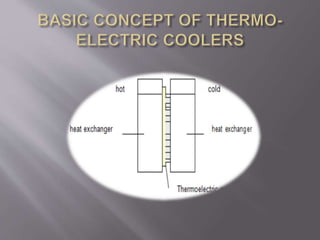
 The basic principle behind thermoelectric effect is
peltier effect it occurs whenever electric current
flows between two dissimilar conductors,
depending on the direction of the current flow, the
junction of the two conductors will either absorb or
release heat.
 A thermoelectric material is made of two legs, one
of which is ‘n-type’ and contains negatively charged
mobile carriers in the form of electrons while the
other leg is ‘p-type’ and contains positively charged
mobile carriers known as holes. These two legs are
connected electrically in series and thermally in
parallel.
 By connecting 2 wires of different electrically
leading materials at the 2 ends and by applying
additionally a voltage, a current flows, which
transports heat of one junction point to the other.
In the consequence one junction point becomes
cold and the other one warm.
 For thermoelectric modules materials are applicable
with a high electrical conductivity and a small thermal
conductivity. Unfortunately good electrical conductors
are also good heat conductors. The best efficiency is
obtained with semi-conductors
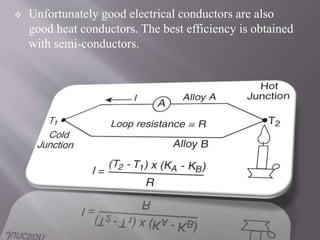
 Unfortunately good electrical conductors are also
good heat conductors. The best efficiency is obtained
with semi-conductors.
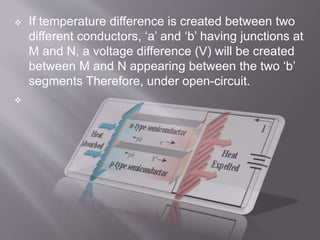
 If temperature difference is created between two
different conductors, ‘a’ and ‘b’ having junctions at
M and N, a voltage difference (V) will be created
between M and N appearing between the two ‘b’
segments Therefore, under open-circuit.

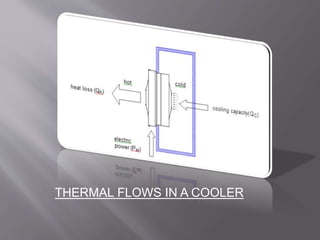
 On the hot side the net heat from the cold side and
the power required to pump this heat must be
transferred to the environment.
 Qh = Pel + Qc
 By changing the direction of the current the heat
flow changes too, from the cooling mode into the
heating mode.
THERMAL FLOWS IN A COOLER
Thermo electric coolers

Thermo electric coolers

  • 1.
  • 2.
    PREPARED BY:- MAYANK H.PAL 5TH SEM MECH.ENGG. (136120319528) Topic-:Thermo electric cooling Sub-:Project-1
  • 3.
     Gadhiya SagarK. (136120319506)  Marakana Sanket S. (136120319521)  Mendapara Prince K. (136120319523)  Modi Anuj B. (136120319525)  Pal Mayank H. (136120319528)  Parmar Maulik R. (136120319530)
  • 4.
     The thermoelectriccooling is used as renewed technology, has made an impact in the field of alternative refrigeration. The common principle is the presence of coupled electrical and thermal currents, so that it is possible to use the effects to generate power from a temperature differential.  Thermoelectric cooling provides an alternative solution to the common compressor and absorber cooler. Thermoelectric coolers are used especially if small cooling power is
  • 5.
     Thomas Seebeckin the early 1820’s found that a voltage difference is generated between the hot and cold ends when certain materials are placed in a temperature gradient.  This phenomenon is popularly known as Seebeck effect.
  • 7.
     Depending onthe used heat exchangers the cooling units are distinguished:  air to air  air to fluid  fluid to fluid  direct to air (cooling plate to air)
  • 8.
     small size light in weight  no fluid  independent from the working position  high reliability  exact temperature control  heating by changing the direction of the current
  • 9.
     The basicprinciple behind thermoelectric effect is peltier effect it occurs whenever electric current flows between two dissimilar conductors, depending on the direction of the current flow, the junction of the two conductors will either absorb or release heat.  A thermoelectric material is made of two legs, one of which is ‘n-type’ and contains negatively charged mobile carriers in the form of electrons while the other leg is ‘p-type’ and contains positively charged mobile carriers known as holes. These two legs are connected electrically in series and thermally in parallel.
  • 10.
     By connecting2 wires of different electrically leading materials at the 2 ends and by applying additionally a voltage, a current flows, which transports heat of one junction point to the other. In the consequence one junction point becomes cold and the other one warm.  For thermoelectric modules materials are applicable with a high electrical conductivity and a small thermal conductivity. Unfortunately good electrical conductors are also good heat conductors. The best efficiency is obtained with semi-conductors
  • 11.
     Unfortunately goodelectrical conductors are also good heat conductors. The best efficiency is obtained with semi-conductors.
  • 12.
     If temperaturedifference is created between two different conductors, ‘a’ and ‘b’ having junctions at M and N, a voltage difference (V) will be created between M and N appearing between the two ‘b’ segments Therefore, under open-circuit. 
  • 13.
     On thehot side the net heat from the cold side and the power required to pump this heat must be transferred to the environment.  Qh = Pel + Qc  By changing the direction of the current the heat flow changes too, from the cooling mode into the heating mode.
  • 14.