Submitted By
TIDAL POWER PLANT
MIRZA WAJAHAT
AHMAD
Guided BY
DR. M. R. DHARME
Department Of Mechanical Engineering
DR.Rajendra Gode Institute Of
Technology&Research ,Amravati
Content
 Introduction
 Basic physics of tide
 How Tides Work..?
 Tidal Barrages
 Tidal Current Powe Plant
 Significant benefits from using Tidal Energy
 Advantages
 Disadvantages
 Conclusion
 Reference
Introduction
 Tidal power, also called tidal energy, is a form
of hydropower that converts the energy of
tides into useful forms of power mainly
electricity. This is the only form of energy
whose source is the moon.
 Tides are the waves caused due to the
gravitational pull of the moon and also
sun(though its pull is very low).
 The rise is called high tide and fall is called
low tide.
 This building up and receding of waves
happens twice a day and causes enormous
movement of water.
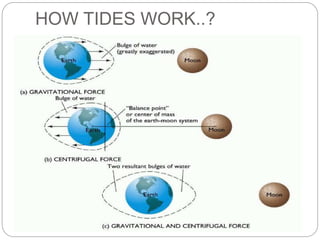
BASIC PHYSICS OF TIDE
 Gravitational pull of the sun and moon and the pull of
the centrifugal force of rotation of the earth-moon
system.
 When a landmass lines up with the earth-moon
system, the Water around it is at HIGH TIDES
 When a landmass is at 90 to the earth-moon system,
the water around it is at LOW TIDES.
 There are two high tides and two low tides during
each period of rotation of the earth.
 Flood Currents: currents moving in the direction of
the coast.
 Ebb Currents: the current receding from the coast
HOW TIDES WORK..?
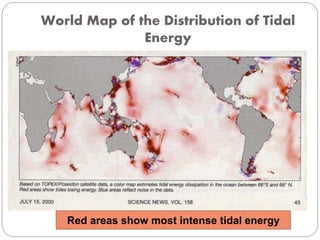
World Map of the Distribution of Tidal
Energy
Red areas show most intense tidal energy
HISTORY
 The first tidal power station was the Rance tidal
power plant built over a period of 6 years from
1960 to 1966 at La Rance, France. It has 240
MW installed capacity.
 Also the world's second biggest tidal power
station.
 With a peak rating of 240 Megawatts, generated
by its 24 turbines, it supplies 0.012% of the power
demand of France.
 With a capacity factor of approximately 40%, it
supplies an average 96 Megawatts, giving an
annual output of approximately 600GWh.
Two types of Tidal Plant
facilities.
Its classified as…
 Tidal barrages.
 Tidal current turbines.
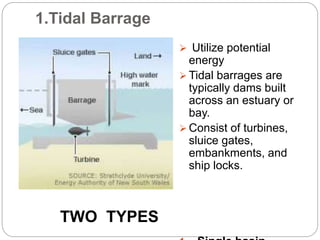
1.Tidal Barrage
 Utilize potential
energy
 Tidal barrages are
typically dams built
across an estuary or
bay.
 Consist of turbines,
sluice gates,
embankments, and
ship locks.
TWO TYPES
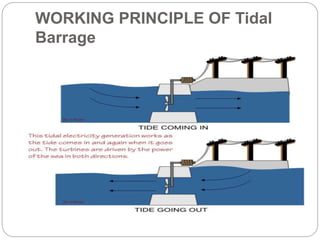
WORKING PRINCIPLE OF Tidal
Barrage
Current sites of tidal barrages
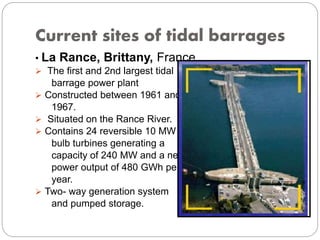
• La Rance, Brittany, France
 The first and 2nd largest tidal
barrage power plant
 Constructed between 1961 and
1967.
 Situated on the Rance River.
 Contains 24 reversible 10 MW
bulb turbines generating a
capacity of 240 MW and a net
power output of 480 GWh per
year.
 Two- way generation system
and pumped storage.
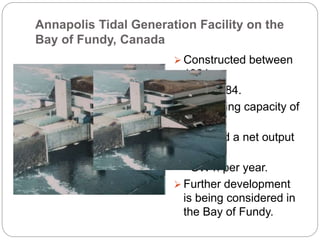
Annapolis Tidal Generation Facility on the
Bay of Fundy, Canada
 Constructed between
1981
and 1984.
 Generating capacity of
20
MW and a net output
of 30
GW h per year.
 Further development
is being considered in
the Bay of Fundy.
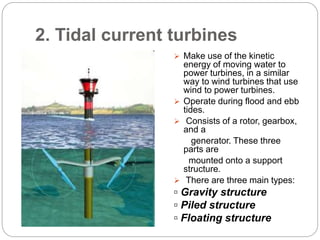
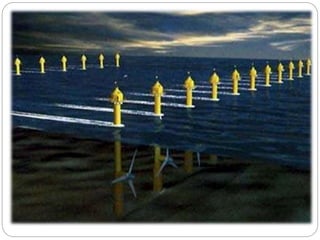
2. Tidal current turbines
 Make use of the kinetic
energy of moving water to
power turbines, in a similar
way to wind turbines that use
wind to power turbines.
 Operate during flood and ebb
tides.
 Consists of a rotor, gearbox,
and a
generator. These three
parts are
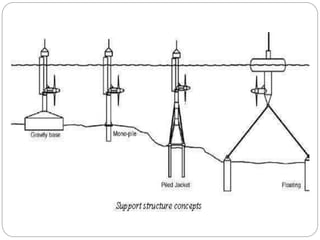
mounted onto a support
structure.
 There are three main types:
▫ Gravity structure
▫ Piled structure
▫ Floating structure
Significant benefits from using
Tidal Energy include:
 • Electrification of isolated communities
 • Generation for the grid
 • Regrowth of coral reefs using mineral accretion
technology
 • Substitution of imported petroleum used to
generate electricity
Advantages
 It is an inexhaustible source of energy.
 Tidal energy is environment friendly energy and
doesn't produce greenhouse gases.
 As 71% of Earth’s surface is covered by water,
there is scope to generate this energy on large
scale.
 We can predict the rise and fall of tides as they
follow cyclic fashion.
 Efficiency of tidal power is far greater as
compared to coal, solar or wind energy. Its
efficiency is around 80%.
 Although cost of construction of tidal power is
high but maintenance costs are relatively low
Disadvantages
 Cost of construction of tidal power plant is high.
 There are very few ideal locations for
construction of plant and they too are localized
to coastal regions only.
 Intensity of sea waves is unpredictable and
there can be damage to power generation units.
 Influences aquatic life adversely and can disrupt
migration of fish.
 The actual generation is for a short period of
time. The tides only happen twice a day so
electricity can be produced only for that time.
 Frozen sea, low or weak tides, straight
shorelines, low tidal rise or fall are some of the
obstructions.
Conclusion
 Tidal energy is a kind of renewable energy with
large potential. It has many advantages over
solar and wind energy.
 For example, the availability of tidal energy is
highly predictable and not subject to the impact of
weather condition. The energy density of tides is
also higher than solar and wind energy.
Reference
 “Tidal energy-a premier” by Michael Maser of Blue
energy Canada Inc.2004.
 www.energyocean.com
 www.blueenergy.com
 Blue Energy Canada Inc.
 Tidal energy update 2009
Applied Energy , Volume 87, Issue 2 , February 2010,
Pages 398-409
Fergal O Rourke, Fergal Boyle, Anthony Reynolds
 http://www.emec.org.uk/
Thank You

Tidal power Plant

  • 1.
    Submitted By TIDAL POWERPLANT MIRZA WAJAHAT AHMAD Guided BY DR. M. R. DHARME Department Of Mechanical Engineering DR.Rajendra Gode Institute Of Technology&Research ,Amravati
  • 2.
    Content  Introduction  Basicphysics of tide  How Tides Work..?  Tidal Barrages  Tidal Current Powe Plant  Significant benefits from using Tidal Energy  Advantages  Disadvantages  Conclusion  Reference
  • 3.
    Introduction  Tidal power,also called tidal energy, is a form of hydropower that converts the energy of tides into useful forms of power mainly electricity. This is the only form of energy whose source is the moon.  Tides are the waves caused due to the gravitational pull of the moon and also sun(though its pull is very low).  The rise is called high tide and fall is called low tide.  This building up and receding of waves happens twice a day and causes enormous movement of water.
  • 4.
    BASIC PHYSICS OFTIDE  Gravitational pull of the sun and moon and the pull of the centrifugal force of rotation of the earth-moon system.  When a landmass lines up with the earth-moon system, the Water around it is at HIGH TIDES  When a landmass is at 90 to the earth-moon system, the water around it is at LOW TIDES.  There are two high tides and two low tides during each period of rotation of the earth.  Flood Currents: currents moving in the direction of the coast.  Ebb Currents: the current receding from the coast
  • 5.
  • 6.
    World Map ofthe Distribution of Tidal Energy Red areas show most intense tidal energy
  • 7.
    HISTORY  The firsttidal power station was the Rance tidal power plant built over a period of 6 years from 1960 to 1966 at La Rance, France. It has 240 MW installed capacity.  Also the world's second biggest tidal power station.  With a peak rating of 240 Megawatts, generated by its 24 turbines, it supplies 0.012% of the power demand of France.  With a capacity factor of approximately 40%, it supplies an average 96 Megawatts, giving an annual output of approximately 600GWh.
  • 8.
    Two types ofTidal Plant facilities. Its classified as…  Tidal barrages.  Tidal current turbines.
  • 9.
    1.Tidal Barrage  Utilizepotential energy  Tidal barrages are typically dams built across an estuary or bay.  Consist of turbines, sluice gates, embankments, and ship locks. TWO TYPES
  • 10.
    WORKING PRINCIPLE OFTidal Barrage
  • 11.
    Current sites oftidal barrages • La Rance, Brittany, France  The first and 2nd largest tidal barrage power plant  Constructed between 1961 and 1967.  Situated on the Rance River.  Contains 24 reversible 10 MW bulb turbines generating a capacity of 240 MW and a net power output of 480 GWh per year.  Two- way generation system and pumped storage.
  • 12.
    Annapolis Tidal GenerationFacility on the Bay of Fundy, Canada  Constructed between 1981 and 1984.  Generating capacity of 20 MW and a net output of 30 GW h per year.  Further development is being considered in the Bay of Fundy.
  • 13.
    2. Tidal currentturbines  Make use of the kinetic energy of moving water to power turbines, in a similar way to wind turbines that use wind to power turbines.  Operate during flood and ebb tides.  Consists of a rotor, gearbox, and a generator. These three parts are mounted onto a support structure.  There are three main types: ▫ Gravity structure ▫ Piled structure ▫ Floating structure
  • 16.
    Significant benefits fromusing Tidal Energy include:  • Electrification of isolated communities  • Generation for the grid  • Regrowth of coral reefs using mineral accretion technology  • Substitution of imported petroleum used to generate electricity
  • 17.
    Advantages  It isan inexhaustible source of energy.  Tidal energy is environment friendly energy and doesn't produce greenhouse gases.  As 71% of Earth’s surface is covered by water, there is scope to generate this energy on large scale.  We can predict the rise and fall of tides as they follow cyclic fashion.  Efficiency of tidal power is far greater as compared to coal, solar or wind energy. Its efficiency is around 80%.  Although cost of construction of tidal power is high but maintenance costs are relatively low
  • 18.
    Disadvantages  Cost ofconstruction of tidal power plant is high.  There are very few ideal locations for construction of plant and they too are localized to coastal regions only.  Intensity of sea waves is unpredictable and there can be damage to power generation units.  Influences aquatic life adversely and can disrupt migration of fish.  The actual generation is for a short period of time. The tides only happen twice a day so electricity can be produced only for that time.  Frozen sea, low or weak tides, straight shorelines, low tidal rise or fall are some of the obstructions.
  • 19.
    Conclusion  Tidal energyis a kind of renewable energy with large potential. It has many advantages over solar and wind energy.  For example, the availability of tidal energy is highly predictable and not subject to the impact of weather condition. The energy density of tides is also higher than solar and wind energy.
  • 20.
    Reference  “Tidal energy-apremier” by Michael Maser of Blue energy Canada Inc.2004.  www.energyocean.com  www.blueenergy.com  Blue Energy Canada Inc.  Tidal energy update 2009 Applied Energy , Volume 87, Issue 2 , February 2010, Pages 398-409 Fergal O Rourke, Fergal Boyle, Anthony Reynolds  http://www.emec.org.uk/
  • 21.