Harnessing Tidal Energy
SHIVAM PRAJAPATI
MECHNICAL BRANCH
BBDNITM
Roadmap
• First we will explain the basics about tides, tidal energy, and
the different types of tidal energy capture systems.
• The first major system, Tidal Barrages, will be discussed in
detail, with a focus towards the only major commercial tidal
energy power plant, the La Rance Tidal Barrage.
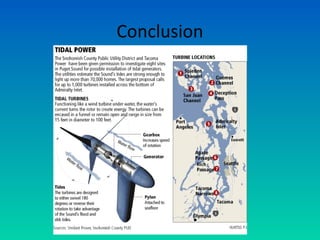
• The second system, Tidal Stream Generation, seems favored
in the US for proposed tidal energy.
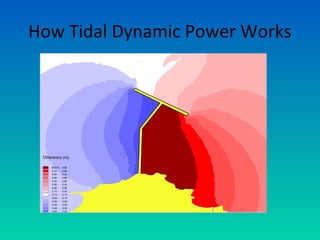
• The third system, Dynamic Tidal Power, is the latest, most
theoretical form.
• Finally, we conclude our presentation with a discussion of the
practical steps necessary before we see a tidal plant in the US.
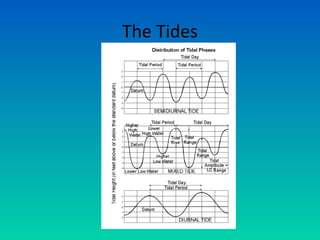
The Tides
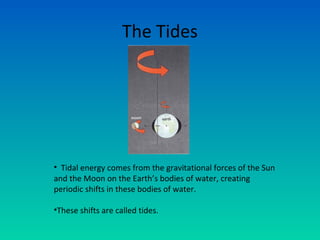
• Tidal energy comes from the gravitational forces of the Sun
and the Moon on the Earth’s bodies of water, creating
periodic shifts in these bodies of water.
•These shifts are called tides.
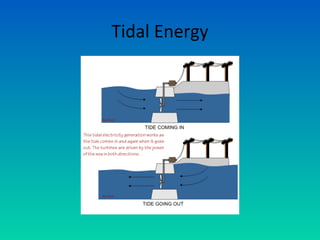
Tidal Energy
• Millions of gallons of water flow onto shore
during tidal flows and away from shore during
ebb tide periods.
• The larger the tidal influence, the greater the
displacement of water and therefore the more
potential energy that can be harvested during
power generation.
• The tides are perfectly predictable, regular, and
the US contains miles of coastline for energy
exploitation.
The Tides
Tidal Energy
The Long History of Tidal Energy
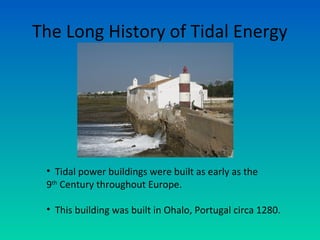
• Tidal power buildings were built as early as the
9th
Century throughout Europe.
• This building was built in Ohalo, Portugal circa 1280.
Tidal Energy
• Tidal energy is one of many forms of hydropower
generation.
• Tidal power has many advantages as compared to other
forms of renewable energy.
– It is predictable
– Global Climate Change should only increase its generating
capacity due to higher ocean levels.
– It is completely carbon neutral like wind or hydro energy.
• Its main drawbacks include: higher cost of installation,
limited availability for ideal siting, environmental impacts
on local area, including flooding and ecological changes,
and the inflexible generation schedule (not timed to peak
consumption).
Different Types of Tidal Plants
• Tidal Barrages
– These involve the creation of mammoth concrete dams with
sluices to create grander scale operations than the 12th
century
tide mills.
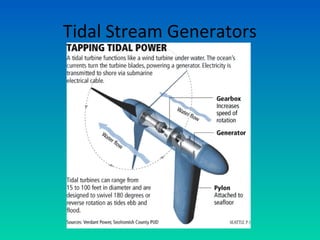
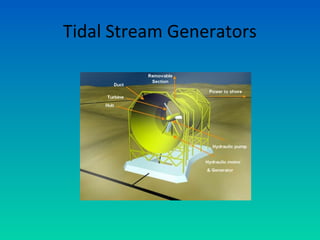
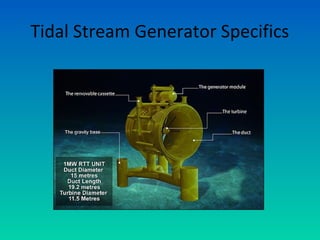
• Tidal Stream Generators
– Very similar to the principles in wind power generation – water
flows across blades which turn a turbine much like how wind
turns blades for wind power turbines.
• Dynamic Tidal Power
– This is a technology that is not currently commercial viable, but
in which the UK, Korea, and China invested heavily to research.
It involves a partial dam which raises the tidal height and several
hydropower generators. The differences in height between the
head of the dam and the low tide coast force water through the
generator, much like a traditional hydropower dam.
Tidal Barrage
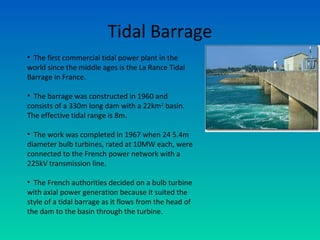
• The first commercial tidal power plant in the
world since the middle ages is the La Rance Tidal
Barrage in France.
• The barrage was constructed in 1960 and
consists of a 330m long dam with a 22km2
basin.
The effective tidal range is 8m.
• The work was completed in 1967 when 24 5.4m
diameter bulb turbines, rated at 10MW each, were
connected to the French power network with a
225kV transmission line.
• The French authorities decided on a bulb turbine
with axial power generation because it suited the
style of a tidal barrage as it flows from the head of
the dam to the basin through the turbine.
Tidal Barrage Cont’d
• Calculating the total energy production of the La
Rance plant is easy if you know some key facts:
– The La Rance plant has 24 generators with a 10MW
capacity:
– The equation is as follows:
Maximum Electricity generated per annum (kWh) =
Generator capacity * time + Cf (capacity factor)
The particular generator used in this plant had a Cf of
40%, resulting in 3504MWh per year per generator.
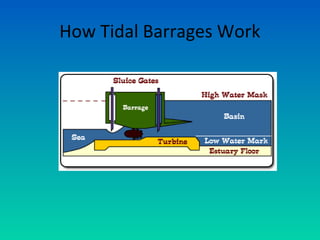
How Tidal Barrages Work
Tidal Barrage Drawbacks
• There are notable complications with tidal
barrage energy generation
• While they generate comparable power to
hydropower plants, they also have economic
and environmental issues
– The necessary infrastructure to build a tidal
barrage is cost prohibitive.
– Tidal barrages negatively affect the turbidity,
water levels, and ecology of the separated areas.
Tidal Barrage Drawbacks Cont’d
• Benthic habitats may change due to the bottom
stress from modified waves and currents.
• Migratory fish may be impeded although fish
passes can be constructed to facilitate
migrations.
• Fish and marine mammals may suffer injuries and
death when colliding with the barrage/turbines.
• Estuaries that are currently providing breeding
spaces for fish, may not be suitable for this
purpose after construction.
Effects on Turbidity
• Because the tides are being captured, the
turbidity of the La Rance estuary more closely
resembles lower tidal basins.
• The high turbidity regions have shrunk,
affecting the preferences of wildlife who lived
in the pre-barrage La Rance estuary.
Effects of Turbidity
• UK government reports made while preparing
to evaluate the suitability of barrage style tidal
power plants in the UK contain observations
of the barrages have on the environment,
including forecasted effects on UK tidal
estuary systems.
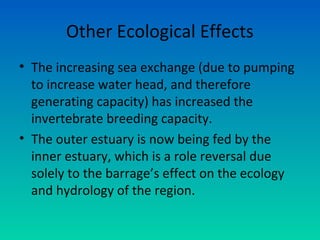
Other Ecological Effects
• The increasing sea exchange (due to pumping
to increase water head, and therefore
generating capacity) has increased the
invertebrate breeding capacity.
• The outer estuary is now being fed by the
inner estuary, which is a role reversal due
solely to the barrage’s effect on the ecology
and hydrology of the region.
Ecological Effects Cont’d
• Shorebird prevalence has increased, but this is a nationwide
trend across France.
– The primary attributing force for the increased shorebird
populations are the increasing invertebrate life which is the
primary source of food for shorebirds.
• Like shorebirds, fish diversity and biomass have increased
due to the greater availability of invertebrate life that
sustains these fish stocks.
– However, some fish species cannot traverse through the barrage
and these species are no longer present.
– The new types of fish have displaced these original fish stocks
and have thrived.
– Due to the dual flow nature of tidal barrages, fish mortality from
turbine blades is nearly twice that of other hydropower.
Economic Issues
• The capital costs of a barrage like La Rance are
tremendous because of the sheer scope of a
project and the few sites around the world that
are suitable for tidal power generation.
• The company that administers the La Rance
power plant now claims that the capital
investments in the barrage have been paid off
and currently the power plant generates cheaper
electricity than a nuclear power plant. (1.6 cents
per kWh vs. 2.5 cents per kWh for a nuclear
plant).
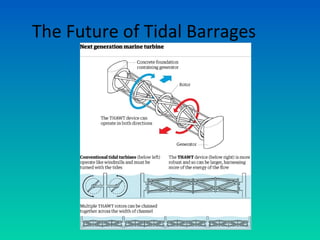
The Future of Tidal Barrages
Tidal Stream Generators
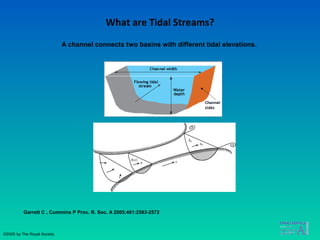
A channel connects two basins with different tidal elevations.
Garrett C , Cummins P Proc. R. Soc. A 2005;461:2563-2572
©2005 by The Royal Society
What are Tidal Streams?
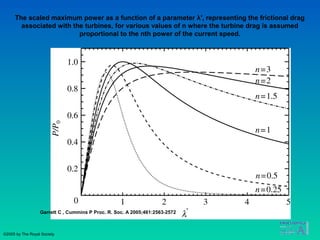
The scaled maximum power as a function of a parameter λ′, representing the frictional drag
associated with the turbines, for various values of n where the turbine drag is assumed
proportional to the nth power of the current speed.
Garrett C , Cummins P Proc. R. Soc. A 2005;461:2563-2572
©2005 by The Royal Society
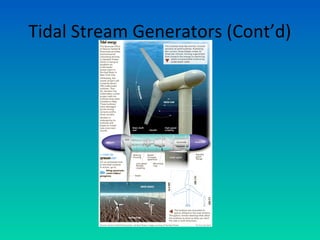
Tidal Stream Generators (Cont’d)
Tidal Stream Generators
Tidal Stream Generator Specifics
Tidal Stream Generators
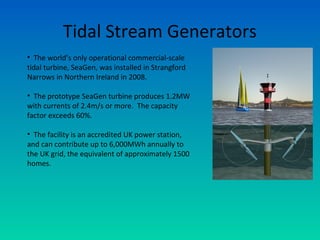
• The world’s only operational commercial-scale
tidal turbine, SeaGen, was installed in Strangford
Narrows in Northern Ireland in 2008.
• The prototype SeaGen turbine produces 1.2MW
with currents of 2.4m/s or more. The capacity
factor exceeds 60%.
• The facility is an accredited UK power station,
and can contribute up to 6,000MWh annually to
the UK grid, the equivalent of approximately 1500
homes.
Room to Grow
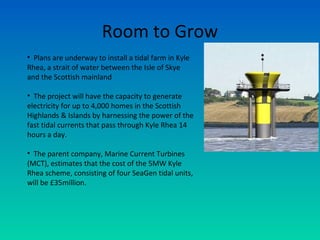
• Plans are underway to install a tidal farm in Kyle
Rhea, a strait of water between the Isle of Skye
and the Scottish mainland
• The project will have the capacity to generate
electricity for up to 4,000 homes in the Scottish
Highlands & Islands by harnessing the power of the
fast tidal currents that pass through Kyle Rhea 14
hours a day.
• The parent company, Marine Current Turbines
(MCT), estimates that the cost of the 5MW Kyle
Rhea scheme, consisting of four SeaGen tidal units,
will be £35million.
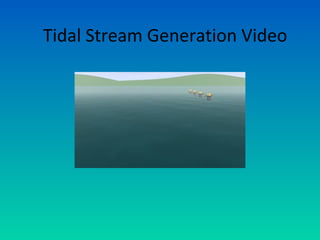
Tidal Stream Generation Video
Drawbacks of
Tidal Stream Generators
• High start-up and construction costs: due to limited
experience of installing, operating and maintaining plants,
contractors’ perceptions of risk are likely to be reflected in
higher costs.
• Like the wind, waves and tidal streams are variable renewable
energy sources. Their intermittent generation has
implications for large scale grid integration.
• Because the amount of energy tidal streams naturally varies
over time, the power output of wave energy converters and
tidal stream energy generators will also vary. This has
implications for grid integration, particularly balancing supply
and demand.
Economic Issues
• Although the capital costs of tidal stream generators can be
quite high, there is preliminary evidence that the
installation of these facilities gives support to local
economies because local firms can expect to participate in
the tidal farm’s installation, operation and maintenance.
• The company that administers MCT’s project in Northern
Ireland notes that a number of local companies such as
marine support vessels, engineering and electrical
contractors, civil engineers, environmental scientists and
divers as well as local hotels, pubs and restaurants have
benefited from the Strangford Lough project. It is
estimated that the project has contributed more than
£4million into the Northern Irish economy over the past
three years
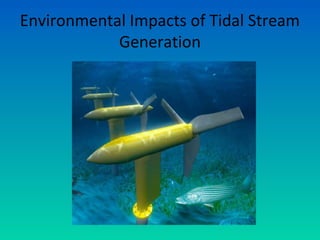
Environmental Impacts of Tidal Stream
Generation
Environmental Effects
• Studies to date suggest that local environmental
impacts are likely to be minor, but further research is
required into device-environment interactions,
particularly the impact of tidal stream energy
generators on flow momentum.
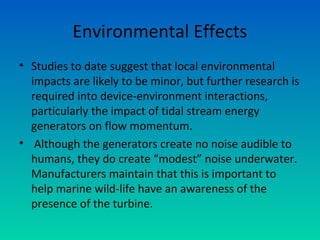
• Although the generators create no noise audible to
humans, they do create “modest” noise underwater.
Manufacturers maintain that this is important to
help marine wild-life have an awareness of the
presence of the turbine.
Environmental Effects, cont’d:
• MCT’s information for the project in Northern
Ireland notes that, “rigorous and detailed
environmental impact studies, carried out by
independent consultants, suggest that the
technology is most unlikely to pose a threat to
fish or marine mammals, or the marine
environment in which they live. A major
monitoring programme is already under way
for the SeaGen device installed in Strangford
Narrows which will build upon this work.”
Dynamic Tidal Power
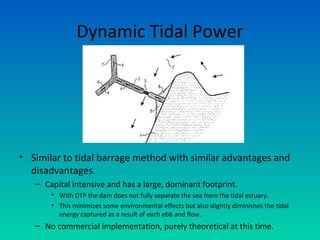
• Similar to tidal barrage method with similar advantages and
disadvantages.
– Capital intensive and has a large, dominant footprint.
• With DTP the dam does not fully separate the sea from the tidal estuary.
• This minimizes some environmental effects but also slightly diminishes the tidal
energy captured as a result of each ebb and flow.
– No commercial implementation, purely theoretical at this time.
Dynamic Tidal Power
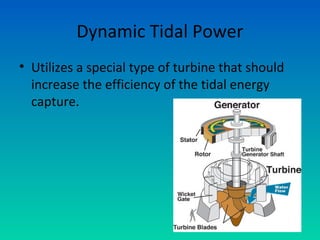
• Utilizes a special type of turbine that should
increase the efficiency of the tidal energy
capture.
How Tidal Dynamic Power Works
Practical Steps Regarding Tidal
Energy
• The EISA of 2007, Title II, has specific provisions for hydrokinetic energy
sources.
– It provides in Subtitle C, Section 621 et seq.:
• Research and development
• A lack of specific mandates or priority on federal land.
• Coastal management with state lands (CMZA).
• Energy Policy Act of 2005, §931 directs the Secretary of Energy to conduct
research and development (R&D) programs for ocean energy, including
wave energy and kinetic hydrogeneration projects, and §388 amends §8
of the Outer Continental Shelf Lands Act (43 U.S.C. §1337) to grant
authority to the Secretary of the Interior to grant leases on the Outer
Continental Shelf (OCS) for the production of energy from sources other
than oil and natural gas.
Steps for Permit
• File for a preliminary permit subject to 4(f) of
the Federal Power Act to preserve priority of
permit status while:
– Conduct studies to determine the feasibility of the
proposed project.
– Design specs are reviewed
• Preliminary permit does not grant title to land,
but instead sparks the public comment
process per APA regulations.
Permit Steps Cont’d
• Licensing provisions are fashioned from the
consideration of the studies on feasibility and
environmental and social impacts and the
public comment process.
• Commission decides whether to grant
preliminary permit and whether to grant a
license.
– Similar to other proceedings under FPA and
procedures under the APA.
Current Legal Issues Regarding
Proposed Tidal Plants in the US
• Section 4(e) of the FPA directs the
Commission to give equal consideration to the
purposes of power and development, energy
conservation, fish and wildlife, recreational
opportunities, and preservation of
environmental quality “in deciding whether to
issue a license.”
• (National Wildlife Federation).
Current Issues Cont’d
• Similarly, sections 10(a) and 10(j) are prefaced
with the direction that “all licenses issued
under this subchapter” shall include the
conditions required by sections 10(a) and
10(j).
Conclusion

tidal energy

  • 1.
    Harnessing Tidal Energy SHIVAMPRAJAPATI MECHNICAL BRANCH BBDNITM
  • 2.
    Roadmap • First wewill explain the basics about tides, tidal energy, and the different types of tidal energy capture systems. • The first major system, Tidal Barrages, will be discussed in detail, with a focus towards the only major commercial tidal energy power plant, the La Rance Tidal Barrage. • The second system, Tidal Stream Generation, seems favored in the US for proposed tidal energy. • The third system, Dynamic Tidal Power, is the latest, most theoretical form. • Finally, we conclude our presentation with a discussion of the practical steps necessary before we see a tidal plant in the US.
  • 3.
    The Tides • Tidalenergy comes from the gravitational forces of the Sun and the Moon on the Earth’s bodies of water, creating periodic shifts in these bodies of water. •These shifts are called tides.
  • 4.
    Tidal Energy • Millionsof gallons of water flow onto shore during tidal flows and away from shore during ebb tide periods. • The larger the tidal influence, the greater the displacement of water and therefore the more potential energy that can be harvested during power generation. • The tides are perfectly predictable, regular, and the US contains miles of coastline for energy exploitation.
  • 5.
  • 6.
  • 7.
    The Long Historyof Tidal Energy • Tidal power buildings were built as early as the 9th Century throughout Europe. • This building was built in Ohalo, Portugal circa 1280.
  • 8.
    Tidal Energy • Tidalenergy is one of many forms of hydropower generation. • Tidal power has many advantages as compared to other forms of renewable energy. – It is predictable – Global Climate Change should only increase its generating capacity due to higher ocean levels. – It is completely carbon neutral like wind or hydro energy. • Its main drawbacks include: higher cost of installation, limited availability for ideal siting, environmental impacts on local area, including flooding and ecological changes, and the inflexible generation schedule (not timed to peak consumption).
  • 9.
    Different Types ofTidal Plants • Tidal Barrages – These involve the creation of mammoth concrete dams with sluices to create grander scale operations than the 12th century tide mills. • Tidal Stream Generators – Very similar to the principles in wind power generation – water flows across blades which turn a turbine much like how wind turns blades for wind power turbines. • Dynamic Tidal Power – This is a technology that is not currently commercial viable, but in which the UK, Korea, and China invested heavily to research. It involves a partial dam which raises the tidal height and several hydropower generators. The differences in height between the head of the dam and the low tide coast force water through the generator, much like a traditional hydropower dam.
  • 10.
    Tidal Barrage • Thefirst commercial tidal power plant in the world since the middle ages is the La Rance Tidal Barrage in France. • The barrage was constructed in 1960 and consists of a 330m long dam with a 22km2 basin. The effective tidal range is 8m. • The work was completed in 1967 when 24 5.4m diameter bulb turbines, rated at 10MW each, were connected to the French power network with a 225kV transmission line. • The French authorities decided on a bulb turbine with axial power generation because it suited the style of a tidal barrage as it flows from the head of the dam to the basin through the turbine.
  • 11.
    Tidal Barrage Cont’d •Calculating the total energy production of the La Rance plant is easy if you know some key facts: – The La Rance plant has 24 generators with a 10MW capacity: – The equation is as follows: Maximum Electricity generated per annum (kWh) = Generator capacity * time + Cf (capacity factor) The particular generator used in this plant had a Cf of 40%, resulting in 3504MWh per year per generator.
  • 12.
  • 13.
    Tidal Barrage Drawbacks •There are notable complications with tidal barrage energy generation • While they generate comparable power to hydropower plants, they also have economic and environmental issues – The necessary infrastructure to build a tidal barrage is cost prohibitive. – Tidal barrages negatively affect the turbidity, water levels, and ecology of the separated areas.
  • 14.
    Tidal Barrage DrawbacksCont’d • Benthic habitats may change due to the bottom stress from modified waves and currents. • Migratory fish may be impeded although fish passes can be constructed to facilitate migrations. • Fish and marine mammals may suffer injuries and death when colliding with the barrage/turbines. • Estuaries that are currently providing breeding spaces for fish, may not be suitable for this purpose after construction.
  • 15.
    Effects on Turbidity •Because the tides are being captured, the turbidity of the La Rance estuary more closely resembles lower tidal basins. • The high turbidity regions have shrunk, affecting the preferences of wildlife who lived in the pre-barrage La Rance estuary.
  • 16.
    Effects of Turbidity •UK government reports made while preparing to evaluate the suitability of barrage style tidal power plants in the UK contain observations of the barrages have on the environment, including forecasted effects on UK tidal estuary systems.
  • 17.
    Other Ecological Effects •The increasing sea exchange (due to pumping to increase water head, and therefore generating capacity) has increased the invertebrate breeding capacity. • The outer estuary is now being fed by the inner estuary, which is a role reversal due solely to the barrage’s effect on the ecology and hydrology of the region.
  • 18.
    Ecological Effects Cont’d •Shorebird prevalence has increased, but this is a nationwide trend across France. – The primary attributing force for the increased shorebird populations are the increasing invertebrate life which is the primary source of food for shorebirds. • Like shorebirds, fish diversity and biomass have increased due to the greater availability of invertebrate life that sustains these fish stocks. – However, some fish species cannot traverse through the barrage and these species are no longer present. – The new types of fish have displaced these original fish stocks and have thrived. – Due to the dual flow nature of tidal barrages, fish mortality from turbine blades is nearly twice that of other hydropower.
  • 19.
    Economic Issues • Thecapital costs of a barrage like La Rance are tremendous because of the sheer scope of a project and the few sites around the world that are suitable for tidal power generation. • The company that administers the La Rance power plant now claims that the capital investments in the barrage have been paid off and currently the power plant generates cheaper electricity than a nuclear power plant. (1.6 cents per kWh vs. 2.5 cents per kWh for a nuclear plant).
  • 20.
    The Future ofTidal Barrages
  • 21.
  • 22.
    A channel connectstwo basins with different tidal elevations. Garrett C , Cummins P Proc. R. Soc. A 2005;461:2563-2572 ©2005 by The Royal Society What are Tidal Streams?
  • 23.
    The scaled maximumpower as a function of a parameter λ′, representing the frictional drag associated with the turbines, for various values of n where the turbine drag is assumed proportional to the nth power of the current speed. Garrett C , Cummins P Proc. R. Soc. A 2005;461:2563-2572 ©2005 by The Royal Society
  • 24.
  • 25.
  • 26.
  • 27.
    Tidal Stream Generators •The world’s only operational commercial-scale tidal turbine, SeaGen, was installed in Strangford Narrows in Northern Ireland in 2008. • The prototype SeaGen turbine produces 1.2MW with currents of 2.4m/s or more. The capacity factor exceeds 60%. • The facility is an accredited UK power station, and can contribute up to 6,000MWh annually to the UK grid, the equivalent of approximately 1500 homes.
  • 28.
    Room to Grow •Plans are underway to install a tidal farm in Kyle Rhea, a strait of water between the Isle of Skye and the Scottish mainland • The project will have the capacity to generate electricity for up to 4,000 homes in the Scottish Highlands & Islands by harnessing the power of the fast tidal currents that pass through Kyle Rhea 14 hours a day. • The parent company, Marine Current Turbines (MCT), estimates that the cost of the 5MW Kyle Rhea scheme, consisting of four SeaGen tidal units, will be £35million.
  • 29.
  • 30.
    Drawbacks of Tidal StreamGenerators • High start-up and construction costs: due to limited experience of installing, operating and maintaining plants, contractors’ perceptions of risk are likely to be reflected in higher costs. • Like the wind, waves and tidal streams are variable renewable energy sources. Their intermittent generation has implications for large scale grid integration. • Because the amount of energy tidal streams naturally varies over time, the power output of wave energy converters and tidal stream energy generators will also vary. This has implications for grid integration, particularly balancing supply and demand.
  • 31.
    Economic Issues • Althoughthe capital costs of tidal stream generators can be quite high, there is preliminary evidence that the installation of these facilities gives support to local economies because local firms can expect to participate in the tidal farm’s installation, operation and maintenance. • The company that administers MCT’s project in Northern Ireland notes that a number of local companies such as marine support vessels, engineering and electrical contractors, civil engineers, environmental scientists and divers as well as local hotels, pubs and restaurants have benefited from the Strangford Lough project. It is estimated that the project has contributed more than £4million into the Northern Irish economy over the past three years
  • 32.
    Environmental Impacts ofTidal Stream Generation
  • 33.
    Environmental Effects • Studiesto date suggest that local environmental impacts are likely to be minor, but further research is required into device-environment interactions, particularly the impact of tidal stream energy generators on flow momentum. • Although the generators create no noise audible to humans, they do create “modest” noise underwater. Manufacturers maintain that this is important to help marine wild-life have an awareness of the presence of the turbine.
  • 34.
    Environmental Effects, cont’d: •MCT’s information for the project in Northern Ireland notes that, “rigorous and detailed environmental impact studies, carried out by independent consultants, suggest that the technology is most unlikely to pose a threat to fish or marine mammals, or the marine environment in which they live. A major monitoring programme is already under way for the SeaGen device installed in Strangford Narrows which will build upon this work.”
  • 35.
    Dynamic Tidal Power •Similar to tidal barrage method with similar advantages and disadvantages. – Capital intensive and has a large, dominant footprint. • With DTP the dam does not fully separate the sea from the tidal estuary. • This minimizes some environmental effects but also slightly diminishes the tidal energy captured as a result of each ebb and flow. – No commercial implementation, purely theoretical at this time.
  • 36.
    Dynamic Tidal Power •Utilizes a special type of turbine that should increase the efficiency of the tidal energy capture.
  • 37.
    How Tidal DynamicPower Works
  • 38.
    Practical Steps RegardingTidal Energy • The EISA of 2007, Title II, has specific provisions for hydrokinetic energy sources. – It provides in Subtitle C, Section 621 et seq.: • Research and development • A lack of specific mandates or priority on federal land. • Coastal management with state lands (CMZA). • Energy Policy Act of 2005, §931 directs the Secretary of Energy to conduct research and development (R&D) programs for ocean energy, including wave energy and kinetic hydrogeneration projects, and §388 amends §8 of the Outer Continental Shelf Lands Act (43 U.S.C. §1337) to grant authority to the Secretary of the Interior to grant leases on the Outer Continental Shelf (OCS) for the production of energy from sources other than oil and natural gas.
  • 39.
    Steps for Permit •File for a preliminary permit subject to 4(f) of the Federal Power Act to preserve priority of permit status while: – Conduct studies to determine the feasibility of the proposed project. – Design specs are reviewed • Preliminary permit does not grant title to land, but instead sparks the public comment process per APA regulations.
  • 40.
    Permit Steps Cont’d •Licensing provisions are fashioned from the consideration of the studies on feasibility and environmental and social impacts and the public comment process. • Commission decides whether to grant preliminary permit and whether to grant a license. – Similar to other proceedings under FPA and procedures under the APA.
  • 41.
    Current Legal IssuesRegarding Proposed Tidal Plants in the US • Section 4(e) of the FPA directs the Commission to give equal consideration to the purposes of power and development, energy conservation, fish and wildlife, recreational opportunities, and preservation of environmental quality “in deciding whether to issue a license.” • (National Wildlife Federation).
  • 42.
    Current Issues Cont’d •Similarly, sections 10(a) and 10(j) are prefaced with the direction that “all licenses issued under this subchapter” shall include the conditions required by sections 10(a) and 10(j).
  • 43.

Editor's Notes

  • #4 Photo: Boyle, Renewable Energy, Oxford University Press (2004).
  • #6 http://upload.wikimedia.org/wikipedia/en/0/00/Tide_type.gif
  • #8 Historic Tidal mill in Portugal: http://cdn.wn.com/pd/8f/b9/0060eea52cd83c78005a38fcba61_grande.jpg
  • #9 Boyle, Renewable Energy, Oxford University Press (2004).
  • #10 Boyle, Renewable Energy, Oxford University Press (2004).
  • #11 http://www.esru.strath.ac.uk/EandE/web_sites/01-02/RE_info/tidal1.htm. Photo: http://interestingenergyfacts.blogspot.com/2008/04/tidal-power-tidal-energy-facts.html
  • #13 http://www.esru.strath.ac.uk/EandE/Web_sites/01-02/RE_info/Tidal%20power%20files/image004.jpg
  • #14 Roger H. Charlier and John Justus. Ocean Energies: Environmental, Economic, and Technological Aspects of Alternative Power Sources. Elselvier, 1993. (p. 325). J Wolf, IA Walkington, J Holt, R Burrows. Environmental Impacts of Tidal Power Schemes. Proudman Oceanographic Laboratory, The University of Liverpool, Department of Engineering, p.2.
  • #15 J Wolf, IA Walkington, J Holt, R Burrows. Environmental Impacts of Tidal Power Schemes. Proudman Oceanographic Laboratory, The University of Liverpool, Department of Engineering, p.3.
  • #17 http://webarchive.nationalarchives.gov.uk/+/http://www.berr.gov.uk/files/file31334.pdf
  • #18 http://webarchive.nationalarchives.gov.uk/+/http://www.berr.gov.uk/files/file31334.pdf
  • #19 http://webarchive.nationalarchives.gov.uk/+/http://www.berr.gov.uk/files/file31334.pdf http://www.wyretidalenergy.com/tidal-barrage/la-rance-barrage
  • #20 http://www.wyretidalenergy.com/tidal-barrage/la-rance-barrage
  • #21 http://www.inhabitat.com/wp-content/uploads/turbine1.jpg
  • #22 http://www.seattlepi.com/dayart/20070509/tidal-turbine.gif http://media.photobucket.com/image/Tidal%20Stream%20Generators/greenthoughts/verdant.jpg
  • #23 A channel connects two basins with different tidal elevations. At any instant the current through the channel has speed u, a function of the local cross-sectional area A(x), where x is the along-strait coordinate. At the channel entrance the current enters from all directions, but at the exit it may separate as a jet with speed ue, surrounded by comparatively stagnant water with elevation the same as that in the downstream basin. IN ENGLISH: Tidal streams are caused by the familiar rise and fall of the tides, which occurs twice a day around the UK coast. As water flows in and out of estuaries, it carries energy. The amount of energy it is possible to extract depends on the speed of the flowing stream and the area intercepted. This is similar to wind power extraction, but because water is much denser than air, an equivalent amount of power can be extracted over smaller areas and at slower velocities.
  • #24 The scaled maximum power as a function of a parameter λ′, representing the frictional drag associated with the turbines, for various values of n where the turbine drag is assumed proportional to the nth power of the current speed.
  • #25 http://blog.syracuse.com/progress_impact/2008/02/0211_progress_wave_turbines.gif
  • #26 http://www.reuk.co.uk/OtherImages/lunar-energy-tidal-turbine2.jpg
  • #27 http://www.lunarenergy.co.uk/media/NewTurbinenodolphin.jpg
  • #28 http://www.esru.strath.ac.uk/EandE/web_sites/01-02/RE_info/tidal1.htm. The commercial system under development by MCT is known as “SeaGen” . The prototype is operational in Strangford Narrows, Northern Ireland, and uses twin 16m diameter rotors to develop a rated power of 1.2MW at a current velocity of 2.4m/s. The system is accredited to OFGEM as an official UK generating station and regularly runs at full rated power. It has the capability to deliver about 10MWh per tide, which adds up to 6,000MWh per year. This is approximately the rate of energy capture that a wind turbine of about 2.4MW rated capacity can typically produce. So SeaGen shows that the tides are not only more prodictable than wind but twice as productive. Photo: http://interestingenergyfacts.blogspot.com/2008/04/tidal-power-tidal-energy-facts.html
  • #29 http://www.esru.strath.ac.uk/EandE/web_sites/01-02/RE_info/tidal1.htm. Photo: http://interestingenergyfacts.blogspot.com/2008/04/tidal-power-tidal-energy-facts.html
  • #30 http://www.marineturbines.com/21/technology/32/seagen_video/
  • #31 http://www.marineturbines.com
  • #32 http://www.marineturbines.com
  • #33 Image: http://www.treehugger.com/verdant-power-turbine-j003.jpg http://webarchive.nationalarchives.gov.uk/+/http://www.berr.gov.uk/files/file31334.pdf http://www.marineturbines.com/21/technology/29/environmental_impact/
  • #34 http://webarchive.nationalarchives.gov.uk/+/http://www.berr.gov.uk/files/file31334.pdf
  • #37 http://farm2.static.flickr.com/1377/5185303051_bec6bd33c2_b.jpg
  • #38 http://en.wikipedia.org/wiki/File:DTP_T_dam_top-down_view.jpg Similar to a barrage, except the dam extends perpendicular to the shore to capture the tides which flow laterally across the shoreline. The dam does not fully enclose the tidal estuaries. The tide is halted by the dam and creates a large differential (head) which flows over the turbines and generates electricity like a traditional hydrokinetic dam.
  • #39 Congressional Report: http://www.pstidalenergy.org/Tidal_Energy_Projects/Misc/CRS_Rept_on_Ocean_Energy_regs.pdf
  • #40 Maine Tidal Energy Company, 2008 WL 4612931 (F.E.R.C 12666-001, 2008).
  • #42 16 U.S.C. §§ 797(f) and 798 (West 2010). 2008 WL 4612931 (F.E.R.C.), 3 (citing National Wildlife Federation, et al. v. Federal Energy Regulatory Commission, 801 F.2d 1505, 1514 (9th Cir. 1986)).
  • #43 Id.