Grid Connected PV
Systems
Ankur Maheshwari
NIT Hamirpur
Compendium
▪ Introduction
▪ Objective of Grid Connected PV System
▪ Working Principle Of Grid Connected PV System
▪ Condition of Grid Interfacing
▪ Two Stage Grid Connected PV System
▪ Multi-Stage Grid Connected PV System
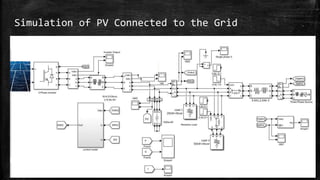
▪ Simulation of Grid Connected PV System
▪ Simple Payback Period
▪ Lifecycle Costing
Introduction
▪ Solar PV systems are generally classified into Grid-
connected and Stand-alone systems.
▪ In isolated system, power from the PV is not
sufficient to supply load during bad weather
condition.
▪ The excess power generated by isolated PV system is
loss during summer days.
Objective of Grid-Connected PV Systems
▪ The main objectives of Grid-connected PV
systems are
–Excess power, not required by the load can be
directly fed into the grid which is considered to
be an infinite source or sink of power.
–If power required by the load is more than the
power generated by the PV, it can draw power form
the grid.
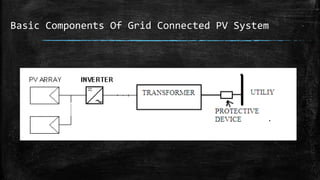
Basic Components Of Grid Connected PV System
(Cont…)
▪ PV ARRAY: A number of PV panels connected in series and/or in parallel
giving a DC output out of the incident irradiance.
▪ INVERTER: A power converter that 'inverts' the DC power from the panels
into AC power. The characteristics of the output signal should match the
voltage, frequency and power quality limits in the supply network.
Basic Components Of Grid Connected PV System
(Cont…)
▪ TRANSFORMER:A transformer can boost up the ac output voltage
from inverter when needed. Otherwise transformer less design is
also acceptable.
▪ LOAD: Stands for the network connected appliances that are fed
from the inverter, or, alternatively, from the grid.
▪ METERS:They account for the energy being drawn from or fed into
the local supply network.
Basic Components Of Grid Connected PV System
(Cont…)
▪ PROTECTIVE DEVICES: Some protective devices is also
installed, like under voltage relay, circuit breakers etc. for
resisting power flow from utility to SPV system.
▪ OTHER DEVICES: Other devices like dc-dc boost converter, ac
filter can also be used for better performance.
Working Principle Of Grid Connected PV System
▪ Electricity is produced by the PV array most efficiently during sunny periods. At
night or during cloudy periods, independent power systems use storage batteries
to supply electricity needs.
▪ With grid interactive systems, the grid acts as the battery, supplying electricity
when the PV array cannot. During the day, the power produced by the PV array
supplies loads.
▪ An inverter converts direct current (DC) produced by the PV array to alternating
current (AC) and transformer stepped up the voltage level as need for export to
the grid.
▪ However all consist of solar arrays, inverters, electrical metering and components
necessary for wiring and mounting.
Conditions For Grid Inter Facing
▪ There are some conditions to be satisfied for interfacing or
synchronizing the SPV system with grid or utility. If proper
synchronizing is not done then SPV potential cannot be fed to the
grid.
– Phase sequence should be same
– Frequency should be matched.
– Voltage should be same
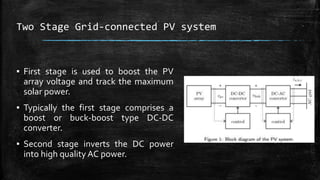
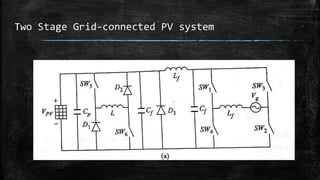
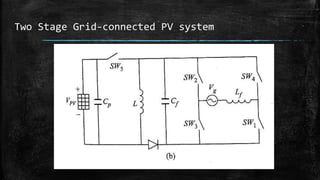
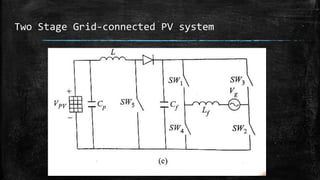
Two Stage Grid-connected PV system
▪ First stage is used to boost the PV
array voltage and track the maximum
solar power.
▪ Typically the first stage comprises a
boost or buck-boost type DC-DC
converter.
▪ Second stage inverts the DC power
into high quality AC power.
Two Stage Grid-connected PV system
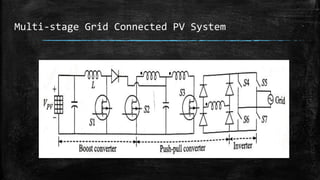
Multi-stage Grid Connected PV System
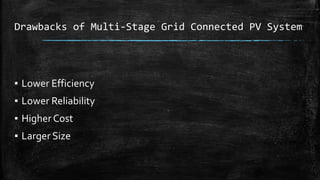
Drawbacks of Multi-Stage Grid Connected PV System
▪ Lower Efficiency
▪ Lower Reliability
▪ Higher Cost
▪ Larger Size
Simulation of PV Connected to the Grid
Simple Payback Period
▪ After investing money into solar PV system, it is desirable to find out in
what time period we are going to recover the invested money or save the
invested money.
▪ Comparison has to be made with other electricity source that might have
been used without having solar PV system, example Grid-electricity, wind
turbine, biogas system or diesel generator.
▪ The period within which the invested money can be recovered or saved is
known as payback period.
Simple Payback Period (Cont..)
▪ Estimation of Payback period can be done two ways
– By estimating simple payback period.
– By estimating life cycle cost (LCC) of the system.
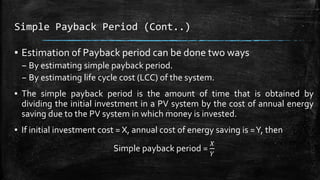
▪ The simple payback period is the amount of time that is obtained by
dividing the initial investment in a PV system by the cost of annual energy
saving due to the PV system in which money is invested.
▪ If initial investment cost = X, annual cost of energy saving is =Y, then
Simple payback period =
𝑋
𝑌
Drawback of Simple Payback Period
▪ It fails to factor in several important parameters in estimation such
as:
– Time value of money
– Inflation rate
– Lifetime of the system
– Operation and maintenance cost
Lifecycle Costing (LCC)
▪ The LCC is the cost of using a PV system during its lifetime.
▪ The cost of running and owing a system or equipment over its
lifetime can be divided into three components:
– Capital cost (paid while purchasing the equipment/system)
– Operation and maintenance cost
– Replacement cost
Lifecycle Costing (Cont..)
▪ LCC is calculated before making the purchase.
▪ It is used to evaluate different designs of PV systems having same
functionalities.
▪ It is used to purchase any other appliances or equipment's.
Thank you

Grid Connected PV Systems

  • 1.
    Grid Connected PV Systems AnkurMaheshwari NIT Hamirpur
  • 2.
    Compendium ▪ Introduction ▪ Objectiveof Grid Connected PV System ▪ Working Principle Of Grid Connected PV System ▪ Condition of Grid Interfacing ▪ Two Stage Grid Connected PV System ▪ Multi-Stage Grid Connected PV System ▪ Simulation of Grid Connected PV System ▪ Simple Payback Period ▪ Lifecycle Costing
  • 3.
    Introduction ▪ Solar PVsystems are generally classified into Grid- connected and Stand-alone systems. ▪ In isolated system, power from the PV is not sufficient to supply load during bad weather condition. ▪ The excess power generated by isolated PV system is loss during summer days.
  • 4.
    Objective of Grid-ConnectedPV Systems ▪ The main objectives of Grid-connected PV systems are –Excess power, not required by the load can be directly fed into the grid which is considered to be an infinite source or sink of power. –If power required by the load is more than the power generated by the PV, it can draw power form the grid.
  • 5.
    Basic Components OfGrid Connected PV System
  • 6.
    Basic Components OfGrid Connected PV System (Cont…) ▪ PV ARRAY: A number of PV panels connected in series and/or in parallel giving a DC output out of the incident irradiance. ▪ INVERTER: A power converter that 'inverts' the DC power from the panels into AC power. The characteristics of the output signal should match the voltage, frequency and power quality limits in the supply network.
  • 7.
    Basic Components OfGrid Connected PV System (Cont…) ▪ TRANSFORMER:A transformer can boost up the ac output voltage from inverter when needed. Otherwise transformer less design is also acceptable. ▪ LOAD: Stands for the network connected appliances that are fed from the inverter, or, alternatively, from the grid. ▪ METERS:They account for the energy being drawn from or fed into the local supply network.
  • 8.
    Basic Components OfGrid Connected PV System (Cont…) ▪ PROTECTIVE DEVICES: Some protective devices is also installed, like under voltage relay, circuit breakers etc. for resisting power flow from utility to SPV system. ▪ OTHER DEVICES: Other devices like dc-dc boost converter, ac filter can also be used for better performance.
  • 9.
    Working Principle OfGrid Connected PV System ▪ Electricity is produced by the PV array most efficiently during sunny periods. At night or during cloudy periods, independent power systems use storage batteries to supply electricity needs. ▪ With grid interactive systems, the grid acts as the battery, supplying electricity when the PV array cannot. During the day, the power produced by the PV array supplies loads. ▪ An inverter converts direct current (DC) produced by the PV array to alternating current (AC) and transformer stepped up the voltage level as need for export to the grid. ▪ However all consist of solar arrays, inverters, electrical metering and components necessary for wiring and mounting.
  • 10.
    Conditions For GridInter Facing ▪ There are some conditions to be satisfied for interfacing or synchronizing the SPV system with grid or utility. If proper synchronizing is not done then SPV potential cannot be fed to the grid. – Phase sequence should be same – Frequency should be matched. – Voltage should be same
  • 11.
    Two Stage Grid-connectedPV system ▪ First stage is used to boost the PV array voltage and track the maximum solar power. ▪ Typically the first stage comprises a boost or buck-boost type DC-DC converter. ▪ Second stage inverts the DC power into high quality AC power.
  • 12.
  • 13.
  • 14.
  • 15.
  • 16.
    Drawbacks of Multi-StageGrid Connected PV System ▪ Lower Efficiency ▪ Lower Reliability ▪ Higher Cost ▪ Larger Size
  • 17.
    Simulation of PVConnected to the Grid
  • 18.
    Simple Payback Period ▪After investing money into solar PV system, it is desirable to find out in what time period we are going to recover the invested money or save the invested money. ▪ Comparison has to be made with other electricity source that might have been used without having solar PV system, example Grid-electricity, wind turbine, biogas system or diesel generator. ▪ The period within which the invested money can be recovered or saved is known as payback period.
  • 19.
    Simple Payback Period(Cont..) ▪ Estimation of Payback period can be done two ways – By estimating simple payback period. – By estimating life cycle cost (LCC) of the system. ▪ The simple payback period is the amount of time that is obtained by dividing the initial investment in a PV system by the cost of annual energy saving due to the PV system in which money is invested. ▪ If initial investment cost = X, annual cost of energy saving is =Y, then Simple payback period = 𝑋 𝑌
  • 20.
    Drawback of SimplePayback Period ▪ It fails to factor in several important parameters in estimation such as: – Time value of money – Inflation rate – Lifetime of the system – Operation and maintenance cost
  • 21.
    Lifecycle Costing (LCC) ▪The LCC is the cost of using a PV system during its lifetime. ▪ The cost of running and owing a system or equipment over its lifetime can be divided into three components: – Capital cost (paid while purchasing the equipment/system) – Operation and maintenance cost – Replacement cost
  • 22.
    Lifecycle Costing (Cont..) ▪LCC is calculated before making the purchase. ▪ It is used to evaluate different designs of PV systems having same functionalities. ▪ It is used to purchase any other appliances or equipment's.
  • 23.