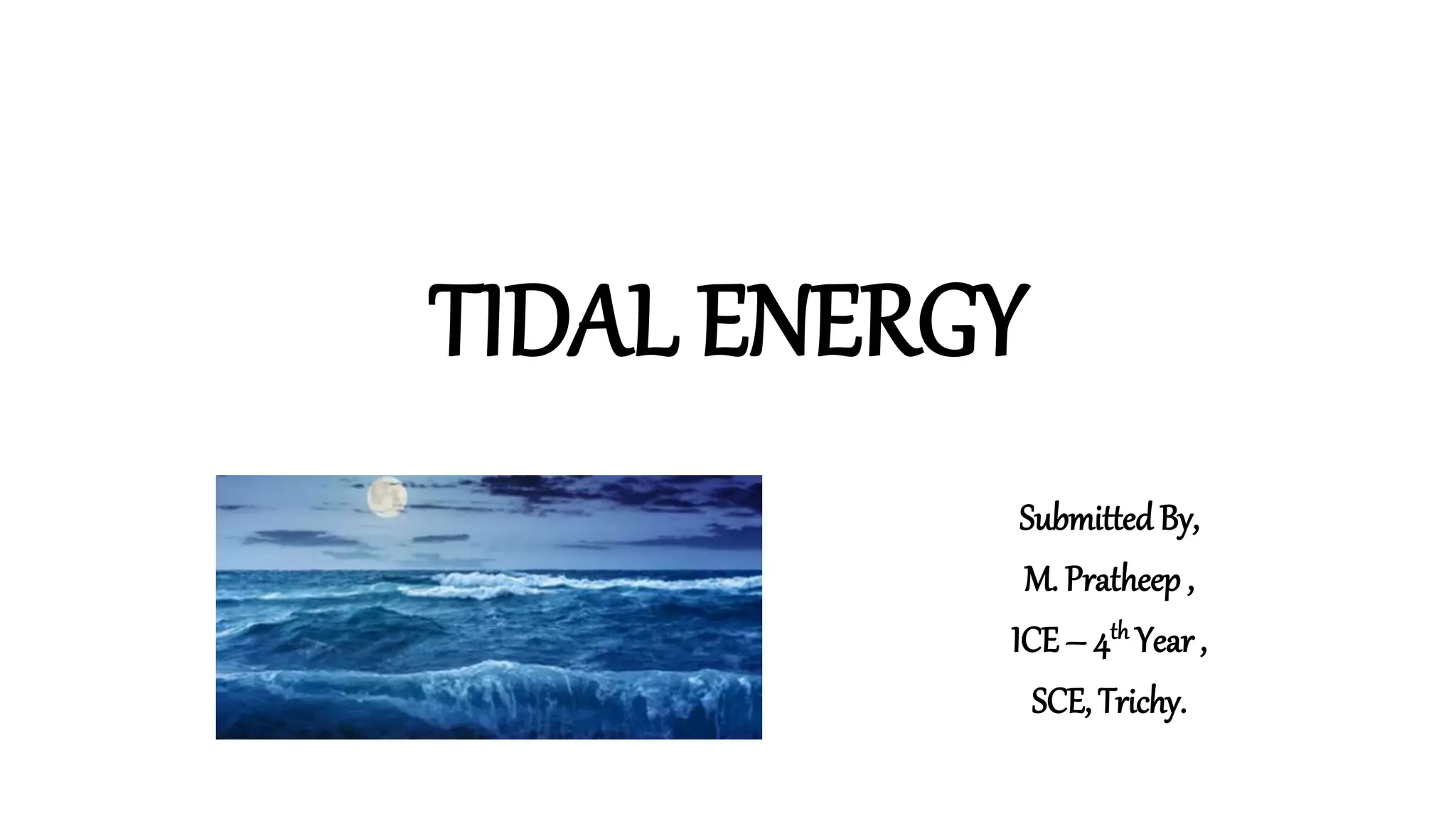

TIDAL ENERGY
Submitted By,
M. Pratheep ,
ICE – 4th Year ,
SCE, Trichy.
TIDAL ENERGY :
It is also known as Tidal Power, is a form of hydropower that converts
the energy of tides into useful forms energy – mainly electricity.
TIDE :
Tides are the rising and falling of earth’s ocean surface, caused by
the gravitational attraction by the celestial bodies.
TIDAL ENERGY POTTENTIAL :
Tidal potential is derived from the gravitational attraction of masses of the
moon and the sun and from this potential tide generating forces are derived
taking its horizontal gradients.
TIDALFORCE :
The Tidal force is the vectorial difference between the gravitational force of
the Earth and that of moon.
PRINCIPLE OF TIDE GENERATION :
Tides are generated by a resultant force between the gravitational attraction of
the moon and the centrifugal force due to the rotation of the Earth.
The tide-producing forces due to the sun is about 0.45 times that of the moon.
Other planets are either too far away or small to generate any significant
impacts.
TRANSFORMATION OF TIDAL ENERGY INTO ELECTRICAL
ENERGY :
• Tidal energy is produced through the use of tidal energy generators.
• These large underwater turbines are placed in areas with high tidal movements,
and are designed to capture the kinetic motion of the ebbing and surging of
ocean tides in order to produce electricity.
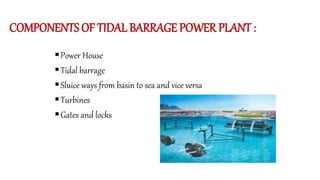
COMPONENTS OF TIDAL BARRAGE POWER PLANT :
Power House
Tidal barrage
Sluice ways from basin to sea and vice versa
Turbines
Gates and locks
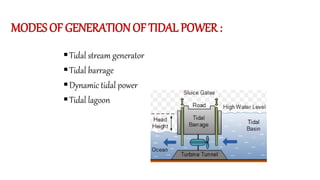
MODES OF GENERATIONOF TIDAL POWER :
Tidal stream generator
Tidal barrage
Dynamic tidal power
Tidal lagoon
TIDAL STREAMGENERATOR :
Tidal stream generators are very similar to wind turbines except their below
the water surface instead of above or on land.
The turbine and generator converts the movement of water coming from
change in tide, the kinetic energy, into electricity.
Water is 830 times denser than air and therefore can generate electricity at
lower speeds than wind turbines.
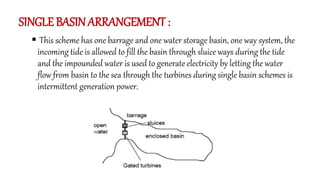
SINGLE BASIN ARRANGEMENT :
 This scheme has one barrage and one water storage basin, one way system, the
incoming tide is allowed to fill the basin through sluice ways during the tide
and the impounded water is used to generate electricity by letting the water
flow from basin to the sea through the turbines during single basin schemes is
intermittent generation power.
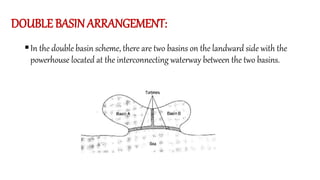
DOUBLE BASINARRANGEMENT:
In the double basin scheme, there are two basins on the landward side with the
powerhouse located at the interconnecting waterway between the two basins.
TYPES OF TIDAL STREAMGENERATORS
• Since tidal stream generators are an immature technology, no standard
technology has yet emerged as the clear winner.
• But a large variety of designs are being experimented with, some very close to
large scale deployment.
Two Major Types :
1. Axial turbines - These are close in concept to traditional windmills
operating under the sea.
2. Vertical and horizontal axis cross flow turbines - These turbines that
can be deployed either vertically or horizontally.
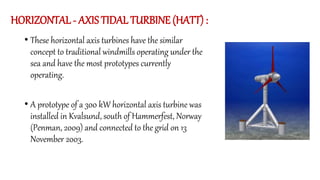
HORIZONTAL - AXIS TIDAL TURBINE (HATT) :
• These horizontal axis turbines have the similar
concept to traditional windmills operating under the
sea and have the most prototypes currently
operating.
• A prototype of a 300 kW horizontal axis turbine was
installed in Kvalsund, south of Hammerfest, Norway
(Penman, 2009) and connected to the grid on 13
November 2003.
VERTICAL – AXIS TIDAL TURBINES (VATT) :
The Cross flow turbines are known as vertical axis turbine because their axis is
vertical to the flow of water.
These turbines are also known as floating waterwheels. These are mainly drag
based devices.
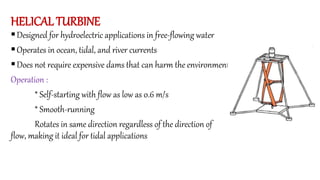
HELICAL TURBINE
Designed for hydroelectric applications in free-flowing water
Operates in ocean, tidal, and river currents
Does not require expensive dams that can harm the environment
Operation :
* Self-starting with flow as low as 0.6 m/s
* Smooth-running
Rotates in same direction regardless of the direction of
flow, making it ideal for tidal applications
DYNAMIC TIDAL POWER PLANT :
• Dynamic tidal power or DTP is a new and untested method of tidal power generation.
It would involve creating large dam-like structure extending from the coast straight to
the ocean, with a perpendicular barrier at the far end, forming a large 'T' shape.
• A single dam can accommodate over 8 GW (8000 MW) of installed capacity.
• A DTP dam is a long dam of 30 to 60 km which is built perpendicular to the coast,
running straight out into the ocean, without enclosing an area.
• Other concerns include: shipping routes, marine ecology, sediments, and storm surges.
ENVRONMENTAL IMPACTS:
• Different environmental impacts on different sites.
• Lack of Knowledge : Effects of changing tides on Aquatic and Shoreline
Ecosystems .
• Prediction: Building of Barrages may effect sedimentation and turbidity of
water within basins.
• Effect on Plants and animals - Restriction on movement of aquatic
organisms.
SITE SELECTION FOR TIDAL POWER PLANT :
• The volume of water moving around during the tide or the cubature of the tidal
flow is an important factor which determines the suitability of a site.
• The site should not interrupt the flow of normal shipping traffic which passes
through the estuary otherwise it will interrupt the economic cycle of the region.
• It should be possible to construct a barrage which stores the maximum quantity
of water with minimum cost of construction.
• There are several other factors as well such as suitability to marine environment,
silt index of water and so on .
ADVANTAGES OF TIDAL ENERGY:
It is an inexhaustible source of energy.
Tidal energy is environment friendly energy and doesn't produce greenhouse
gases.
As 71% of Earth’s surface is covered by water, there is scope to generate this
energy on large scale.
Efficiency of tidal power is far greater as compared to coal, solar or wind
energy. Its efficiency is around 80%.
Tidal Energy doesn’t require any kind of fuel to run.
The life of tidal energy power plant is very long.
DISADVANTAGES OF TIDAL ENERGY :
Cost of construction of tidal power plant is high.
There are very few ideal locations for construction of plant and they too are
localized to coastal regions only.
Intensity of sea waves is unpredictable and there can be damage to power
generation units.
Influences aquatic life adversely and can disrupt migration of fish.
The actual generation is for a short period of time.
!...THANK YOU…!
Email ID : pratheepm2001@gmail.com

Tidal Energy

  • 1.
    TIDAL ENERGY Submitted By, M.Pratheep , ICE – 4th Year , SCE, Trichy.
  • 2.
    TIDAL ENERGY : Itis also known as Tidal Power, is a form of hydropower that converts the energy of tides into useful forms energy – mainly electricity. TIDE : Tides are the rising and falling of earth’s ocean surface, caused by the gravitational attraction by the celestial bodies.
  • 3.
    TIDAL ENERGY POTTENTIAL: Tidal potential is derived from the gravitational attraction of masses of the moon and the sun and from this potential tide generating forces are derived taking its horizontal gradients. TIDALFORCE : The Tidal force is the vectorial difference between the gravitational force of the Earth and that of moon.
  • 4.
    PRINCIPLE OF TIDEGENERATION : Tides are generated by a resultant force between the gravitational attraction of the moon and the centrifugal force due to the rotation of the Earth. The tide-producing forces due to the sun is about 0.45 times that of the moon. Other planets are either too far away or small to generate any significant impacts.
  • 5.
    TRANSFORMATION OF TIDALENERGY INTO ELECTRICAL ENERGY : • Tidal energy is produced through the use of tidal energy generators. • These large underwater turbines are placed in areas with high tidal movements, and are designed to capture the kinetic motion of the ebbing and surging of ocean tides in order to produce electricity.
  • 6.
    COMPONENTS OF TIDALBARRAGE POWER PLANT : Power House Tidal barrage Sluice ways from basin to sea and vice versa Turbines Gates and locks
  • 7.
    MODES OF GENERATIONOFTIDAL POWER : Tidal stream generator Tidal barrage Dynamic tidal power Tidal lagoon
  • 8.
    TIDAL STREAMGENERATOR : Tidalstream generators are very similar to wind turbines except their below the water surface instead of above or on land. The turbine and generator converts the movement of water coming from change in tide, the kinetic energy, into electricity. Water is 830 times denser than air and therefore can generate electricity at lower speeds than wind turbines.
  • 9.
    SINGLE BASIN ARRANGEMENT:  This scheme has one barrage and one water storage basin, one way system, the incoming tide is allowed to fill the basin through sluice ways during the tide and the impounded water is used to generate electricity by letting the water flow from basin to the sea through the turbines during single basin schemes is intermittent generation power.
  • 10.
    DOUBLE BASINARRANGEMENT: In thedouble basin scheme, there are two basins on the landward side with the powerhouse located at the interconnecting waterway between the two basins.
  • 11.
    TYPES OF TIDALSTREAMGENERATORS • Since tidal stream generators are an immature technology, no standard technology has yet emerged as the clear winner. • But a large variety of designs are being experimented with, some very close to large scale deployment. Two Major Types : 1. Axial turbines - These are close in concept to traditional windmills operating under the sea. 2. Vertical and horizontal axis cross flow turbines - These turbines that can be deployed either vertically or horizontally.
  • 12.
    HORIZONTAL - AXISTIDAL TURBINE (HATT) : • These horizontal axis turbines have the similar concept to traditional windmills operating under the sea and have the most prototypes currently operating. • A prototype of a 300 kW horizontal axis turbine was installed in Kvalsund, south of Hammerfest, Norway (Penman, 2009) and connected to the grid on 13 November 2003.
  • 13.
    VERTICAL – AXISTIDAL TURBINES (VATT) : The Cross flow turbines are known as vertical axis turbine because their axis is vertical to the flow of water. These turbines are also known as floating waterwheels. These are mainly drag based devices.
  • 14.
    HELICAL TURBINE Designed forhydroelectric applications in free-flowing water Operates in ocean, tidal, and river currents Does not require expensive dams that can harm the environment Operation : * Self-starting with flow as low as 0.6 m/s * Smooth-running Rotates in same direction regardless of the direction of flow, making it ideal for tidal applications
  • 15.
    DYNAMIC TIDAL POWERPLANT : • Dynamic tidal power or DTP is a new and untested method of tidal power generation. It would involve creating large dam-like structure extending from the coast straight to the ocean, with a perpendicular barrier at the far end, forming a large 'T' shape. • A single dam can accommodate over 8 GW (8000 MW) of installed capacity. • A DTP dam is a long dam of 30 to 60 km which is built perpendicular to the coast, running straight out into the ocean, without enclosing an area. • Other concerns include: shipping routes, marine ecology, sediments, and storm surges.
  • 16.
    ENVRONMENTAL IMPACTS: • Differentenvironmental impacts on different sites. • Lack of Knowledge : Effects of changing tides on Aquatic and Shoreline Ecosystems . • Prediction: Building of Barrages may effect sedimentation and turbidity of water within basins. • Effect on Plants and animals - Restriction on movement of aquatic organisms.
  • 17.
    SITE SELECTION FORTIDAL POWER PLANT : • The volume of water moving around during the tide or the cubature of the tidal flow is an important factor which determines the suitability of a site. • The site should not interrupt the flow of normal shipping traffic which passes through the estuary otherwise it will interrupt the economic cycle of the region. • It should be possible to construct a barrage which stores the maximum quantity of water with minimum cost of construction. • There are several other factors as well such as suitability to marine environment, silt index of water and so on .
  • 18.
    ADVANTAGES OF TIDALENERGY: It is an inexhaustible source of energy. Tidal energy is environment friendly energy and doesn't produce greenhouse gases. As 71% of Earth’s surface is covered by water, there is scope to generate this energy on large scale. Efficiency of tidal power is far greater as compared to coal, solar or wind energy. Its efficiency is around 80%. Tidal Energy doesn’t require any kind of fuel to run. The life of tidal energy power plant is very long.
  • 19.
    DISADVANTAGES OF TIDALENERGY : Cost of construction of tidal power plant is high. There are very few ideal locations for construction of plant and they too are localized to coastal regions only. Intensity of sea waves is unpredictable and there can be damage to power generation units. Influences aquatic life adversely and can disrupt migration of fish. The actual generation is for a short period of time.
  • 20.
    !...THANK YOU…! Email ID: pratheepm2001@gmail.com