PLEURAL EFFUSION

Conducted By: Mr. Atul Lawrence
M. Sc Nursing 1st Year
Medical Surgical Nursing
Rattan Professional College of Nursing
Physiology of the Normal
Lungs
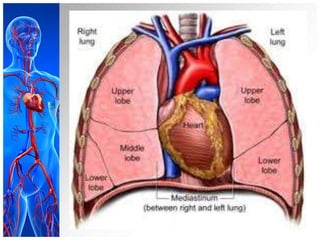
• The lungs are soft, spongy, coneshaped organs located in the chest
cavity.
• They are separated by the
mediastinum and the heart. There
are 3 lobes on the right lung and 2
lobes on the left lung.
Physiology of the
normal lungs cont..

• The lungs are supplied with blood via
the pulmonary and bronchial
circulations.
• Pulmonary circulation: supplied from
the pulmonary artery and provides for
gas exchange function of the lungs.
• Bronchial circulation: distributes blood
to the conducting airways and
supporting structures of the lung.
Physiology of the
normal lungs cont..

Layers of the lung
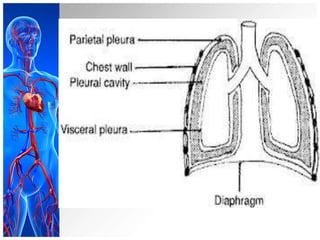
• Parietal Pleura -Lines the thoracic
cavity, including the thoracic cage,
mediastinum, and diaphragm.
• Pleural space- thin, transparent,
serous membrane which lines the
thoracic cavity a potential space
between the parietal pleura and
visceral pleura
• Visceral pleura- Lines the entire
surface of the lung.
Definition
The body produces pleural fluid in small
amounts to lubricate the surfaces of the
pleura, it lines the chest cavity and
surrounds the lungs. The pleural cavity
contains a relatively small amount of
fluid, approximately 10 ml on each side A
PLEURAL EFFUSION is an abnormal,
excessive collection of this fluid .
Excessive amounts of such fluid can
impair breathing by limiting the
expansion of the lungs during respiration
Types of Effusions
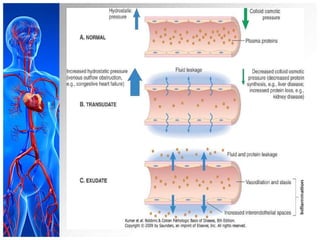
a) TRANSUDATIVE PLEURAL EFFUSIONS
a fluid substance that has passed through
a membrane or has been extruded from
a tissue it is of high fluidity and has a
low content of protein, cells, or solid
materials derived from cells. It caused
by fluid leaking into the pleural space.
This is caused by increased pressure in,
or low protein content in, the blood
vessels . A transudate is a clear fluid,
similar to blood serum . It reflect a
systemic disturbance of body
Causes of Transudates
•
•
•
•
•
•

Atelectasis
(early)Cirrhosis
Congestive heart failure
Hypoalbuminemia
Nephrotic syndrome
Peritoneal dialysis
Types Of Effusions
cont..

EXUDATIVE EFFUSIONS
A fluid rich in protein and cellular
elements that oozes out of blood vessels
due to inflammation . It is caused by
blocked blood vessels, inflammation,
lung injury, and drug reactions. An
exudate—which often is a cloudy fluid,
containing cells and much protein .
signify underlying local
(pleuropulmonary) disease.
Causes of Exudates:
• Asbestos exposure
• Atelectasis
• Hemothorax Infection (bacteria, viruses,
fungi, tuberculosis, or parasites)
• Pulmonary embolism
• Uremia
Types of fluids
Four types of fluids can accumulate in the
pleural space:
Serous fluid (hydrothorax) : A hydrothorax
is a condition that results from serous
fluid accumulating in the pleural cavity.
This specific condition can be related to
cirrhosis with ascites in which ascitic fluid
leaks into the pleural cavity
Blood (haemothorax): is a condition that
results from blood accumulating in the
pleural cavity
Chyle (chylothorax): chyle is a milky
bodily fluid consisting of lymph and
emulsified fats, or free fatty acids
(FFAs). It is formed in the small
intestine during digestion of fatty
foods .It is a type of pleural effusion .
It results from lymphatic fluid (chyle)
accumulating in the pleural cavity.
Pus (pyothorax or empyema) : is an
accumulation of pus in the pleural
cavity
Pathophysiology

It is explained by increased pleural fluid
formation or decreased pleural fluid
absorption. Increased pleural fluid formation
can result from elevation of hydrostatic
pressure & decreased osmotic pressure. It
leads to increased capillary permeability &
passage of fluid is through openings in the
diaphragm Hence production increases &
absorption is decreases lymphatic obstruction
Pleural effusions produce a restrictive
ventilatory defect and also decrease the total
lung capacity and vital capacity
CLINICAL MANIFESTATION
Pleuritic chest pain indicates
inflammation of the parietal pleura
Physical examination findings that can
reveal the presence of an effusion dull
or flat note on percussion diminished
or absent breath sounds on
auscultation. Chest pain, usually a
sharp pain that is worse with cough or
deep breaths, Cough, Fever, Rapid
breathing, Shortness of breath
DIAGNOSTIC EVALUATION
During a physical examination, the doctor
will listen to the sound of your breathing
with a stethoscope and may tap on your
chest to listen for dullness. The following
tests may help to confirm a diagnosis :
Chest CT scan Chest x-ray Pleural fluid
analysis (examining the fluid under a
microscope to look for bacteria, amount
of protein, and presence of cancer cells)
Thoracentesis (a sample of fluid is
removed with a needle inserted between
the ribs) Ultrasound of the chest
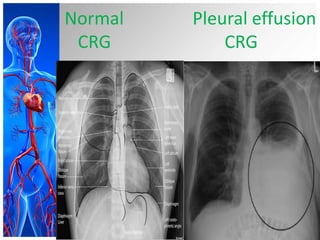
• Chest Radiography :The posteroanterior
and lateral chest radiographs are still the
most important initial tools in diagnosing
a pleural effusion.
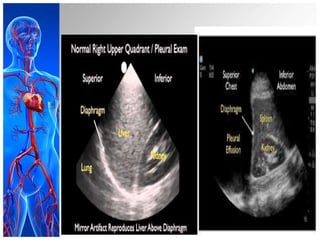
• Ultrasound is useful both as a diagnostic
tool and as an aid in performing
thoracentesis. It assist in identifying
pleural fluid loculations.
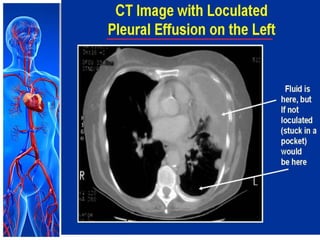
• Computed Tomography: Cross-sectional
computed tomography (CT) It helps
distinguish anatomic compartments more
clearly This modality is useful as well in
distinguishing empyema
Normal
CRG

Pleural effusion
CRG
Treatment
Treatment aims to: Remove the fluid
Prevent fluid from building up again
Treating the cause of the fluid buildup
• Therapeutic thoracentesis may be
done if the fluid collection is large and
causing chest pressure, shortness of
breath, or other breathing problems,
such as low oxygen levels. Removing
the fluid allows the lung to expand,
making breathing easier.
pleural effusions caused by congestive
heart failure are treated with diuretics
(water pills) and other medications that
treat heart failure. Pleural effusions
caused by infection are treated with
appropriate antibiotics. In people with
cancer or infections. the effusion is often
treated by using a chest tube for several
days to drain the fluid. small tubes can
be left in the pleural cavity for a long
time to drain the fluid.
In some cases, the following may be done:
Surgery
• Thoracentasis Pleural fluid is drawn out of
the pleural space in a process called
thoracentesis. A needle is inserted through
the back of the chest wall in the sixth,
seventh, or eighth intercostal space into
the pleural space. The fluid may then be
evaluated.
• Gram stain and culture to identify possible
bacterial infections Cytopathology to
identify cancer cells, but may also identify
some infective organisms
Nursing Diagnosis
&
Nursing Intervention

• 1. Ineffective breathing pattern related to
decreased lung expansion(accumulation
of liquid), as evidenced by dyspnea,
changes in depth of breathing, accessory
muscle use.
Interventions
• Maintain a comfortable position is
usually elevated headboard
• Given oxygen through a cannula (8mls)
2. Acute Pain related to accumulation of
fluid in the pleural space and rubbing of
thoracostomy tube to the lungs
• Interventions
• -The presence of pain, the scale and
intensity of pain was well assessed
• -The client taught about pain
management and relaxation with
distraction
• -Chest tube secured to restrict
movement and avoid irritation
• -Given prescribed analgesics i.e
diclofenac 75mg.
3. Risk for nutrition impariment, less than
body requirement related to inability to
ingest adequate nutrients
Interventions
• -Patient relative i.e his father encouraged
to give him energy reaching food stuff
together with energy supplement so that
he can get enough energy.
• -Administer DNS as prescribed to the
patient to increase energy lost.
4. Risk for fluid volume deficit related to
chest tube drainage.
• Interventions
• -encourage the patient to drink
enough water to supplement the one
lost by chest tube drainage
• -IV fluids & DNS to replace fluid lost in
drainage system monitored in
24hours.
5. Risk for infection related to the
presence of fluid in the pleural space
and the incision site.
• Interventions
• -The patient dressed at the incision
site when it is wetted, probably after 2
to 3 days
• -Given antibiotics as prescribed i.e IV
metronidazole 500mg 8 hourly, IV
ceftiaxone 1gm.
Possible Complications
A lung that is surrounded by excess
fluid for a long time may be
damaged. Pleural fluid that becomes
infected may turn into an abscess,
called an empyema, which will need
to be drained with a chest tube.
Pneumothorax (air in the chest
cavity) can be a complication of the
thoracentesis procedure.
References
• A. Putnam JB. Malignant pleural effusions. Surg Clin N
Am.2002;38;375-383.
• B. Villena V, López Encuentra E, García-Luján R,
Clinicalimplications of appearance of pleural fluid at
thoracentesis.Chest.2004;125:156-9.
• C. cleveland clinic journal of medicine volume 72 • number
10 october 2005
• D. villena garrido v et al. diagnosis and treatment of
pleural effusion(2005)
• E. Jeffrey Rubins, MD; Chief Editor: Zab Mosenifar, MD.
Pleural Effusion Clinical Presentation.
• F. Sarah Avery, RGN Insertion and management of chest
drains vol: 96, issue: 37, page no: 3 (2000).
• G.Burrows CM, Mathews WC, Colt HG. Predicting
survival in patientswith recurrent symptomatic
malignant pleural effusions: an assessment of the
prognostic values of physiologic, morphologic, and
quality of life measures of extent of disease. Chest.
2000;117(1):73-78. [PubMed]
• H.Anderson CB, Philpott GW, Gerguson TB. The
treatment of malignant pleural effusion.
Cancer.1974;33(4):916–922.
Pleural Effusion

Pleural Effusion

  • 1.
    PLEURAL EFFUSION Conducted By:Mr. Atul Lawrence M. Sc Nursing 1st Year Medical Surgical Nursing Rattan Professional College of Nursing
  • 2.
    Physiology of theNormal Lungs • The lungs are soft, spongy, coneshaped organs located in the chest cavity. • They are separated by the mediastinum and the heart. There are 3 lobes on the right lung and 2 lobes on the left lung.
  • 4.
    Physiology of the normallungs cont.. • The lungs are supplied with blood via the pulmonary and bronchial circulations. • Pulmonary circulation: supplied from the pulmonary artery and provides for gas exchange function of the lungs. • Bronchial circulation: distributes blood to the conducting airways and supporting structures of the lung.
  • 5.
    Physiology of the normallungs cont.. Layers of the lung • Parietal Pleura -Lines the thoracic cavity, including the thoracic cage, mediastinum, and diaphragm. • Pleural space- thin, transparent, serous membrane which lines the thoracic cavity a potential space between the parietal pleura and visceral pleura • Visceral pleura- Lines the entire surface of the lung.
  • 8.
    Definition The body producespleural fluid in small amounts to lubricate the surfaces of the pleura, it lines the chest cavity and surrounds the lungs. The pleural cavity contains a relatively small amount of fluid, approximately 10 ml on each side A PLEURAL EFFUSION is an abnormal, excessive collection of this fluid . Excessive amounts of such fluid can impair breathing by limiting the expansion of the lungs during respiration
  • 9.
    Types of Effusions a)TRANSUDATIVE PLEURAL EFFUSIONS a fluid substance that has passed through a membrane or has been extruded from a tissue it is of high fluidity and has a low content of protein, cells, or solid materials derived from cells. It caused by fluid leaking into the pleural space. This is caused by increased pressure in, or low protein content in, the blood vessels . A transudate is a clear fluid, similar to blood serum . It reflect a systemic disturbance of body
  • 10.
    Causes of Transudates • • • • • • Atelectasis (early)Cirrhosis Congestiveheart failure Hypoalbuminemia Nephrotic syndrome Peritoneal dialysis
  • 11.
    Types Of Effusions cont.. EXUDATIVEEFFUSIONS A fluid rich in protein and cellular elements that oozes out of blood vessels due to inflammation . It is caused by blocked blood vessels, inflammation, lung injury, and drug reactions. An exudate—which often is a cloudy fluid, containing cells and much protein . signify underlying local (pleuropulmonary) disease.
  • 12.
    Causes of Exudates: •Asbestos exposure • Atelectasis • Hemothorax Infection (bacteria, viruses, fungi, tuberculosis, or parasites) • Pulmonary embolism • Uremia
  • 14.
    Types of fluids Fourtypes of fluids can accumulate in the pleural space: Serous fluid (hydrothorax) : A hydrothorax is a condition that results from serous fluid accumulating in the pleural cavity. This specific condition can be related to cirrhosis with ascites in which ascitic fluid leaks into the pleural cavity Blood (haemothorax): is a condition that results from blood accumulating in the pleural cavity
  • 15.
    Chyle (chylothorax): chyleis a milky bodily fluid consisting of lymph and emulsified fats, or free fatty acids (FFAs). It is formed in the small intestine during digestion of fatty foods .It is a type of pleural effusion . It results from lymphatic fluid (chyle) accumulating in the pleural cavity. Pus (pyothorax or empyema) : is an accumulation of pus in the pleural cavity
  • 16.
    Pathophysiology It is explainedby increased pleural fluid formation or decreased pleural fluid absorption. Increased pleural fluid formation can result from elevation of hydrostatic pressure & decreased osmotic pressure. It leads to increased capillary permeability & passage of fluid is through openings in the diaphragm Hence production increases & absorption is decreases lymphatic obstruction Pleural effusions produce a restrictive ventilatory defect and also decrease the total lung capacity and vital capacity
  • 17.
    CLINICAL MANIFESTATION Pleuritic chestpain indicates inflammation of the parietal pleura Physical examination findings that can reveal the presence of an effusion dull or flat note on percussion diminished or absent breath sounds on auscultation. Chest pain, usually a sharp pain that is worse with cough or deep breaths, Cough, Fever, Rapid breathing, Shortness of breath
  • 18.
    DIAGNOSTIC EVALUATION During aphysical examination, the doctor will listen to the sound of your breathing with a stethoscope and may tap on your chest to listen for dullness. The following tests may help to confirm a diagnosis : Chest CT scan Chest x-ray Pleural fluid analysis (examining the fluid under a microscope to look for bacteria, amount of protein, and presence of cancer cells) Thoracentesis (a sample of fluid is removed with a needle inserted between the ribs) Ultrasound of the chest
  • 19.
    • Chest Radiography:The posteroanterior and lateral chest radiographs are still the most important initial tools in diagnosing a pleural effusion. • Ultrasound is useful both as a diagnostic tool and as an aid in performing thoracentesis. It assist in identifying pleural fluid loculations. • Computed Tomography: Cross-sectional computed tomography (CT) It helps distinguish anatomic compartments more clearly This modality is useful as well in distinguishing empyema
  • 20.
  • 23.
    Treatment Treatment aims to:Remove the fluid Prevent fluid from building up again Treating the cause of the fluid buildup • Therapeutic thoracentesis may be done if the fluid collection is large and causing chest pressure, shortness of breath, or other breathing problems, such as low oxygen levels. Removing the fluid allows the lung to expand, making breathing easier.
  • 24.
    pleural effusions causedby congestive heart failure are treated with diuretics (water pills) and other medications that treat heart failure. Pleural effusions caused by infection are treated with appropriate antibiotics. In people with cancer or infections. the effusion is often treated by using a chest tube for several days to drain the fluid. small tubes can be left in the pleural cavity for a long time to drain the fluid.
  • 25.
    In some cases,the following may be done: Surgery • Thoracentasis Pleural fluid is drawn out of the pleural space in a process called thoracentesis. A needle is inserted through the back of the chest wall in the sixth, seventh, or eighth intercostal space into the pleural space. The fluid may then be evaluated. • Gram stain and culture to identify possible bacterial infections Cytopathology to identify cancer cells, but may also identify some infective organisms
  • 26.
    Nursing Diagnosis & Nursing Intervention •1. Ineffective breathing pattern related to decreased lung expansion(accumulation of liquid), as evidenced by dyspnea, changes in depth of breathing, accessory muscle use. Interventions • Maintain a comfortable position is usually elevated headboard • Given oxygen through a cannula (8mls)
  • 27.
    2. Acute Painrelated to accumulation of fluid in the pleural space and rubbing of thoracostomy tube to the lungs • Interventions • -The presence of pain, the scale and intensity of pain was well assessed • -The client taught about pain management and relaxation with distraction • -Chest tube secured to restrict movement and avoid irritation • -Given prescribed analgesics i.e diclofenac 75mg.
  • 28.
    3. Risk fornutrition impariment, less than body requirement related to inability to ingest adequate nutrients Interventions • -Patient relative i.e his father encouraged to give him energy reaching food stuff together with energy supplement so that he can get enough energy. • -Administer DNS as prescribed to the patient to increase energy lost.
  • 29.
    4. Risk forfluid volume deficit related to chest tube drainage. • Interventions • -encourage the patient to drink enough water to supplement the one lost by chest tube drainage • -IV fluids & DNS to replace fluid lost in drainage system monitored in 24hours.
  • 30.
    5. Risk forinfection related to the presence of fluid in the pleural space and the incision site. • Interventions • -The patient dressed at the incision site when it is wetted, probably after 2 to 3 days • -Given antibiotics as prescribed i.e IV metronidazole 500mg 8 hourly, IV ceftiaxone 1gm.
  • 31.
    Possible Complications A lungthat is surrounded by excess fluid for a long time may be damaged. Pleural fluid that becomes infected may turn into an abscess, called an empyema, which will need to be drained with a chest tube. Pneumothorax (air in the chest cavity) can be a complication of the thoracentesis procedure.
  • 32.
    References • A. PutnamJB. Malignant pleural effusions. Surg Clin N Am.2002;38;375-383. • B. Villena V, López Encuentra E, García-Luján R, Clinicalimplications of appearance of pleural fluid at thoracentesis.Chest.2004;125:156-9. • C. cleveland clinic journal of medicine volume 72 • number 10 october 2005 • D. villena garrido v et al. diagnosis and treatment of pleural effusion(2005) • E. Jeffrey Rubins, MD; Chief Editor: Zab Mosenifar, MD. Pleural Effusion Clinical Presentation. • F. Sarah Avery, RGN Insertion and management of chest drains vol: 96, issue: 37, page no: 3 (2000).
  • 33.
    • G.Burrows CM,Mathews WC, Colt HG. Predicting survival in patientswith recurrent symptomatic malignant pleural effusions: an assessment of the prognostic values of physiologic, morphologic, and quality of life measures of extent of disease. Chest. 2000;117(1):73-78. [PubMed] • H.Anderson CB, Philpott GW, Gerguson TB. The treatment of malignant pleural effusion. Cancer.1974;33(4):916–922.