Thoracentesis
Sacro, Joy Marian Victoria M.
♥Thoracentesis
• is an invasive procedure to remove fluid or
air from the pleural space for diagnostic or
therapeutic purposes.
• It is done with a needle (and sometimes a
plastic catheter) inserted through the
chest wall, generally after administration
of local anesthesia.
• The recommended location varies
depending upon the source. Some sources
recommend the midaxillary line, in the
sixth, seventh, or eighth intercostal space.
♥Why is it done?
• Removal of fluid and air from the
pleural cavity
• Diagnostic aspiration of pleural fluid
• Pleural biopsy
• Instillation of medication into the
pleural space
• Relieve shortness of breath and pain
caused by a pleural effusion.
♥Overview
Thoracentesis is done to find the cause of a pleural
effusion. It also may be done to help the patient breathe
easier.
During the procedure, the doctor will insert a thin
needle or plastic tube into the pleural space and draws out
the excess fluid. Usually, doctors take only the amount of
fluid needed to find the cause of the pleural effusion.
However, if there's a lot of fluid, they may take more. This
helps the lungs expand and take in more air, which allows
breathing easier.
After the fluid is removed from the chest, it's sent for
testing. Once the cause of the pleural effusion is known, the
doctor will plan treatment. For example, if an infection is
causing the excess fluid, the patient may be given antibiotics
to fight the infection. If the cause is heart failure, the
patient will be treated for that condition.
Thoracentesis usually takes 10 to 15 minutes. It may
take longer if there's a lot of fluid in the pleural space. The
patient will be watched for up to a few hours after the
♥What To Expect Before
Thoracentesis
• You will be asked to sign a consent form before a
thoracentesis.
• Before thoracentesis, your doctor will talk to you
about the procedure and how to prepare for it.
Tell your doctor what medicines you're taking,
about any previous bleeding problems, and about
allergies to medicines or latex.
• Also, certain conditions may increase the
difficulty of thoracentesis. Let your doctor know
if you have:
- Had lung surgery. The scarring from the
first procedure may make it difficult to do this
procedure.
- A long-term (chronic), irreversible lung
disease, such as emphysema.
♥Procedure♥
♥Find the anatomical landmarks before
you perform the thoracentesis.
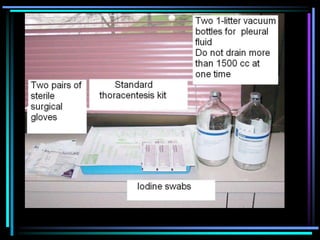
♥Clean the area with iodine
♥Open the kit and make sure that
you know which tube and needle are
used for
♥Practice sliding the flexible
catheter.
♥Prepare for local anesthesia.
♥Prepare the area.
♥Perform the procedure (under supervision, if
you are not certified). Anesthetize the skin
and pleura, try to reach the effusion fluid.
♥Prepare the flexible catheter.
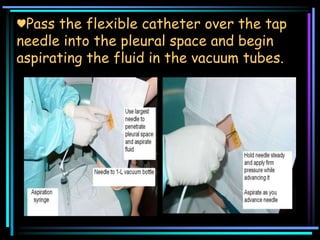
♥Pass the flexible catheter over the tap
needle into the pleural space and begin
aspirating the fluid in the vacuum tubes.
♥What To Expect After Thoracentesis
• After thoracentesis, you may need a chest
x ray to check for any lung problems. Your
blood pressure and breathing will be
checked for up to a few hours to make sure
you don't have complications.
• Your doctor will let you know when you can
return to your normal activities, such as
driving, physical activity, and working.
• Once at home, call your doctor right away
if you have any breathing problems.
♥Nursing activities
RATIONALE
1. Ascertain in advance whether chest x-
ray films have been prescribed and
completed and the consent form has
been signed.
- posteroanterior and lateral chest x-ray
films are used to localize fluid and air
in the pleural cavity and to aid in
determining puncture site.
2. Assess the patient for allergy
anesthetic agent to be used. Give
sedation if prescribed.
3. Inform the patient about the procedure:
a. The nature of the procedure
b. The importance of remaining
immobile
c. Pressure sensations to be experienced
d. That no discomfort is anticipated after
the procedure.
-An explanation helps to orient the
patient to the procedure, assists the
patient to mobilize resources, and
provides an opportunity to ask
4. Make the patient comfortable with adequate
supports. If possible, place the patient upright
and is one of the following positions:
a.Sitting on the edge of the bed with feet
supported and arms and head on a
padded over-the-bed table.
b.Straddling a chair with arms and head
resting on the back of the chair.
c.Lying on the unaffected side with the
with the bed elevated 30 to 45 degrees if
unable to assume a sitting position.
-The upright position facilitates the removal
of fluid that usually localizes at the base of the
chest. A position of comfort helps the patient
to relax.
5. Support and reassure the patient during the
procedure.
a. Prepare the patient for cold sensation of
skin germicide solution and of pressure
sensation from infiltration of local anesthetic
agent.
b. Encourage the patient to refrain from
coughing.
-Sudden and unexpected movement by the
patient can cause trauma to the visceral pleura
and lung.
6. Expose the entire chest. The site for
aspiration is determined from chest x-ray
films and by percussion.
-If air is in the pleural cavity, the thoracentesis
site is usually in the second or third
intercostals space in the midclavicular line
because air rises in the thorax.
7. The procedure is performed under aseptic
conditions. After the skin is cleansed, a local
anesthetic is injected slowly with a small-
caliber needle into the intercostals space by
the physician.
-An intradermal wheat is raised slowly, rapid
injection causes pain. The parietal pleura is
very sensitive and should be well infiltrated
with anesthetic before the thoracentesis needle
is passed through it.
8. The physician advances the thoracentesis
needle with the syringe attached. When the
pleural space is reached, suction maybe
applied with the syringe.
a. A 20-ml syringe with a three-way adapter
(stopcock) is attached to the needle and the
other to the tubing leading to a receptable that
receives the fluid being aspirated)
b. If a considerable quantity of fluid is
removed, the needle is held in place on the
chest wall with a small hemostat
-when a large quantity of fluid is withdrawn, a
three-way adapter serves to keep air from
entering the pleural cavity.
-The hemostat steadies the needle on the chest
wall. Sudden pleurific chest pain or shoulder
pain may indicate that the visceral or
diaphragmatic pleura is being irritated by the
needle point.
9. After the needle is withdrawn, pressure is
applied over the puncture site and a small,
sterile dressing is fixed in place.
10. The patient is placed on bed rest.
Chest x-ray is obtained after
thoracentesis.
- A chest x-ray verifies that there is
pneumothorax.
11. Record the total amount of fluid
withdrawn and the nature of the fluid, its
color, and its viscosity. If requested,
prepare samples of fluid for laboratory
evaluation. A specimen container with
formalin may be needed if a pleural
biopsy is to be obtained.
-The fluid may be clear, serous, bloody,
purulent, etc.
12. Evaluate the patient at intervals for
increasing respiratory rate; asymmetry in
respiratory movement; faintness; vertigo;
tightness in chest; uncontrollable cough;
blood-tinged, frothy mucus; a rapid
pulse, and signs of hypoxemia
-Pneumothorax, tension pneumothorax,
subcutaneous emphysema, or pyrogenic
infection may result from a
thoracentesis. Pulmonary edema or
cardiac distress can be produced by a
sudden shift in mediastinal contents
when large amounts of fluid are
aspirated.
☺☺☺

-Thoracentesis.pptx

  • 1.
  • 2.
    ♥Thoracentesis • is aninvasive procedure to remove fluid or air from the pleural space for diagnostic or therapeutic purposes. • It is done with a needle (and sometimes a plastic catheter) inserted through the chest wall, generally after administration of local anesthesia. • The recommended location varies depending upon the source. Some sources recommend the midaxillary line, in the sixth, seventh, or eighth intercostal space.
  • 3.
    ♥Why is itdone? • Removal of fluid and air from the pleural cavity • Diagnostic aspiration of pleural fluid • Pleural biopsy • Instillation of medication into the pleural space • Relieve shortness of breath and pain caused by a pleural effusion.
  • 4.
    ♥Overview Thoracentesis is doneto find the cause of a pleural effusion. It also may be done to help the patient breathe easier. During the procedure, the doctor will insert a thin needle or plastic tube into the pleural space and draws out the excess fluid. Usually, doctors take only the amount of fluid needed to find the cause of the pleural effusion. However, if there's a lot of fluid, they may take more. This helps the lungs expand and take in more air, which allows breathing easier. After the fluid is removed from the chest, it's sent for testing. Once the cause of the pleural effusion is known, the doctor will plan treatment. For example, if an infection is causing the excess fluid, the patient may be given antibiotics to fight the infection. If the cause is heart failure, the patient will be treated for that condition. Thoracentesis usually takes 10 to 15 minutes. It may take longer if there's a lot of fluid in the pleural space. The patient will be watched for up to a few hours after the
  • 6.
    ♥What To ExpectBefore Thoracentesis • You will be asked to sign a consent form before a thoracentesis. • Before thoracentesis, your doctor will talk to you about the procedure and how to prepare for it. Tell your doctor what medicines you're taking, about any previous bleeding problems, and about allergies to medicines or latex. • Also, certain conditions may increase the difficulty of thoracentesis. Let your doctor know if you have: - Had lung surgery. The scarring from the first procedure may make it difficult to do this procedure. - A long-term (chronic), irreversible lung disease, such as emphysema.
  • 7.
  • 9.
    ♥Find the anatomicallandmarks before you perform the thoracentesis.
  • 10.
    ♥Clean the areawith iodine
  • 11.
    ♥Open the kitand make sure that you know which tube and needle are used for
  • 12.
    ♥Practice sliding theflexible catheter.
  • 13.
  • 14.
  • 15.
    ♥Perform the procedure(under supervision, if you are not certified). Anesthetize the skin and pleura, try to reach the effusion fluid.
  • 16.
  • 17.
    ♥Pass the flexiblecatheter over the tap needle into the pleural space and begin aspirating the fluid in the vacuum tubes.
  • 20.
    ♥What To ExpectAfter Thoracentesis • After thoracentesis, you may need a chest x ray to check for any lung problems. Your blood pressure and breathing will be checked for up to a few hours to make sure you don't have complications. • Your doctor will let you know when you can return to your normal activities, such as driving, physical activity, and working. • Once at home, call your doctor right away if you have any breathing problems.
  • 21.
    ♥Nursing activities RATIONALE 1. Ascertainin advance whether chest x- ray films have been prescribed and completed and the consent form has been signed. - posteroanterior and lateral chest x-ray films are used to localize fluid and air in the pleural cavity and to aid in determining puncture site. 2. Assess the patient for allergy anesthetic agent to be used. Give sedation if prescribed. 3. Inform the patient about the procedure: a. The nature of the procedure b. The importance of remaining immobile c. Pressure sensations to be experienced d. That no discomfort is anticipated after the procedure. -An explanation helps to orient the patient to the procedure, assists the patient to mobilize resources, and provides an opportunity to ask
  • 22.
    4. Make thepatient comfortable with adequate supports. If possible, place the patient upright and is one of the following positions: a.Sitting on the edge of the bed with feet supported and arms and head on a padded over-the-bed table. b.Straddling a chair with arms and head resting on the back of the chair. c.Lying on the unaffected side with the with the bed elevated 30 to 45 degrees if unable to assume a sitting position. -The upright position facilitates the removal of fluid that usually localizes at the base of the chest. A position of comfort helps the patient to relax. 5. Support and reassure the patient during the procedure. a. Prepare the patient for cold sensation of skin germicide solution and of pressure sensation from infiltration of local anesthetic agent. b. Encourage the patient to refrain from coughing. -Sudden and unexpected movement by the patient can cause trauma to the visceral pleura and lung. 6. Expose the entire chest. The site for aspiration is determined from chest x-ray films and by percussion. -If air is in the pleural cavity, the thoracentesis site is usually in the second or third intercostals space in the midclavicular line because air rises in the thorax.
  • 23.
    7. The procedureis performed under aseptic conditions. After the skin is cleansed, a local anesthetic is injected slowly with a small- caliber needle into the intercostals space by the physician. -An intradermal wheat is raised slowly, rapid injection causes pain. The parietal pleura is very sensitive and should be well infiltrated with anesthetic before the thoracentesis needle is passed through it. 8. The physician advances the thoracentesis needle with the syringe attached. When the pleural space is reached, suction maybe applied with the syringe. a. A 20-ml syringe with a three-way adapter (stopcock) is attached to the needle and the other to the tubing leading to a receptable that receives the fluid being aspirated) b. If a considerable quantity of fluid is removed, the needle is held in place on the chest wall with a small hemostat -when a large quantity of fluid is withdrawn, a three-way adapter serves to keep air from entering the pleural cavity. -The hemostat steadies the needle on the chest wall. Sudden pleurific chest pain or shoulder pain may indicate that the visceral or diaphragmatic pleura is being irritated by the needle point. 9. After the needle is withdrawn, pressure is applied over the puncture site and a small, sterile dressing is fixed in place.
  • 24.
    10. The patientis placed on bed rest. Chest x-ray is obtained after thoracentesis. - A chest x-ray verifies that there is pneumothorax. 11. Record the total amount of fluid withdrawn and the nature of the fluid, its color, and its viscosity. If requested, prepare samples of fluid for laboratory evaluation. A specimen container with formalin may be needed if a pleural biopsy is to be obtained. -The fluid may be clear, serous, bloody, purulent, etc. 12. Evaluate the patient at intervals for increasing respiratory rate; asymmetry in respiratory movement; faintness; vertigo; tightness in chest; uncontrollable cough; blood-tinged, frothy mucus; a rapid pulse, and signs of hypoxemia -Pneumothorax, tension pneumothorax, subcutaneous emphysema, or pyrogenic infection may result from a thoracentesis. Pulmonary edema or cardiac distress can be produced by a sudden shift in mediastinal contents when large amounts of fluid are aspirated.
  • 25.