Basic
Pulmonology
Procedures
Adwin Haryo Indrawan Sumartono
Narasumber : dr. Eric Daniel Tenda, SpPD, DIC, PhD
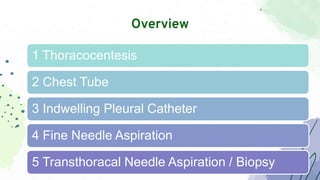
Overview
1 Thoracocentesis
2 Chest Tube
3 Indwelling Pleural Catheter
4 Fine Needle Aspiration
5 Transthoracal Needle Aspiration / Biopsy
Thoracentesis
● Thoracentesis is a procedure that is performed to remove fluid or air from the thoracic
cavity for both diagnostic and/or therapeutic purposes.
Thoracentesis
Wiederhold BD, Amr O, Modi P, et al. Thoracentesis. [Updated 2022 May 1]. In: StatPearls [Internet]. Treasure Island (FL): StatPearls Publishing; 2022 Jan-. Available from:
https://www.ncbi.nlm.nih.gov/books/NBK441866/
Diagnostic
• Effusion with unknown etiology
• Malignancy or infection
• First time thoracentesis
Therapeutic
• Large effusion with clinically
significant symptomps
Contraindication
• Absolute - none
• Relative
• Uncontrolled coagulation deficit
• Unsafe positioning
• Mechanical ventilation
1. Patient education and consent
2. Equipment (needle 16-20 G, syringe 10 mL, 5
mL, 20 mL, antiseptic, lidocaine, drainage
bag, sterile towels)
3. Positioning (leaning slightly forward and
resting the head on the arms or hands or on
a pillow
● An invasive procedure → semi-sterile field
● Effusion estimation → absent sounds on
auscultation, dullness to percussion, and
decreased or absent fremitus
● Bedside USG → puncture site
Procedure
Wiederhold BD, Amr O, Modi P, et al. Thoracentesis. [Updated 2022 May 1]. In: StatPearls [Internet]. Treasure Island (FL): StatPearls Publishing; 2022 Jan-. Available from:
https://www.ncbi.nlm.nih.gov/books/NBK441866/
● Preferred site :
○ Either the midaxillary line if the procedure is being performed in the supine position
○ Posterior midscapular line if the procedure is being performed in the upright or seated position.
1. Bedside ultrasound to identify an appropriate location for the procedure
2. Prep and drape the patient in a sterile fashion.
3. Cleanse the skin with an antiseptic solution.
4. Administer local anesthesia to the skin (make a wheal in the skin surface)
5. Continue infiltration of local anestesia to the tissue around the rib, marching the needle tip just above the
rib margin
6. Proof puncture
7. Mark the puncture spot
8. Use a larger gauge needle connected to a three way (syringe and collection tube)
9. Collect pleural effusion using syringe and if necessary, drain larger effusion into a plastic drainage bag
Technique and Steps
Wiederhold BD, Amr O, Modi P, et al. Thoracentesis. [Updated 2022 May 1]. In: StatPearls [Internet]. Treasure Island (FL): StatPearls Publishing; 2022 Jan-. Available from:
https://www.ncbi.nlm.nih.gov/books/NBK441866/
● Bleeding, pain, and infection at the point
of needle entry
● Re-expansion pulmonary edema
● Splenic and hepatic puncture
● Pneumothorax (most common)
○ Indications of chest tube placement
to manage the pneumothorax
following thoracentesis :
1. large pneumothorax
2. progressive
3. symptomatic pneumothorax
Complications
Wiederhold BD, Amr O, Modi P, et al. Thoracentesis. [Updated 2022 May 1]. In: StatPearls [Internet]. Treasure Island (FL): StatPearls Publishing; 2022 Jan-. Available from:
https://www.ncbi.nlm.nih.gov/books/NBK441866/
National Heart, Lung and Blood Institute ( PD-US NIH)
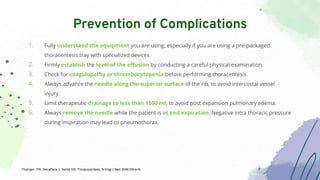
1. Fully understand the equipment you are using, especially if you are using a pre-packaged
thoracentesis tray with specialized devices.
2. Firmly establish the level of the effusion by conducting a careful physical examination.
3. Check for coagulopathy or thrombocytopenia before performing thoracentesis.
4. Always advance the needle along the superior surface of the rib, to avoid intercostal vessel
injury.
5. Limit therapeutic drainage to less than 1500 ml, to avoid post expansion pulmonary edema.
6. Always remove the needle while the patient is at end expiration. Negative intra thoracic pressure
during inspiration may lead to pneumothorax.
Prevention of Complications
Thomsen TW, DeLaPena J, Setnik GS. Thoracocentesis. N Engl J Med 2006;355:e16.
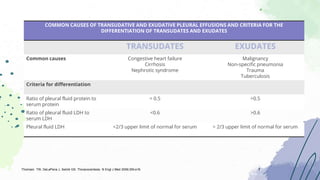
COMMON CAUSES OF TRANSUDATIVE AND EXUDATIVE PLEURAL EFFUSIONS AND CRITERIA FOR THE
DIFFERENTIATION OF TRANSUDATES AND EXUDATES
TRANSUDATES EXUDATES
Common causes Congestive heart failure
Cirrhosis
Nephrotic syndrome
Malignancy
Non-specific pneumonia
Trauma
Tuberculosis
Criteria for differentiation
Ratio of pleural fluid protein to
serum protein
< 0.5 >0.5
Ratio of pleural fluid LDH to
serum LDH
<0.6 >0.6
Pleural fluid LDH <2/3 upper limit of normal for serum > 2/3 upper limit of normal for serum
Thomsen TW, DeLaPena J, Setnik GS. Thoracocentesis. N Engl J Med 2006;355:e16.
Chest Tube
● A flexible tube that can be inserted through the chest wall between the ribs into the
pleural space.
Chest Tube
Ravi C, McKnight CL. Chest Tube. [Updated 2021 Oct 9]. In: StatPearls [Internet]. Treasure Island (FL): StatPearls Publishing; 2022 Jan-. Available from:
https://www.ncbi.nlm.nih.gov/books/NBK459199/
Indication
• Pneumothorax: persistent/recurrent, tension, large
secondary spontaneous pneumothorax (>2cm),
iatrogenic
• Pleural fluid: malignancy, empyema and
complicated parapneumonic pleural effusion
• Traumatic pneumothorax or hemopneumothorax
• Peri-operative: thoracotomy, esophageal surgery,
cardiothoracic surgery
Contraindication
• Absolut - none
• Relative:
• Pulmonary adhesions from previous surgery,
pulmonary disease, and/or trauma.
• Coagulopathy and diaphragmatic hernias
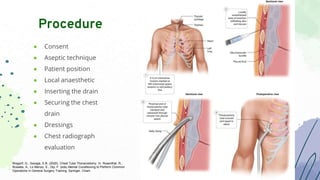
● Consent
● Aseptic technique
● Patient position
● Local anaesthetic
● Inserting the drain
● Securing the chest
drain
● Dressings
● Chest radiograph
evaluation
Procedure
Wegerif, G., Savage, E.B. (2020). Chest Tube Thoracostomy. In: Rosenthal, R.,
Rosales, A., Lo Menzo, E., Dip, F. (eds) Mental Conditioning to Perform Common
Operations in General Surgery Training. Springer, Cham.
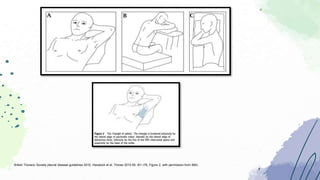
British Thoracic Society pleural disease guidelines 2010, Havelock et al, Thorax 2010 65: i61–i76, Figure 2, with permission from BMJ.
● Bleeding, superficial site infection
● Deep organ space infection (empyema)
● Dislodgement of the tube
● Clogging of the tube
● Re-expansion pulmonary edema
● Injury to intraabdominal and intrathoracic
organs
Complications
● No air leak is visualized
● Output is serohemorrhagic with no signs of
bleeding
● Output is less than 150 cc to 400 cc over a 24-
hour period (debatable)
● Nonexistent or stable mild pneumothorax on
chest x-ray
● Patient is minimized on positive pressure from
the ventilator
Discontinuation
Ravi C, McKnight CL. Chest Tube. [Updated 2021 Oct 9]. In: StatPearls [Internet]. Treasure Island (FL): StatPearls Publishing; 2022 Jan-. Available from:
https://www.ncbi.nlm.nih.gov/books/NBK459199/
Indwelling Pleural Catheter (IPC)
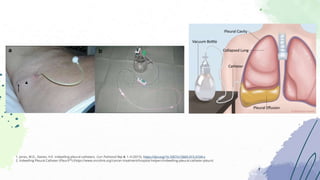
● A long-term soft silicone tubes that allow patients with recurrent pleural effusions (usually
malignant pleural effusions) to be brought outside hospital care
● Talc pleurodesis and indwelling pleural catheters are the standard therapeutic options for patients
presenting with symptomatic malignant pleural effusions
● Indwelling catheters are particularly useful in patients with trapped lung or failed pleurodesis.
IPC
Sivagnaname, Y. , Krishnamurthy, D. , Radhakrishnan, P. , Selvam, A. M. . Indwelling Pleural Catheters. In: Sandri, A. , editor. Pleura - A Surgical Perspective [Internet].
London: IntechOpen; 2021 [cited 2022 Sep 15]. Available from: https://www.intechopen.com/chapters/79289 doi: 10.5772/intechopen.100645
1. Jones, W.D., Davies, H.E. Indwelling pleural catheters. Curr Pulmonol Rep 4, 1–9 (2015). https://doi.org/10.1007/s13665-015-0104-x
2. Indwelling Pleural Catheter (PleurX™) (https://www.oncolink.org/cancer-treatment/hospital-helpers/indwelling-pleural-catheter-pleurx)
IPC
Indication
•Recurrent pleural effusion due to malignant
etiology.
•Trapped lung with symptomatic pleural effusions.
•Recurrent pleural effusion due to benign
etiologies:
•Hepatic hydrothorax
•Chylothorax
•CKD related effusions, loculated effusions and
empyema
Contraindication
•Inability for the patient and care givers to handle
or tolerate the drain.
•Significant coagulopathy
•Parapneumonic effusion/empyema.
•Local cellulitis in the insertion site.
•Individuals in immunocompromised state due to
systemic diseases.
Sivagnaname, Y. , Krishnamurthy, D. , Radhakrishnan, P. , Selvam, A. M. . Indwelling Pleural Catheters. In: Sandri, A. , editor. Pleura - A Surgical Perspective [Internet].
London: IntechOpen; 2021 [cited 2022 Sep 15]. Available from: https://www.intechopen.com/chapters/79289 doi: 10.5772/intechopen.100645
Immediate
● Small pneumothorax
● Subcutaneous
emphysema
● Pain, bleeding
Late
● Infections
● Catheter tract
metastasis
● Catheter fracture
● IPC blockage
● Leakage
Complications
Drainage
● At least 3 times a week or
in presence of symptoms
● Normal drainage timing
may last for 15–20 min
Removal
● Pleural sepsis
● Nonfunctional/defective
IPC
● Severe pain with local
cellulitis
● Usually not necessary,
especially in spontaneous
pleurodesis
Drainage and Removal
Sivagnaname, Y. , Krishnamurthy, D. , Radhakrishnan, P. , Selvam, A. M.Indwelling Pleural Catheters. In: Sandri, A., editor. Pleura - A Surgical Perspective [Internet].
London: IntechOpen; 2021 [cited 2022 Sep 15]. Available from: https://www.intechopen.com/chapters/79289 doi: 10.5772/intechopen.100645
Fine Needle Aspiration (FNA)
● A minimally invasive way to obtain a cell sample for diagnosis, an alternative to more invasive
methods such as incisional or excisional biopsy.
● Common sites of aspiration: breast, thyroid, superficial lymph nodes, or skin masses
FNA
Sigmon DF, Fatima S. Fine Needle Aspiration. [Updated 2022 May 2]. In: StatPearls [Internet]. Treasure Island (FL): StatPearls Publishing; 2022 Jan-. Available from:
https://www.ncbi.nlm.nih.gov/books/NBK557486/
Indication
• Confirm suspected reactive
hyperplasia
• Diagnose a specific infection
• Diagnose a neoplastic infiltration
• Unknown primary
Contraindication
• Absolute - none
• Relative - Risk outweighs benefit
• Bleeding diathesis
• Carotid body tumour
• High risk respiratory compromise
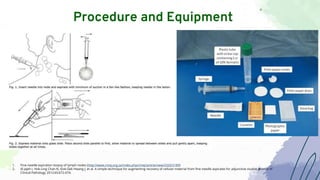
Procedure and Equipment
1. Fine-needle aspiration biopsy of lymph nodes (http://www.cmej.org.za/index.php/cmej/article/view/2333/2189)
2. Al Jajeh I, Hok-Ling Chan N, Siok-Gek Hwang J, et al. A simple technique for augmenting recovery of cellular material from fine needle aspirates for adjunctive studies Journal of
Clinical Pathology 2012;65:672-674.
• Bleeding
• Damage to surrounding
structures
• Fistula
• Seed tissue with infection
or neoplastic cells (rare)
• No hospitalisation – outpatient
procedure
• No sutures or scars
• Minimal pain
• Inexpensive
• Less morbidity
Advantages
Complications
Sigmon DF, Fatima S. Fine Needle Aspiration. [Updated 2022 May 2]. In: StatPearls [Internet]. Treasure Island (FL): StatPearls Publishing; 2022 Jan-. Available from:
https://www.ncbi.nlm.nih.gov/books/NBK557486/
Transthoracic Needle
Aspiration/Biopsy (TTNA/TTB)
● A rapid method used to achieve definitive diagnosis for most thoracic lesions, whether the
lesion is located in the pleura, the lung parenchyma, or the mediastinum.
● Usually guided by ultrasound or CT
● Work up of lesions using cytopathology, histopathology, or microbiologic examination
TTNA/TTB
Indication
• Metastatic, inoperable, or recurrent neoplastic
disease
• Obtain material for culture of suspected infection
• Lung nodule, unfit for surgery
Contraindication
• Uncooperative patient
• Incorrectable bleeding
• Contraindications to sedation
• Pulmonary hypertension, incorrectable hypoxemia
• Deep lesions are not contraindication
Young M, Shapiro R. Lung Biopsy. [Updated 2022 May 5]. In: StatPearls [Internet]. Treasure Island (FL): StatPearls Publishing; 2022 Jan-. Available
from: https://www.ncbi.nlm.nih.gov/books/NBK513290/
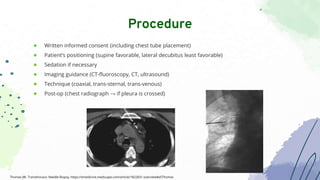
● Written informed consent (including chest tube placement)
● Patient’s positioning (supine favorable, lateral decubitus least favorable)
● Sedation if necessary
● Imaging guidance (CT-fluoroscopy, CT, ultrasound)
● Technique (coaxial, trans-sternal, trans-venous)
● Post-op (chest radiograph → if pleura is crossed)
Procedure
Thomas JW. Transthoracic Needle Biopsy. https://emedicine.medscape.com/article/1822831-overview#a5Thomas
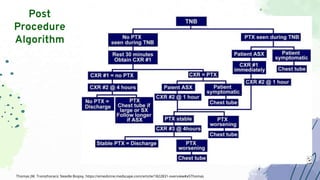
Post
Procedure
Algorithm
Thomas JW. Transthoracic Needle Biopsy. https://emedicine.medscape.com/article/1822831-overview#a5Thomas
● Pneumothorax
● Hemorrhage/Hemoptysis
○ puncturing a pulmonary cavity or enlarged bronchus
○ patient can be placed biopsy side down
○ consider bronchoscopic tamponade of the lobar bronchus, bronchial artery embolization,
pulmonary artery embolization, and surgery.
● Air embolism
○ trocar has been removed from a needle tip located in a pulmonary vein and/or 2) iatrogenic
creation of a bronchovenous fistula.
○ signs of a stroke or seizure
○ Patient should be in left lateral decubitus position
● Needle-track seeding with malignant cells
Complications
Young M, Shapiro R. Lung Biopsy. [Updated 2022 May 5]. In: StatPearls [Internet]. Treasure Island (FL): StatPearls Publishing; 2022 Jan-. Available
from: https://www.ncbi.nlm.nih.gov/books/NBK513290/
Thank You

DT Basic Int Pulm.pptx

  • 1.
    Basic Pulmonology Procedures Adwin Haryo IndrawanSumartono Narasumber : dr. Eric Daniel Tenda, SpPD, DIC, PhD
  • 2.
    Overview 1 Thoracocentesis 2 ChestTube 3 Indwelling Pleural Catheter 4 Fine Needle Aspiration 5 Transthoracal Needle Aspiration / Biopsy
  • 3.
  • 4.
    ● Thoracentesis isa procedure that is performed to remove fluid or air from the thoracic cavity for both diagnostic and/or therapeutic purposes. Thoracentesis Wiederhold BD, Amr O, Modi P, et al. Thoracentesis. [Updated 2022 May 1]. In: StatPearls [Internet]. Treasure Island (FL): StatPearls Publishing; 2022 Jan-. Available from: https://www.ncbi.nlm.nih.gov/books/NBK441866/ Diagnostic • Effusion with unknown etiology • Malignancy or infection • First time thoracentesis Therapeutic • Large effusion with clinically significant symptomps Contraindication • Absolute - none • Relative • Uncontrolled coagulation deficit • Unsafe positioning • Mechanical ventilation
  • 5.
    1. Patient educationand consent 2. Equipment (needle 16-20 G, syringe 10 mL, 5 mL, 20 mL, antiseptic, lidocaine, drainage bag, sterile towels) 3. Positioning (leaning slightly forward and resting the head on the arms or hands or on a pillow ● An invasive procedure → semi-sterile field ● Effusion estimation → absent sounds on auscultation, dullness to percussion, and decreased or absent fremitus ● Bedside USG → puncture site Procedure Wiederhold BD, Amr O, Modi P, et al. Thoracentesis. [Updated 2022 May 1]. In: StatPearls [Internet]. Treasure Island (FL): StatPearls Publishing; 2022 Jan-. Available from: https://www.ncbi.nlm.nih.gov/books/NBK441866/
  • 6.
    ● Preferred site: ○ Either the midaxillary line if the procedure is being performed in the supine position ○ Posterior midscapular line if the procedure is being performed in the upright or seated position. 1. Bedside ultrasound to identify an appropriate location for the procedure 2. Prep and drape the patient in a sterile fashion. 3. Cleanse the skin with an antiseptic solution. 4. Administer local anesthesia to the skin (make a wheal in the skin surface) 5. Continue infiltration of local anestesia to the tissue around the rib, marching the needle tip just above the rib margin 6. Proof puncture 7. Mark the puncture spot 8. Use a larger gauge needle connected to a three way (syringe and collection tube) 9. Collect pleural effusion using syringe and if necessary, drain larger effusion into a plastic drainage bag Technique and Steps Wiederhold BD, Amr O, Modi P, et al. Thoracentesis. [Updated 2022 May 1]. In: StatPearls [Internet]. Treasure Island (FL): StatPearls Publishing; 2022 Jan-. Available from: https://www.ncbi.nlm.nih.gov/books/NBK441866/
  • 7.
    ● Bleeding, pain,and infection at the point of needle entry ● Re-expansion pulmonary edema ● Splenic and hepatic puncture ● Pneumothorax (most common) ○ Indications of chest tube placement to manage the pneumothorax following thoracentesis : 1. large pneumothorax 2. progressive 3. symptomatic pneumothorax Complications Wiederhold BD, Amr O, Modi P, et al. Thoracentesis. [Updated 2022 May 1]. In: StatPearls [Internet]. Treasure Island (FL): StatPearls Publishing; 2022 Jan-. Available from: https://www.ncbi.nlm.nih.gov/books/NBK441866/ National Heart, Lung and Blood Institute ( PD-US NIH)
  • 8.
    1. Fully understandthe equipment you are using, especially if you are using a pre-packaged thoracentesis tray with specialized devices. 2. Firmly establish the level of the effusion by conducting a careful physical examination. 3. Check for coagulopathy or thrombocytopenia before performing thoracentesis. 4. Always advance the needle along the superior surface of the rib, to avoid intercostal vessel injury. 5. Limit therapeutic drainage to less than 1500 ml, to avoid post expansion pulmonary edema. 6. Always remove the needle while the patient is at end expiration. Negative intra thoracic pressure during inspiration may lead to pneumothorax. Prevention of Complications Thomsen TW, DeLaPena J, Setnik GS. Thoracocentesis. N Engl J Med 2006;355:e16.
  • 9.
    COMMON CAUSES OFTRANSUDATIVE AND EXUDATIVE PLEURAL EFFUSIONS AND CRITERIA FOR THE DIFFERENTIATION OF TRANSUDATES AND EXUDATES TRANSUDATES EXUDATES Common causes Congestive heart failure Cirrhosis Nephrotic syndrome Malignancy Non-specific pneumonia Trauma Tuberculosis Criteria for differentiation Ratio of pleural fluid protein to serum protein < 0.5 >0.5 Ratio of pleural fluid LDH to serum LDH <0.6 >0.6 Pleural fluid LDH <2/3 upper limit of normal for serum > 2/3 upper limit of normal for serum Thomsen TW, DeLaPena J, Setnik GS. Thoracocentesis. N Engl J Med 2006;355:e16.
  • 10.
  • 11.
    ● A flexibletube that can be inserted through the chest wall between the ribs into the pleural space. Chest Tube Ravi C, McKnight CL. Chest Tube. [Updated 2021 Oct 9]. In: StatPearls [Internet]. Treasure Island (FL): StatPearls Publishing; 2022 Jan-. Available from: https://www.ncbi.nlm.nih.gov/books/NBK459199/ Indication • Pneumothorax: persistent/recurrent, tension, large secondary spontaneous pneumothorax (>2cm), iatrogenic • Pleural fluid: malignancy, empyema and complicated parapneumonic pleural effusion • Traumatic pneumothorax or hemopneumothorax • Peri-operative: thoracotomy, esophageal surgery, cardiothoracic surgery Contraindication • Absolut - none • Relative: • Pulmonary adhesions from previous surgery, pulmonary disease, and/or trauma. • Coagulopathy and diaphragmatic hernias
  • 12.
    ● Consent ● Aseptictechnique ● Patient position ● Local anaesthetic ● Inserting the drain ● Securing the chest drain ● Dressings ● Chest radiograph evaluation Procedure Wegerif, G., Savage, E.B. (2020). Chest Tube Thoracostomy. In: Rosenthal, R., Rosales, A., Lo Menzo, E., Dip, F. (eds) Mental Conditioning to Perform Common Operations in General Surgery Training. Springer, Cham.
  • 13.
    British Thoracic Societypleural disease guidelines 2010, Havelock et al, Thorax 2010 65: i61–i76, Figure 2, with permission from BMJ.
  • 14.
    ● Bleeding, superficialsite infection ● Deep organ space infection (empyema) ● Dislodgement of the tube ● Clogging of the tube ● Re-expansion pulmonary edema ● Injury to intraabdominal and intrathoracic organs Complications ● No air leak is visualized ● Output is serohemorrhagic with no signs of bleeding ● Output is less than 150 cc to 400 cc over a 24- hour period (debatable) ● Nonexistent or stable mild pneumothorax on chest x-ray ● Patient is minimized on positive pressure from the ventilator Discontinuation Ravi C, McKnight CL. Chest Tube. [Updated 2021 Oct 9]. In: StatPearls [Internet]. Treasure Island (FL): StatPearls Publishing; 2022 Jan-. Available from: https://www.ncbi.nlm.nih.gov/books/NBK459199/
  • 15.
  • 16.
    ● A long-termsoft silicone tubes that allow patients with recurrent pleural effusions (usually malignant pleural effusions) to be brought outside hospital care ● Talc pleurodesis and indwelling pleural catheters are the standard therapeutic options for patients presenting with symptomatic malignant pleural effusions ● Indwelling catheters are particularly useful in patients with trapped lung or failed pleurodesis. IPC Sivagnaname, Y. , Krishnamurthy, D. , Radhakrishnan, P. , Selvam, A. M. . Indwelling Pleural Catheters. In: Sandri, A. , editor. Pleura - A Surgical Perspective [Internet]. London: IntechOpen; 2021 [cited 2022 Sep 15]. Available from: https://www.intechopen.com/chapters/79289 doi: 10.5772/intechopen.100645
  • 17.
    1. Jones, W.D.,Davies, H.E. Indwelling pleural catheters. Curr Pulmonol Rep 4, 1–9 (2015). https://doi.org/10.1007/s13665-015-0104-x 2. Indwelling Pleural Catheter (PleurX™) (https://www.oncolink.org/cancer-treatment/hospital-helpers/indwelling-pleural-catheter-pleurx)
  • 18.
    IPC Indication •Recurrent pleural effusiondue to malignant etiology. •Trapped lung with symptomatic pleural effusions. •Recurrent pleural effusion due to benign etiologies: •Hepatic hydrothorax •Chylothorax •CKD related effusions, loculated effusions and empyema Contraindication •Inability for the patient and care givers to handle or tolerate the drain. •Significant coagulopathy •Parapneumonic effusion/empyema. •Local cellulitis in the insertion site. •Individuals in immunocompromised state due to systemic diseases. Sivagnaname, Y. , Krishnamurthy, D. , Radhakrishnan, P. , Selvam, A. M. . Indwelling Pleural Catheters. In: Sandri, A. , editor. Pleura - A Surgical Perspective [Internet]. London: IntechOpen; 2021 [cited 2022 Sep 15]. Available from: https://www.intechopen.com/chapters/79289 doi: 10.5772/intechopen.100645
  • 19.
    Immediate ● Small pneumothorax ●Subcutaneous emphysema ● Pain, bleeding Late ● Infections ● Catheter tract metastasis ● Catheter fracture ● IPC blockage ● Leakage Complications Drainage ● At least 3 times a week or in presence of symptoms ● Normal drainage timing may last for 15–20 min Removal ● Pleural sepsis ● Nonfunctional/defective IPC ● Severe pain with local cellulitis ● Usually not necessary, especially in spontaneous pleurodesis Drainage and Removal Sivagnaname, Y. , Krishnamurthy, D. , Radhakrishnan, P. , Selvam, A. M.Indwelling Pleural Catheters. In: Sandri, A., editor. Pleura - A Surgical Perspective [Internet]. London: IntechOpen; 2021 [cited 2022 Sep 15]. Available from: https://www.intechopen.com/chapters/79289 doi: 10.5772/intechopen.100645
  • 20.
  • 21.
    ● A minimallyinvasive way to obtain a cell sample for diagnosis, an alternative to more invasive methods such as incisional or excisional biopsy. ● Common sites of aspiration: breast, thyroid, superficial lymph nodes, or skin masses FNA Sigmon DF, Fatima S. Fine Needle Aspiration. [Updated 2022 May 2]. In: StatPearls [Internet]. Treasure Island (FL): StatPearls Publishing; 2022 Jan-. Available from: https://www.ncbi.nlm.nih.gov/books/NBK557486/ Indication • Confirm suspected reactive hyperplasia • Diagnose a specific infection • Diagnose a neoplastic infiltration • Unknown primary Contraindication • Absolute - none • Relative - Risk outweighs benefit • Bleeding diathesis • Carotid body tumour • High risk respiratory compromise
  • 22.
    Procedure and Equipment 1.Fine-needle aspiration biopsy of lymph nodes (http://www.cmej.org.za/index.php/cmej/article/view/2333/2189) 2. Al Jajeh I, Hok-Ling Chan N, Siok-Gek Hwang J, et al. A simple technique for augmenting recovery of cellular material from fine needle aspirates for adjunctive studies Journal of Clinical Pathology 2012;65:672-674.
  • 23.
    • Bleeding • Damageto surrounding structures • Fistula • Seed tissue with infection or neoplastic cells (rare) • No hospitalisation – outpatient procedure • No sutures or scars • Minimal pain • Inexpensive • Less morbidity Advantages Complications Sigmon DF, Fatima S. Fine Needle Aspiration. [Updated 2022 May 2]. In: StatPearls [Internet]. Treasure Island (FL): StatPearls Publishing; 2022 Jan-. Available from: https://www.ncbi.nlm.nih.gov/books/NBK557486/
  • 24.
  • 25.
    ● A rapidmethod used to achieve definitive diagnosis for most thoracic lesions, whether the lesion is located in the pleura, the lung parenchyma, or the mediastinum. ● Usually guided by ultrasound or CT ● Work up of lesions using cytopathology, histopathology, or microbiologic examination TTNA/TTB Indication • Metastatic, inoperable, or recurrent neoplastic disease • Obtain material for culture of suspected infection • Lung nodule, unfit for surgery Contraindication • Uncooperative patient • Incorrectable bleeding • Contraindications to sedation • Pulmonary hypertension, incorrectable hypoxemia • Deep lesions are not contraindication Young M, Shapiro R. Lung Biopsy. [Updated 2022 May 5]. In: StatPearls [Internet]. Treasure Island (FL): StatPearls Publishing; 2022 Jan-. Available from: https://www.ncbi.nlm.nih.gov/books/NBK513290/
  • 26.
    ● Written informedconsent (including chest tube placement) ● Patient’s positioning (supine favorable, lateral decubitus least favorable) ● Sedation if necessary ● Imaging guidance (CT-fluoroscopy, CT, ultrasound) ● Technique (coaxial, trans-sternal, trans-venous) ● Post-op (chest radiograph → if pleura is crossed) Procedure Thomas JW. Transthoracic Needle Biopsy. https://emedicine.medscape.com/article/1822831-overview#a5Thomas
  • 27.
    Post Procedure Algorithm Thomas JW. TransthoracicNeedle Biopsy. https://emedicine.medscape.com/article/1822831-overview#a5Thomas
  • 28.
    ● Pneumothorax ● Hemorrhage/Hemoptysis ○puncturing a pulmonary cavity or enlarged bronchus ○ patient can be placed biopsy side down ○ consider bronchoscopic tamponade of the lobar bronchus, bronchial artery embolization, pulmonary artery embolization, and surgery. ● Air embolism ○ trocar has been removed from a needle tip located in a pulmonary vein and/or 2) iatrogenic creation of a bronchovenous fistula. ○ signs of a stroke or seizure ○ Patient should be in left lateral decubitus position ● Needle-track seeding with malignant cells Complications Young M, Shapiro R. Lung Biopsy. [Updated 2022 May 5]. In: StatPearls [Internet]. Treasure Island (FL): StatPearls Publishing; 2022 Jan-. Available from: https://www.ncbi.nlm.nih.gov/books/NBK513290/
  • 29.