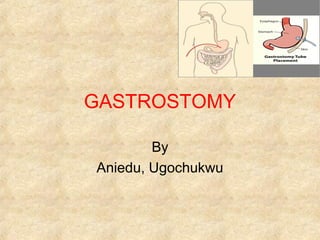
GASTROSTOMY
By
Aniedu, Ugochukwu
OUTLINE
• Definition
• Indications for gastrostomy
• Contraindications
• Types of gastrostomy
• Procedure
• Post op
• Summary
• References
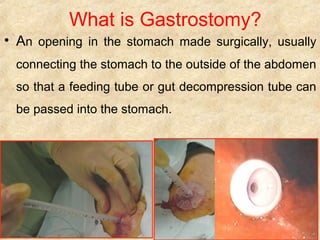
What is Gastrostomy?
• An opening in the stomach made surgically, usually
connecting the stomach to the outside of the abdomen
so that a feeding tube or gut decompression tube can
be passed into the stomach.
Indications for gastrostomy
• Neurological swallowing disorders e.g
cerebral palsy, multiple sclerosis etc
• Esophageal stricture or atresia
• Esophageal cancer
• Gastric outlet or small bowel obstruction
• Major neck surgeries
• Any condition which requires prolonged tube
feeding for > 4weeks.
Contraindications
• Uncorrectable coagulopathy or
thrombocytopenia
• Active gastritis or peptic ulcer disease
• History of total gastrectomy
• Severe ascites
• Active peritonitis
Types
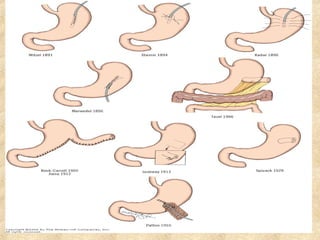
Open gastrostomy
• Stamm’s
• Janeway’s
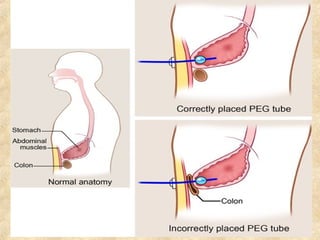
Percutaneous endoscopic gastrostomy(PEG)
Procedure
Open gastrostomy; There are many types of open
gastrostomy but the commonly used types are the Stamm
and Janeway gastrostomy
• Preoperatively; baseline investigations, plain
abd.xray, upper G.I endoscopy, NPO, consent
• Anaesthesia; local, general
• Positioned and Skin prep
• Incision; small upper midline, left subcostal
• The peritoneal cavity is entered and the anterior
wall of the stomach is grasp with two pairs of
Babcock forceps and the stomach drawn unto the
surface. The stomach is incised to allow insertion
of a 12 or 14Fr forley catheter whose balloon is
then inflated. Leakage along side the catheter is
prevented in one of two ways; Stamm’s or
Janeway’s.
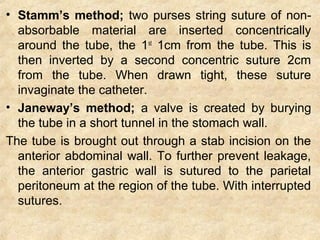
• Stamm’s method; two purses string suture of non-
absorbable material are inserted concentrically
around the tube, the 1st
1cm from the tube. This is
then inverted by a second concentric suture 2cm
from the tube. When drawn tight, these suture
invaginate the catheter.
• Janeway’s method; a valve is created by burying
the tube in a short tunnel in the stomach wall.
The tube is brought out through a stab incision on the
anterior abdominal wall. To further prevent leakage,
the anterior gastric wall is sutured to the parietal
peritoneum at the region of the tube. With interrupted
sutures.
Percutaneous endoscopic gastrostomy
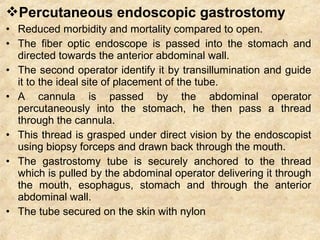
• Reduced morbidity and mortality compared to open.
• The fiber optic endoscope is passed into the stomach and
directed towards the anterior abdominal wall.
• The second operator identify it by transillumination and guide
it to the ideal site of placement of the tube.
• A cannula is passed by the abdominal operator
percutaneously into the stomach, he then pass a thread
through the cannula.
• This thread is grasped under direct vision by the endoscopist
using biopsy forceps and drawn back through the mouth.
• The gastrostomy tube is securely anchored to the thread
which is pulled by the abdominal operator delivering it through
the mouth, esophagus, stomach and through the anterior
abdominal wall.
• The tube secured on the skin with nylon
Post Op.
Feeding is usually after 24hours. When bowel sounds
are heard.
Patient is taught how to care for the tube and to
recognize infection.
Complications;
Infection
Trauma to other structures eg colon
Hemorrhage
Leakage
Blockage
Aspiration pneumonia
Displacement of tube
Conclusion
• Since its introduction, gastrostomy has
gained world-wide acceptance as a safe
technique for providing enteral feeding in
patients with poor oral intake who have a
functional GI system.
References
• http://emedicine.medscape.com/article/149665-overview#a2. Retrieved on the 2nd
March, 2016
• Sampson EL, Candy B, Jones L. Enteral tube feeding for older people with advanced
dementia.Cochrane Database Syst Rev. 2009;(2):CD007209. [PubMed]
• Kimyagarov S, Turgeman D, Fleissig Y, Klid R, Kopel B, Adunsky A. Percutaneous
endoscopic gastrostomy (PEG) tube feeding of nursing home residents is not
associated with improved body composition parameters. J Nutr Health
Aging. 2013;17:162–165. [PubMed]
Gastrostomy

Gastrostomy

  • 1.
  • 2.
    OUTLINE • Definition • Indicationsfor gastrostomy • Contraindications • Types of gastrostomy • Procedure • Post op • Summary • References
  • 3.
    What is Gastrostomy? •An opening in the stomach made surgically, usually connecting the stomach to the outside of the abdomen so that a feeding tube or gut decompression tube can be passed into the stomach.
  • 4.
    Indications for gastrostomy •Neurological swallowing disorders e.g cerebral palsy, multiple sclerosis etc • Esophageal stricture or atresia • Esophageal cancer • Gastric outlet or small bowel obstruction • Major neck surgeries • Any condition which requires prolonged tube feeding for > 4weeks.
  • 5.
    Contraindications • Uncorrectable coagulopathyor thrombocytopenia • Active gastritis or peptic ulcer disease • History of total gastrectomy • Severe ascites • Active peritonitis
  • 6.
    Types Open gastrostomy • Stamm’s •Janeway’s Percutaneous endoscopic gastrostomy(PEG)
  • 7.
    Procedure Open gastrostomy; Thereare many types of open gastrostomy but the commonly used types are the Stamm and Janeway gastrostomy • Preoperatively; baseline investigations, plain abd.xray, upper G.I endoscopy, NPO, consent • Anaesthesia; local, general • Positioned and Skin prep
  • 8.
    • Incision; smallupper midline, left subcostal • The peritoneal cavity is entered and the anterior wall of the stomach is grasp with two pairs of Babcock forceps and the stomach drawn unto the surface. The stomach is incised to allow insertion of a 12 or 14Fr forley catheter whose balloon is then inflated. Leakage along side the catheter is prevented in one of two ways; Stamm’s or Janeway’s.
  • 9.
    • Stamm’s method;two purses string suture of non- absorbable material are inserted concentrically around the tube, the 1st 1cm from the tube. This is then inverted by a second concentric suture 2cm from the tube. When drawn tight, these suture invaginate the catheter. • Janeway’s method; a valve is created by burying the tube in a short tunnel in the stomach wall. The tube is brought out through a stab incision on the anterior abdominal wall. To further prevent leakage, the anterior gastric wall is sutured to the parietal peritoneum at the region of the tube. With interrupted sutures.
  • 11.
    Percutaneous endoscopic gastrostomy •Reduced morbidity and mortality compared to open. • The fiber optic endoscope is passed into the stomach and directed towards the anterior abdominal wall. • The second operator identify it by transillumination and guide it to the ideal site of placement of the tube. • A cannula is passed by the abdominal operator percutaneously into the stomach, he then pass a thread through the cannula. • This thread is grasped under direct vision by the endoscopist using biopsy forceps and drawn back through the mouth. • The gastrostomy tube is securely anchored to the thread which is pulled by the abdominal operator delivering it through the mouth, esophagus, stomach and through the anterior abdominal wall. • The tube secured on the skin with nylon
  • 13.
    Post Op. Feeding isusually after 24hours. When bowel sounds are heard. Patient is taught how to care for the tube and to recognize infection. Complications; Infection Trauma to other structures eg colon Hemorrhage Leakage Blockage Aspiration pneumonia Displacement of tube
  • 14.
    Conclusion • Since itsintroduction, gastrostomy has gained world-wide acceptance as a safe technique for providing enteral feeding in patients with poor oral intake who have a functional GI system.
  • 15.
    References • http://emedicine.medscape.com/article/149665-overview#a2. Retrievedon the 2nd March, 2016 • Sampson EL, Candy B, Jones L. Enteral tube feeding for older people with advanced dementia.Cochrane Database Syst Rev. 2009;(2):CD007209. [PubMed] • Kimyagarov S, Turgeman D, Fleissig Y, Klid R, Kopel B, Adunsky A. Percutaneous endoscopic gastrostomy (PEG) tube feeding of nursing home residents is not associated with improved body composition parameters. J Nutr Health Aging. 2013;17:162–165. [PubMed]